★ LATEST REVIEWS

Our Rating: ★★★★★ 9/10
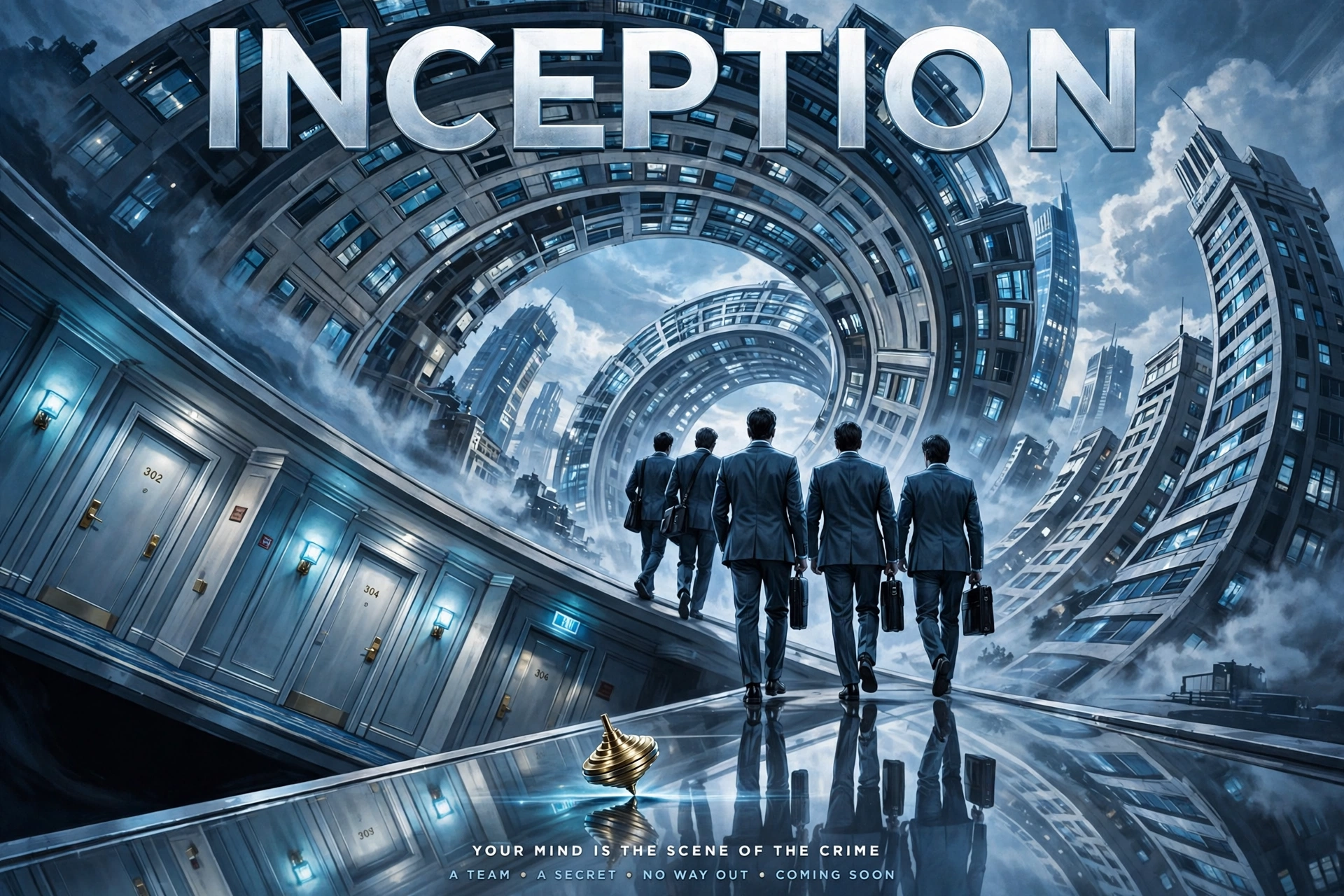
In the summer of 2010, audiences walked into cinemas expecting a clever action film and walked out arguing about a spinning top. Inception was that rare studio release: a large-budget original idea, not adapted from a comic, novel or earlier film, that trusted viewers to follow nested timelines, shifting rules and an ending that refuses to settle its own central question. It became one of the defining films of its decade not despite that difficulty but because of it — people did not just watch it, they compared diagrams of it.
Christopher Nolan had spent the previous decade proving he could bend structure around emotion, from Memento to The Prestige to The Dark Knight. Inception is where that habit reaches its most elaborate form. Underneath the folding cities and corridor fights, it is a film about guilt: about a man who cannot forgive himself, trying to complete one impossible job so he can go home to his children. Whether the machinery serves that story or occasionally smothers it is the real critical question, and this Inception review takes it seriously.
What follows covers the premise without spoiling its turns, the ensemble cast, the practical craft that still looks remarkable, Hans Zimmer’s era-defining score, and where the film’s brain gets in the way of its heart.
| Detail | Information |
|---|---|
| Release date | 16 July 2010 (United States and United Kingdom) |
| Director | Christopher Nolan |
| Writers | Christopher Nolan |
| Genre | Sci-Fi, Action, Heist Thriller |
| Language | English |
| Runtime | 148 minutes |
| Budget | $160 million |
| Lead cast | Leonardo DiCaprio, Joseph Gordon-Levitt, Elliot Page, Tom Hardy, Ken Watanabe, Cillian Murphy, Marion Cotillard, Michael Caine |
| Our rating | 9/10 |
Dom Cobb is a thief with an impossible specialism. Using shared-dream technology, he and his team enter a sleeping person’s mind and steal information the dreamer is trying to protect — corporate secrets that cannot be obtained any other way. The work has made Cobb rich, wanted and exiled: he cannot return to the United States or to his two young children, and the reason is tied to his wife, Mal, whose presence now haunts every dream he enters in ways that endanger anyone working beside him.
A powerful businessman, Saito, offers Cobb a bargain. Instead of stealing an idea, Cobb must do the reverse — plant an idea inside a target’s mind so skilfully that the target believes he thought of it himself. The target is Robert Fischer, heir to an energy empire, and the idea concerns the future of his father’s company. Success would clear Cobb’s name. Failure, at the depths the plan requires — dreams inside dreams inside dreams, each level moving at a different speed of time — risks trapping the team in limbo, an unconstructed dream space where a lifetime can pass in what feels like a night.
To do it, Cobb assembles specialists: a loyal point man, a forger who can impersonate people inside dreams, a chemist to keep everyone sedated, and a brilliant young architect, Ariadne, who designs the worlds they will inhabit and who quickly becomes the only team member asking what Cobb is hiding. The mechanics are explained, largely through her, in the film’s first hour. What those mechanics cost the people inside them is the film’s remaining ninety minutes, and its climax intercuts several layers at once in a way this summary will not untangle for you.
Leonardo DiCaprio as Cobb gives the film its necessary gravity. Cobb could easily have been played as a cool professional with a tragic backstory attached; DiCaprio instead plays him as a man permanently mid-confession, desperate and self-deceiving in equal measure. His scenes explaining what happened to Mal — gradually, and not always honestly — are the film’s emotional core, and they explain why Nolan cast an actor audiences already associated with romantic obsession and guilt from Titanic through Shutter Island. Cobb is not likeable, exactly. He is understandable, which is harder.
Marion Cotillard as Mal has the most difficult assignment: a character who exists only as memory and projection. Cotillard moves between tenderness and genuine menace without changing her register very much, which is precisely the point — she is Cobb’s guilt wearing the face of the woman he loved, and the horror of her appearances comes from how reasonable she sounds. Elliot Page as Ariadne serves as the audience’s guide, and while the role requires a great deal of asking-for-explanations, Page brings curiosity and moral pushback that keep those scenes alive, particularly in confrontations where Ariadne refuses to accept Cobb’s evasions.
The team around them is cast with unusual care for a heist film. Joseph Gordon-Levitt as Arthur is crisp, loyal and quietly funny, and gets the film’s most famous action sequence almost to himself. Tom Hardy as Eames, in the role that announced him to a mass audience, steals scenes with dry, amused confidence — the forger’s charm is a performance inside a performance, and Hardy knows it. Cillian Murphy as Robert Fischer does subtle, important work: the mark of the heist becomes its emotional surprise, a grieving son whose inner life is more moving than the corporate plot built around him. Ken Watanabe as Saito and Michael Caine, in a brief role as Cobb’s father-in-law, add weight at the edges.
Nolan shot Inception across six countries, from Tokyo to Tangier to the Canadian Rockies, and his insistence on practical methods is the film’s lasting visual argument. Corridors were built to rotate. A hallway fight was performed inside a spinning set rather than simulated digitally. A Paris street explosion showered real debris around DiCaprio. Snow vehicles chased across a genuine mountain fortress set. Wally Pfister’s cinematography, which won the Academy Award, keeps each dream layer visually distinct — rain, snow, hotel neutrals, sun-bleached limbo — so that when Lee Smith’s editing begins cross-cutting four simultaneous climaxes, the audience can feel where it is even when it cannot yet calculate the timing.
That final cross-cutting passage is the film’s technical peak and also the clearest illustration of its weakness. The structure is dazzling; the exposition required to maintain it is not. Nolan stops the film repeatedly in its first half to have characters explain rules — what a kick is, how time dilates, what happens if you die in a dream under sedation — and while Page’s presence makes the lectures dramatically plausible, several scenes are unmistakably the screenplay teaching the audience its own operating manual. Viewers who love systems will forgive it. Viewers who came for feeling may find the middle hour more impressive than moving, a puzzle admired slightly more than it is experienced.
Hans Zimmer’s score did not just accompany Inception; it changed the sound of trailers and blockbusters for years afterwards. Its foundation is ingenious: Zimmer took Edith Piaf’s “Non, je ne regrette rien” — the song the team uses as a timing signal inside the film — and slowed elements of it down to build the score’s massive, brass-heavy signature sound, mirroring the film’s own rule that time stretches as you descend. Johnny Marr’s guitar adds a melancholy, human thread for Cobb’s story beneath the enormity.
The famous blaring horns are, in context, used with more discipline than their imitators managed. Zimmer scores the dream layers with increasing weight, lets the snow-fortress sequence run on propulsive rhythm rather than melody, and reserves genuine emotion for the material involving Mal and the children. The score was nominated for an Academy Award and lost; its influence proved larger than the prize. If it has a flaw, it is the same as the film’s: sheer scale occasionally flattens subtlety, announcing importance where the scene had already earned it.
What we loved:
What could be better:
Made for $160 million, Inception earned roughly $839 million worldwide across its original release and later reissues, finishing as the fourth-highest-grossing film of 2010 — an extraordinary result for a film with no pre-existing audience. Published totals differ slightly by source and by whether reissue takings are folded in, with figures generally cited between about $825 million and $839 million, so treat any single precise number as tracker-dependent rather than absolute.
At the 83rd Academy Awards it won four Oscars — Best Cinematography, Best Sound Editing, Best Sound Mixing and Best Visual Effects — from eight nominations, including Best Picture and Best Original Screenplay. Its absence from the Best Director line-up was widely debated at the time. None of that debate slowed its afterlife: it has remained a fixture of greatest-films-of-the-century lists, university film courses and late-night arguments about its final shot ever since.
If you somehow have not, watch it in one sitting, with your phone in another room. Inception demands attention and repays it, which is a fairer bargain than most blockbusters offer. It is not flawless — it explains too much, and its heart beats loudest in only a handful of scenes — but its best passages combine spectacle, structure and feeling in a way mainstream cinema rarely attempts, let alone achieves. And that final shot, whatever you conclude from it, will follow you out of the room. Few films earn an argument that lasts fifteen years. This one did.
Our rating: 9/10 — a daring, dazzling dream-heist whose emotional core survives its own magnificent machinery.
Do I need to watch Inception more than once to understand it?
Most viewers follow the main story on a first viewing; a second viewing rewards you with the layering, the timing clues and details in Cobb’s story that are easy to miss. It is designed to work both ways.
Is the ending of Inception real or a dream?
The film deliberately refuses to confirm it, cutting away at the decisive moment. Nolan has said the important point is Cobb’s attitude in that scene rather than the answer itself. We will not pretend to settle what the film intentionally leaves open.
Is Inception suitable for children?
It is rated PG-13 for extended action, violence within dream sequences and some thematic intensity. There is little gore, but the concepts and sustained peril suit teenagers and above best.
Is Inception connected to Christopher Nolan’s other films?
No. It is a standalone original film, sharing a director, several cast members and composer Hans Zimmer with Nolan’s Batman trilogy, but no story connection to any of them.
Where can I watch Inception?
It is widely available on major streaming platforms and on Blu-ray and 4K editions, including releases that showcase its practical effects work. Availability varies by region, so check your local services.