★ LATEST REVIEWS

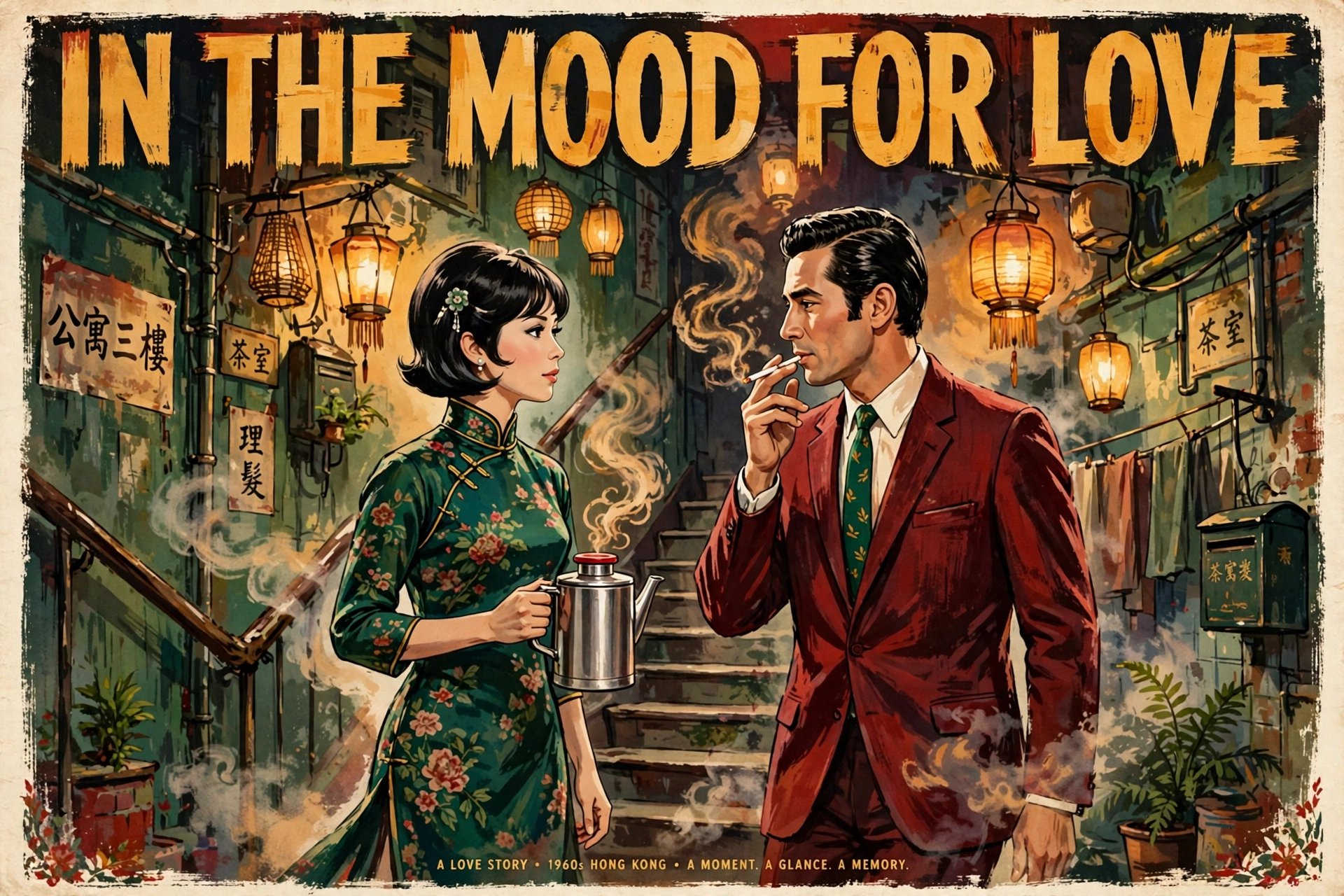
★★★★★ Our Rating: 9.5/10
Some films tell you a love story. In the Mood for Love shows you the space where a love story should have been — and makes that space so beautiful, and so painful, that audiences have been returning to it for a quarter of a century. Premiered at Cannes on 20 May 2000 and released in Hong Kong on 29 September 2000, Wong Kar-wai’s romantic drama is regularly placed among the greatest films ever made in critics’ polls, and this In the Mood for Love review will not pretend to be more original than the consensus: it is a masterpiece. What a review can still do is explain how it works — how a film in which almost nothing conventionally “happens” produces some of the strongest feelings in all of cinema.
The story, stripped bare, could fit on an index card. Two neighbours in 1960s Hong Kong discover that their spouses are having an affair with each other. In their hurt and loneliness, the two betrayed partners grow close — and then spend the entire film deciding, scene by scene, glance by glance, not to become what their spouses became. That is all, and it is everything. Wong Kar-wai built the film out of corridors, clocks, noodle stalls, rain, cigarette smoke and dresses, and out of two of the finest screen performances ever given, by Tony Leung and Maggie Cheung, who carry a whole romance in posture and timing.
If you have never seen it, a gentle preparation: this is a slow film by design, a film that asks you to watch the way its characters listen — attentively, longingly, through walls. Give it that attention and it will quietly rearrange your standards for what a romance can be.
| Detail | Information |
| Release date | 29 September 2000 (Hong Kong); premiered 20 May 2000 at Cannes |
| Director | Wong Kar-wai |
| Writers | Wong Kar-wai |
| Genre | Romance, Drama |
| Language | Cantonese, Shanghainese |
| Runtime | 98 minutes |
| Lead cast | Tony Leung Chiu-wai, Maggie Cheung, Rebecca Pan, Siu Ping-lam, Lai Chin |
| Our rating | 9.5/10 |
Hong Kong, 1962. On the same day, two couples move into neighbouring rooms in a crowded apartment house run by Shanghainese landlords. Chow Mo-wan (Tony Leung Chiu-wai) is a newspaper journalist; his wife works long, irregular hours and is almost never home. Su Li-zhen (Maggie Cheung), called Mrs. Chan, is an executive secretary of immaculate elegance; her husband is a businessman perpetually away in Japan. The building is a warren of mahjong games, landladies’ dinners and thin walls, where privacy is a rumour and gossip is the local currency.
Chow and Su pass each other on the stairway to the noodle stall, thermos in hand, with the small courtesies of neighbours. Slowly, details begin to align in the worst possible way: a necktie of his that matches one her husband owns; a handbag of hers identical to one his wife carries — gifts, both of them, of a kind not sold in Hong Kong. In one of the film’s most quietly devastating scenes, over a restaurant table, the two compare what they know and understand together that their spouses are lovers. “I didn’t think you’d fall in love with me,” neither of them says; instead they rehearse. They role-play how the affair might have begun, how a confrontation might go — Su playing Chow’s wife, Chow playing her husband — and in the rehearsals, real feeling begins to move into the space the performance leaves open.
The film that follows is the story of a relationship conducted almost entirely in restraint. They meet to write martial-arts serial fiction, Chow’s sideline project; they rent a hotel room, number 2046, as a writing refuge; they eat, talk, rehearse breakups with their absent spouses and nearly-meetings with each other. Su’s vow hangs over everything: “We won’t be like them.” Whether that vow holds, bends or breaks is the film’s whole drama, and this review will not resolve it for you — nor will it describe where the story’s celebrated final movement takes Chow. What can be said is that Wong is less interested in whether two people fall in love than in the exact weight of the moments when they choose, or fail to choose, each other — and in how timing, that cruellest of screenwriters, keeps editing their lives a few seconds too early or too late.
Tony Leung Chiu-wai as Chow Mo-wan won the Best Actor award at Cannes for this performance, and it is a masterclass in minimalism. Chow is a decent man corroding quietly: Leung plays him with a soft voice, a tired elegance and a smile that keeps arriving a fraction after the feeling it is meant to hide. Watch him in the rehearsal scenes, where Chow must pretend to confront his wife and keeps breaking down inside the pretence, or in the film’s late passages, where a man who has built his identity on self-control makes one decision after another about what to do with a secret too heavy to carry. Leung has said more with a glance in this film than most actors manage with a monologue, and the performance has lost none of its power in twenty-five years.
Maggie Cheung as Su Li-zhen matches him frame for frame. Su is the more rule-bound of the two, and Cheung finds the war inside that discipline: the precision of her walk, the formality of her greetings, the way emotion floods her face precisely when she is trying hardest to keep it arranged. Her celebrated wardrobe — a procession of high-collared cheongsam dresses, each more beautiful than the last — is not decoration but characterisation: armour tailored to perfection. When Su finally cries in this film, it feels like weather breaking. Together, Leung and Cheung generate a chemistry built entirely out of not touching, and it is more electric than a hundred conventional love scenes.
The supporting cast is small and perfectly judged. Rebecca Pan as Mrs. Suen, the warm, watchful landlady, embodies the community whose eyes make secrecy necessary. Siu Ping-lam as Ah Ping, Chow’s cheerfully tactless colleague, provides the film’s few laughs and one of its shrewdest contrasts — a man who feels everything loudly, beside a man who can afford to feel nothing out loud. The spouses themselves are played by actors we barely see — voices on telephones, backs turned to camera — a casting decision that is really a directing manifesto: the unfaithful pair are the only people in the film who do not matter.
Wong Kar-wai famously makes films the way jazz musicians make records — improvising structure in the cutting room — and In the Mood for Love grew out of a long, difficult production that began as something larger and was refined, under pressure of the Cannes deadline, into this jewel. The result is the most formally disciplined film of his career. Working first with cinematographer Christopher Doyle, who left mid-production, and then with Mark Lee Ping-bing, who completed the film in a matching visual language, Wong builds the world out of frames within frames: doorways, mirrors, curtains, the bars of a window, the shoulder of a passer-by. The two leads are repeatedly photographed obstructed — half-seen, reflected, separated by architecture — so that the camera itself becomes the society that will not let them be together.
William Chang, as editor and production designer, is the film’s second author. The design recreates early-1960s Hong Kong in loving, saturated detail — clocks on every wall, thermoses, steam, the green and amber of corridor lamplight — while the editing turns time into the antagonist: scenes are elliptical, conversations begin mid-thought, and a famous slow-motion motif, the two neighbours passing on the stairs to the ache of a recurring waltz-like theme, compresses years of longing into ninety seconds of pure cinema. Honesty requires noting the cost of the method: Wong’s improvisational process produced a film of fragments, and viewers who need scenes to complete themselves, subplots to resolve, or even to be told certain things outright will find the elisions frustrating. The landlady’s family storyline and the Singapore passages sketched in the final act are felt as much as understood. For this review, that incompleteness is the film’s truthfulness — memory and regret do not arrive in complete scenes either — but it is a demand the film makes, and not every viewer will want to meet it.
The music is inseparable from the film’s identity. Shigeru Umebayashi’s “Yumeji’s Theme”, borrowed from the Japanese film Yumeji, supplies the central motif — a slow, circling string waltz that plays over the stairway encounters and has become one of the most recognised themes in world cinema. It does what the characters cannot: it returns, and returns, to the same unresolved phrase. Michael Galasso contributed additional original music, including the haunting cello-led passages that accompany Chow’s later years, while Wong threads the film with period recordings — Nat King Cole singing in Spanish, among them — that evoke the cosmopolitan, radio-filled Hong Kong of the era and add a melancholy sweetness the score alone could not. Music in this film is not accompaniment but memory itself: certain themes only ever recur with certain places, and hearing them again hurts exactly the way the characters intend it not to.
What we loved:
What could be better:
Here the figures need careful handling, because a film like this earns its money across decades, not weekends. Box Office Mojo’s records put the film’s original worldwide release at roughly US$12.85 million — a respectable result for a Cantonese-language art film in 2000, though Hong Kong grosses of the period were incompletely tracked internationally, so that total is best read as a floor rather than a precise figure. Its lifetime worldwide gross has since climbed to roughly US$17 million once a long series of restorations and re-releases are counted, including successful 4K restoration runs and a 25th-anniversary release in 2025 that drew substantial audiences for a film a quarter-century old. We have not included a production budget in the Quick Facts above, deliberately: Wong Kar-wai’s productions of this era did not publish reliable budget figures, and the numbers circulating on low-quality database sites cannot be verified against trustworthy sources, so we would rather omit the figure than invent one. The commercial verdict needs no numbers anyway: few films in history have converted a modest theatrical run into a permanent, still-growing cultural business the way this one has.
Yes — once in a cinema if you ever get the chance, and otherwise in the quietest room and on the largest screen available to you. In the Mood for Love is the rare canonical classic that has not been inflated by its reputation: it really is as beautiful, as moving and as perfectly performed as you have heard. Watch it when you can give it your full attention, let its repetitions work on you like weather, and expect to find yourself thinking about a stairway, a thermos and a waltz for days afterwards.
Our rating: 9.5/10 — a perfect miniature: the definitive film about longing, and one of the greatest romances cinema has produced.
Is In the Mood for Love based on a true story?
No. It is an original work by Wong Kar-wai, drawing on his own memories of Hong Kong’s Shanghainese émigré community in the 1960s and on literary influences from writer Liu Yichang. The characters are fictional.
Do Chow and Su end up together?
That is the question the entire film asks, and answering it here would rob you of the experience. Go in knowing only that the film is interested in what its characters choose — and what timing chooses for them.
What does the title 2046 have to do with this film?
The hotel room Chow rents is number 2046. Wong Kar-wai later made a loose companion film actually titled 2046 (2004), continuing Chow’s story in a more experimental form. In the Mood for Love stands fully on its own, but the sequel rewards viewers who fall for this one.
Is In the Mood for Love a slow film?
Deliberately, yes. Its 98 minutes are built from repetition, glances and atmosphere rather than plot incident. Most viewers who surrender to its rhythm find it flies by; it is best watched without distractions.
Where can I watch In the Mood for Love?
The restored version streams on major arthouse and general platforms in many regions, with subtitles. Availability changes over time, so check your local services.