★ LATEST REVIEWS

★★★☆☆ Our Rating: 6.5/10
There was a time when the combination alone would have guaranteed a classic. Rajkumar Hirani, the director most trusted by Indian families to make them laugh and cry in the same scene, teaming up for the first time with Shah Rukh Khan, the star most associated with dreams of a bigger life abroad. Add a subject that touches millions of households, the desperate and often dangerous desire to migrate, and Dunki arrived in December 2023 carrying expectations few films could reasonably meet.
To its credit, Dunki is not a cynical film. Its heart is in the right place, its first half contains some genuinely funny and moving passages, and it treats its characters, young people from a small Punjab town who believe England will solve everything, with affection rather than mockery. To be honest in the other direction, it is also the least disciplined Hirani film in years. The tone swings between comedy, classroom lecture and heavy melodrama, the illegal journey at its centre is handled with surprising softness, and the final stretch tells you what to feel so insistently that the feeling itself weakens.
Is it a bad film? No. Is it the film its makers’ track records promised? Also no. Here is our honest breakdown of the story, performances, direction, music and box office, with no spoilers for the ending.
| Detail | Information |
|---|---|
| Release date | 21 December 2023 |
| Director | Rajkumar Hirani |
| Writers | Rajkumar Hirani, Abhijat Joshi, Kanika Dhillon |
| Genre | Comedy, Drama |
| Language | Hindi |
| Runtime | 161 minutes |
| Lead cast | Shah Rukh Khan, Taapsee Pannu, Boman Irani, Anil Grover, Vikram Kochhar, Vicky Kaushal |
| Our rating | 6.5/10 |
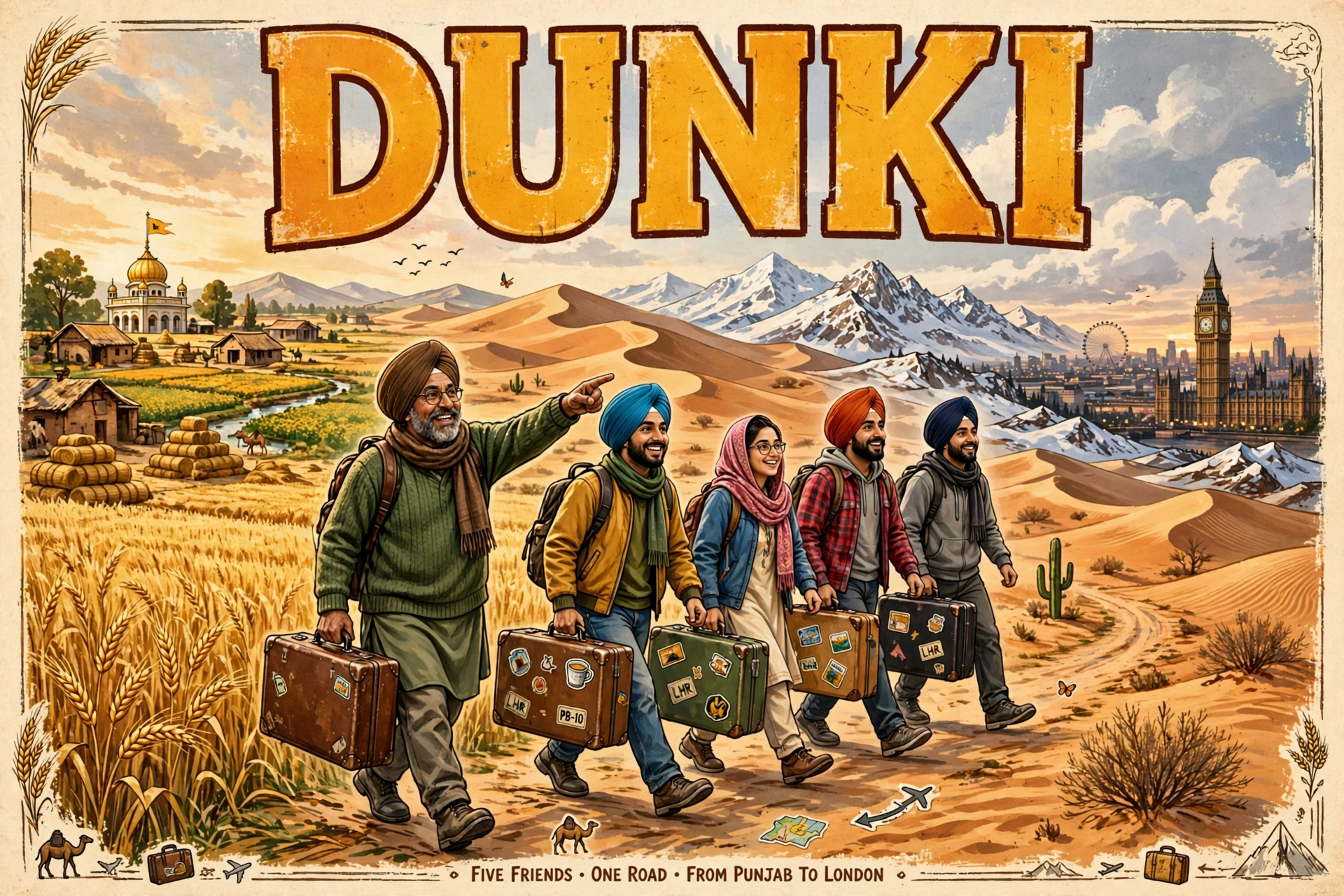
In a small town in Punjab in the mid-1990s, four friends share one obsession. Manu, Buggu, Balli and Sukhi are bright, funny and completely stuck. Jobs are scarce, prospects are limited, and London has become in their minds less a city than a solution to every family problem. None of them can qualify for a visa through ordinary routes, a fact driven home by their chaotic attempts to learn English and clear interviews at a local coaching centre run by the pompous but not unkind Geetu Gulati.
Into this group walks Hardayal Singh Dhillon, called Hardy, a soldier on leave who owes the group, and Sukhi in particular, a debt of gratitude. When circumstances push the friends towards the illegal route known in local slang as the donkey flight, a chain of agents, borders, hiding places and false promises, Hardy reluctantly becomes their protector and guide. The film follows their attempts, first through paperwork and preparation, then through the far more hazardous journey itself.
The narrative is framed by a present-day section set decades later, in which an older Manu in London needs to return to India urgently and finds that the choices made in youth have closed doors in both directions. That framing gives the story its emotional destination, though we will leave what brings the group back together, and what the journey finally costs them, for you to discover.
The subject is real and serious. Thousands attempt such routes every year, and many never reach their destination. The film knows this, and at intervals it shows us the danger. How consistently it respects that reality is one of the central questions of this review.
Shah Rukh Khan as Hardy: After a year spent playing an invincible action hero in two enormous hits, Khan chooses the opposite register here. His Hardy is a decent, slightly bewildered man whose courage is practical rather than glamorous. He is charming in the early comic scenes, convincing as the group’s emotional anchor, and affecting in the later, older portions. The performance is not flawless. In a few heavily emotional moments, the familiar star mannerisms surface and the character briefly disappears behind them, but this is still the most grounded work he had done in some time on release.
Taapsee Pannu as Manu: Pannu matches Khan scene for scene, which is no small achievement. Her Manu is the group’s driving force, stubborn, witty and unwilling to accept that her life must stay small. She handles the Punjabi-inflected comedy naturally and carries the present-day framing sections with a quiet dignity that gives the film much of its pathos.
Vicky Kaushal as Sukhi: In what is billed as a special appearance, Kaushal delivers the film’s most praised performance. Sukhi’s storyline, involving love, an English test and a devastating sense of failure, is the emotional high point of the first half, and Kaushal plays it with a raw simplicity that briefly lifts the whole film to the level its subject deserves. He later won the Filmfare Award for Best Supporting Actor for this role, and it is easy to see why.
Anil Grover and Vikram Kochhar provide much of the comedy as Buggu and Balli, with Kochhar’s timing a consistent pleasure, while Boman Irani makes the English teacher Gulati entertainingly full of himself without turning him into a villain.
Hirani’s direction is at its best in Punjab. The early sections, shot with cinematography shared by C. K. Muraleedharan, Manush Nandan and Amit Roy, have the warmth and observational humour of his finest work. Classrooms, rooftops, railway platforms and family courtyards feel lived in, and small jokes grow naturally out of the characters’ desperation to escape.
The problems begin with structure and tone. The film, edited by Hirani himself, runs 161 minutes, and the journey portion, which should be the most gripping part of the story, is handled in episodes that alternate between real peril and surprisingly comfortable passage. A sequence involving a container and a border crossing gestures at genuine horror, then the film moves on quickly, as if reluctant to let discomfort settle. The result is a story about a life-threatening route that too rarely feels life-threatening.
The courtroom and speech-driven passages in the later part compound the issue. Hirani has always included a message in his films, but here the message is sometimes delivered as a lecture to the audience rather than discovered through the characters. The production design across multiple countries is competent, and the period setting of the 1990s portions is evoked without excessive nostalgia, yet visually the film rarely surprises. It looks like a well-made television drama in stretches where his earlier films found memorable images.
Pritam composed the songs, with Aman Pant providing the background score and Shekhar Ravjiani contributing as a guest composer. The album aims for warmth and nostalgia rather than chart-busting dance numbers, which suits the film’s intentions.
“Lutt Putt Gaya” is the most energetic track, a romantic number that uses Hardy’s growing affection for Manu as an excuse for playful choreography. “Nikle The Kabhi Hum Ghar Se”, sung with deep feeling by Sonu Nigam, is the album’s emotional core, a song about leaving home that understands homesickness in a way the screenplay sometimes only states. “O Maahi” is a pleasant, hummable romantic ballad that performed well with audiences, even if it arrives in the film at a point where the story can least afford to pause.
Pant’s background score supports the drama unobtrusively, rising during the journey sequences and the present-day reunion. Overall, the music is good rather than exceptional. Two songs linger, the rest do their job, and nothing in the album embarrasses itself, but in a Hirani film, where music has historically become part of the cultural memory, that counts as a mild disappointment.
What we loved:
What could be better:
Dunki released worldwide on 21 December 2023, in the middle of the most competitive corridor of Shah Rukh Khan’s extraordinary year, and grossed an estimated ₹470.6 crore worldwide. Reported budget figures vary between sources, with production cost often cited around ₹85 crore and higher totals quoted when prints and publicity are included. Even on the higher estimate, the film was commercially successful, finishing as the fifth highest-grossing Hindi film of 2023.
Context, however, is everything. Khan’s two earlier releases that year had each earned far more, and a Hirani film was expected to dominate the Christmas period rather than share it. Dunki opened more softly, faced strong competition from another major release in the same window, and depended on family audiences and word of mouth to build its total over the following weeks, which it did respectably, particularly in urban centres and overseas markets with large Punjabi diaspora audiences.
The fair verdict is that Dunki was a clear hit that nevertheless underperformed against the extraordinary benchmark its own team had set. Its box office tells a useful story: goodwill and star power guarantee an opening, but in a crowded market they cannot fully substitute for the word of mouth a truly beloved film generates.
Watch Dunki if you are a fan of either its star or its director, or if the subject of migration runs through your own family, as it does for so many viewers in Punjab and the diaspora. You will find real laughs, one superb supporting performance and moments of genuine feeling. Just adjust your expectations. This is a decent, kind-hearted film from two artists capable of greatness, and the gap between those two things is the story of the movie itself.
Our rating: 6.5/10 — A warm-hearted immigration drama whose soft handling of a hard subject keeps it from greatness.
What does “Dunki” mean?
The title refers to the “donkey flight” or donkey route, a slang term for illegal immigration journeys in which people cross multiple borders with the help of agents, often in dangerous conditions, to reach countries such as the UK, the US or Canada.
Is Dunki based on a true story?
No single true story. The characters are fictional, but the film is inspired by the real phenomenon of donkey-route migration from Punjab and by the experiences of many families affected by it.
Is there a sequel to Dunki?
No sequel has been announced or released. The film tells a self-contained story that closes its characters’ arcs.
What language is Dunki in and are subtitles available?
The film is in Hindi with a strong Punjabi flavour. English subtitles are included on most licensed streaming and home versions and are recommended if you are not familiar with Punjabi expressions.
Where can I watch Dunki?
Look for Dunki on major licensed streaming platforms and official digital stores in your country. Availability differs by region and changes over time.
What is the runtime and age rating?
The film runs 161 minutes and was certified U/A in India. It contains emotional themes around migration and loss but no graphic content, making it broadly suitable for family viewing with guidance.