★ LATEST REVIEWS

Our Rating: ★★★★☆ 7/10
Every so often a film arrives that seems designed to split its audience straight down the middle, and Digger is exactly that kind of film. Alejandro G. Iñárritu, the Oscar-winning director of Birdman and The Revenant, has teamed up with Tom Cruise — in his first non-franchise role in nearly a decade — for a satirical black comedy about the most powerful man in the world trying to save humanity from a disaster he himself created. It is loud, strange, funny, exhausting and frequently fascinating, often all in the same scene. It is also one of the most divisive major releases of 2026, and that division is entirely understandable.
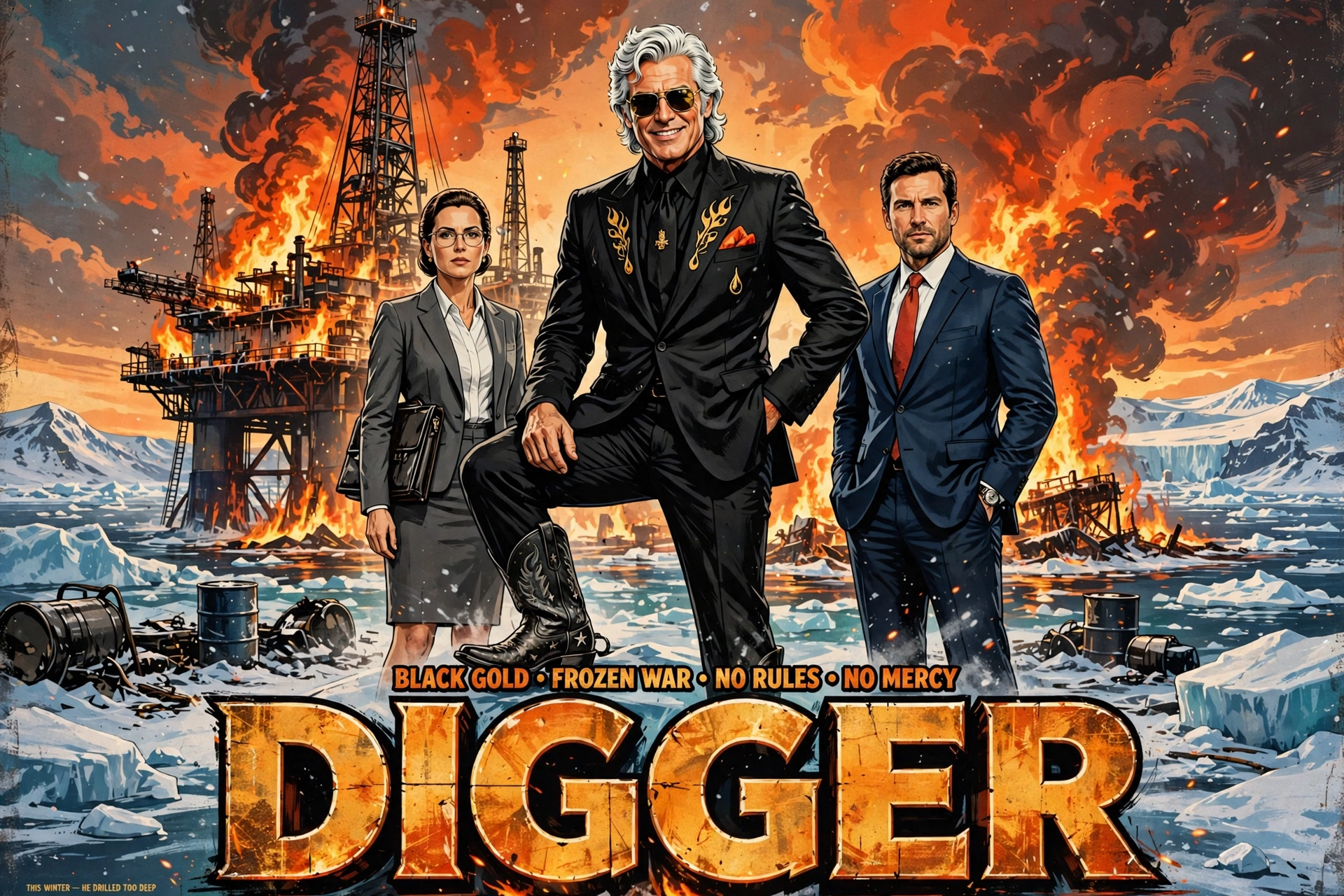
The premise is simple enough to state and wild enough to sustain a film. Cruise plays Digger Rockwell, an ageing oil magnate whose drilling sets off an ecological catastrophe. Faced with the destruction his own empire has unleashed, Digger embarks on a frantic mission to convince the world that he — the man who caused the problem — is the one person who can save humanity from it. Around him orbits a superb ensemble: Riz Ahmed, John Goodman, Sandra Hüller, Michael Stuhlbarg and Jesse Plemons, among others. What follows is less a conventional disaster movie than a character study of power, ego and public relations in an age of crisis.
| Detail | Information |
|---|---|
| Release date | 22 September 2026 (London premiere); 2 October 2026 (United States; international rollout from 30 September 2026) |
| Director | Alejandro G. Iñárritu |
| Writers | Alejandro G. Iñárritu, Sabina Berman, Alexander Dinelaris Jr., Nicolás Giacobone |
| Genre | Satirical black comedy, Drama |
| Language | English |
| Runtime | About 129 minutes (some listings give 128 minutes) |
| Budget | $125–180 million (reported range) |
| Lead cast | Tom Cruise, Riz Ahmed, John Goodman, Sandra Hüller, Michael Stuhlbarg, Jesse Plemons, Emma D’Arcy, Sophie Wilde |
| Our rating | 7/10 |
Digger Rockwell is introduced as a man who has everything: wealth beyond measure, political access, a taste for spectacle and an ego to match. His company’s drilling operations trigger an environmental disaster of global scale — melting ice, methane, storms and a public conversation that rapidly spirals out of anyone’s control. Rather than retreat, Digger does the most Digger thing imaginable: he launches a campaign to present himself as humanity’s saviour, the only man bold enough to fix what he broke.
This review will not spoil the film’s later turns, which are deliberately surprising and best encountered cold. What can be said is that Iñárritu uses Digger’s crusade to satirise several targets at once: the fossil fuel industry’s talent for rebranding itself as the solution to the problems it causes, the political class that enables it, the media ecosystem that turns catastrophe into content, and the difficulty of communicating real science in a world drowning in noise. The film’s most pointed joke is also its most serious idea — that the people who profit from a crisis are often the first to volunteer to solve it, on their own terms.
The tone is deliberately excessive. Digger himself is an outsized creation — flamboyant, vulgar, funny and oddly vulnerable — and the film matches his energy with long takes, bravura camera movement and set pieces that swing between farce and dread. Viewers who enjoy Iñárritu’s formal daring will find plenty to admire. Viewers who want a tidy, message-driven climate drama will likely find the film maddening, because it refuses to be tidy about anything.
Tom Cruise as Digger Rockwell — This is the film’s great selling point, and it delivers. Cruise throws himself into Digger with total commitment: the prosthetics and false teeth, the cowboy boots, the physical comedy, the volcanic line readings. It is a performance built on transformation rather than movie-star charisma, and it is genuinely unlike anything else in his filmography. Even critics who disliked the film have generally singled out Cruise’s fearlessness, and audiences have been notably warmer to the film than critics, with audience scores running well above the critical consensus. Whether you find Digger hilarious or insufferable, you cannot look away from him, and that is the point.
Riz Ahmed, John Goodman and Sandra Hüller — The supporting cast is superb. Ahmed brings intelligence and moral weight to his role as a key figure in Digger’s orbit, Goodman is a delight as a blustering political presence, and Hüller — one of the finest screen actors working today — gives the film some of its sharpest, quietest moments. Michael Stuhlbarg and Jesse Plemons add further texture, and the ensemble as a whole feels like a company of actors who understood exactly what kind of strange film they were making.
One honest note: the film’s sizeable cast also means some characters get less room than they deserve. A few figures feel more like satirical types than fully developed people, and when the film’s pace quickens in its second half, some of its subtler threads are crowded out by Digger’s sheer volume.
Iñárritu directs with his customary ambition. The film was shot entirely in VistaVision by his regular cinematographer Emmanuel Lubezki, and it looks extraordinary — vast, gleaming and tactile, with the kind of long, gliding takes that have become the director’s signature. The production design, costumes and prosthetic makeup are all meticulous, and the film’s visual world feels expensive in the best sense: every frame is considered.
The screenplay, co-written by Iñárritu with Sabina Berman, Alexander Dinelaris Jr. and Nicolás Giacobone, is where the film divides opinion most sharply. Its satire is broad and relentless, and its targets are hit again and again. Supporters will call this brave and bracing; detractors will call it obvious and exhausting. Both readings have merit. The film spends so much energy on how people talk about climate disaster — spin, denial, misinformation, performance — that it sometimes loses sight of the human stakes underneath. At around two hours and nine minutes, it is also a film that could have been tightened; some passages repeat their point when once would have done.
Composer Cosmo Sheldrake provides a score that matches the film’s restless energy, veering between playful and ominous as Digger’s campaign lurches from triumph to farce. The sound design is equally ambitious, and the film’s IMAX presentation makes the most of both. This is a film designed to be experienced loud, in a theatre, and the craft on display is never less than first-rate.
What we loved:
What could be better:
Here the news is sobering, and this review will be precise about what is known. Digger opened in the United States on 2 October 2026 after its London premiere on 22 September, and it has struggled commercially. Trade and reference sources report a worldwide gross of roughly $46–50 million against a reported production budget in the $125–180 million range — a substantial shortfall. Its opening weekend in the United States was reported as one of Cruise’s weakest in nearly two decades. These figures are still moving as the film’s run continues, and they should be read as reported estimates rather than final audited totals, but the broad picture is not in dispute: this is a major commercial disappointment.
The critical picture is equally split. The film holds a Rotten Tomatoes critics’ score of around 51–53%, with an audience score notably higher at roughly 71–74%, and a Metacritic score in the mid-40s. Opening-night audiences gave it a C+ CinemaScore. In other words, Digger is a film people argue about — and the studio, notably, leaned into that division in its marketing, inviting audiences to decide for themselves. That is honest advertising for a film like this.
Yes — with the right expectations. Digger is not a comfortable film, and it is not for everyone. But it is the rare big-budget studio picture that takes a genuine swing, anchored by a Tom Cruise performance unlike anything he has done before, and it raises serious questions about power and climate responsibility even when its satire gets too loud for its own good. Go in expecting provocation rather than comfort, and you may find yourself among the film’s defenders.
Our rating: 7/10 — A bold, messy, frequently brilliant satire that bites off slightly more than it can chew.
Who does Tom Cruise play in Digger?
He plays Digger Rockwell, a powerful oil magnate whose drilling triggers an ecological disaster — and who then campaigns to present himself as humanity’s saviour.
Who directed Digger?
Alejandro G. Iñárritu, the Oscar-winning director of Birdman and The Revenant, who co-wrote the screenplay with Sabina Berman, Alexander Dinelaris Jr. and Nicolás Giacobone.
When was Digger released?
It premiered in London on 22 September 2026 and opened in the United States on 2 October 2026, with international release beginning 30 September 2026.
Is Digger based on a true story?
No. It is an original satirical story, though it draws on real issues including fossil fuel politics, methane emissions, melting ice and climate misinformation.
Why is Digger so divisive?
Critics are split roughly down the middle (around 51–53% on Rotten Tomatoes) while audiences have been warmer; the film’s loud, exaggerated satire delights some viewers and exhausts others.