★ LATEST REVIEWS

Our Rating: ★★★★☆ 7.5/10
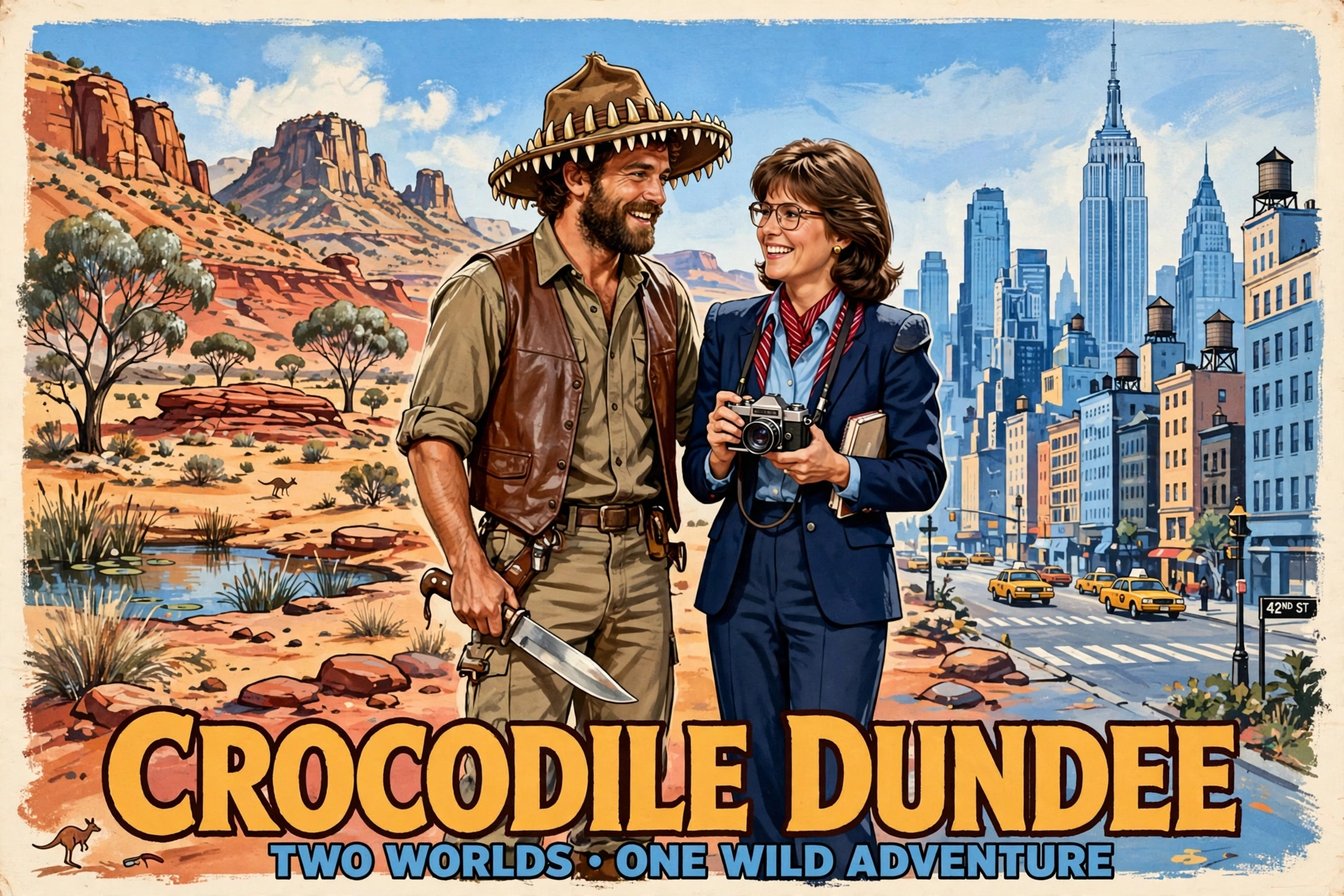
Some films are hits, and some films are weather events. Crocodile Dundee was the second kind. Made cheaply in Australia with a television comedian in the lead, it became the second-highest-grossing film in the world in 1986, turned Paul Hogan into an international star overnight and taught a generation of moviegoers a handful of Australian slang they are still using. Any honest Crocodile Dundee review today has to hold two ideas at once: this is a genuinely charming, well-built comedy — and it is also very much a film of 1986, with attitudes and jokes that land differently now than they did for the audiences who queued around the block for it.
Directed by Peter Faiman and built entirely around Hogan’s screen persona, the film is a fish-out-of-water story told twice. First a New York reporter is the fish, dropped into the Australian Outback. Then the Outback’s most famous fish is dropped into Manhattan, and the film becomes something rarer: a comedy where the supposed innocent understands people better than the sophisticated city folk around him. That warmth — more than the famous knife line, more than the crocodile — is why the film is still watched, quoted and argued about nearly forty years later.
| Detail | Information |
|---|---|
| Release date | 24 April 1986 (Australia) |
| Director | Peter Faiman |
| Writers | Paul Hogan, Ken Shadie, John Cornell (screenplay); story by Paul Hogan |
| Genre | Comedy, Adventure, Romance |
| Language | English |
| Runtime | 98 minutes (international version); 104 minutes (Australian version) |
| Budget | A$8.8 million |
| Lead cast | Paul Hogan, Linda Kozlowski, John Meillon, David Gulpilil, Mark Blum |
| Our rating | 7.5/10 |
Sue Charlton, a feature writer for the New York newspaper Newsday owned by her father, hears a story too good to ignore: in a remote Northern Territory settlement called Walkabout Creek, a crocodile hunter named Michael J. “Crocodile” Dundee supposedly survived a saltwater crocodile attack that took half his leg, then crawled an impossible distance back to safety. Sue travels to Australia to meet the legend, is looked after by Dundee’s business partner Walter Reilly, and finally meets Mick himself — whose leg, it turns out, is very much attached, decorated only by an impressive scar he cheerfully calls a love bite.
Mick agrees to take Sue back through the bush to the place where the attack happened. Out there, the comedy reverses: the capable, sceptical reporter is the one out of her depth, while Mick reads the landscape the way she reads a newsroom. He deals calmly with a water buffalo blocking the track, with poachers shooting kangaroos at night, and with dangers Sue cannot even see coming. Their walk becomes a slow, good-humoured courtship conducted through teasing, competence and one dramatic rescue — and Sue realises the follow-up her story really needs is not in Australia at all.
She brings Mick to New York, a city he has never visited and barely believes is real, and the film’s second half runs the same joke in the opposite direction with surprising freshness. Mick treats Manhattan exactly as he treats the Outback: he greets strangers, trusts people until they prove otherwise, misreads bidets and escalators, befriends everyone from limo drivers to street workers, and applies bush logic to muggers, high society parties and Sue’s slick editor boyfriend, Richard, who clearly sees Mick as a novelty act. How the visit resolves the distance between Sue’s two worlds — and between Sue and Mick — is the film’s business to finish, and we will leave the ending, including its beloved final crowd scene, unspoiled.
Paul Hogan as Mick Dundee gives one of those star performances that only works because it barely looks like acting. Hogan had spent years playing versions of the cheerful, laconic Australian in television comedy and tourism advertising, and Mick is that persona polished into a leading man. The performance is built on timing: the pause before a dry answer, the friendly eye-contact with people the script expects him to be baffled by, and a physical ease in the Outback scenes that sells Mick’s competence without speeches. Hogan won the Golden Globe for Best Actor in a Musical or Comedy, and the film’s screenplay was nominated for an Academy Award — remarkable for a comedy this unpretentious. Judged today, Hogan still carries the film effortlessly; what has dated is some of the material around him, not the man himself.
Linda Kozlowski as Sue Charlton has the harder job and does it well. Sue must be competent enough that her interest in Mick’s world feels professional rather than silly, warm enough that the romance works, and funny in a register completely different from Hogan’s deadpan. Kozlowski, an American stage-trained actor in her first major film role, matches him by underplaying; her reactions — exasperation softening into fascination — are where most of the first half’s laughs actually live. The chemistry was real enough to become famous off-screen, and on-screen it gives the film an emotional centre that pure gag comedies lack.
Around them, the Australian supporting cast does essential work. John Meillon as Walter Reilly is the film’s quiet anchor — wry, loyal and forever managing the Dundee legend for fun and profit. David Gulpilil as Neville Bell, Mick’s Aboriginal friend, brings a presence that the film uses too briefly; Gulpilil, one of Australian cinema’s most important Indigenous actors, gives his scenes a dignity and sly humour that deserved more screen time than 1986 commercial instincts allowed. Mark Blum as Richard Mason plays Sue’s New York boyfriend as an elegant obstacle rather than a villain, which keeps the romantic triangle civilised, and Michael Lombard as Sam Charlton lends the newspaper sequences a brisk, old-Hollywood efficiency.
Peter Faiman came from television, and his direction is best described as invisible in the service of his star. He does not decorate Crocodile Dundee; he frames Hogan, the locations and the joke, then gets out of the way. That restraint was exactly right for this material. The film’s clean two-part structure — Outback first, New York second, mirrored jokes rhyming across the halves — is a piece of classic commercial screenwriting by Hogan, Ken Shadie and John Cornell, and Faiman keeps it moving at a pace modern comedies, with their improvised sprawl, rarely achieve. At roughly an hour and forty minutes, nothing outstays its welcome.
Russell Boyd’s cinematography does the film’s other great job of selling. His Outback is golden, spacious and quietly majestic, shot in the Northern Territory and Kakadu country so persuasively that Australian tourism felt the effect for years. Against that, his New York is vertical, crowded and grey-blue, and the contrast — space versus density, silence versus sirens — becomes the film’s visual argument about Mick and Sue’s worlds. Editor David Stiven keeps the reaction shots, which are this film’s true currency, perfectly timed; comedy editing lives or dies on holding a face half a second longer, and Stiven consistently finds that half-second.
Honest craft criticisms exist. The production is plainly modest — some New York sequences are thinly dressed, and the score occasionally underlines jokes that did not need help. The Aboriginal ceremonial sequence, presented respectfully for its era, is still filtered through a tourist’s gaze in a way contemporary filmmakers would approach very differently. And one notorious New York gag involving a transgender character is played purely for shocked laughter in a manner that reads as cruel today, however standard it was in 1980s mainstream comedy. A fair modern review should name these things plainly, because pretending they are not there helps nobody decide what to watch.
The music is by Australian composer Peter Best, and it does exactly what a light adventure-comedy score of its period should do. His main material has a bright, open-air quality — acoustic colours and an unhurried melody that fits the Territory sequences like sunlight — and he shifts register for New York with a busier, more urban pulse under the street scenes. It is not a score people hum forty years later the way they quote the dialogue, and at moments it leans on the soft synthesiser textures that date so many mid-eighties films. But it never fights the performances, it gives the romantic thread a gentle lift without syrup, and its restraint in the rescue and farewell scenes shows good judgement. In a film sold on a personality, the music’s willingness to stay in support is a virtue.
What we loved:
What could be better:
The numbers, unusually for a film of this era, are well documented and genuinely astonishing. Crocodile Dundee was made for A$8.8 million as a deliberate attempt to build an Australian commercial film that American audiences would accept. It grossed about US$328 million worldwide — roughly $174.8 million in North America and $153.4 million elsewhere — becoming the second-highest-grossing film of 1986 both in the United States and worldwide, and at the time the highest-grossing Australian film ever made. Tens of millions of tickets were sold in America alone, a scale of success no one involved pretends they predicted. Two sequels followed — Crocodile Dundee II in 1988, itself a major hit, and Crocodile Dundee in Los Angeles in 2001 — but neither matched the original’s critical welcome, which included that Oscar nomination for its screenplay and Hogan’s Golden Globe win. One small note for precision: some older references list the Australian opening as 30 April 1986 rather than 24 April; the 24 April date is the one carried by current reference listings, and the difference does not affect the film’s story.
If you have never seen it, yes — with your eyes open about its era. Crocodile Dundee remains a masterclass in star-driven comedy construction: a simple premise, a perfectly cast lead, locations that do half the seduction and a romance that earns its ending. First-time viewers will also meet the 1980s face to face, including a couple of jokes and attitudes that have aged badly, and the film is honest evidence of both its country’s charm and its decade’s blind spots. Rewatching it today is less like revisiting a museum piece and more like visiting an old friend who is mostly delightful and occasionally embarrassing — and that, for a forty-year-old popular comedy, is a better outcome than most achieve.
Our rating: 7.5/10 — an enduringly likeable star vehicle whose warmth survives its dated edges.
Is Crocodile Dundee based on a true story?
It was inspired by the real-life exploits of Australian bushman Rod Ansell, who survived weeks alone in remote country after a fishing trip went wrong. Mick Dundee, Sue Charlton and the film’s plot are fictional creations built around Hogan’s screen persona.
What is the famous knife line, exactly?
Confronted by a New York mugger with a small flick-knife, Mick produces his own very large hunting knife and delivers the line most people misquote slightly: “That’s not a knife. That’s a knife.” It became one of the most quoted movie moments of the decade.
Is Crocodile Dundee suitable for family viewing?
Mostly, for older children and up. It carries a mid-level rating in most regions for mild language, some innuendo, brief drug references in New York scenes and light peril. Parents should also know that a couple of jokes reflect 1980s attitudes that families may want to talk about.
Are the Australian and international versions different?
Yes, slightly. Two versions were prepared: the Australian cut runs about 104 minutes, while the international version runs about 98 minutes, with some Australian slang replaced by more widely understood wording for overseas audiences.
Where can I watch Crocodile Dundee?
It is widely available on streaming and rental platforms in most regions and is regularly reissued on disc, often in a set with its two sequels. Availability varies by country, so check your local services.