★ LATEST REVIEWS

★★★★☆ Our Rating: 8.5/10
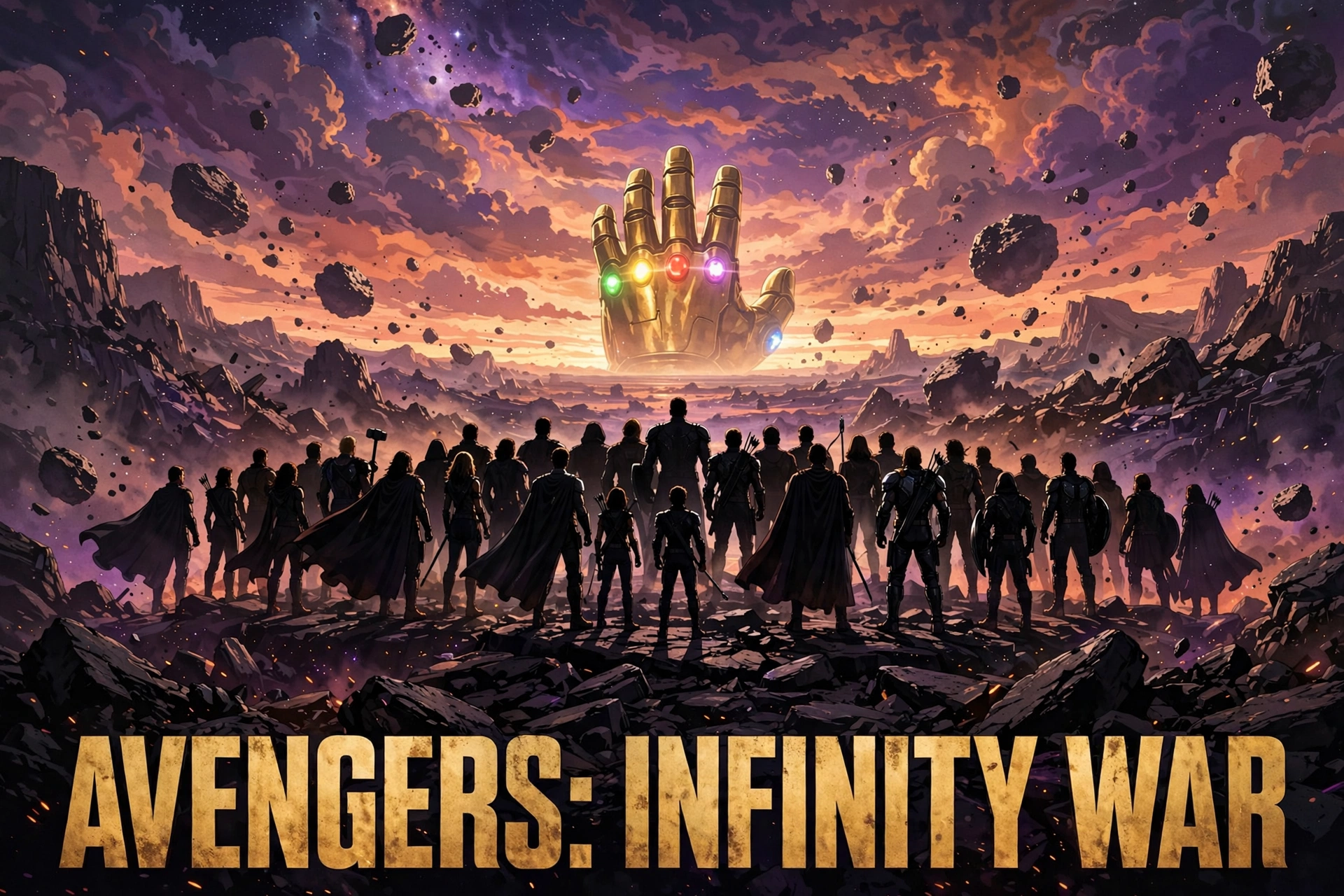
Ten years and eighteen films of build-up is an unreasonable amount of homework to set an audience — and Avengers: Infinity War, released in April 2018, is the rare blockbuster that made the homework feel worth it. Directed by Anthony and Joe Russo, written by Christopher Markus and Stephen McFeely, it gathers more than twenty established heroes into one story and does the unthinkable: it makes the story belong to the villain, and then it lets him succeed.
This Avengers Infinity War review is written with admiration and a few reservations. The film is a staggering feat of logistics and escalation, and Josh Brolin’s Thanos is one of the great blockbuster antagonists. But it is also, deliberately, half a story — a magnificent first movement whose final meaning depends on its sequel. Judged on its own terms, here is what soars, what strains, and why that silent, ash-filled ending left audiences sitting in their seats long after the credits began.
| Detail | Information |
|---|---|
| Release date | 27 April 2018 (United States) |
| Director | Anthony Russo, Joe Russo |
| Writers | Christopher Markus, Stephen McFeely |
| Genre | Superhero, Action, Adventure, Science Fiction |
| Language | English |
| Runtime | 149 minutes |
| Budget | Reported between $316 million and $400 million |
| Lead cast | Robert Downey Jr., Chris Evans, Chris Hemsworth, Scarlett Johansson, Mark Ruffalo, Benedict Cumberbatch, Tom Holland, Chadwick Boseman, Zoe Saldaña, Josh Brolin |
| Our rating | 8.5/10 |
For years, in the margins of other heroes’ films, Thanos (Josh Brolin) has been hunting six Infinity Stones — objects of immense power scattered across the universe. His purpose, as he explains it with the calm of a man reciting weather, is balance: life has outgrown its resources, and so, randomly and without cruelty as he sees it, half of all living things must cease to exist. With all six stones set into his gauntlet, he could do it with a snap of his fingers.
The film opens with that hunt already costing lives, and it does not slow down for the next two and a half hours. The Avengers — fractured since the events of Captain America: Civil War — and the Guardians of the Galaxy are split into teams across Earth and deep space: a desperate defence of the stones that remain, a journey to forge a weapon capable of killing a god, and a stand on the fields of Wakanda that becomes the largest battle Marvel had ever staged. Threaded through the spectacle is Thanos himself, given the film’s emotional centre in his twisted bond with his adopted daughter Gamora (Zoe Saldaña). Where the story ends, this review will not say in detail — only that the film closes on the boldest downbeat in blockbuster history, and that audiences in 2018 walked out of cinemas in genuine shock.
Josh Brolin as Thanos is the performance the entire film is built around, and the gamble pays off. Motion capture and digital artistry could easily have produced a purple monument; Brolin instead plays a weary true believer — soft-spoken, almost gentle, convinced of his own mercy. His Thanos cries real tears for what his mission costs him, and that sincerity is far more frightening than any roar. It is among the finest CGI-assisted performances ever put on screen.
Robert Downey Jr. as Tony Stark anchors the space-bound thread with the weary guilt of a man who saw this coming years ago and could not stop preparing. His scenes opposite Tom Holland as Peter Parker carry the mentor-student warmth the film needs before it turns cold, and Holland — given the film’s most quoted improvised-feeling moment late on — earns every second of it. Chris Hemsworth as Thor completes the character’s reinvention from stiff prince to broken, funny, grieving god; his forge sequence, in which Thor calmly accepts he may die simply to have a chance, is the film’s heroic peak.
Chris Evans as Steve Rogers has less to do than in his own films but commands every frame he enters, while Zoe Saldaña as Gamora gives the film its broken heart — her scenes with Brolin are the movie in miniature: love and monstrousness in the same embrace. Benedict Cumberbatch as Doctor Strange and Downey trade wonderfully spiky chemistry, Chadwick Boseman as T’Challa lends Wakanda its regal calm, and Elizabeth Olsen as Wanda Maximoff is handed the film’s most impossible choice and plays it with devastating clarity. With this many heroes, some are inevitably short-changed — a few favourites are reduced to entrances and exits — but no performance is less than committed.
The Russo brothers, working with cinematographer Trent Opaloch, stage-manage an impossible traffic problem with remarkable clarity. Shot entirely with IMAX cameras, the film hops between New York, Edinburgh, Wakanda, Titan and the void of space, yet each thread keeps its own visual temperature — the orange ruin of Titan, the green expanse of the Wakandan battlefield — and Jeffrey Ford and Matthew Schmidt’s editing braids them into a single rising line of dread. The action set pieces are genuinely varied: a street-level brawl in Edinburgh plays completely differently from the operatic, magic-versus-technology duel on Titan.
The seams do show in places. The Wakanda battle, for all its scale, eventually becomes the familiar spectacle of digital armies colliding, and the film’s sheer population means some confrontations are resolved by arrival rather than by character. The visual effects — Oscar-nominated, and mostly superb — occasionally soften in the biggest wide shots. But as industrial filmmaking, this is close to the ceiling of what a studio blockbuster can coordinate: dozens of characters, five interwoven quests, and a tone that moves from quips to genocide without snapping.
Alan Silvestri, who composed the original Avengers theme, returns and understands his assignment perfectly: this is a tragedy scored like a triumph slowly curdling. His Thanos material is sombre and funereal, built on low brass and a sense of grim inevitability, while the famous Avengers theme is rationed — withheld through most of the film so that when it finally swells, over a certain bearded captain’s entrance, entire cinemas erupted. The score’s finest work is in the final minutes, where Silvestri largely steps aside and lets silence, wind and a single mournful cue carry an ending that no rousing music could honourably accompany.
What we loved:
What could be better:
A note on the numbers first, because reports differ. The production budget was never officially confirmed, and credible reports place it anywhere between roughly $316 million and $400 million — either way, among the most expensive films ever made. The gross is firmer ground: around $2.05 billion worldwide, with trackers varying slightly between approximately $2.048 billion and $2.052 billion. That made it the first superhero film ever to pass $2 billion, the highest-grossing film of 2018, and at the time the fourth-highest-grossing film in history. Its opening weekend — about $258 million in North America and roughly $641 million globally — set records on both fronts. The film received one Academy Award nomination, for Best Visual Effects. For a film that ends with its heroes utterly beaten, audiences rewarded it like a coronation — proof that the decade of storytelling that fed into it had built something no opening weekend could fake.
If you have followed the Marvel saga at all, this is essential viewing: the payoff film, the one where the accumulated weight of eighteen movies lands on a single snapped finger. If you are new to the series, start earlier — this film assumes your affection and spends it brilliantly, but it cannot create it from nothing. Avengers: Infinity War is not the most complete film in its franchise; its own sequel had to finish the sentence. But as an experience — the scale, the dread, the villain, that ending — it is the moment the biggest franchise in cinema history took its biggest risk, and won.
Our rating: 8.5/10 — a monumental, villain-led blockbuster whose only real flaw is that it is half of a masterpiece.
Do I need to watch the other Marvel films before Avengers: Infinity War?
Realistically, yes — at minimum The Avengers, Guardians of the Galaxy, Captain America: Civil War, Doctor Strange and Thor: Ragnarok. The film opens mid-story and assumes you know these characters and the Infinity Stones.
Is Avengers: Infinity War a complete story?
No. It is the first half of a two-part conclusion, completed by Avengers: Endgame (2019). Its ending is intentionally unresolved — one of the boldest cliffhangers in blockbuster history.
Is Avengers: Infinity War suitable for children?
It is rated PG-13 and is the darkest of the Avengers films, with intense violence, deaths of established characters and a deeply upsetting final act for younger viewers. Older children who know the series will cope; young ones may not.
Why is Thanos considered such a good villain?
Because the film is structured as his story: he has a philosophy he sincerely believes, a genuine emotional sacrifice to make, the clearest goal of any character — and, uniquely for a superhero film, he achieves it.
Where can I watch Avengers: Infinity War?
It streams on Disney+ in most regions and is available on Blu-ray and digital purchase elsewhere. Availability varies by country, so check your local services.