★ LATEST REVIEWS

Our Rating: ★★★★☆ 8.5/10
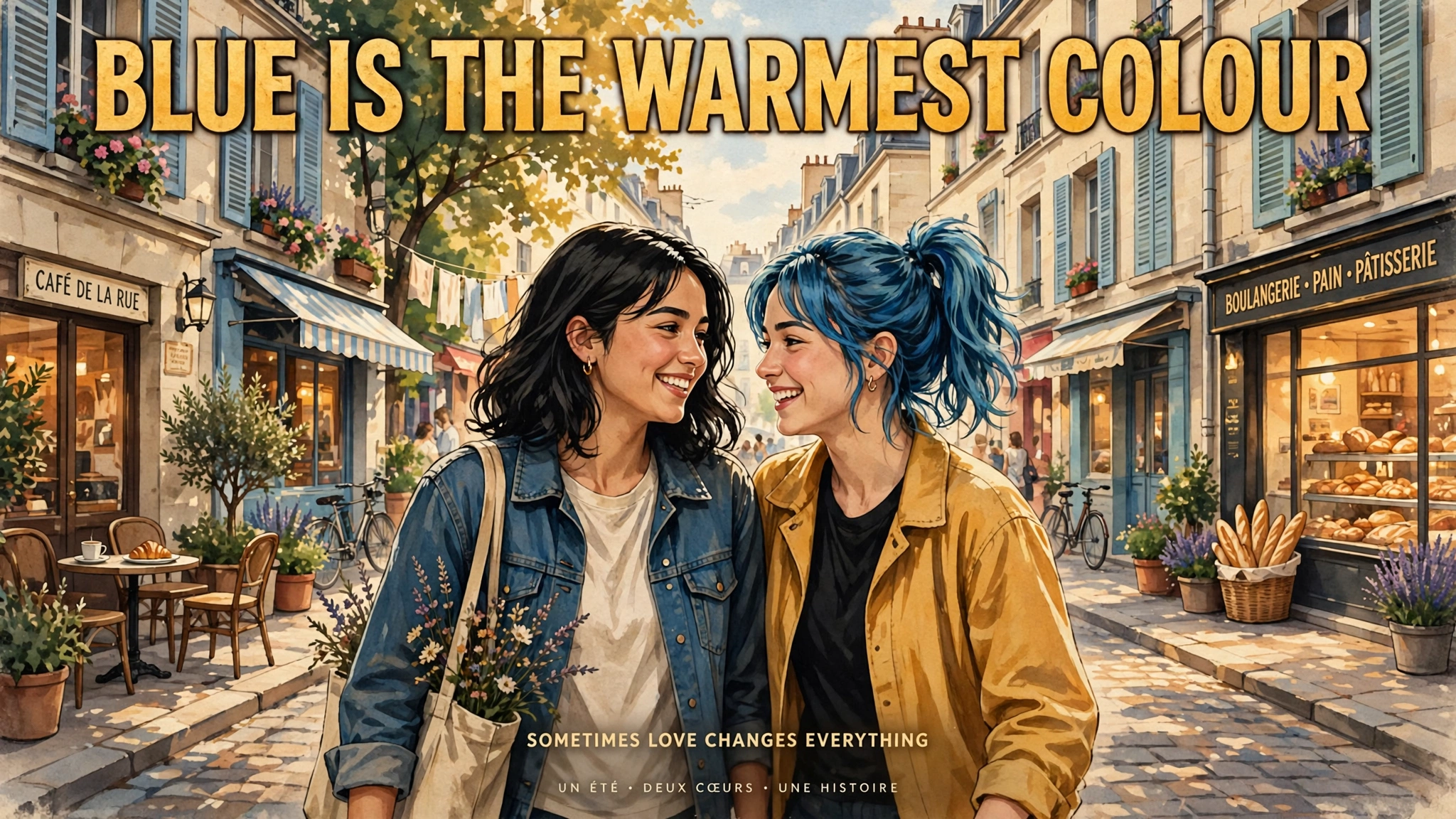
Few films of the last decade have been as acclaimed, as argued over, or as hard to watch with detachment as Blue Is the Warmest Colour. Abdellatif Kechiche’s three-hour portrait of a young woman’s first great love — from schoolgirl uncertainty to adult independence — won the Palme d’Or at Cannes in an unprecedented way: the jury awarded it jointly to the director and to both lead actresses, Adèle Exarchopoulos and Léa Seydoux, the first time the prize had ever been shared like that. It is a film of extraordinary intimacy and patience, and also a film whose methods and whose most famous scenes have been fiercely debated ever since. Both things are true, and any honest review has to hold them together.
What endures is the central achievement: a coming-of-age story told at life’s own pace, with two performances of rare openness. Kechiche films his heroine the way a novelist writes — closely, over years, with attention to meals, arguments, classrooms and silences — and the result is a love story that feels less like a plot than like a memory.
| Detail | Information |
|---|---|
| Release date | 23 May 2013 (Cannes premiere); 9 October 2013 (France) |
| Director | Abdellatif Kechiche |
| Writers | Abdellatif Kechiche, Ghalia Lacroix; based on the graphic novel by Julie Maroh |
| Genre | Romance, Drama |
| Language | French |
| Runtime | 179 minutes (some listings round to 180) |
| Budget | €4 million |
| Lead cast | Adèle Exarchopoulos, Léa Seydoux, Jérémie Laheurte, Catherine Salée |
| Our rating | 8.5/10 |
Adèle is fifteen, at school in Lille, drifting through friendships, classes and a first boyfriend who does not hold her attention. She has a feeling she cannot yet name — a restlessness, a sense that something in her life is missing — when she passes a young woman with blue hair on the street and cannot get the image out of her head. When the two meet properly, at a gay bar Adèle visits with a friend, the connection is immediate and overwhelming.
The film follows Adèle and Emma — the older, art-student Emma, confident, political, already sure of who she is — across years: from school to university to Adèle’s adult life as a primary-school teacher, from first discovery to domestic life together to the slow, painful process of growing apart. Kechiche structures the film in two chapters, with a leap of years between them, and the second chapter is where the film earns its length: it watches two people who once completed each other become, gradually and without a single villain, unable to live together.
This review will not reveal how the relationship ends, or what the film’s final scenes show. It is enough to say that the ending is unsentimental, that it refuses both tragedy and reconciliation, and that it leaves Adèle — as the title insists — still becoming.
Adèle Exarchopoulos as Adèle — Exarchopoulos was nineteen when the film won at Cannes, making her the youngest Palme d’Or recipient in history, and her performance is the reason the film works at all. She is in almost every scene, and Kechiche films her in long, unbroken takes that leave nowhere to hide: eating, sleeping, crying, arguing, laughing, thinking. Her Adèle is not a symbol but a person — stubborn, hungry for life in every sense, tender and sometimes infuriating. The performance’s power is in its ordinariness: this is what it looks like to be young and to feel everything at full volume.
Léa Seydoux as Emma — Seydoux gives the film its other pole. Her Emma is older, surer, an artist who has already fought the battles Adèle is only beginning, and Seydoux plays her confidence with a warmth that keeps Emma from becoming merely the glamorous older lover. As the years pass, Seydoux shows Emma’s patience thinning and her own ambitions hardening, without ever turning her into a villain. The two performances are a genuine duet: Exarchopoulos’s openness against Seydoux’s control, and the film’s tragedy is in how those qualities stop fitting together.
The supporting cast — Jérémie Laheurte is sympathetic as Thomas, Adèle’s first boyfriend, and Catherine Salée and Aurélien Recoing give Adèle’s parents a believable, loving ordinariness. The friends, the dinner-party guests, the school colleagues — all are played with the naturalism Kechiche demands, which makes the world around the couple feel real rather than staged.
Kechiche’s direction is famously immersive and famously demanding. He shoots with handheld cameras, in long takes, from very close, and he builds scenes out of conversation and behaviour rather than plot beats: a ten-minute dinner-party argument, a classroom scene that runs its full course, a walk home that takes as long as a walk home takes. The method produces moments of startling truth — the film’s scenes of Adèle at work as a teacher, patient and alive with children, are among its finest — and it also produces the film’s central problem: a length and an intensity that can feel indulgent, and intimate scenes that go on well past the point of narrative need.
That debate cannot be avoided in an honest review. The film’s long, explicit love scenes have been criticised — including, after release, by the actresses themselves and by the graphic novel’s author — as excessive and as shaped more by a male director’s gaze than by the characters’ experience. Viewers should know that these scenes are a significant, extended part of the film, and that the controversy around how they were filmed is part of the film’s history. What can also be said is that the film’s power does not depend on them: its most moving passages are its quietest, and a viewer who finds the intimate scenes too much will still find a great deal of the film that is tender, funny and true.
Technically, Sofian El Fani’s cinematography is superb — warm, close, saturated with the blues of Emma’s hair and the colours of food, classrooms and studios — and the editing, which shaped some 800 hours of footage into three hours, is a feat of selection. The film looks and feels like life remembered in close-up.
The film uses music sparingly and pointedly. There is no wall-to-wall score; instead, songs and pieces arrive as part of the characters’ world — at parties, in studios, on the radio — and the most famous musical moment, a song that becomes associated with the couple, works because it is allowed to recur and gather meaning across the years. The absence of score in the film’s most emotional scenes is deliberate: Kechiche wants the audience to hear breathing, voices and silence, not an instruction about how to feel. It is a risky choice, and for the most part it pays off.
What we loved:
What could be better:
Blue Is the Warmest Colour premiered at Cannes on 23 May 2013, where it won the Palme d’Or unanimously, and opened in France on 9 October 2013. Made for about €4 million, it grossed roughly $19.5 million worldwide — a strong result for a three-hour French-language drama, driven by its Cannes triumph and by the controversy that kept it in the news. In the United States it earned about $2.2 million, a solid arthouse figure for a subtitled film of this length. Some sources quote the worldwide total in euros at over €14 million, which is consistent with the dollar figure once exchange rates are accounted for.
The film’s awards life was long: it was nominated for the Golden Globe for Best Foreign Language Film and the BAFTA for Best Film Not in the English Language, won the Independent Spirit Award for Best International Film, and gave Exarchopoulos the César for Most Promising Actress. Its cultural shadow has been longer still — it remains a reference point in every argument about intimacy, authorship and the camera’s gaze in modern cinema.
Yes, with eyes open. Blue Is the Warmest Colour is one of the great screen portraits of first love, carried by two performances that will stay with you for years, and it is also a film that demands a viewer who is comfortable with its length, its intensity and its controversies. It is not an easy watch, and it should not be: first love, at this scale, is not easy either.
For viewers interested in serious cinema, it is essential. For viewers looking for a light romance, it is emphatically not that — and the film would be the first to say so.
Our rating: 8.5/10 — A towering, difficult, unforgettable portrait of becoming, carried by two great performances.
Is Blue Is the Warmest Colour based on a book?
Yes. It is based on Julie Maroh’s 2010 graphic novel Le Bleu est une couleur chaude (Blue Is the Warmest Colour). The film changes and expands the story considerably.
Why did it win the Palme d’Or jointly?
At Cannes 2013, the jury awarded the Palme d’Or to director Abdellatif Kechiche and to both lead actresses, Adèle Exarchopoulos and Léa Seydoux — the first time the prize had ever been shared this way.
How long is Blue Is the Warmest Colour?
It runs 179 minutes — just under three hours. Some listings round it to 180 minutes.
Is it suitable for younger viewers?
No. It contains extended scenes of adult intimacy and is rated for adults in most countries. It is a serious drama, not a teen romance.
Where can I watch Blue Is the Warmest Colour?
It is available on major streaming and digital purchase services in many regions, though availability changes by country and over time, so check your local platforms.