★ LATEST REVIEWS

Our Rating: ★★★★☆ 8/10
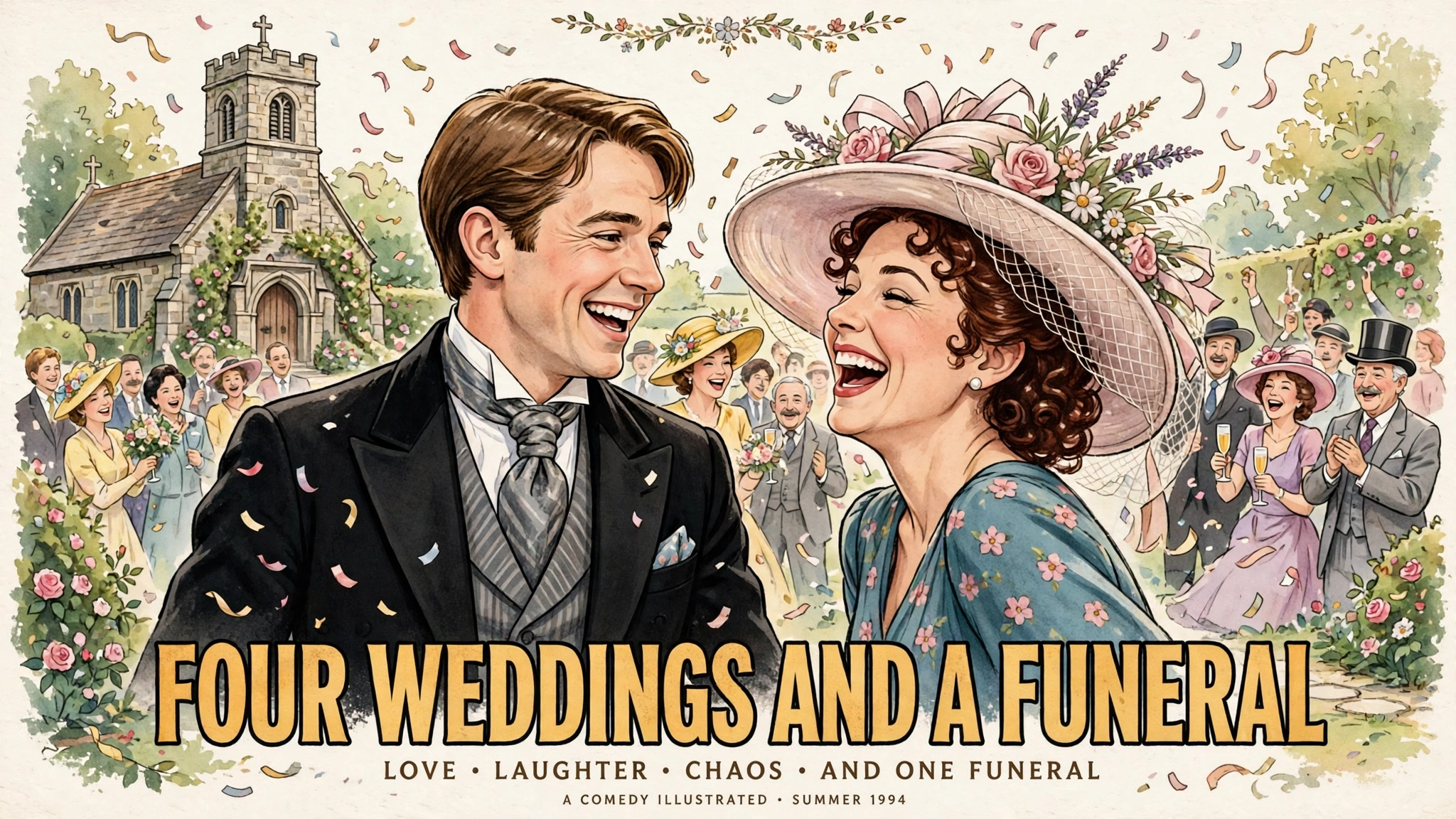
It is hard, from the vantage point of thirty years on, to remember how unlikely Four Weddings and a Funeral was. A small British film, shot in six weeks for under £3 million, about a group of upper-middle-class London friends and their love lives, became the highest-grossing British film in history at the time and turned Hugh Grant into an international star overnight. It earned Oscar nominations for Best Picture and Best Original Screenplay — for a romantic comedy, a genre the Academy usually ignores — and it fixed the template for the modern British rom-com so firmly that Richard Curtis, its writer, spent the next decade refining it.
What keeps the film alive is not its plot, which is deliberately slight, but its voice. Curtis’s dialogue — literate, self-deprecating, funny about embarrassment in a way that feels specifically English — and a cast that plays it as if it were the most natural thing in the world. It is a film about people who talk too much, commit too little and feel too deeply, and it understands all three conditions.
| Detail | Information |
|---|---|
| Release date | 13 May 1994 (United Kingdom; premiered at Sundance, 20 January 1994) |
| Director | Mike Newell |
| Writer | Richard Curtis |
| Genre | Romantic Comedy, Drama |
| Language | English |
| Runtime | 117 minutes |
| Budget | £3 million (about $4.4 million) |
| Lead cast | Hugh Grant, Andie MacDowell, Kristin Scott Thomas, Simon Callow, John Hannah, James Fleet |
| Our rating | 8/10 |
Charles is a charming, chronically single Londoner in his early thirties, surrounded by a close circle of friends who are all, one by one, getting married. The film’s structure is its title: we follow Charles and his friends through four weddings and a funeral, and at each occasion Charles’s life is rearranged by the same woman — Carrie, an American he meets at the first wedding and keeps meeting, at the worst possible moments, ever after.
At the first wedding, Charles and Carrie spend a night together and part with a joke about not exchanging numbers. At the second, Carrie reappears — engaged to someone else. At the third, further complications arrive. Between the ceremonies there are the friendships that give the film its real weight: the group’s shared jokes, their loyalty, their grief when one of their own is lost. The funeral of the title is the film’s emotional centre, and it is played with a restraint that still catches audiences off guard: a eulogy, delivered by John Hannah’s Matthew, that is widely considered one of the great set pieces of the genre.
This review will not reveal whether Charles and Carrie end up together, or how the fourth wedding resolves. What can be said is that the film’s ending is both a romantic-comedy payoff and a small rebellion against the genre’s rules — Charles’s final decision is about what kind of commitment he is actually capable of, rather than the one the ceremony demands.
Hugh Grant as Charles — This is the performance that made Grant a star, and it is easy to see why. His Charles is a creation of tics and timing: the floppy hair, the stammer, the self-deprecating joke deployed as a shield, the panic when sincerity is required. Grant makes charm look effortless, but the performance is carefully calibrated — underneath the jokes is a man genuinely afraid of committing to anything, and the film’s best scenes are the ones where the charm fails and the fear shows. It is a star-making turn because it is also a real characterisation.
Andie MacDowell as Carrie — MacDowell has the harder job, and it is fair to say the film does not always make it easy for her. Carrie is written as an ideal — beautiful, American, slightly out of reach — rather than as a fully developed character, and MacDowell’s serene, low-key playing sometimes reads as underpowered against Grant’s fireworks. But she brings a warmth and directness that the role needs, and her scenes with Grant have a genuine, unforced chemistry. The film’s romance works because the two of them seem to actually like each other, not just because the script says so.
The friends — The ensemble is the film’s secret weapon. Kristin Scott Thomas, as the sharp, funny Fiona, steals every scene she is in and gives the film its clearest voice of romantic realism. Simon Callow is magnificent as Gareth, the group’s larger-than-life centre, and John Hannah’s funeral oration — W. H. Auden’s “Funeral Blues”, delivered with devastating simplicity — is the scene audiences remember longest. James Fleet, Charlotte Coleman, David Bower and Rowan Atkinson, as a gloriously inept young vicar, fill out a circle of friends that feels like a real group rather than a cast list. The film’s warmth lives in this company.
Mike Newell’s direction is unshowy, and that is a choice. Where Curtis’s later films as director would lean into gloss, Newell keeps the camera close to the actors and lets the dialogue and the performances do the work. Michael Coulter’s cinematography gives London and the English countryside a soft, lived-in glow without turning them into postcards, and the wedding sequences — each with its own mood, from chaotic to grand to quietly devastating — are staged with a sure sense of occasion.
The film’s craft is most visible in its structure. Curtis builds the story as a series of set pieces linked by time passing, and the rhythm of it — joke, embarrassment, feeling, joke — is what makes a film about affluent people at weddings feel universal rather than narrow. The famous opening, in which Charles and his friends wake up late for a wedding and swear their way through London in a single, breathless rush, establishes the film’s comic contract in five minutes: this is a world where embarrassment is constant and affection is the only defence.
If there is a limitation, it is the film’s narrowness of world. Its characters are almost entirely privileged, white and London-based, and the film has little interest in anything outside their circle. That was a fair criticism in 1994 and it has only grown fairer since. But within its chosen world, the film is observant and honest about the things it does care about: friendship, grief, and the terror of growing up.
Richard Rodney Bennett’s score is gentle and unobtrusive, and the film’s musical identity is really carried by its set pieces: the hymns and readings at the weddings, the pop songs at the receptions, and above all the Auden poem at the funeral, which functions as the film’s musical and emotional climax. The soundtrack’s best-known moment is not a song at all but a piece of poetry read aloud — proof that the film understands that ceremony, not background music, is what gives its occasions their power. The score supports rather than leads, and the film is better for it.
What we loved:
What could be better:
Four Weddings and a Funeral was made in six weeks for under £3 million — about $4.4 million — and became the highest-grossing British film in history at the time, earning $245.7 million worldwide. That is a return of more than fifty times its budget, one of the most profitable ratios of any major hit of the decade. It was number one in the United Kingdom for nine consecutive weeks and became a phenomenon in the United States, where it turned Grant into a star and made Curtis’s voice the defining sound of the British rom-com.
Its honours matched its earnings: Academy Award nominations for Best Picture and Best Original Screenplay, a BAFTA for Best Film, Best Direction for Newell and Best Supporting Actress for Scott Thomas, and a Golden Globe for Grant as Best Actor. The film’s success also launched Working Title Films as a global force and set the template for Notting Hill, Bridget Jones’s Diary and the whole Curtis era that followed.
Yes — and if you have seen it before, watch it again for the friendships rather than the romance. Four Weddings and a Funeral is not the most sophisticated film ever made about love, and its world is narrower than a modern audience might wish. But its dialogue still sparkles, its ensemble still charms, and its funeral scene still silences a room. It is the rare romantic comedy that understands that the people around a love story matter as much as the lovers.
For newcomers, it is the essential starting point of the modern British rom-com. For returning viewers, it holds up better than its reputation suggests — funnier, sadder and more honest than the parodies of it remember.
Our rating: 8/10 — A small, sparkling comedy that became a phenomenon and still earns its place.
Is Four Weddings and a Funeral based on a true story?
No. It is an original screenplay by Richard Curtis, though Curtis drew on his own circle of friends and their weddings for its world and humour.
What poem is read at the funeral?
W. H. Auden’s “Funeral Blues” (“Stop all the clocks”), read by John Hannah’s character Matthew. It became one of the most famous readings in film history and revived Auden’s popularity.
Did it win any Oscars?
It was nominated for Best Picture and Best Original Screenplay at the 67th Academy Awards but did not win either. It won the BAFTA for Best Film.
How long is Four Weddings and a Funeral?
It runs 117 minutes — just under two hours.
Where can I watch Four Weddings and a Funeral?
It is available on major streaming and digital purchase services in many regions, though availability changes by country and over time, so check your local platforms.