★ LATEST REVIEWS

★★★★☆ Our Rating: 7.5/10
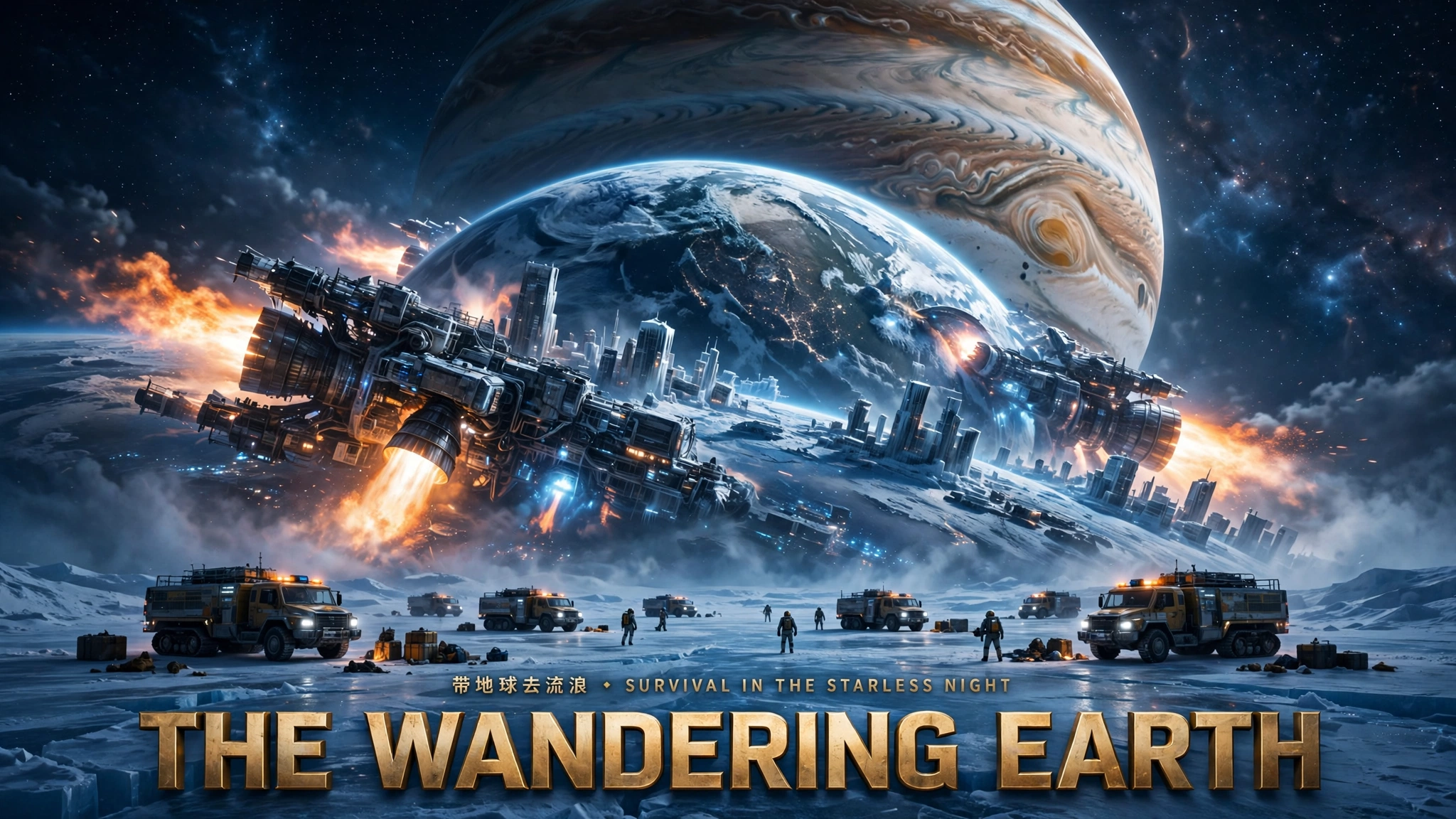
There is no modest version of this premise, and Frant Gwo’s film knows it. The sun is dying. Rather than abandon the planet, humanity builds ten thousand colossal fusion engines on its surface, stops the Earth’s rotation, and sets out to drive the entire world — cities, oceans, 3.5 billion surviving people and all — across 4.2 light-years of space to a new star, on a voyage of 2,500 years and a hundred generations. Released in China on 5 February 2019, Chinese New Year’s Day, The Wandering Earth turned that magnificent absurdity into roughly $700 million, the defining proof that a Chinese science-fiction blockbuster could stand at Hollywood scale, and an international calling card when Netflix carried it to the world.
The source is a novella by Liu Cixin, author of The Three-Body Problem, and the film preserves his signature move: an idea so large it rearranges civilisation, examined through logistics. How do you feed a planet in permanent night? What does hope mean when rescue is scheduled for your descendants’ descendants? But Gwo — credited in Chinese as Guo Fan — is not really an ideas-first director, and his film is only partly the austere hard sci-fi the premise promises. It is, at heart, a disaster movie and a family story: a rescue convoy crossing a frozen wasteland, and a father in orbit who left his son behind.
This The Wandering Earth review is honest about both halves of that bargain. The scale, the production achievement and the sincerity are real and were historic for Chinese cinema. So are the melodrama, the thin supporting characters and an ending that solves physics with sacrifice in a way that will delight half its audience and raise the other half’s eyebrows clean off. Both reactions are correct. The film is exactly as good — and as flawed — as its reputation in each direction.
| Detail | Information |
|---|---|
| Release date | 5 February 2019 (China, Chinese New Year’s Day) |
| Director | Frant Gwo |
| Writers | Gong Ge’er, Yan Dongxu, Frant Gwo, Ye Junce, Yang Zhixue, Wu Yi, Ye Ruchang; based on the novella by Liu Cixin |
| Genre | Science Fiction, Disaster, Action |
| Language | Mandarin |
| Runtime | 125 minutes |
| Budget | $50 million |
| Lead cast | Wu Jing, Qu Chuxiao, Li Guangjie, Ng Man-tat, Zhao Jinmai, Qu Jingjing |
| Our rating | 7.5/10 |
Seventeen years before the main action, as the dying sun forced humanity underground, astronaut Liu Peiqiang (Wu Jing) left his small son Liu Qi — and an infant adopted daughter, Han Duoduo — to serve aboard the international space station that navigates ahead of the wandering Earth. He promised to return when his tour ended. The tour has been extended by history, and Liu Qi (Qu Chuxiao) has grown into a resentful young man who regards his father as a deserter and a picture on a screen. Raised mainly by his grandfather Han Zi’ang (Ng Man-tat), Liu Qi steals his grandfather’s transport credentials, takes Duoduo (Zhao Jinmai) up to the frozen surface without permits — largely to spite the absent father and see the world — and is arrested in the middle of an excursion neither sibling was equipped for.
Then Jupiter intervenes. Earth’s slingshot pass by the giant planet goes wrong: Jupiter’s gravity spike drags the planet off course, shuts down engines across Asia, triggers earthquakes on a world whose crust is already stressed by the engine thrust, and puts Earth on a trajectory to be torn apart. Grandfather, grandchildren and a military rescue team under Captain Wang Lei (Li Guangjie) are swept into a desperate convoy mission — hauling a vital engine component across a ruined, minus-eighty-degree landscape of frozen seas and collapsed cities, toward an engine whose restart is one small part of a worldwide, coordinated attempt to save the planet. Above them, on the station, Liu Peiqiang faces the other half of the crisis, where the station’s governing intelligence, MOSS, is executing its own cold arithmetic about what survival requires.
How the Jupiter crisis is solved — and it involves one of the most gloriously unreasonable acts of engineering improvisation in blockbuster history — this review will not spoil, nor the fates the film assigns its family. What can be said is that Gwo structures the film as two races, one on the ice and one in orbit, that mirror each other: a son who believes his father abandoned the family, and a father who has spent seventeen years arranging, in the only ways his duty allows, not to. The planet is the biggest set in the film. The distance between those two men is its real subject.
Wu Jing as Liu Peiqiang is the film’s commercial engine as well as its emotional anchor. Wu — whose Wolf Warrior 2 was China’s biggest film ever at the time — joined this production initially for a supporting role and famously deepened his involvement as the shoot grew, and his presence gives the space-station thread its authority. His Liu Peiqiang is a study in deferred fatherhood: a man performing calm for mission control while every decision is secretly a message to a son who will not answer. Wu plays him without vanity, and the restraint pays off in a final movement that depends entirely on how much the audience has invested in this distant, dutiful father.
Qu Chuxiao as Liu Qi has the film’s least grateful part and handles it better than the script helps him to. Liu Qi is written as sullen, reckless and slow to learn — the kind of protagonist a disaster film saddles with causing half the danger — but Qu finds the wounded kid inside the resentment, particularly in his scenes with Ng Man-tat, and his gradual conversion from saboteur to someone hauling cargo beside the soldiers is the ground-level arc the film needs. Ng Man-tat as Han Zi’ang, the legendary Hong Kong character actor in one of his final major roles before his death in 2021, is quietly the best thing in the film: warm, funny, exasperated and brave, a grandfather from the old world driving a truck across the end of it, embodying everything the journey is supposed to preserve. His death-era generation’s tenderness toward the children gives the spectacle its conscience.
Zhao Jinmai as Han Duoduo, then a teenager, brings energy and heart to a role that the screenplay asks to do a great deal of moral pleading in the final act — more, in truth, than any character should have to carry in speeches. Li Guangjie as Captain Wang Lei does solid, soldierly work as the convoy’s commander, a man whose losses are stated rather than dramatised, which is the film’s character writing in miniature: almost everyone outside the central family is given one defining grief and asked to run on it for two hours. It works at disaster-movie pace. It would not survive a slower film.
The production story is now part of Chinese film history. Gwo spent years developing the film, built enormous practical sets, and at its peak employed thousands of crew — figures around 7,000 participants are commonly cited — effectively training a domestic industry in large-scale science-fiction production while making the movie. The visual effects, largely by Chinese houses with international support, number in the thousands of shots, and the best of them are genuinely spectacular: the Earth engines as cathedral-sized torches in permanent night, Jupiter filling half the sky above a frozen Shanghai, transporters as moving cities of light on the ice. The world-building texture — underground cities, New Year celebrations persisting underground, the lottery that decided who survived — is thoughtful Liu Cixin-flavoured detail, delivered in glimpses between emergencies.
Gwo directs the disaster sequences with real confidence in scale and geography: you always know where the convoy is, what has broken, and what it will cost to fix. His weakness is pacing and proportion. At 125 minutes the film is one emergency stacked directly on another with almost no air between them, and the final act asks the audience to absorb two or three climaxes’ worth of sacrifice, speeches and physics in quick succession. Some of the international-version criticism also lands fairly: character motivations are announced rather than developed, the science oscillates between researched and pure invention, and MOSS — the station intelligence, and the film’s most interesting potential antagonist — is resolved more simply than its chilling introduction promises. None of this stopped audiences, and honestly, in the cinema, scale this sincere covers many sins. But it is why the film is a landmark rather than a masterpiece.
Roc Chen’s score, with additional music by Liu Tao, supplies the full blockbuster orchestra the premise demands — heroic brass for the engines and the convoy, aching strings for the Liu family, and electronic weight for the station and MOSS. Its best quality is commitment: the music never ironises the film’s emotion, and during the Jupiter sequences it achieves the genuine, old-fashioned disaster-epic swell the images are reaching for. If the score has a fault, it shares the film’s: it rarely rests, underlining feelings the performances have already earned, and the final act’s emotional peaks are scored so continuously that the volume of feeling can tip from moving into insistent. Heard in isolation, several themes — the family motif above all — hold up as fine, sincere blockbuster writing.
What we loved:
What could be better:
Made for a reported $50 million — after a production so stretched that its star reportedly helped it over the line — The Wandering Earth opened over the fiercely competitive Chinese New Year holiday and became a phenomenon, finishing with approximately $700 million worldwide, the vast majority from China, where it stood for a time as the second-highest-grossing film in the country’s history behind only Wolf Warrior 2. Tracker totals cluster tightly around $699–701 million. Its North American release was small but historic in kind, and Netflix’s acquisition of international streaming rights made it, for millions of viewers, their first Chinese blockbuster — a soft-power milestone as much as a commercial one. The prequel, The Wandering Earth 2 (2023), confirmed the franchise’s scale, but the first film remains the breakthrough: the moment Chinese sci-fi stopped asking permission.
Yes — for the scale, the sincerity and the history, with expectations set correctly. This is not the cerebral Liu Cixin adaptation some readers dream of; it is a big, loud, wet-eyed disaster epic that happens to be carrying one of science fiction’s greatest premises. Meet it on those terms and its best sequences — the convoy under Jupiter, the grandfather on the ice, the father’s long-distance devotion — deliver exactly what they promise. Few films get to say they changed what a national cinema believed it could do. This one can, engines and all.
Our rating: 7.5/10 — an uneven, overstuffed, genuinely historic blockbuster: thin in places, thunderous where it counts.
Is The Wandering Earth based on a book?
It is loosely based on Liu Cixin’s 2000 novella of the same name. The premise — moving Earth to a new star — and the world come from Liu, but the characters, family story and Jupiter crisis plot were created and greatly expanded for the film.
Do I need to watch The Wandering Earth before The Wandering Earth 2?
No. The second film (2023) is a prequel that expands the first film’s backstory, and it works in either order, though watching this one first gives the prequel’s returning characters their full emotional weight.
How realistic is the science in The Wandering Earth?
The broad strokes — a dying sun, fusion propulsion, a Jupiter gravity assist, a 2,500-year voyage — are grounded in real concepts, generously stretched. The timescales, engine power and especially the final-act solution are blockbuster physics, not engineering proposals.
Is The Wandering Earth suitable for children?
It is an intense disaster film: mass peril, characters dying, frozen corpses and sustained danger, played seriously. Older children and teenagers who enjoy disaster epics should be fine; younger children may find the scale of death upsetting.
Where can I watch The Wandering Earth?
Netflix acquired international streaming rights and carries the film in many regions outside China, and it is widely available on home video. Availability varies by country, so check your local services.