★ LATEST REVIEWS

★★★★★ Our Rating: 9.5/10
Every art form has a work that proves scale is a lie. Children of Heaven is cinema’s exhibit A. Majid Majidi’s 1997 Iranian family drama is about a lost pair of shoes — not a fortune, not a kingdom, just one poor family’s one pair of girls’ shoes, mislaid by a nine-year-old boy on an errand — and from that almost nothing of a premise it builds ninety minutes of suspense, tenderness and moral beauty that most blockbusters never approach. It premiered at Tehran’s Fajr Film Festival in February 1997, charmed festivals around the world, and in 1998 became the first Iranian film ever nominated for the Academy Award for Best Foreign Language Film. Nearly three decades later it is shown in classrooms on every continent, and it has lost none of its power to make grown audiences cry.
This review will be direct about the film’s few limitations — it is sentimental by design, and one subplot leans on coincidence — but they are small change against what Majidi achieves here. This Children of Heaven review looks at the story, the two extraordinary child performances at its centre, and why a film made for a tiny fraction of a Hollywood catering budget still glows as it does, without spoiling its famous final movement.
| Detail | Information |
| Release date | February 1997 (Fajr Film Festival, Tehran); US release 22 January 1999 |
| Director | Majid Majidi |
| Writers | Majid Majidi |
| Genre | Family Drama |
| Language | Persian |
| Runtime | 88 minutes (some listings give 89 minutes) |
| Budget | US$180,000 (reported production estimate) |
| Lead cast | Amir Farrokh Hashemian, Bahare Seddiqi, Mohammad Amir Naji, Fereshte Sarabandi |
| Our rating | 9.5/10 |
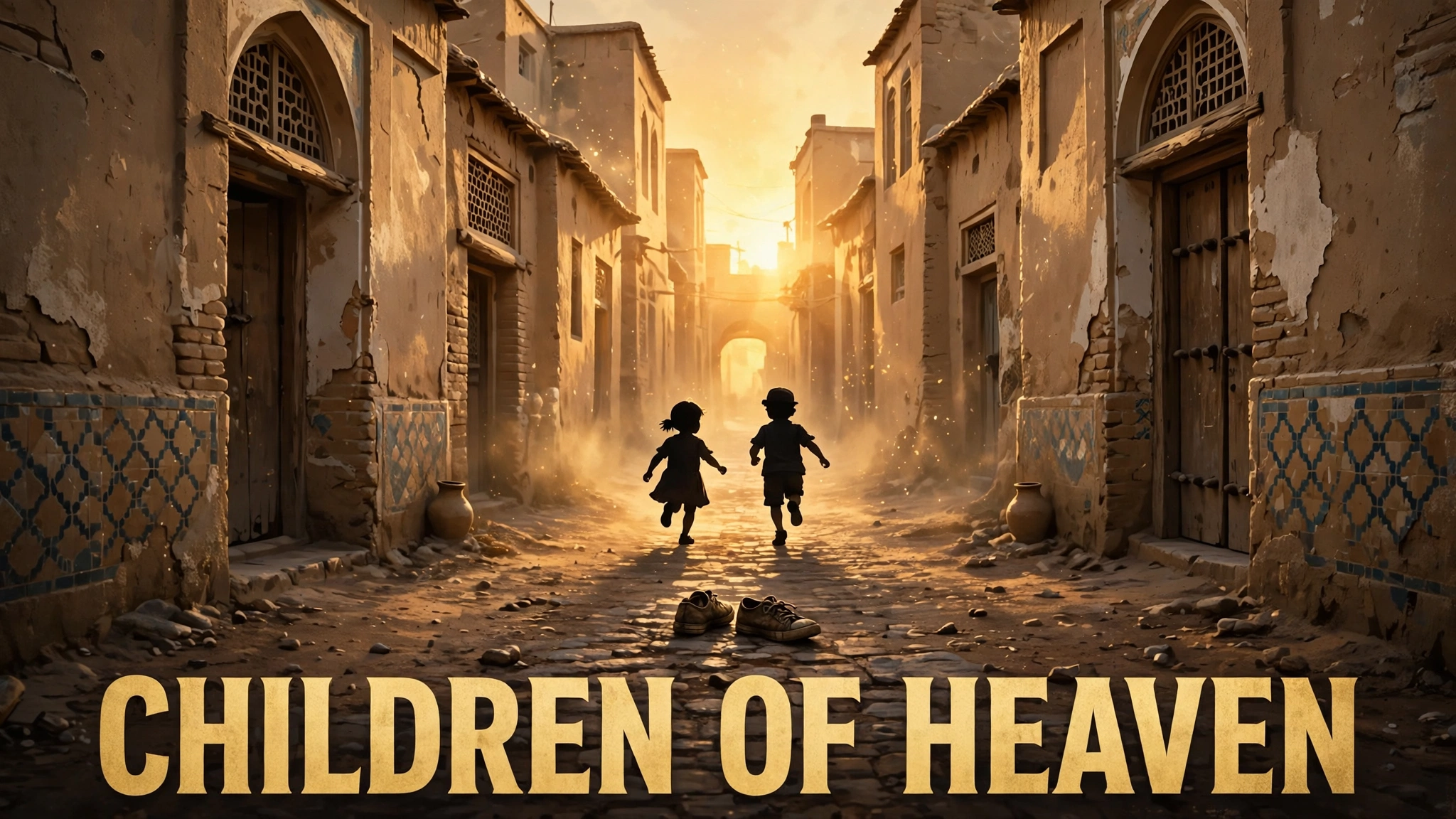
Ali (Amir Farrokh Hashemian), nine years old, is sent to collect his little sister Zahra’s (Bahare Seddiqi) shoes from the cobbler, where their one good pair has been repaired — again. On the way home, stopping for groceries his mother needs, he sets the bag down for a moment. When he turns back, the shoes are gone, gathered up unknowingly with refuse. It is a tiny accident, and in a wealthy house it would mean nothing. In Ali’s house it means everything: his father (Mohammad Amir Naji) is a labourer behind on rent and in debt to the grocer, his mother (Fereshte Sarabandi) is unwell, there is a new baby, and there is simply no money for another pair.
So the children do what children in Majidi’s films do: they absorb an adult problem in silence rather than add their trouble to their parents’ load. Zahra cannot go to school barefoot. Ali has one worn pair of sneakers. The solution the siblings devise is an arrangement of pure childhood logistics — the two will share Ali’s pair, trading them in an alley between their different school shifts, in a daily relay of swaps, sprints and near-disasters that the film turns into some of the most suspenseful sequences of the decade. Every day the exchange must happen on time; every day something — a strict teacher, a suspicious adult, the simple physics of a small girl running in shoes that must then run back — threatens the whole fragile system.
The arrangement cannot hold forever, and Ali eventually fixes on a desperate, hopeful plan involving a children’s foot race and the prize list he has seen posted for it. Where that plan leads, this review will not say. The ending of Children of Heaven is among the most discussed in modern cinema — gentle, unresolved in the way life is unresolved — and it should arrive unspoiled.
Amir Farrokh Hashemian as Ali gives one of the great child performances in film history, and its greatness lies in how little it resembles “performing.” Ali’s shame at losing the shoes, his pleading with Zahra to keep the secret, his terror of his father’s disappointment, the physical panic of the daily runs — Hashemian plays all of it with a directness adult actors train years to recover. Majidi, working in the Iranian tradition of casting non-professionals and shooting around real streets, builds the film to protect that authenticity rather than exploit it: the camera observes Ali the way a kind adult would, never pushing him toward cuteness or tears for their own sake.
Bahare Seddiqi as Zahra is his equal. Zahra is no passive victim of the plot; she is its co-conspirator and its conscience, and Seddiqi gives her a watchful intelligence — the scenes where Zahra notices something the adults around her have missed, and must decide what a good sister does with that knowledge, are the film’s quiet moral centre. The two children together achieve something rare: a screen sibling bond that feels entirely unconstructed, full of negotiation, resentment, loyalty and love in the proportions real siblings actually feel them.
Mohammad Amir Naji as the father (the actor is also widely credited as Reza Naji) is essential to why the film works. A lesser film would make him an ogre; Majidi and Naji make him a tired, proud, decent man ground down by poverty, whose sternness the children fear precisely because they know his burdens. His own subplot — seeking work, taking pride in a skill, riding a bicycle across the city from poverty toward a wealthier Tehran the film lets us glimpse — widens the story from a children’s predicament into a portrait of a whole family’s dignity. Fereshte Sarabandi completes the household as the ailing mother, warmth under strain.
Majidi directs with what looks like simplicity and is actually rigour. The film was shot in Tehran — in some of its poorer districts — and, by production accounts, shot discreetly to preserve the reality of the streets it moves through. Cinematographer Parviz Malekzaade’s camera stays at child height and child speed: the alleys, courtyards, doorways and water channels of the neighbourhood become a known world with rules and dangers, and the famous relay sequences are edited by Hassan Hassandoost into pure kinetic suspense without a single artificial device. No villain, no score-driven manipulation — just a small girl running, and everything that depends on her arriving.
The craft choice that defines the film is restraint. Majidi refuses melodrama’s usual machinery: there are no speeches about poverty, no cruelty staged for outrage, no poverty tourism. The family’s hardship is rendered in objects — sugar to be broken up for the mosque, a pen that matters, a bicycle, shoes — and the film trusts the audience to feel the weight of things. If the film has a technical limitation, it is the modesty of its means: the image is unpolished by design and by budget, and a subplot detour involving the father’s search for gardening work resolves with a convenience the rest of the film mostly avoids. But these are the textures of a film made for a reported US$180,000; the miracle is how completely the direction makes the budget irrelevant.
Comparisons made at the time to Vittorio De Sica’s Bicycle Thieves were apt and remain so: like that film, Children of Heaven understands that for the poor, a small object is never a small thing, because everything is riding on it.
Kayvan Jahanshahi’s score is a model of proportion. Iranian cinema of this period rarely wallpapers a film with music, and here the score enters sparingly — gentle, melodic phrases that lift the children’s sequences and underline the film’s lyricism without instructing the audience to weep. Much of the film’s emotional work is done by sound itself: footsteps on stone, water in the channels, the breath of a running child. The famous later passages of the film achieve their effect with remarkably little musical help, which is precisely why they work; Majidi trusts the images, the children and the silence between them. If you are accustomed to scores that announce every feeling, this film’s quiet will recalibrate you — and its restraint makes the few full musical moments feel earned.
What we loved:
What could be better:
Iranian box-office data from the 1990s is sparse, and this review will not invent a domestic total that no reliable source records. What is documented is the film’s international journey, and it is remarkable for a production of this size. Made for a reported US$180,000, the film went on to gross about US$1.6 million worldwide in tracked releases — roughly nine times its production cost — with the majority of its American earnings, tracked at just over US$933,000 in the United States, arriving after its Oscar nomination was announced and Miramax took it into US cinemas from January 1999. Trackers differ in their fragments — some databases record only partial totals — so US$1.6 million should be read as the commonly documented worldwide figure, not an audit of every territory.
The honours, which are fully documented, matter more than the money. At home, the film won major awards at the Fajr Film Festival, including Best Film, Best Director, Best Screenplay and Best Editing. It won four awards at the Montreal World Film Festival, the Best Asian Feature award in Singapore and an audience award in Warsaw. And in 1998 it made history as the first Iranian film nominated for the Academy Award for Best Foreign Language Film, losing to Roberto Benigni’s Life Is Beautiful — a defeat that, in retrospect, says more about that year’s sentiment than about the two films’ relative permanence in world cinema. The nomination changed Iranian cinema’s global position permanently: after Children of Heaven, the world’s festivals and distributors were watching.
Yes — without reservation, and with your family if you have one old enough to read subtitles or follow a simple story told beautifully. This is that rare film that is simultaneously a masterpiece of its national cinema and a perfect first subtitled film for a young viewer: its stakes are small enough for a child to grasp and deep enough for an adult to drown in. If you have ever wondered whether cinema needs scale to move you, give Majidi ninety minutes and one pair of shoes to prove otherwise.
Our rating: 9.5/10 — a perfect miniature: two children, one secret, and a director who understood that dignity, not misery, is poverty’s most moving story.
Was Children of Heaven really nominated for an Oscar? Yes. It was nominated for Best Foreign Language Film at the Academy Awards for 1997 films (ceremony held in 1998) — the first Iranian film ever nominated in the category. It lost to Italy’s Life Is Beautiful.
Is Children of Heaven suitable for children? Emphatically yes — Roger Ebert called it “very nearly a perfect movie for children,” and it carries a PG rating in the US. Its themes of poverty and responsibility are handled gently, and children worldwide respond to Ali and Zahra as peers, not as subjects of a lesson.
Is Children of Heaven based on a true story? No. It is an original screenplay by Majid Majidi, though it is rooted in the real social texture of 1990s Tehran and shot in real neighbourhoods with largely non-professional child leads, which gives it its documentary-like truthfulness.
How much did Children of Heaven make at the box office? Its documented worldwide tracked gross is about US$1.6 million, against a reported production cost of about US$180,000. Iranian domestic figures from the era are not reliably recorded, so the film’s true total, including its long festival and educational life, is certainly higher than any single tracker shows.
Where can I watch Children of Heaven? It is widely available on streaming services carrying classic world cinema and on DVD and Blu-ray, often through Miramax-catalogue outlets. Availability varies by region, so check your local services — it is also a staple of school and library collections.