★ LATEST REVIEWS

Our Rating: ★★★★☆ 8/10
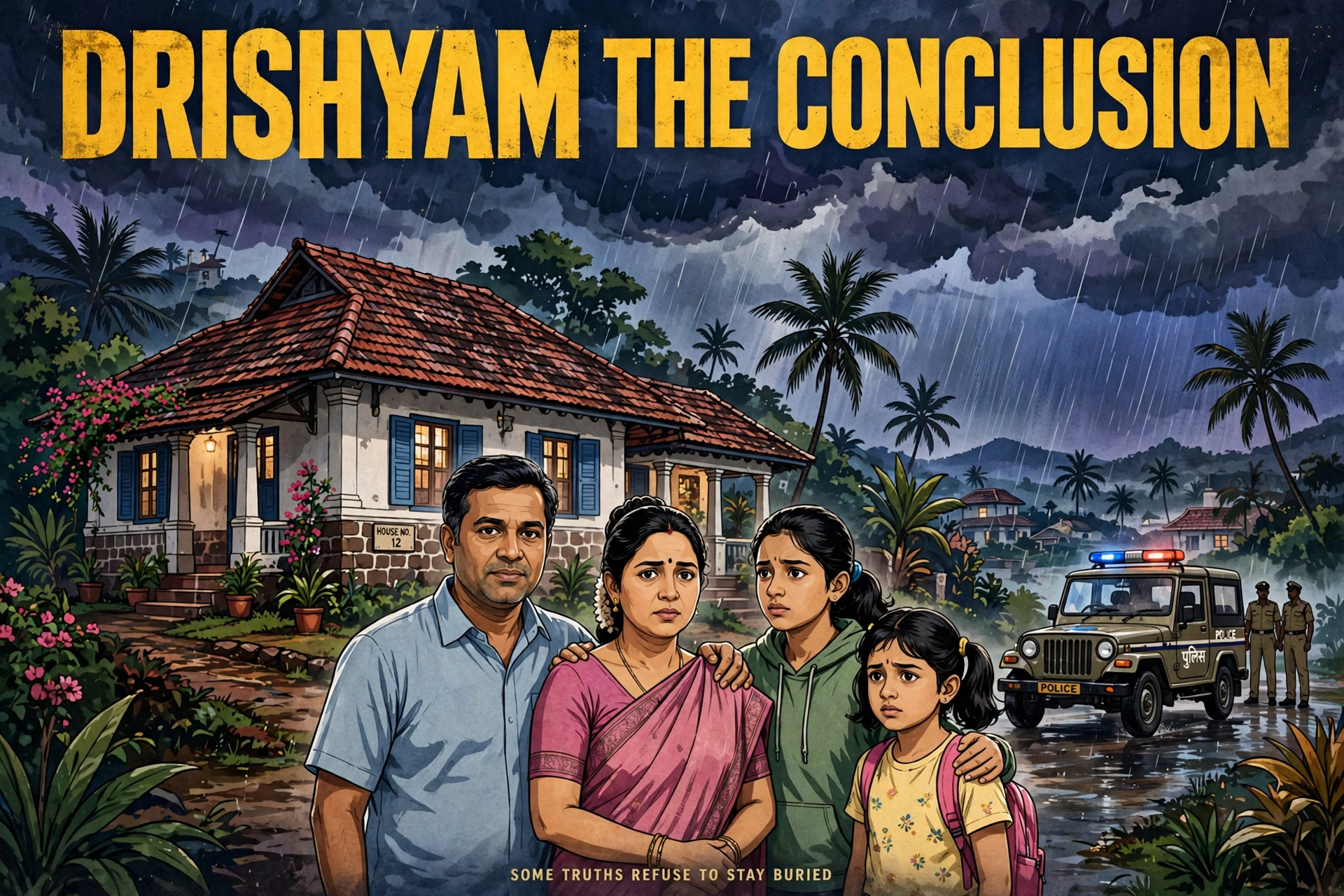
Eleven years after a cable operator from Goa first taught Indian audiences to fear October 2nd, the Hindi Drishyam story has reached its end. Drishyam: The Conclusion brings Ajay Devgn’s Vijay Salgaonkar back for one final battle of wits, this time against a formidable new Crime Branch officer played by Jaideep Ahlawat, with Tabu’s Meera Deshmukh still determined to find answers about her son. Directed by Abhishek Pathak, who also helmed Drishyam 2, the film takes an original Hindi path rather than following the Malayalam series, and it delivers what this franchise has always promised: a tense, twist-laden thriller built on one ordinary man’s extraordinary mind.
It is not a perfect finale. Some of its cleverness leans on convenience, and the family warmth that made the first film so special is thinner here. But as a piece of popular suspense entertainment, it works — and its extraordinary box office run suggests audiences agree.
| Detail | Information |
|---|---|
| Release date | 2 October 2026 (India) |
| Director | Abhishek Pathak |
| Writers | Abhishek Pathak, Aamil Keeyan Khan, Parveez Shaikh |
| Genre | Crime, Thriller, Mystery |
| Language | Hindi |
| Runtime | About 150 minutes (some listings give up to 170 minutes) |
| Lead cast | Ajay Devgn, Tabu, Jaideep Ahlawat, Shriya Saran, Prakash Raj, Rajat Kapoor, Ishita Dutta, Mrunal Jadhav |
| Our rating | 8/10 |
Years have passed since the events of the earlier films, and Vijay Salgaonkar and his family are trying to live quiet, ordinary lives. That peace does not last. Meera Deshmukh, still driven by the loss of her son, refuses to let the case rest, and a new Crime Branch officer — SP Rajveer Singh Tomar, played by Jaideep Ahlawat — reopens the investigation with a different, more methodical approach. The pressure builds on Vijay, his wife Nandini and their daughters, as old allies come under scrutiny and the story moves toward a courtroom confrontation.
This review will not reveal the film’s twists, which are its main currency. What can be said is that the film stays true to the franchise’s formula: Vijay’s weapon is not violence but planning, patience and an understanding of how people think. The pleasures here are the pleasures of watching a smart man stay one step ahead — and wondering, as the net tightens, whether this time he has finally met someone smarter.
One significant choice deserves praise: rather than adapting a Malayalam original, the Hindi series has written its own conclusion. That gives the film freedom, and it uses it, staging a finale that belongs to this version of the characters. Fans of the franchise will appreciate how much of the film’s humour and tension comes from self-awareness — including a fond nod to the series’ own mythology around October 2nd, pav bhaji and satsangs, courtesy of the returning Inspector Gaitonde.
Ajay Devgn as Vijay Salgaonkar — Devgn has played Vijay three times now, and his performance here is a masterclass in restraint. Vijay’s genius has always been his ordinariness: a man who looks like nobody and thinks like a chess master. Devgn plays him with minimal fuss — a steady gaze, a measured voice, a mind visibly working behind a calm face. It is the kind of star performance that trusts the audience to pay attention, and it remains the franchise’s anchor.
Jaideep Ahlawat as the new investigator — Ahlawat is the film’s great addition. His officer is sharp, energetic and genuinely threatening — a worthy adversary rather than a cardboard policeman — and the face-offs between him and Devgn are the film’s highlights. Several critics singled out their cat-and-mouse dynamic as the best thing in the film, and they are right: when these two actors share a scene, the film is at its best.
Tabu, Shriya Saran and the supporting cast — Tabu returns as Meera Deshmukh with her customary authority; her grief and determination give the film its emotional spine, even when the screenplay sidelines her for stretches. Prakash Raj and Rajat Kapoor add gravitas, and Kamlesh Sawant’s Gaitonde provides welcome humour. The honest caveat, noted by several critics, is that Shriya Saran and the daughters have far less to do this time — the film’s focus on the thriller machinery comes at the cost of the family life that made the original so affecting. Vijay the family man is missed here.
Abhishek Pathak directs with confidence and clarity. The film is built on slow pressure rather than action: scenes of questioning, watching and waiting, edited to keep the audience guessing. The cinematography supports the serious, grounded tone, and the background score adds urgency to the key confrontations — though, as one prominent critic noted, it occasionally gets too loud for its own good.
The screenplay’s strength is its structure. It understands that Drishyam works on anticipation: the audience knows Vijay is planning something, and the fun is in not knowing what. The weakness, also widely noted, is that some of the final explanations require the audience to simply go along with them. The meticulous, airtight logic of the first film’s famous alibi is replaced here by developments that feel more convenient than earned. The climax, too, divides opinion: some viewers found it satisfying, others anticlimactic after such a long build-up. This review leans toward the former — the journey grips even when the destination wobbles — but the criticism is fair.
The film’s length is another point of honest disagreement. At roughly two and a half hours, it is a substantial sit, and some critics felt the middle section sags and the final stretch could have been tighter. Others found the pace brisk throughout. Your mileage may vary, but the film never feels padded with irrelevant subplots; it stays focused on its central conflict.
Drishyam has never been a musical franchise, and this instalment follows suit: the score is functional and atmospheric rather than memorable, designed to tighten tension rather than produce hit songs. That is the right choice for this material. The sound design in the interrogation and courtroom scenes does much of the heavy lifting, and it does it well.
What we loved:
What could be better:
The commercial story here is extraordinary, and it must be reported with the right caveats. Indian box office reporting relies on trade trackers, principally Sacnilk, whose figures are estimates rather than audited studio accounts — and different outlets report slightly different totals on the same day. With that caveat stated plainly, the trajectory is consistent across sources: Drishyam: The Conclusion opened on the Gandhi Jayanti holiday, 2 October 2026, to a massive response, crossed ₹300 crore worldwide within days, and kept climbing.
By its fourth weekend (26 October 2026), trade reports put its worldwide gross in the range of roughly ₹550–575 crore, with India net collections of roughly ₹360–370 crore — making it the highest-grossing film of Ajay Devgn’s career, ahead of Tanhaji: The Unsung Warrior, and one of the top worldwide grossers of 2026. The film was still running in cinemas at the time of writing, so these figures will rise further; treat any single figure you see online as a snapshot from a particular day, not a final total.
Yes. Drishyam: The Conclusion is a gripping, largely satisfying finale that understands exactly what its audience wants: tension, twists, and two superb actors circling each other. It is not as emotionally rich as the original, and its cleverness is not always airtight, but as a farewell to one of Hindi cinema’s most beloved characters, it earns its applause — and its record-breaking run.
Our rating: 8/10 — A tense, crowd-pleasing finale with a superb central duel, even if some of its tricks lean on convenience.
Is Drishyam: The Conclusion the last Drishyam film?
It is presented as the conclusion of the Hindi franchise’s story, though the ending leaves some room for speculation. The makers have positioned it as the finale.
Do I need to watch Drishyam and Drishyam 2 first?
Strongly recommended. The finale builds directly on both earlier films, and much of its tension depends on knowing what Vijay and Meera have already been through.
Who is the new villain in Drishyam: The Conclusion?
Jaideep Ahlawat plays a new Crime Branch officer who reopens the case against Vijay Salgaonkar, with Tabu’s Meera Deshmukh also returning as a driving force.
Is Drishyam: The Conclusion a remake of the Malayalam Drishyam 3?
No. The Hindi film follows an original storyline written for this franchise, separate from the Malayalam series.
How much has Drishyam: The Conclusion earned?
Trade estimates (principally Sacnilk) put its worldwide gross at roughly ₹550–575 crore by late October 2026, still rising; these are tracker estimates, not audited studio figures.