★ LATEST REVIEWS

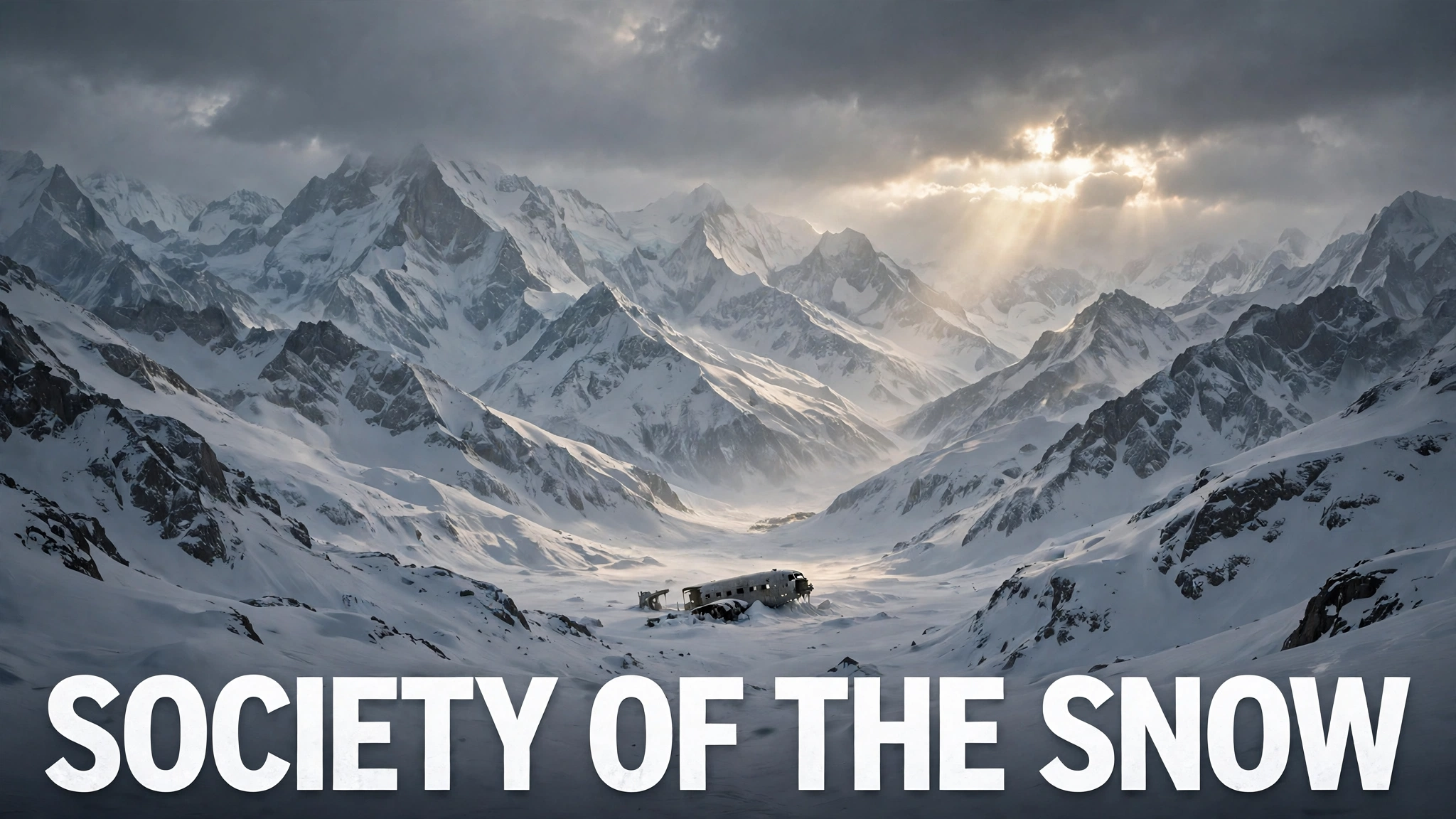
Our Rating: ★★★★★ 9/10
Some true stories have been filmed more than once, and the question for any new version is simple: what can it say that the earlier films could not? The crash of Uruguayan Air Force Flight 571 in the Andes in October 1972 — a plane carrying a young rugby team, their friends and family, that came down on a glacier and left its survivors stranded for more than two months in one of the most hostile places on earth — had already produced the 1993 Hollywood film Alive. J. A. Bayona’s Society of the Snow, a Spanish-language Netflix production that closed the Venice Film Festival in 2023 and won twelve Goya Awards including Best Picture and Best Director, answers the question completely. This is the same events told from inside the group, in their own language, with the dead honoured as carefully as the living.
A note on respect is necessary before anything else, because this Society of the Snow review is about a film built on real suffering. Twenty-nine people died in the crash and its aftermath; sixteen survived. Families still live with this story. Bayona worked from Pablo Vierci’s book La sociedad de la nieve, recorded extensive interviews with the surviving passengers, and involved survivors and victims’ families throughout. The result is a survival film that refuses spectacle for its own sake — and is more powerful, scene for scene, than almost any disaster movie of recent years.
| Detail | Information |
|---|---|
| Release date | 15 December 2023 (Spain, theatrical); premiered 9 September 2023 at Venice; on Netflix 4 January 2024 |
| Director | J. A. Bayona |
| Writers | J. A. Bayona, Bernat Vilaplana, Jaime Marques, Nicolás Casariego (based on the book by Pablo Vierci) |
| Genre | Survival, Drama |
| Language | Spanish |
| Runtime | 144 minutes |
| Budget | €60 million (approx. $65 million; see Box Office note) |
| Lead cast | Enzo Vogrincic, Matías Recalt, Agustín Pardella, Esteban Bigliardi, Diego Vegezzi |
| Our rating | 9/10 |
On 13 October 1972, Flight 571, chartered to carry the Old Christians rugby team from Montevideo to a match in Santiago, crashes into a glacier high in the Andes after a navigational error in appalling weather. Of the 45 people on board, 29 survive the impact — many of them badly injured, none of them equipped for the cold, the altitude or the weeks ahead. They shelter in the broken fuselage, ration what little food the plane carried, melt snow for water, and listen to a small radio for news of a rescue that, unknown to them at first, the outside world eventually calls off.
The film follows what happened next without flinching and without sensationalism: the deaths that follow from injury and exposure, an avalanche that changes everything in a single night, and the agonising decision the survivors are eventually forced into to stay alive — a decision the film presents as a communal, almost sacred pact rather than a horror-movie shock. At the centre of the telling is Numa Turcatti, a young law student who was not a member of the rugby team, whose voice and fate give the film its moral shape. Bayona’s crucial choice is to narrate this as the story of a society — the title is the thesis — a group of young men who survive, in the end, because they organise, share, grieve and carry one another rather than compete.
Because this is a matter of historical record, the broad outcome is no secret, and we will not pretend otherwise. What we will not do is walk through who lives and who dies in sequence, or describe the film’s final passages in detail: the emotional force of the film depends on experiencing those moments with the people on screen, several of whom did not come home, and every one of whom deserves better than a plot summary.
Bayona cast Uruguayan and Argentine actors, most of them newcomers, and the decision pays off everywhere. There are no stars here to pull you out of 1972; there are only young men growing thinner, weaker and more determined in front of you. The cast famously lost significant weight across a chronological shoot, and the physical transformation is not a stunt — it is the film’s clock, written on their faces.
Enzo Vogrincic as Numa Turcatti is the film’s soul. Numa is an outsider among teammates, a quiet, reflective young man, and Vogrincic plays him with a stillness that grows more powerful as his circumstances worsen. The film’s narration rests on him, and a letter he leaves behind provides some of the most moving passages in any film of 2023. Matías Recalt as Roberto Canessa, the intense, pragmatic medical student who becomes one of the group’s driving wills, won the Goya Award for Best New Actor; his Canessa is argumentative, tireless and incapable of surrender, and the film is honest about how difficult such a person can be to live beside. Agustín Pardella as Nando Parrado gives the film much of its grief — Parrado lost his mother and sister in the disaster — and Pardella plays that loss not as breakdown but as fuel, a man converting pain into the single-mindedness the group eventually needs.
Around them, the ensemble builds a true society rather than a queue of supporting parts: Esteban Bigliardi as Javier Methol, travelling with his wife Liliana, brings an older man’s tenderness to the group; the Strauch cousins, played by Esteban Kukuriczka, Francisco Romero and Rafael Federman, become the group’s organisers and provision-keepers; and Diego Vegezzi as team captain Marcelo Pérez del Castillo embodies the leadership the team brought with it onto the mountain. Nobody grandstands. That restraint is the film’s tribute to its subjects.
Bayona has been building towards this film his whole career — the waterlogged terror of The Impossible, the gothic grief of The Orphanage (also reviewed in this batch) — and Society of the Snow is his most complete work. The crash sequence itself is almost unbearable: shot and edited for physical truth rather than blockbuster exhilaration, it is the standard against which such scenes will now be measured. The production filmed largely in Spain’s Sierra Nevada, using three fuselage replicas, real altitude locations and second-unit photography of the actual Andes, with around 300 production workers across units and a shoot of well over 100 days. Cinematographer Pedro Luque — who won the Goya — keeps the palette locked in whites, greys and frozen blues, so that beauty and lethality are the same image: this landscape looks like heaven and behaves like an executioner, and the film never lets you forget either fact.
The technical craft extends to the unglamorous details that sell survival: prosthetic work by the Oscar-winning team behind Pan’s Labyrinth‘s effects tradition, sound design that makes wind a character and silence a threat, and editing by Jaume Martí and Andrés Gil that holds on faces long after a lesser film would cut away. If there is a criticism, it is length: at 144 minutes, the middle passages of endurance necessarily repeat some beats of waiting, cold and hunger. But endurance is the subject, and the repetition is honest rather than lazy. You are meant to feel time the way they felt it.
Michael Giacchino’s score won the Goya Award for Best Original Score, and it is some of the composer’s finest work — notably because of what it refuses to do. There is no adventure-movie triumphalism here, no heroic brass telling you survival is glorious. Giacchino writes instead for the film’s spiritual register: hushed, aching string writing, choral textures that feel like breath in cold air, and themes that gather weight as the group’s bond deepens. The music treats the dead with the same tenderness as the living, which is the film’s whole moral position expressed in sound.
The sound world around the score matters just as much. The crack and roar of the avalanche, the constant scouring wind, the terrible quiet inside the fuselage at night — the film’s sound team, also Goya-honoured, builds an Andes you hear in your chest. When music does swell, late in the film, it has been earned by two hours of restraint, and the effect is overwhelming rather than manipulative.
What we loved:
What could be better:
This section needs to be straightforward, because the usual box-office story does not exist here and any review pretending otherwise would be inventing numbers. Society of the Snow was produced for Netflix, with a budget reported at €60 million (about $65 million); some production reporting describes total costs running somewhat higher, so treat that figure as the widely cited production budget rather than an audited final account. It received limited, awards-qualifying theatrical releases — in Uruguay from 13 December 2023, in Spain from 15 December 2023 through Tripictures, and in the United States from 22 December 2023 — before arriving on Netflix worldwide on 4 January 2024. Those cinema runs were brief and partial, and no meaningful worldwide theatrical total was ever published; the tiny figures that appear in some databases reflect only fragmentary tracked screenings, not the film’s real audience, and should not be quoted as a box-office gross.
The audience it actually found was on streaming, and it was enormous: Netflix viewing figures reported around the release put it at roughly 51 million views in its first 11 days on the platform, and about 103 million views by the end of June 2024, making it one of Netflix’s most-watched films of that period and one of the most-watched non-English films in the service’s history. Its honours matched its reach: twelve Goya Awards from thirteen nominations — the third-highest haul in Goya history — including Best Film and Best Director, six Platino Awards, and two Academy Award nominations, for Best International Feature Film (as Spain’s entry) and Best Makeup and Hairstyling. For a Spanish-language film about real loss, made largely with unknown actors, that is a legacy no box-office chart could improve on.
Yes — once, completely, with your full attention, and not as background viewing. Society of the Snow is the rare survival epic that leaves you thinking less about death than about what people owe one another: the survivors of Flight 571 have spent fifty years saying that what saved them was each other, and this film finally makes a global audience understand exactly what they mean. It is harrowing, beautiful and made with uncommon decency. Watch it, and then sit quietly for a minute before you do anything else. That silence is part of the film too.
Our rating: 9/10 — Bayona’s masterpiece: a survival story told with mastery, humility and love for everyone who was on that mountain.
Is Society of the Snow based on a true story?
Yes. It dramatises the crash of Uruguayan Air Force Flight 571 in the Andes on 13 October 1972 and the survivors’ 72 days in the mountains. It is based on Pablo Vierci’s book of the same name, and the production worked closely with survivors and with victims’ families.
How is Society of the Snow different from Alive (1993)?
Alive was an English-language Hollywood production based on a different book, told largely through a few lead characters. Society of the Snow is in Spanish, uses Uruguayan and Argentine actors, draws on Vierci’s account, and centres the whole group — including passengers who did not survive — rather than a handful of heroes.
Why is there no big box-office figure for Society of the Snow?
Because it is a Netflix film. It had only limited theatrical releases in a few countries before streaming globally on 4 January 2024, so its audience is measured in Netflix views — roughly 103 million by mid-2024 — not ticket sales.
Did Society of the Snow win any major awards?
Yes. It won twelve Goya Awards including Best Film and Best Director, and was nominated for two Academy Awards: Best International Feature Film and Best Makeup and Hairstyling.
Is Society of the Snow difficult to watch?
Parts of it are intense and upsetting — the crash, injuries and deaths are depicted realistically, and the survivors’ hardest decision is handled frankly, though never exploitatively. It is rated R and is best approached as a serious drama, not a thriller for a casual evening.