★ LATEST REVIEWS

Our Rating: ★★★★☆ 8.5/10
Sequels to beloved thrillers usually fail in one of two ways: they repeat the original and feel like a photocopy, or they escalate so wildly that they betray what made the first film believable. Drishyam 2, released directly on Amazon Prime Video on 19 February 2021, avoids both traps — and that is a minor miracle. Jeethu Joseph’s follow-up to his 2013 landmark does not try to out-twist its predecessor for the first two hours at all. Instead, it asks a quieter, harder question: what does it cost a family to win the way Georgekutty’s family won? Only once it has earned your patience does it remind you, in its final movement, that this director still knows how to pull a floor out from under an audience.
A quick note on spoilers, because this film demands one. Our own review of the first Drishyam is already in this bank, and this review is designed to stand on its own — but the sequel’s very premise grows out of the first film’s events, so a small amount of first-film context is unavoidable. We have kept it to the premise alone: a young man went missing, a family became suspects, and no charge ever stuck. Nothing about how either film ends is revealed here.
This review covers the story spoiler-free, the performances old and new, the craft of a film shot quickly under pandemic restrictions, and the unusual release story of a major sequel that never opened in cinemas at all — plus an honest look at a first hour that deliberately tests your patience.
| Detail | Information |
|---|---|
| Release date | 19 February 2021 (Amazon Prime Video) |
| Director | Jeethu Joseph |
| Writers | Jeethu Joseph |
| Genre | Crime, Drama, Thriller |
| Language | Malayalam |
| Runtime | 153 minutes |
| Budget | Approx. ₹20 crore (reported) |
| Lead cast | Mohanlal, Meena, Ansiba Hassan, Esther Anil, Murali Gopy, Asha Sharath, Siddique |
| Our rating | 8.5/10 |
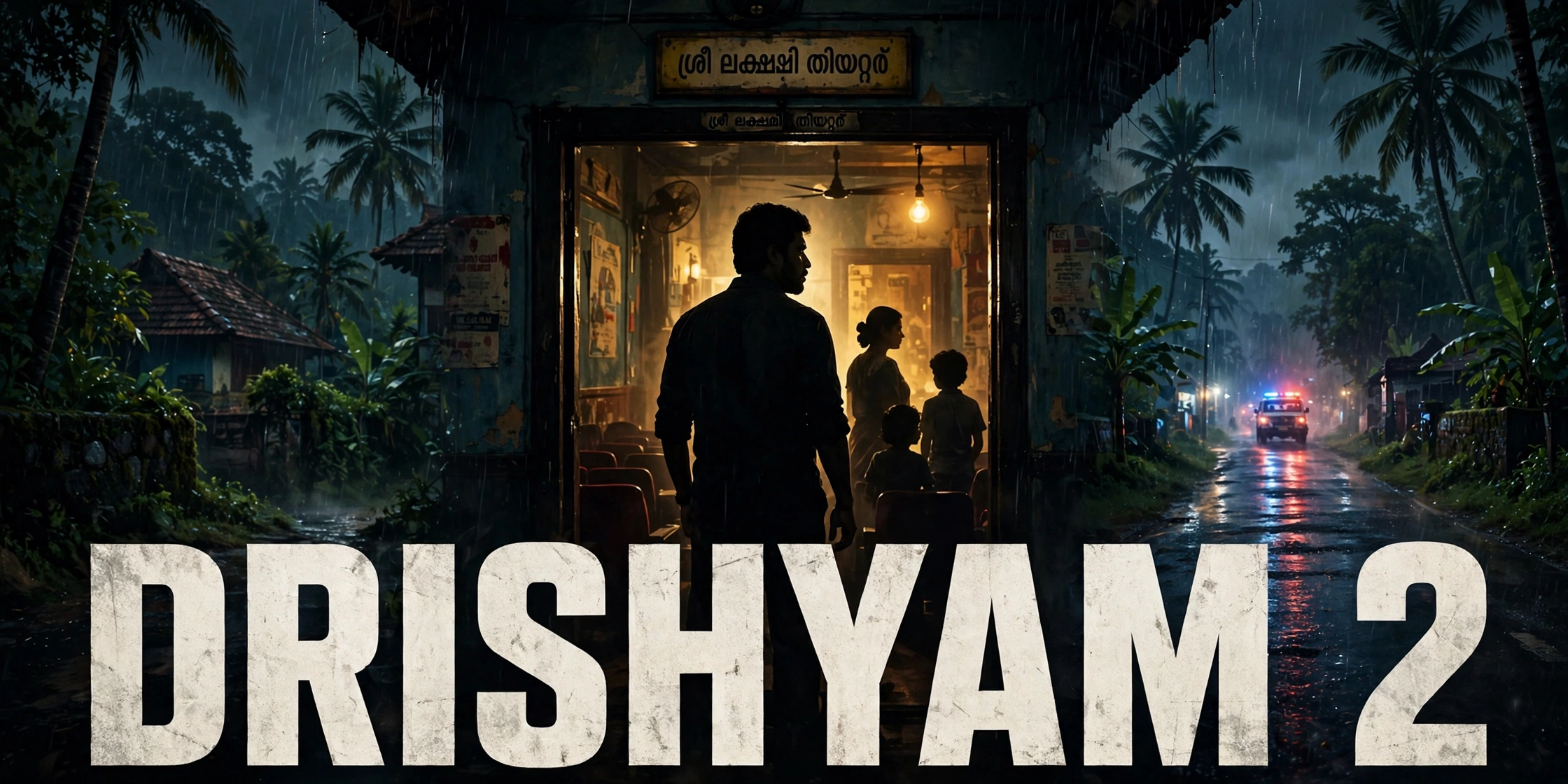
Several years have passed. Georgekutty (Mohanlal), once a frugal cable-TV operator, is now a prosperous man: he owns a cinema theatre, moves in more comfortable circles, and nurses a cherished ambition to produce a film of his own one day. On the surface, it is the classic story of a self-made man rewarded. Underneath, nothing in the house has healed. The events surrounding the disappearance of Varun Prabhakar — the son of a senior police officer, whose case once consumed this family — still govern their lives. His elder daughter lives with lasting psychological trauma from that period. His wife Rani (Meena) carries a constant, corroding anxiety. The town, meanwhile, has never stopped whispering, because in a small town an unsolved case is never really closed; it is merely waiting.
The police have not forgotten either. A new Inspector General, Thomas Bastin (Murali Gopy), quietly reopens the case at the urging of Varun’s parents, and this time the state’s approach is different: slower, more patient, and built on watching rather than raiding. New people enter the family’s orbit. A man from the past, carrying a fragment of memory from the night everything happened, begins to understand what his fragment might be worth. And Georgekutty — older, richer, apparently softer — must work out whether the defences he built years ago can hold against an investigation that has had years to study his methods, mounted this time by an opponent who respects how clever he is.
To go further would be to start dismantling the film’s carefully laid machinery, so we will stop there. What can be said safely is this: the sequel’s tension does not come from whether the family is guilty — the audience knows far more than the police do — but from watching two patient intelligences circle each other, and from the film’s recurring insistence that Georgekutty’s cleverness, however dazzling, has left real wounds in the people he was protecting. The final act reframes much of what you have watched, and it does so in a way that provoked the same stunned-silence reaction the first film’s ending did — no small feat for a sequel released straight to people’s living rooms.
Mohanlal as Georgekutty had the harder assignment this time: not to repeat a famous performance, but to age it. His Georgekutty here is heavier in every sense — more prosperous, more tired, and visibly carrying the years of vigilance. Mohanlal plays him with the same minimalism as before, but the calculation now shares space with guilt and a father’s sorrow at what protection has cost his children. Watch how he listens in this film: entire scenes turn on Georgekutty absorbing information a half-second before he permits himself to react. It is a quieter performance than the original’s, and in some ways a sadder and richer one.
Meena as Rani is given the sequel’s most painful material and rises to it completely. Rani’s fragility was the first film’s pressure point; here, Meena shows what years of that pressure do to a person — the protectiveness, the loneliness, the need to talk to someone, anyone, about the weight the family carries in silence. Her warmth with a new neighbour becomes one of the film’s most quietly devastating threads, and Meena makes every step of it believable. Ansiba Hassan as Anju portrays trauma without melodrama, while Esther Anil as Anu, now older, brings a steadier, more watchful presence to the younger daughter.
The new and returning antagonists are superbly cast. Murali Gopy as IG Thomas Bastin is the sequel’s masterstroke: an investigator who is neither corrupt nor cruel, but methodical, self-aware and quietly certain — a worthy mind across the board, which makes him far more frightening than a shouting villain would be. Asha Sharath as Geetha Prabhakar returns with her grief hardened into something more complicated, and her scenes with Siddique as Prabhakar give the film its moral counterweight: whatever Georgekutty protected, these two people lost. Saikumar brings warmth and literary ease to a small but significant role as a writer who crosses Georgekutty’s path, and the supporting ensemble around Thodupuzha once again makes the town feel populated rather than plotted.
Jeethu Joseph reportedly wrote this script during the pandemic pause that stalled his other project, and the film was shot in just 46 days, from late September to early November 2020, under strict COVID protocols, in and around Thodupuzha and Kochi — including the same house and street locations as the first film, renovated to reflect the family’s changed fortunes. That speed and economy are visible, occasionally as limitation but more often as discipline. There is nothing here the story does not need.
The direction’s boldest choice is patience. The first hour is, deliberately, almost a family drama with a thriller buried inside it: business ambitions, neighbourhood friendships, old gossip resurfacing, a daughter’s treatment, a wife’s unease. Some viewers, primed by the first film’s cat-and-mouse structure, found this slow. It is better understood as the sequel changing the source of dread — from procedure to consequence. When the investigation does tighten, every relaxed early scene retroactively becomes evidence, atmosphere or threat, which is precisely the first film’s method applied at a slower burn. Satheesh Kurup’s cinematography keeps the high-range locations handsome but ordinary, refusing glamour, and V. S. Vinayak’s editing handles the final act’s layered revelations with clarity — the audience is surprised, never confused. If there is a craft criticism, it is that a couple of expository passages in the middle explain the family’s situation more fully than the performances already have, and the film briefly tells us what it has already shown us.
Anil Johnson returns as composer, and his work here is an exercise in restraint appropriate to a sequel about aftermath. The film has only one song, “Ore Pakal”, sung by Zonobia Safar, and it functions as emotional shading rather than interruption. The background score does the heavy lifting: familiar tonal colours from the first film return in subdued form, strings and silence are used to stretch the interrogation and surveillance passages, and Johnson resists underlining the climax’s revelations with melodrama. The score trusts the writing. In a thriller whose biggest weapon is withheld information, that trust is the right call, and it is a large part of why the final half-hour plays with such accumulating pressure at home, on a television, without a cinema crowd to amplify it.
What we loved:
What could be better:
There is no conventional box office story here, and this review will not invent one. Drishyam 2 was originally planned for theatres, but with Kerala’s cinemas closed and their reopening entangled in industry disputes during the pandemic, the producers chose a direct digital premiere on Amazon Prime Video, where it released worldwide on 19 February 2021 in over 240 countries. A theatrical gross therefore does not exist.
What circulates instead are business figures from press and trade reporting, and they should be read as estimates, not audited results. The budget is commonly reported at around ₹20 crore — that is the figure carried in the Quick Facts table above, flagged as reported rather than officially confirmed. Contemporary trade reports, notably Filmibeat’s March 2021 account, put the film’s total earnings at roughly ₹40 crore, built from reported digital rights of about ₹25 crore and satellite rights of about ₹15 crore, and described the film on that basis as highly profitable for its producers. Those are reported deal values from entertainment-press coverage, not independently verified accounts, and later retellings sometimes blur them into a “box office collection” the film never had. The honest summary is simpler: by landing a premium streaming premiere at the height of pandemic closures, the sequel reached a global audience instantly, became one of the most talked-about Indian streaming releases of its year, and its success story is measured in reach and reputation rather than ticket stubs. Theatre owners in Kerala, it should be noted, publicly criticised the decision at the time — a debate about the future of Malayalam cinema that this film, willingly or not, came to symbolise.
Yes — and watch the original first if you possibly can, because the sequel’s emotional weight depends on knowing this family before prosperity and time changed them. Seen in sequence, Drishyam 2 is that rarest of things: a follow-up that deepens its predecessor, honours its audience’s memory, and still manages to outmanoeuvre that audience in the final stretch. Its first hour asks for the patience the first film also asked for; its last rewards it almost as richly. For Mohanlal’s admirers, it is essential. For thriller lovers, it is proof that a sequel built on consequence can be as gripping as one built on novelty.
Our rating: 8.5/10 — a patient, intelligent and quietly devastating sequel that earns its place beside one of Indian cinema’s most beloved thrillers.
Do I need to watch Drishyam (2013) before Drishyam 2?
Yes, strongly recommended. The sequel is a direct continuation with the same family, the same town and the same unresolved case. It can be followed alone, but its emotional and narrative power depends on the first film.
Is Drishyam 2 a theatrical film or a streaming release?
It premiered directly on Amazon Prime Video on 19 February 2021, after the producers abandoned theatrical plans during the pandemic — so it has no theatrical box office gross.
Does this review spoil the first film’s ending?
No. We discuss only the shared premise — a disappearance, a family under suspicion, no conviction — and nothing about how either film resolves. Watch both in order, unspoiled, for the full effect.
Is Drishyam 2 as good as the original?
It is close, and many critics called it one of the finest Indian sequels ever made. The original remains the tighter, more groundbreaking film; the sequel is the more melancholic and, in its portrait of a family’s trauma, arguably the more mature one.
Is there a Drishyam 3?
A third instalment has been part of the franchise’s onward life, and the story’s world has also been remade extensively, including the Hindi Drishyam 2 (2022). For the Malayalam originals, begin with the 2013 film and this sequel, in that order.
Where can I watch Drishyam 2?
It premiered on Amazon Prime Video and has remained associated with that platform in most regions. Availability varies, so check your local services.