★ LATEST REVIEWS

Our Rating: ★★★★☆ 8.5/10
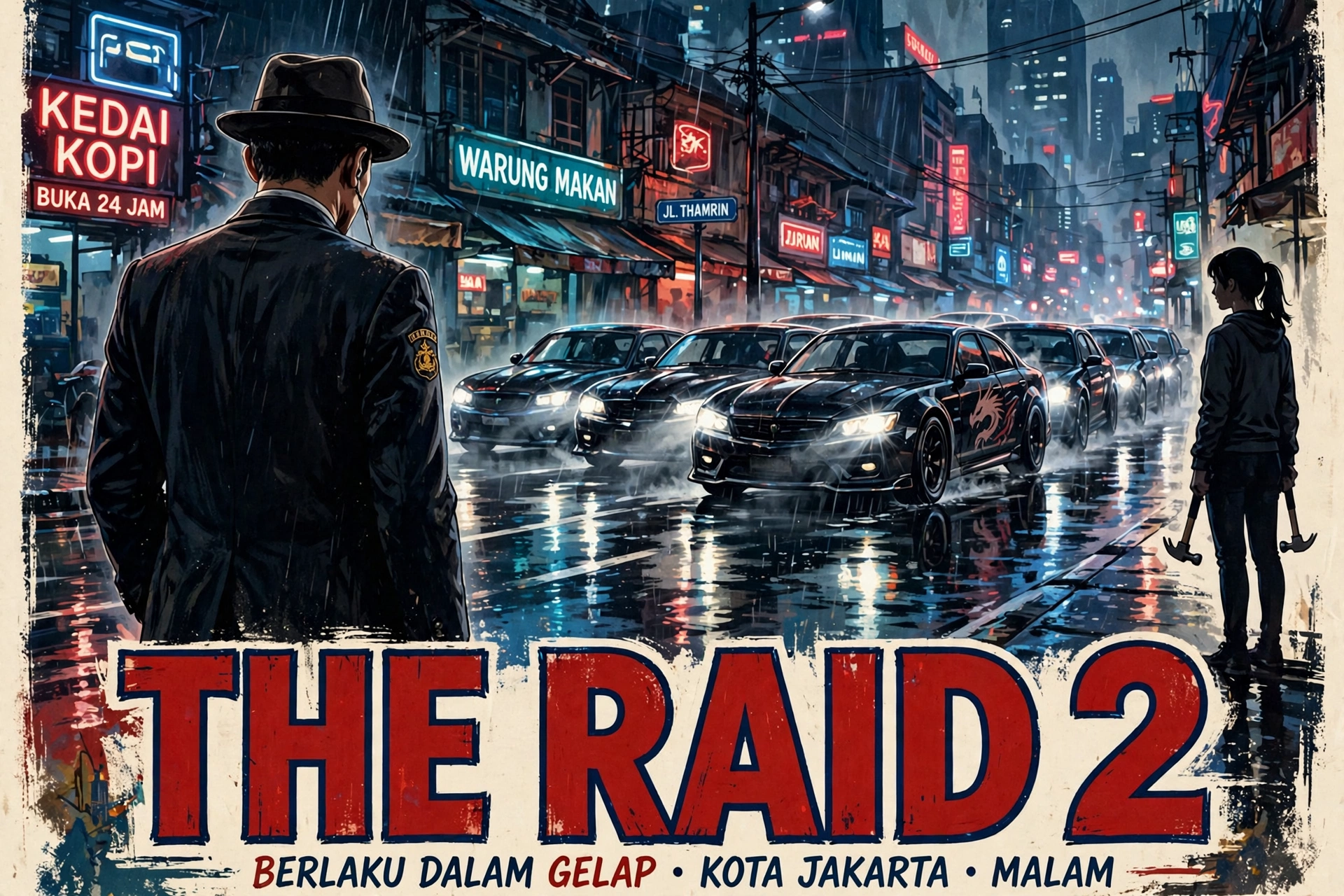
Where could a sequel to The Raid possibly go? The first film used up its entire location — literally, floor by floor — in 101 minutes. Gareth Evans’ answer, in this The Raid 2 review, is: everywhere. Released in 2014 after premiering at Sundance that January, The Raid 2 (Indonesian title: The Raid 2: Berandal) takes Rama out of the tower block and drops him undercover into Jakarta’s gang wars, police corruption and family betrayals, across a full two and a half hours. It is a bigger film in every measurable way — budget, cast, geography, body count — and a more uneven one.
That unevenness is the honest price of ambition, and we think it is mostly worth paying. When The Raid 2 is fighting, it contains sequences that surpass the original and stand among the finest action scenes ever filmed anywhere. When it is plotting, it can feel like a very good crime saga being interrupted by a masterpiece. Both halves come from the same director, and the tension between them defines the film.
| Detail | Information |
|---|---|
| Release date | 28 March 2014 (United States; premiered Sundance, 21 January 2014) |
| Director | Gareth Evans |
| Writers | Gareth Evans |
| Genre | Action, Crime, Martial Arts |
| Language | Indonesian, Japanese |
| Runtime | 150 minutes |
| Budget | Approx. $4.5 million |
| Lead cast | Iko Uwais, Arifin Putra, Tio Pakusadewo, Oka Antara, Julie Estelle |
| Our rating | 8.5/10 |
The sequel begins almost immediately after the first film ends. Rama (Iko Uwais) has survived the building, but surviving turns out to be the easy part. A senior officer, Bunawar, tells him the corruption behind the raid goes far higher than one lieutenant — into the police force itself and the crime families it protects — and that the only way to expose it is from inside. Rama’s family is in danger, his brother’s fate weighs on him, and the offer is less a choice than a sentence: disappear into prison, earn the trust of a gangster’s son, and report back.
In prison, under a new name, Rama engineers a meeting with Uco (Arifin Putra), the ambitious, volatile heir of the Bangun crime family. Freed after serving his time, Rama is taken into the family’s inner circle as an enforcer, where he meets the patriarch Bangun (Tio Pakusadewo), his cautious adviser Eka (Oka Antara), and the family’s rivals and would-be successors — including the rising gangster Bejo (Alex Abbad), who keeps a stable of specialist killers, and the Japanese Goto clan, whose uneasy peace with Bangun holds Jakarta’s underworld together.
What follows is a genuine gangster epic: succession struggles, staged provocations, shifting alliances and a war everyone can see coming except the men who think they control it. Rama’s undercover position grows more precarious with every job he is asked to do, and the film keeps its best suspense trick from the crime genre — the hero must become convincing as a criminal without becoming one. We will not spoil where the loyalties finally land. Expect the last forty minutes to be less a climax than a gauntlet, as Rama fights through Bejo’s entire operation, assassin by assassin.
Iko Uwais as Rama has a harder job here than in the first film. The tower block asked him to survive; the undercover plot asks him to act — frightened in prison, deferential before Bangun, coldly efficient on jobs — while still delivering the physical performances nobody else on earth was matching in 2014. He manages both. His Rama is visibly older in spirit, a man whose decency is becoming a liability he refuses to put down, and Uwais plays the erosion quietly, in glances held a second too long.
Arifin Putra as Uco is the film’s dramatic engine and its best performance. Uco is a prince who suspects he will never be king: charming, funny, humiliated by his father’s caution and ravenous for respect. Putra plays him as a tragedy in progress — you can watch, scene by scene, the exact moments where pride makes the fatal choice. Tio Pakusadewo as Bangun counters him with stillness: an old-style boss whose courtesy is real and whose ruthlessness is procedural, the most frightening kind.
Julie Estelle as Hammer Girl (credited as Alicia) barely speaks — her character is deaf and does not talk — and becomes the film’s most iconic presence anyway, all stillness and sudden, appalling motion with her twin claw hammers. Very Tri Yulisman as Baseball Bat Man, her brother, turns a gimmick into menace with a child’s logic and a killer’s patience. Cecep Arif Rahman as the Assassin, Bejo’s final blade, brings a master’s economy to the climactic kitchen duel; a real silat practitioner, he fights like a man tidying up. And Yayan Ruhian, Mad Dog in the first film, returns in a new role as Prakoso, a weary, loyal hitman whose single extended sequence — an ambush in a nightclub — is the film’s most unexpectedly moving passage. Ruhian proves here that his menace in the original was acting, not just athleticism.
Evans directs the sequel like a man testing how far his own style can stretch, and the stretch marks are part of the fascination. The single-location discipline is gone; in its place are a mud-drowned prison-yard riot involving what feels like the entire inmate population, a nightclub ambush shot with balletic patience, a multi-car chase in which Rama fights several men inside a moving vehicle while another car attacks the convoy alongside, and a final act constructed as a series of one-on-one and two-on-one duels, each with its own weapon, rhythm and room.
The fight choreography, again led by Iko Uwais and Yayan Ruhian and built on pencak silat, has visibly evolved. The first film’s fights were problems of survival in corridors; these are set pieces with personalities — Hammer Girl’s subway-car massacre, the bathroom-stall ambush on Rama in prison, the kitchen finale against the Assassin, in which two masters use an entire professional kitchen as an arsenal. Cinematographers Matt Flannery and Dimas Imam Subhono keep Evans’ signature discipline: long, readable takes, a camera that moves with the violence rather than cutting away from it, and — new here — a genuinely painterly eye in the dramatic scenes, from snow-dusted exteriors to rain-slick night streets.
The craft criticism is structural, and Evans, who also edited, must own it: at 150 minutes, the middle hour’s gangland exposition occasionally stalls the momentum the action builds. Individual scenes are well played, but the sheer number of factions, names and betrayals asks more attention than the film’s emotional stakes always repay. It is the one area where the sequel is plainly inferior to its leaner predecessor.
The score, by Joseph Trapanese working with the first film’s Indonesian composers Aria Prayogi and Fajar Yuskemal, is a study in scale. Where the original’s music was pressure in a box, this is pressure across a city: low electronic pulses under the undercover tension, heavier percussive assaults for the riot and the chase, and — crucially — real silence and near-silence in the dramatic confrontations, so that Bangun’s quiet voice and Uco’s unraveling land without competition. The kitchen finale’s scoring is a lesson in restraint, letting blade, breath and breaking furniture carry the scene until the music finally leans in. It is a more conventional score than the first film’s, in service of a more conventional (if bloodier) kind of film.
What we loved:
What could be better:
Reported figures put the production budget at roughly $4.5 million — about four times the first film’s, though some reports round it closer to $4 million — and its worldwide theatrical gross at approximately $6.6 million. On paper that is a disappointment next to the original’s roughly $9.1 to $9.3 million on a far smaller budget, and the comparison is fair as far as it goes. Context matters, though: a 150-minute, subtitled, extremely violent Indonesian film was always going to face a theatrical ceiling in most markets, and The Raid 2 made much of its real money and reputation afterwards, in home viewing, where it was reported as the best-selling foreign-language title of 2015 in the United Kingdom. Critically, it matched or exceeded the first film’s standing, and its set pieces entered the action canon immediately. As a theatrical investment it underperformed its predecessor; as a calling card and a catalogue title, it succeeded completely.
If the first film’s fights thrilled you, this sequel is essential — several of its sequences are, pound for pound, the best action filmmaking of the decade. Go in knowing it is a different animal: a sprawling, sometimes over-plotted crime epic rather than a 100-minute adrenaline needle, and give its middle hour the patience you would give a gangster saga. Viewers who found the original too violent should not expect mercy; this one is longer, bloodier and more graphic. Everyone else: clear the evening, and watch the kitchen scene with someone to gasp with.
Our rating: 8.5/10 — a more sprawling, less perfect film than the original, with peaks that climb even higher.
Do I need to see The Raid before The Raid 2?
Strongly recommended. The sequel opens in the first film’s immediate aftermath, and Rama’s motives, family and surviving relationships all carry over directly.
Why is Yayan Ruhian in The Raid 2 if Mad Dog died in the first film?
He plays a different character, Prakoso, a veteran enforcer for the Bangun family. Evans brought him back in a new role because of his skill as both performer and choreographer.
Is The Raid 2 longer than the first film?
Yes, considerably: 150 minutes against the original’s 101, reflecting its shift from a single-location siege to a city-wide crime saga.
Will there be a The Raid 3?
Evans has spoken about a possible third film over the years, but as of now none has been made, and he has indicated his focus has moved to other projects. Treat any date you see reported as rumour until production is confirmed.
Is The Raid 2 suitable for family viewing?
No. Its violence is more graphic and prolonged than the first film’s, and it is firmly an adult action film.