★ LATEST REVIEWS

Our Rating: ★★★★★ 9/10
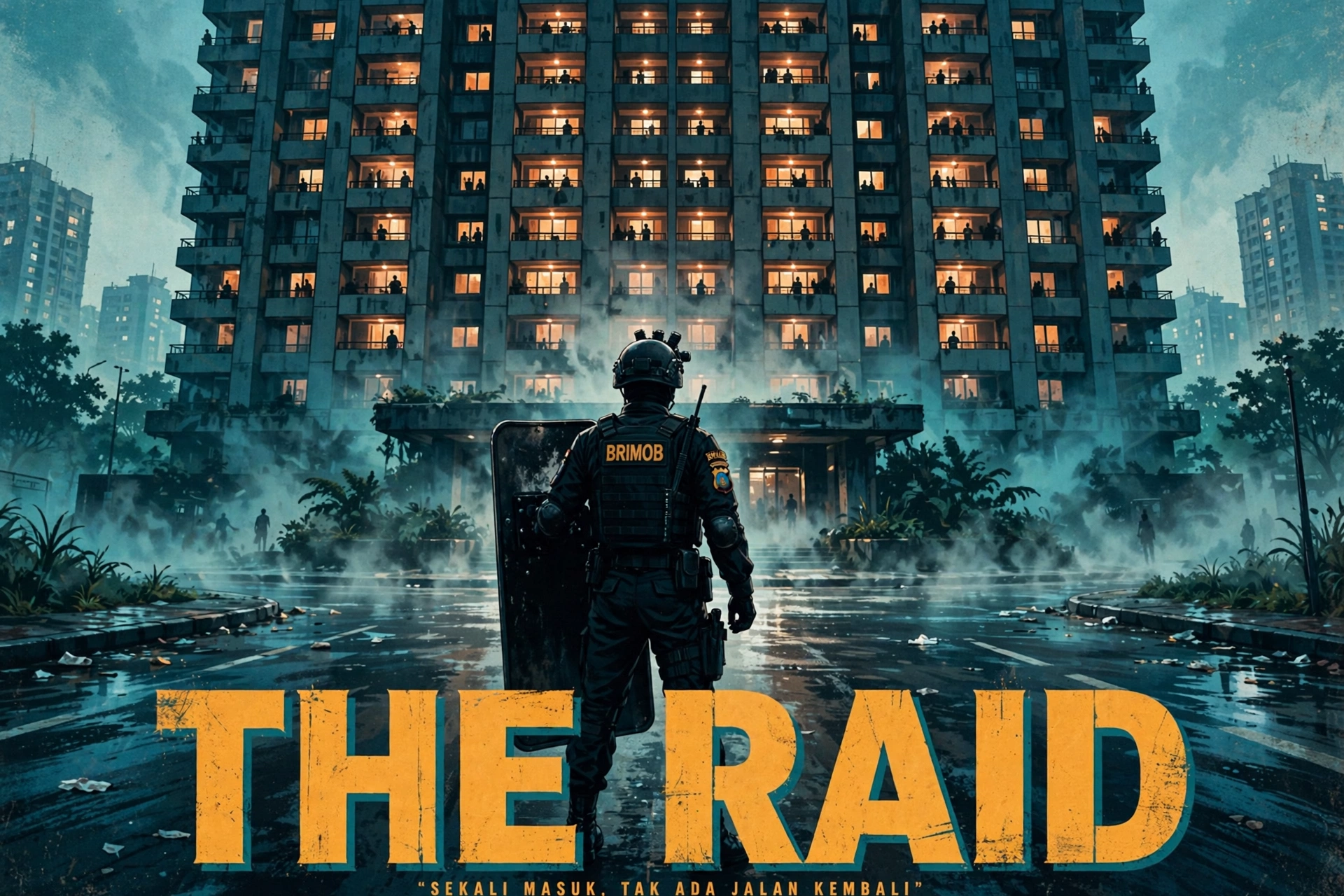
Some action films have plots that happen to contain fights. The Raid is the opposite: it is a fight that happens to contain just enough plot, and it is all the better for knowing exactly what it is. A rookie-heavy police squad walks into a Jakarta apartment block controlled by a drug lord, the alarm is raised within minutes, and for the next hour and a half the only question is how many floors of armed men stand between the survivors and the street. This The Raid review is about the original Indonesian film — released internationally as The Raid: Redemption — which premiered at Toronto in September 2011 before opening in Indonesia and the United States in March 2012.
Our verdict is simple to state and easy to defend: this is one of the defining action films of its century. It did not invent martial-arts cinema, and it does not pretend to be a deep character study. What it did was strip the genre down to geography, stamina and skill, then execute that stripped-down idea so ferociously well that Hollywood spent the next decade quietly copying its homework.
| Detail | Information |
|---|---|
| Release date | 23 March 2012 (Indonesia; premiered Toronto, 8 September 2011) |
| Director | Gareth Evans |
| Writers | Gareth Evans |
| Genre | Action, Martial Arts, Thriller |
| Language | Indonesian |
| Runtime | 101 minutes |
| Budget | Approx. $1.1 million |
| Lead cast | Iko Uwais, Joe Taslim, Donny Alamsyah, Yayan Ruhian, Ray Sahetapy |
| Our rating | 9/10 |
Before dawn, a police van rolls through Jakarta carrying a tactical team toward a run-down high-rise in a poor district of the city. The building belongs, in every way that matters, to Tama (Ray Sahetapy), a drug lord who rents its rooms to criminals, addicts and killers and watches the hallways through a bank of security cameras. The team’s orders are plain: go in quietly, climb to Tama’s floor, and bring him out.
Among the officers is Rama (Iko Uwais), a young policeman with a pregnant wife at home and a private reason of his own for volunteering. His commander is Sergeant Jaka (Joe Taslim), and the operation is led by Lieutenant Wahyu (Pierre Gruno), whose motives are not quite what the men under him assume. The entry goes smoothly for a few floors. Then a lookout spots the team, Tama’s voice booms over the building’s speakers offering free rent for life to whoever kills the intruders, and the raid becomes a siege in reverse — the hunters trapped inside the prey’s home.
From there the film is structured like a descent and a climb at the same time. Ammunition runs out. Radios fail. Help, the survivors learn, is not coming, because the operation was never officially approved. What remains is pencak silat, knives, machetes, furniture, walls and nerve, floor by floor. A family connection inside the building complicates Rama’s loyalties late in the story, but the film wisely keeps that thread lean. We will not describe the ending; the architecture of the escape is the film’s whole pleasure.
Iko Uwais as Rama is the discovery the whole film is built around. Evans had already directed him in Merantau (2009), and here Uwais carries a leading role with minimal dialogue and maximal physical storytelling. Rama’s decency reads in his face — this is the one man in the building who pauses to help the wounded and honour a promise to a tenant — while his fighting does the rest of the acting. Exhaustion, fear and resolve are all visible in how he moves as the film grinds on; by the final floors he looks like a man running on obligation alone, which is precisely the character.
Joe Taslim as Jaka gives the film its authority figure and one of its finest duels. Taslim, a former national-level judoka, brings a different physical grammar to his big fight — throws and grappling against silat — and a commander’s gravity to the quieter scenes. Yayan Ruhian as Mad Dog, Tama’s chief enforcer, is the film’s nightmare made flesh: small, wiry, almost cheerful in his love of a fair fight, and so confident he prefers his hands to a gun. Ruhian’s menace is playful, which makes it worse.
Ray Sahetapy as Tama spends much of the film behind a desk and a wall of monitors, yet he sets the temperature of every scene he watches; his calm is more frightening than shouting would be. Donny Alamsyah as Andi, Tama’s more calculating lieutenant, plays the building’s internal politics with a stillness that pays off when the story turns. Nobody here is giving a showy dramatic performance, and that restraint is a strength: the film casts people who can truly do what their characters do, then lets them do it.
Welsh director Gareth Evans, who also wrote and edited the film, directs action the way good editors think: in clear geography and unbroken lines of movement. At a time when much Hollywood action hid weak choreography behind shaking cameras and half-second cuts, Evans and cinematographers Matt Flannery and Dimas Imam Subhono do the reverse. The camera stays wide enough to read bodies, tracks alongside fighters down corridors, tilts and drops with them through holes smashed in floors, and holds takes long enough that you can verify, with your own eyes, that the performers are really doing this.
The fight choreography, led by Iko Uwais and Yayan Ruhian themselves, is rooted in pencak silat, the Indonesian martial art built on close-range strikes, joint manipulation, throws and bladed weapons. What makes it cinematic is not just speed but logic: every exchange has a problem — a knife, a doorway, three men where there should be one — and a visible, improvised solution. A machete fight in a corridor, a brawl spilling from room to room, a two-against-one finale in a small tiled space: each set piece changes its rules, so repetition never becomes monotony. The sound design deserves equal credit. Impacts land with a crunch that makes audiences flinch, and the building itself — concrete, tile, thin partition walls — becomes a percussion instrument.
If there is a technical caveat, it is that the film’s grey, washed palette and relentless interior gloom, while atmospheric, can blur together in the middle stretch. Evans seems aware of it, varying the fights’ staging and tempo, but viewers who need visual variety should know the film deliberately never leaves its single location.
The Raid is unusual in having two legitimate scores. The original Indonesian version features music by Fajar Yuskemal and Aria Prayogi, an electronic-leaning score that pulses under the building’s dread. For the American release, retitled The Raid: Redemption, a new score was composed by Mike Shinoda of Linkin Park together with Joseph Trapanese, bringing a heavier, more industrial drive that many international viewers now associate with the film. Both versions share the same instinct: the music rarely stops to admire itself. It ticks, builds and drops with the fights, functioning as a second editor — raising heart rates in the climbs between floors and going lean and percussive when fists take over. Neither score wastes time on melody you are meant to hum afterwards; this is pressure, set to rhythm.
What we loved:
What could be better:
The figures here are unusually well documented for a film of this size. The Raid was produced for approximately $1.1 million — a modest sum even by regional standards — and went on to gross roughly $9.1 to $9.3 million worldwide, with published totals varying slightly by source and by how later re-releases are counted. Around $4.1 million of that came from the United States, a remarkable result for a subtitled Indonesian genre film released without major stars. The money, though, understates the impact. Festival acclaim at Toronto turned into a global distribution deal, a hit sequel, and a decade of influence: the clear, wide-shot, close-quarters style Evans and his team proved here can be felt across modern action filmmaking, from the John Wick series onward. Few films costing this little have redirected an entire genre’s technique.
Yes — if you care about action cinema at all, this is close to compulsory viewing, and if you only know it by reputation, the reputation is earned. Go in expecting a simple story told at maximum physical intensity, forgive the thin characterisation as a deliberate trade, and prepare to rewind at least two fights to work out how they were done. Viewers who cannot enjoy screen violence should take the warning seriously: the film is honest about its brutality from the first floor onward.
Our rating: 9/10 — a genre landmark: the purest, hardest-hitting action film of its era, made for the price of a luxury car.
Is The Raid the same film as The Raid: Redemption?
Yes. Redemption was the title used for the American and some international releases. It is the same Indonesian film, Serbuan Maut, in most territories differing mainly in its musical score.
Do I need to watch The Raid before The Raid 2?
It helps. The sequel continues Rama’s story directly and assumes you know the first film’s survivors and the family thread it introduces, though its plot quickly moves into new territory.
What martial art is used in The Raid?
Pencak silat, a family of Indonesian fighting styles. Leads Iko Uwais and Yayan Ruhian are genuine practitioners and led the film’s fight choreography.
Is The Raid based on a true story?
No. It is an original screenplay by Gareth Evans. Its realism comes from practical stunt work and real martial-arts skill, not from real events.
Is The Raid suitable for family viewing?
No. It is an adults-only film in spirit and in rating: the violence is graphic, frequent and central to its appeal.