★ LATEST REVIEWS

Our Rating: ★★★★★ 9.5/10
There is a moment, somewhere in the middle of A Separation, when you realise the film has quietly done something almost no film dares to do: it has made you understand every single person on screen, including the ones who are lying, including the ones whose lies are hurting innocent people. Asghar Farhadi’s 2011 Iranian drama won the Academy Award for Best Foreign Language Film, the Golden Bear at Berlin, and the admiration of critics worldwide — and for once, the honours undersell it.
This A Separation review will argue a simple case: this is one of the greatest films of the twenty-first century, built from ordinary materials — a divorce hearing, an elderly man with Alzheimer’s, a hired caregiver — and assembled with such moral precision that it plays like a thriller while feeling like life. The few caveats worth naming are real but small, and we will name them honestly below. First, the praise, because the praise is what this film has earned.
| Detail | Information |
|---|---|
| Release date | 15 February 2011 (Berlin); 16 March 2011 (Iran) |
| Director | Asghar Farhadi |
| Writers | Asghar Farhadi |
| Genre | Drama |
| Language | Persian |
| Runtime | 123 minutes |
| Budget | Approx. $500,000–$800,000 (estimates vary; see Box Office note) |
| Lead cast | Leila Hatami, Peyman Moaadi, Shahab Hosseini, Sareh Bayat, Sarina Farhadi |
| Our rating | 9.5/10 |
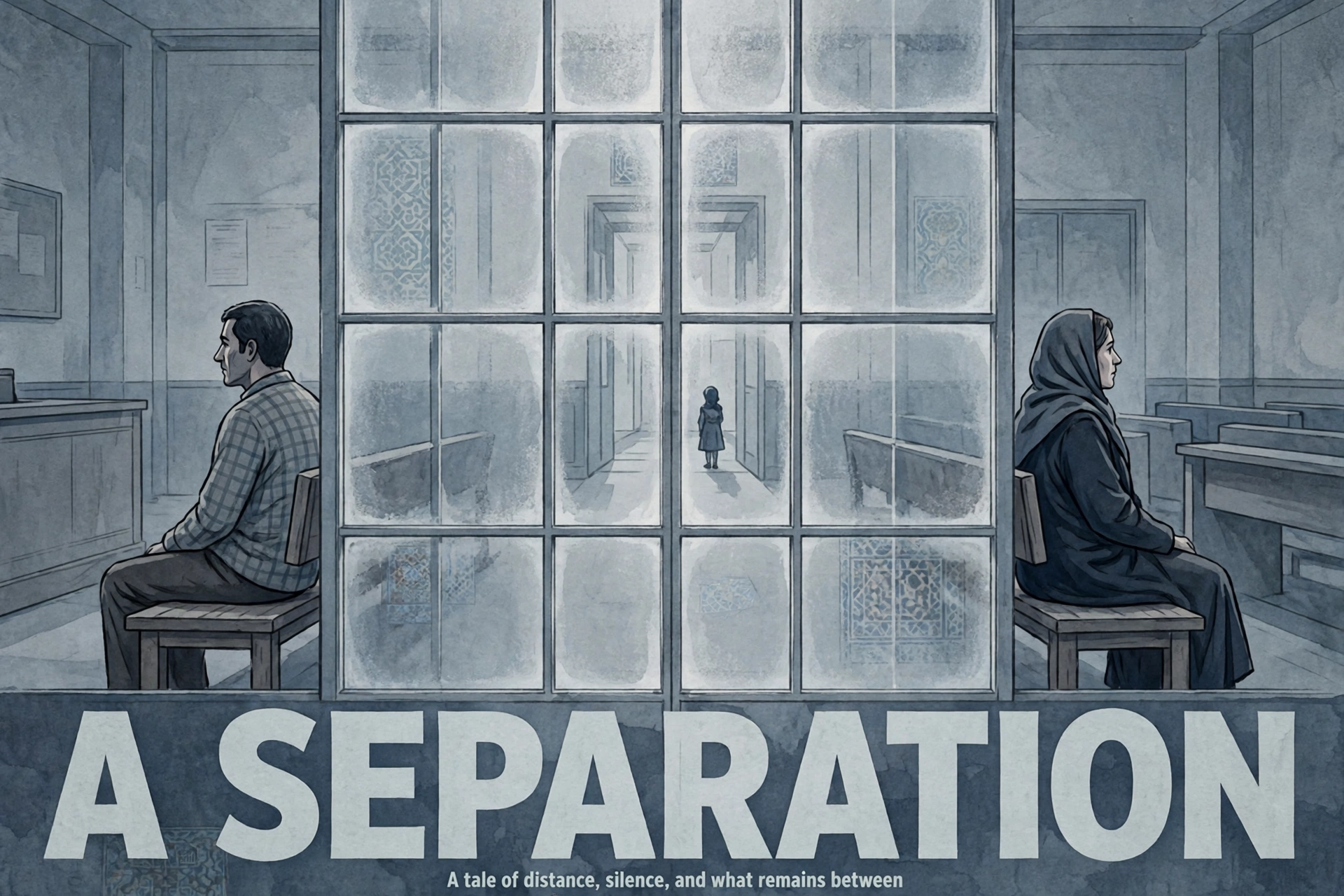
Simin (Leila Hatami) wants to leave Iran. She has spent well over a year securing visas for herself, her husband Nader (Peyman Moaadi) and their eleven-year-old daughter Termeh, because she does not want Termeh to grow up under the conditions she sees around her — conditions the film, pointedly, never needs to spell out. Nader had agreed to the plan. Now he refuses to go: his father, who lives with them, has advanced Alzheimer’s and no longer even knows his son’s name, and Nader will not abandon him.
The film opens in a family court, the couple addressing the judge — and us — directly. The judge finds their problem too small for a divorce and sends them home. Simin moves out anyway, back to her parents. Termeh chooses, painfully, to stay with her father, hoping her presence will eventually bring her mother home. Nader, who works at a bank, must hire help for his father during the day. On Simin’s own suggestion he employs Razieh (Sareh Bayat), a deeply religious woman from a poor suburb, pregnant, desperate for income, and working without the knowledge of her unemployed, debt-hounded husband Hodjat (Shahab Hosseini) — because a devout wife does not work alone in another man’s house, and because her family needs the money too much to refuse it.
Razieh is not equipped for the job. The old man is incontinent, wanders, and cannot be left alone; her faith makes even basic care a matter of anxious consultation about sin. Then comes an afternoon when Nader returns home to find his father alone, tied to the bed, and money missing. Accusations fly. A furious confrontation at the door ends with Razieh pushed out of the apartment — and, later, in hospital, having lost her baby. What begins as a marital separation becomes a legal and moral labyrinth: Did Nader know she was pregnant when he pushed her? What actually caused the miscarriage? Who is lying, and — the question Farhadi refuses to let go of — what would the truth even cost the person who tells it? We will say no more about the plot. The film’s final movement, involving an oath, is among the most quietly devastating sequences in modern cinema, and it must be discovered, not described.
Peyman Moaadi as Nader — billed in some sources as Payman Maadi — won the Silver Bear for Best Actor at Berlin as part of the ensemble honours, and his performance is a masterclass in pride disguised as principle. Nader is decent, dutiful and completely unable to admit fault; Moaadi lets you watch a good man’s rigidity slowly become a weapon he uses on everyone, including himself.
Leila Hatami as Simin matches him with the film’s most underrated work. Simin is often read as the reasonable one, but Hatami plays her impatience, her flashes of manipulation and her real terror for her daughter with equal honesty. Sareh Bayat as Razieh, who shared Berlin’s Best Actress honours with her female co-stars, is heartbreaking: a woman crushed between poverty, faith and a husband’s temper, whose silences carry as much meaning as anyone’s speeches.
Shahab Hosseini as Hodjat is volcanic — an unemployed cobbler humiliated by debt, whose rage is real and whose grievance is also real, a combination Hosseini holds together without softening either side. At the film’s centre stands Sarina Farhadi as Termeh, the director’s daughter, whose watchful, wounded performance gives the story its conscience; the adults lie for many reasons, but they lie most often, they tell themselves, for her. Ali-Asghar Shahbazi as Nader’s father says almost nothing and somehow anchors the entire film: every argument in it is, at root, about what is owed to this silent man. Babak Karimi as the investigating judge deserves mention too — weary, procedural, human — representing a system that wants the truth but has only blunt tools to find it.
Farhadi’s direction is invisible in the way only total control can be. The camera, in the hands of cinematographer Mahmoud Kalari, behaves like a concerned witness: handheld but never showy, drifting between rooms, catching faces through doorways and glass, always positioned where a family member might stand. Domestic spaces become moral architecture — the apartment’s divided rooms and half-open doors let people overhear, misunderstand and conceal, so that the set itself generates the drama.
Hayedeh Safiyari’s editing is the film’s secret engine. A Separation contains no chase and no violence beyond one push, yet it moves with thriller urgency because information is rationed with Hitchcockian discipline: every scene ends having changed what you think happened three scenes earlier. Farhadi’s screenplay — Oscar-nominated, a rare honour for a non-English film — is engineered so that each character’s version of events is partially true, and each new revelation re-sorts your sympathies without ever cancelling them. If there is a criticism to make of the craft, it is that the machinery is almost too perfect: one or two convergences near the end feel arranged rather than lived, and the relentless withholding may frustrate viewers who want at least one character to simply say everything plainly. But that frustration is, arguably, the subject of the film.
Farhadi is famous for distrusting musical instruction — he does not want a score telling you what to feel about people he has worked so hard to leave unjudged — and A Separation is his purest demonstration of that principle. For almost its entire length the film has effectively no background score at all. What you hear instead is Tehran: traffic, schoolyards, hospital corridors, the old man’s breathing, doors closing between people who used to share a life. The silence is not empty; it is where the moral pressure builds.
Sattar Oraki is credited with the film’s music, and what little there is arrives essentially at the end, over the closing credits — a sombre, piano-led piece that lands with enormous force precisely because the film has denied you music for two hours. By the time it plays, you have been made to sit with these people unaccompanied, and the credits music feels less like commentary than like finally being allowed to exhale. Few films prove so convincingly that the bravest sound design is restraint.
What we loved:
What could be better:
The financial figures for A Separation should be stated carefully, because sources differ. Its worldwide gross is most commonly reported at around $24.4 million, though some trackers and older reports place the total closer to $22–23 million; the honest summary is a worldwide figure in the low-to-mid twenty millions of US dollars. Budget estimates vary even more widely: the figure most often attached to the film is around $800,000, while some sources estimate closer to $500,000, so this review gives that range rather than a single invented precision. What is beyond dispute is the proportion: for well under a million dollars by any estimate, Farhadi made a film that won Iran its first Academy Award — for Best Foreign Language Film, alongside an Oscar nomination for Best Original Screenplay — plus the Golden Globe for Best Foreign Language Film, the Golden Bear and both ensemble acting Silver Bears at Berlin, and the top honours of critics’ circles around the world. In Iran it was a genuine popular success as well as a prestige title. Few films in history have converted so small an investment into so much art and so much honour at once.
Yes — and if you care about cinema as an art form, consider it compulsory. A Separation is the rare film that respects its audience completely: it will not tell you who is right, because it understands that “who is right” is usually the wrong question, and it will stay in your head for days, rearranging itself. Watch it with subtitles, watch it without distractions, and watch it with someone you can argue with afterwards. You will both be right. That is the point, and it is a kind of genius.
Our rating: 9.5/10 — a flawlessly acted, morally fearless masterpiece; the small deduction is only for machinery that occasionally shows its own perfection.
Did A Separation win the Oscar?
Yes. It won the Academy Award for Best Foreign Language Film at the 84th Academy Awards, becoming the first Iranian film to win an Oscar. Asghar Farhadi was also nominated for Best Original Screenplay.
Is A Separation based on a true story?
No. It is an original screenplay by Asghar Farhadi. Its realism comes from observation of Iranian family life, law, class and religious practice, not from a specific real case.
Why is there almost no music in A Separation?
Farhadi deliberately avoids score for most of the film so that audiences judge the characters without musical guidance. Sound designer and composer contributions are minimal until the closing credits, which makes that final piece of music unusually powerful.
Is A Separation suitable for family viewing?
It contains no graphic content, but its themes — divorce, a miscarriage, legal conflict and a child caught between parents — are adult and emotionally intense. It is best for older teens and adults.
Where can I watch A Separation (2011)?
The film is widely available on arthouse and major streaming platforms and on disc in most regions, with subtitles. Availability varies, so check your local services.