★ LATEST REVIEWS

★★★★★ Our Rating: 9/10
There is a moment, roughly halfway through Oldboy, when you realise the film you are watching is not really about whether its hero will get his revenge. It is about what revenge does to the person who insists on having it. Released in South Korea on 21 November 2003, Park Chan-wook’s second entry in his loose Vengeance Trilogy arrived like a thunderclap: stylish enough to thrill genre fans, strange enough to unsettle arthouse audiences, and emotional enough to win the Grand Prix at the 2004 Cannes Film Festival. More than two decades later, this Oldboy review has to begin with a simple acknowledgement — very few thrillers since have matched its combination of craft, cruelty and heartbreak.
This is a review of the original 2003 South Korean film, loosely adapted from the Japanese manga by Garon Tsuchiya and Nobuaki Minegishi. It is not a review of the 2013 American remake, which retold the premise without the original’s operatic soul. If you have avoided Oldboy because of its reputation for violence, that reputation is earned — but it is also incomplete. The violence is the surface. Underneath it sits a tragedy about words spoken carelessly, years stolen silently, and a man who discovers that knowing the truth can be a far worse punishment than never knowing it at all.
A spoiler warning, honestly given: Oldboy lives on its revelations, and this review will protect them. We will discuss the premise, the performances and the famous set pieces, but the answers Dae-su is hunting for — who imprisoned him, and why — will stay locked in their room until you open the door yourself.
| Detail | Information |
| Release date | 21 November 2003 (South Korea) |
| Director | Park Chan-wook |
| Writers | Hwang Jo-yoon, Im Joon-hyeong, Park Chan-wook (based on the manga by Garon Tsuchiya and Nobuaki Minegishi) |
| Genre | Neo-Noir, Action, Thriller, Mystery |
| Language | Korean |
| Runtime | 120 minutes |
| Budget | Approx. US$3 million |
| Lead cast | Choi Min-sik, Yoo Ji-tae, Kang Hye-jung, Ji Dae-han, Oh Dal-su |
| Our rating | 9/10 |
Oh Dae-su (Choi Min-sik) is, by his own cheerful admission, an ordinary man — a Seoul businessman with a wife, a young daughter, a fondness for drink and a talent for talking too much. Picked up for drunken behaviour on the night of his daughter’s fourth birthday, he is bailed out by his friend Joo-hwan (Ji Dae-han), makes a phone call from a booth outside the police station — and vanishes. He wakes inside a locked room that resembles a shabby hotel suite: a bed, a television, a bathroom, meals of fried dumplings pushed through a hatch, and no explanation of any kind.
He stays there for fifteen years.
The television becomes his school, his newspaper and his tormentor. Through it he learns that his wife has been murdered and that he is the prime suspect. Through it he watches the world move on without him. Alone, he trains his body against the wall, keeps a diary of everyone he may ever have wronged, and slowly converts confusion into a single sustaining purpose. Then, as abruptly as he was taken, he is released — dressed in a new suit, given money and a phone, and set loose on a rooftop with no instructions except the ones his unseen captor soon delivers by call: find out who did this, and why, within five days, or the consequences will fall on the people Dae-su has come to care about since his release.
Those people matter. Adrift in a city that has changed beyond recognition, Dae-su is taken in by Mi-do (Kang Hye-jung), a young sushi chef whose warmth is the first human kindness he has known in a decade and a half, and their growing closeness gives the hunt an emotional stake far beyond curiosity. Guiding the game from a luxurious distance is Lee Woo-jin (Yoo Ji-tae), a wealthy, unnervingly composed man who seems to know everything about Dae-su — including things Dae-su himself has forgotten. That is as far as this review will go. Oldboy‘s second half turns its mystery inward, asking not just who built the prison, but what a throwaway moment from youth can grow into when it is fed on for years. The final answers reframe everything — but they are the film’s to give, not ours.
Choi Min-sik as Oh Dae-su gives one of the great performances in modern cinema, and much of it is physical before it is verbal. He plays three versions of the same man: the loud, careless drunk of the opening; the caged animal of the prison years, talking to ants and shadow-boxing a wall; and the released avenger, smarter and harder but visibly out of step with the world, a man whose manners, haircut and rage all belong to another era. Choi never asks for pity. His Dae-su is funny, crude, frightening and pathetic, sometimes within a single scene, and the performance’s courage lies in how unheroic it allows him to be. By the final act, his face alone carries material most films would need pages of dialogue to explain.
Yoo Ji-tae as Lee Woo-jin is the perfect counterweight: still where Choi is frantic, soft-spoken where Choi shouts, amused where Choi bleeds. Yoo plays Woo-jin not as a ranting villain but as a man performing calm over an old wound, and the restraint makes him far more frightening than any shouting antagonist would be. There is genuine sorrow under the menace, which is exactly what the film’s themes require.
Kang Hye-jung as Mi-do brings the film its warmth. Mi-do could easily have been a passive love interest, but Kang plays her as direct, funny and emotionally braver than the hero — the one person in the story who acts out of uncomplicated feeling. Ji Dae-han as Joo-hwan and Oh Dal-su as Cheol-woong, the cheerfully mercenary operator of the private prison, round out a supporting cast that gives Seoul a lived-in, morally flexible texture: in this world, everything, even a man’s freedom, has a price list.
Park Chan-wook directs Oldboy like a man determined that no frame will be merely functional. Working with cinematographer Chung Chung-hoon, he builds a visual language of symmetry, saturated colour and prowling camera moves, then breaks it whenever Dae-su’s world breaks. The prison room is photographed as both cosy and hellish; Woo-jin’s penthouse is all glass, water and empty space — wealth as another kind of cell. Park’s control of tone is the real marvel: the film can be absurdly funny, brutally violent and quietly devastating in rotation, and the shifts feel designed rather than accidental.
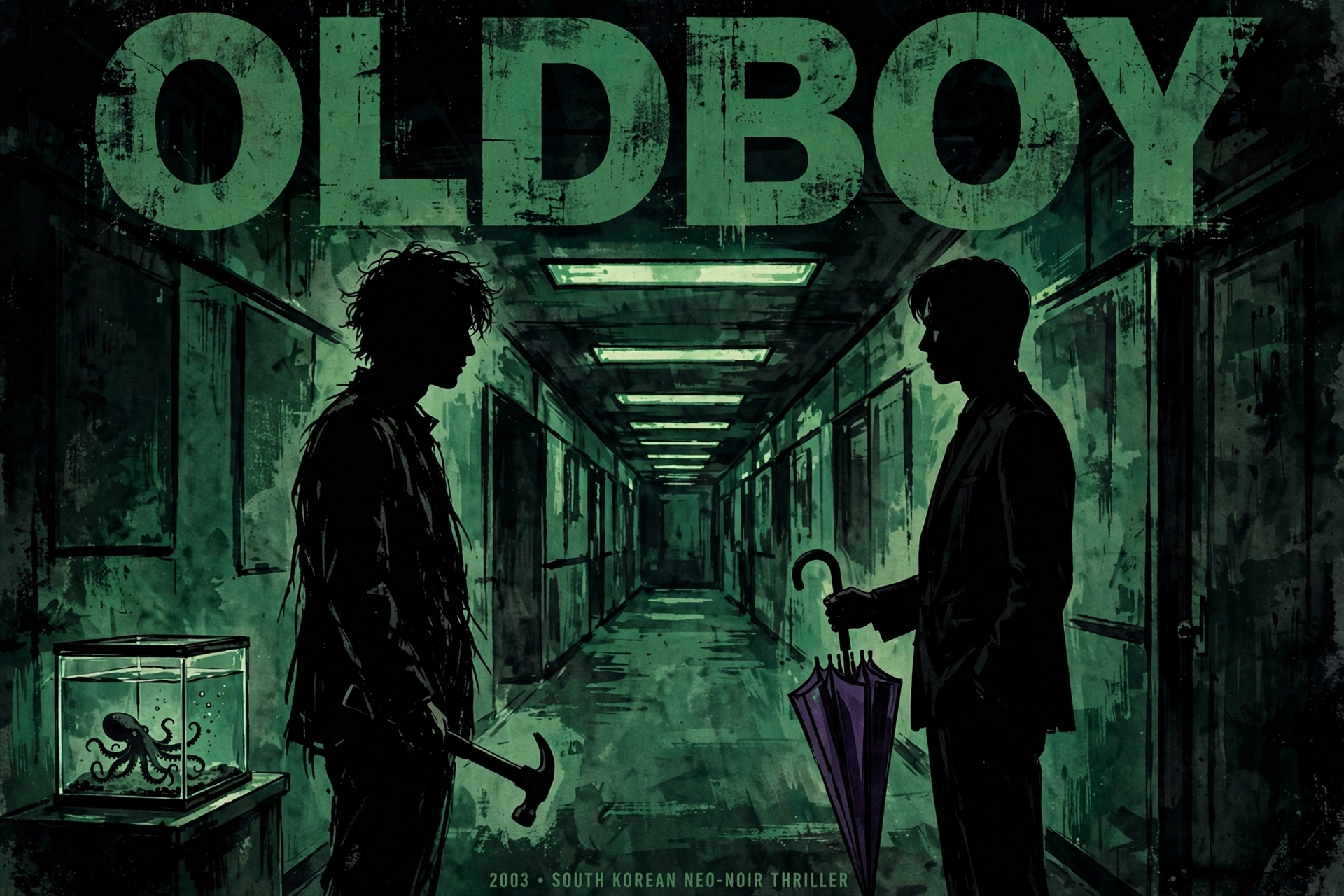
Two sequences have entered film history. The corridor fight, in which an exhausted Dae-su battles a crowd of attackers in a single unbroken side-scrolling shot, remains a landmark of action choreography — not because it looks slick, but because it looks tiring. Men fall, get up, swing badly, and keep coming; our hero wins the way real endurance wins, by refusing to stop. The second sequence, involving a live octopus in a sushi bar, is the film’s most notorious moment and its most debated; it is shocking, deliberately so, but it also establishes, in one image, how completely fifteen years have rewired this man’s relationship with the living world. Editor Kim Sang-bum deserves credit for the film’s propulsive puzzle structure, which feeds the audience information at exactly Dae-su’s pace — we are never ahead of him for long, and never behind him either.
The craft is not flawless. Park’s flourishes occasionally call attention to themselves, and a mid-film detour into hypnosis and memory pushes plausibility harder than some viewers will accept. But even the excesses serve the film’s operatic register: this is a Greek tragedy wearing a neo-noir suit, and it behaves like one.
Music director Jo Yeong-wook, Park’s long-time collaborator, gives Oldboy a score of unusual elegance for so violent a film. The dominant colours are orchestral — strings, piano and waltz rhythms — laid over brutality in a way that deepens rather than softens it. The recurring use of Vivaldi’s “Winter” is the score’s signature gesture: beautiful, formal music accompanying a man coming apart, as if his captor has scored his suffering like an art piece. Elsewhere the music leans into melancholy electronics and quiet piano for Dae-su’s rare moments of tenderness with Mi-do. It is a soundtrack that understands the film’s central idea — that this revenge was composed, patiently, by someone who thinks of himself as an artist — and it lingers in the memory long after the plot’s machinery stops turning.
What we loved:
What could be better:
Oldboy was a genuine hit at home, not just a critics’ darling. Korean reporting of the era is admissions-based, and the film drew roughly 3.26 million admissions in South Korea — a strong result for an adults-only thriller — before the Cannes Grand Prix in May 2004 turned it into an international phenomenon. Worldwide dollar figures need a small caution: most standard references put the film’s global gross at roughly US$15 million against its roughly US$3 million budget, while some secondary sources run slightly higher, so treat that total as a well-supported estimate rather than an audited figure. The more important commercial story is longevity. Strong DVD sales in the West, a 20th-anniversary remastered re-release in 2023 that performed remarkably for a catalogue title, and permanent residence on greatest-films lists have kept Oldboy earning — and being discovered — for over twenty years. The Spike Lee-directed American remake of 2013, by contrast, was a box-office disappointment, a useful reminder that this material’s power lies in its execution, not just its premise.
Yes — with eyes open. Oldboy is essential viewing for anyone who cares about modern thrillers, Korean cinema, or the revenge genre it permanently changed, and it remains Park Chan-wook’s most complete fusion of entertainment and emotional devastation. Go in knowing as little as possible, accept that some scenes are designed to make you flinch, and let the film’s final movement do to you what it has done to audiences since Cannes. Viewers who cannot watch graphic violence should honestly give it a pass; everyone else should clear an evening for it.
Our rating: 9/10 — a neo-noir masterpiece whose craft, performances and emotional punch still tower over the genre it reshaped.
Is Oldboy based on a true story?
No. It is a loose adaptation of the Japanese manga Old Boy by Garon Tsuchiya and Nobuaki Minegishi, and its story is fictional, though its themes of guilt and consequence are painfully human.
Do I need to watch the other Vengeance Trilogy films first?
No. Sympathy for Mr. Vengeance (2002), Oldboy (2003) and Lady Vengeance (2005) are connected by theme and director, not by plot or characters. Each stands completely alone.
How violent is Oldboy, honestly?
Very, in places. The violence is stylised but intense, and a few scenes — including animal content in the famous sushi-bar sequence — are genuinely distressing. It is an adults-only film and earns that classification.
Is the 2013 American remake worth watching instead?
It tells a related story with a strong cast, but it is widely regarded as the weaker film, and it was a commercial disappointment. Start with the 2003 original; watch the remake afterwards only out of curiosity.
Where can I watch Oldboy (2003)?
The original, including its remastered version, streams on major platforms in many regions with subtitles. Availability changes over time, so check your local services.