★ LATEST REVIEWS

★★★★☆ Our Rating: 8.5/10
What happens when someone arrives in India with absolutely no idea what religion, money, clothing or social hierarchy means, and simply starts asking why? That innocent question sits at the heart of PK, one of the most talked-about Hindi films of the last decade. Released in the crowded Christmas season of 2014, the film arrived with enormous expectations. Director Rajkumar Hirani was coming off two beloved successes, and Aamir Khan was at a stage in his career where every release felt like an event. Instead of playing safe with a routine comedy, the team chose a risky subject: faith, godmen, and the business that sometimes grows around belief.
The gamble could easily have offended, bored or confused audiences. Instead, PK connected across generations because it never stops being entertaining while it makes its point. It is funny in the way a street conversation is funny, emotional without becoming heavy-handed for most of its run, and built around a central performance that still holds up on repeat viewing. It also remains a film people argue about, which is perhaps the best proof that it touched a nerve.
Does it deserve its reputation as a modern classic, or does the message overwhelm the movie? In this review we give you an honest breakdown of the story, performances, craft, music and box office, without spoilers for the ending.
| Detail | Information |
|---|---|
| Release date | 19 December 2014 |
| Director | Rajkumar Hirani |
| Writers | Rajkumar Hirani, Abhijat Joshi |
| Genre | Comedy, Drama, Science Fiction Satire |
| Language | Hindi |
| Runtime | 152 minutes |
| Budget | ₹122 crore |
| Lead cast | Aamir Khan, Anushka Sharma, Sushant Singh Rajput, Boman Irani, Saurabh Shukla, Sanjay Dutt |
| Our rating | 8.5/10 |
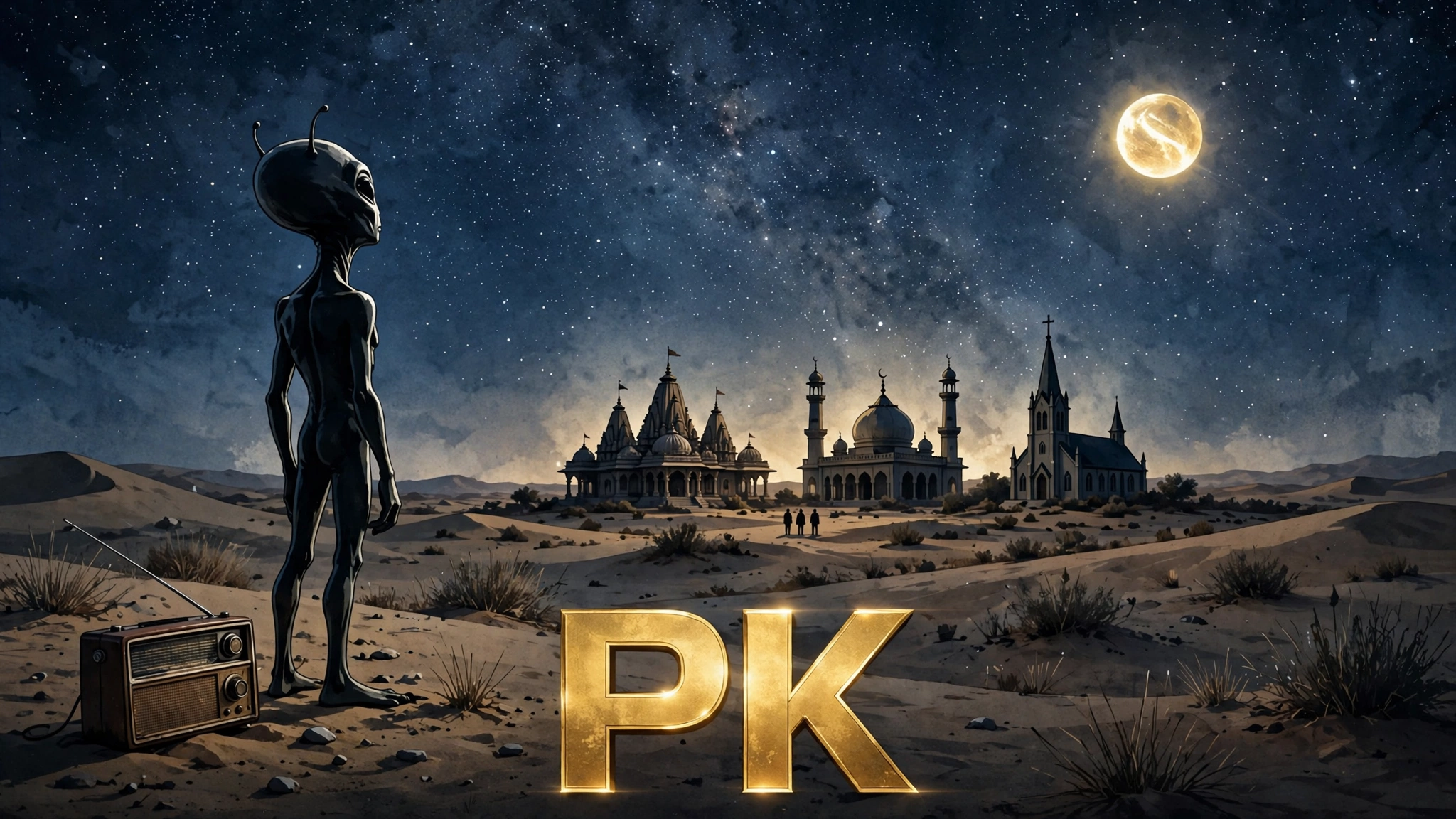
The film opens far from any city, in the desert of Rajasthan, where a spacecraft leaves behind a lone visitor. He has come to study human life, he carries no clothes and no possessions, and his only link back to his ship is a small pendant-like device. Within minutes of landing, that device is stolen. Stranded, unable to speak any local language and baffled by everything from temple bells to currency notes, he must learn how this planet works if he ever wants to go home.
Locals give him a nickname based on his odd behaviour and his habit of asking questions that sound almost drunken in their directness. As he travels from village to Delhi, he discovers that people keep telling him the same advice whenever he is in trouble: ask God for help. That advice sends him on a tour of temples, mosques, churches and roadside shrines, where he tries every ritual he is offered. When none of it brings his device back, he begins to wonder whether people are calling the right number at all, or whether middlemen have built a profitable confusion around faith.
His path crosses with Jagat Janani, known as Jaggu, a television journalist who has returned from Belgium with her own heartbreak. She first sees him as a colourful story for her channel, then gradually realises his questions are more serious than they sound. Together, they edge towards a confrontation with a powerful and popular godman who happens to possess the missing device, now presented to followers as a sacred object. The rest of the film follows whether an outsider with no agenda can challenge that authority in public, and what it costs Jaggu to support him.
The premise is simple, almost fable-like, and that is its strength. The story never needs complicated science fiction. Earth itself is the strange planet here.
Aamir Khan as PK: This is a performance built on physical choices. The wide, unblinking stare, the ears pushed out, the Bhojpuri-flavoured Hindi he picks up, and the way he holds a radio to his ear as if it were a lifeline all create a character who feels genuinely displaced. Khan resists the temptation to play the role as a cute clown. His confusion in a scene at a temple or a police station comes from logic, not slapstick alone, which is why the comedy lands and the later emotional beats feel earned. It is one of his most controlled comic performances, even when the character is at his most exaggerated.
Anushka Sharma as Jaggu: Sharma has the harder, less showy job. She has to be the audience’s bridge, amused at first, then curious, then convinced. She plays Jaggu as a professional who is also nursing a personal disappointment, and she keeps both tracks believable. Her scenes explaining human customs to PK give the film much of its warmth, and she never lets the character become merely a helper for the hero.
Sushant Singh Rajput as Sarfaraz Yousuf: In a brief but important role, Rajput brings a gentleness that makes the opening romance in Bruges feel fresh rather than decorative. His track returns at a crucial point, and his sincerity helps that payoff work.
Saurabh Shukla as Tapasvi Maharaj: Shukla avoids turning the godman into a shouting caricature. He is calm, well-spoken and completely convinced of his own importance, which makes him a more credible opponent. Boman Irani as the ratings-hungry news channel head and Sanjay Dutt as the kind-hearted Bhairon Singh add texture in short appearances, with Dutt in particular giving the early desert section a lot of heart.
Rajkumar Hirani’s greatest skill has always been clarity. Complicated ideas are introduced through small, funny incidents, and no scene exists only to lecture. In PK, he and co-writer Abhijat Joshi structure the film as a series of discoveries. Each new custom PK encounters teaches the audience something about how he sees us, and the screenplay is patient enough to let a joke develop into a question rather than forcing the point immediately.
That patience does come with a cost. The second half leans more heavily on television studio debates and emotional speeches, and the rhythm becomes more predictable than the freewheeling first hour. A viewer who loved the wandering, observational early section may find the climax a little too neatly arranged.
Cinematographer C. K. Muraleedharan gives the film a bright, open look. Rajasthan is shot in warm, dusty tones, Delhi feels busy without becoming visually messy, and the Belgium portions have a clean, postcard quality that contrasts nicely with the chaos back home. Hirani, who also edited the film, keeps most scenes crisp, although the film’s 152-minute length could have survived a small trim in the middle.
Production design deserves credit for the details: the cramped TV office, the crowded places of worship, the fairground where PK first tries to earn money. Nothing looks overly glossy, which suits a story about ordinary people and everyday belief. The few visual effects involving the spacecraft are kept minimal and are used as bookends rather than spectacle.
The songs are composed mainly by Shantanu Moitra, with guest contributions from Ajay–Atul and Ankit Tiwari, while Sanjay Wandrekar and Atul Raninga provide the background score. The album follows Hirani’s usual philosophy: songs should push character or feeling, not just pause the film.
“Love Is a Waste of Time” turns a tentative attraction into a playful number without breaking PK’s innocent logic. “Chaar Kadam” is the most conventionally romantic track, filmed in Belgium, and it gives the Jaggu and Sarfaraz thread its lingering sweetness. “Bhagwan Hai Kahan Re Tu”, sung by Sonu Nigam, is the emotional centre of the soundtrack. It arrives when PK’s search has failed repeatedly, and its simple, searching lyric captures his exhaustion better than any dialogue could.
Not every track is equally memorable. “Tharki Chokro” is energetic and helps establish Bhairon Singh’s world, but it is more functional than lasting, and “Dil Darbadar” is pleasant without being essential. The background score stays light for most of the film, supporting the comedy, and swells only when the story turns openly emotional. Overall, this is a good album rather than an all-time great one, lifted by one or two songs that have stayed popular long after release.
What we loved:
What could be better:
PK was a major commercial success by any measure. Made on a reported budget of ₹122 crore, it grossed ₹769.89 crore worldwide according to widely reported figures, becoming at the time the highest-grossing Indian film ever released. Box Office India, which tracks figures with a different methodology and does not count some later overseas expansions the same way, recorded a worldwide gross of around ₹616 crore, which still placed it in the all-time blockbuster category in India.
Its domestic run was historic in its own right. The film was widely reported as the first Hindi film to cross the ₹300 crore nett mark in India, helped by strong word of mouth after a solid opening on 19 December 2014 and an exceptional hold through the Christmas and New Year holidays. In North America alone it earned more than $10 million, an outstanding result for a satire driven by dialogue and ideas rather than action. A later release in China added substantially to its overseas total and showed how well its universal theme travelled.
The commercial story matters because it proved a point to the industry: a film questioning godmen and organised exploitation of faith, without songs-and-action formula in the usual sense, could still become the biggest hit of its era.
PK is not a perfect film. Its ending is neater than life, and viewers who disagree with its viewpoint may find some scenes provocative by design. But as popular filmmaking, it achieves something rare. It makes a large audience laugh, think and argue on the way home, and it does so without losing its kindness. The film criticises fear and exploitation, not ordinary believers, and that distinction is held carefully for most of the runtime.
If you have never seen it, it remains essential viewing for anyone interested in modern Bollywood. If you saw it on release, a rewatch is rewarding, particularly for Khan’s performance and the beautifully constructed first hour.
Our rating: 8.5/10 — A funny, brave and warm-hearted satire that asks big questions in the simplest possible language.
Is PK based on a true story?
No. The characters and events are fictional. The film uses a fictional alien visitor to comment on real social practices around faith, godmen and media, but it is not adapted from a real person’s life.
Did PK face controversy on release?
Yes. Some groups objected to its portrayal of religious practices and a popular godman figure, and there were public protests and legal complaints. The film was cleared by the censor board and released as scheduled, and the debate around it contributed to its visibility.
What language is PK in and are subtitles available?
The film is mainly in Hindi, with PK himself speaking a Bhojpuri-influenced form of Hindi for much of the film. Most home viewing versions include English subtitles, which help with the dialect and wordplay.
Where can I watch PK?
Availability changes by country and over time. Check major licensed streaming services and official digital rental stores in your region under the title PK. We recommend using only legal platforms.
What is the age rating and runtime?
PK runs 152 minutes and was certified U/A in India, meaning children could watch it with parental guidance. It contains no graphic violence, though its themes are best appreciated by older children and adults.