★ LATEST REVIEWS

★★★★☆ Our Rating: 7/10
There is something quietly audacious about opening a Christmas musical in the middle of a war, and Drummer Boy does exactly that. Angel Studios’ new film, which opened in cinemas on Friday, 6 November 2026, is a Revolutionary War musical from the Smallbone brothers of for KING + COUNTRY — a handsome, emotionally involving period drama about two brothers who find themselves on opposing sides of the American Revolution, and an enslaved young woman fighting for her own freedom. It is deeply earnest, beautifully shot and performed with real conviction, even if its story sometimes strains under the weight of its own sincerity. It is a film that works best when it trusts its characters, and stumbles only when it reaches for the grand gesture.
This review is spoiler-free on the film’s specific scenes. The broad shape of the story is described here; its particular staging is left for the audience.
| Detail | Information |
|---|---|
| Release date | 6 November 2026 (US cinemas, Angel Studios) |
| Directors | Ben Smallbone, Joel David Smallbone |
| Writer | Richard L. Ramsey |
| Genre | Musical drama / historical drama |
| Language | English |
| Lead cast | Joel David Smallbone (Jeremiah Clem), Lucas Leach (Benjamin Clem), India Brown (Emmaline), Ioan Gruffudd (Nathaniel Clem), Melora Hardin (Rachel Clem), Charles Esten (Lord Balfour), Beth Easdown (Elizabeth Balfour), Iain Glen (Major Ambrose), Beverley Knight |
| Music | Joel and Luke Smallbone; score by Garrett P. Tyler and Danny Lopez |
| Cinematography | Cathal Watters |
| Runtime | About 129 minutes |
| Certification | PG-13 (US, for war violence and some bloody images) |
| Our rating | 7/10 |
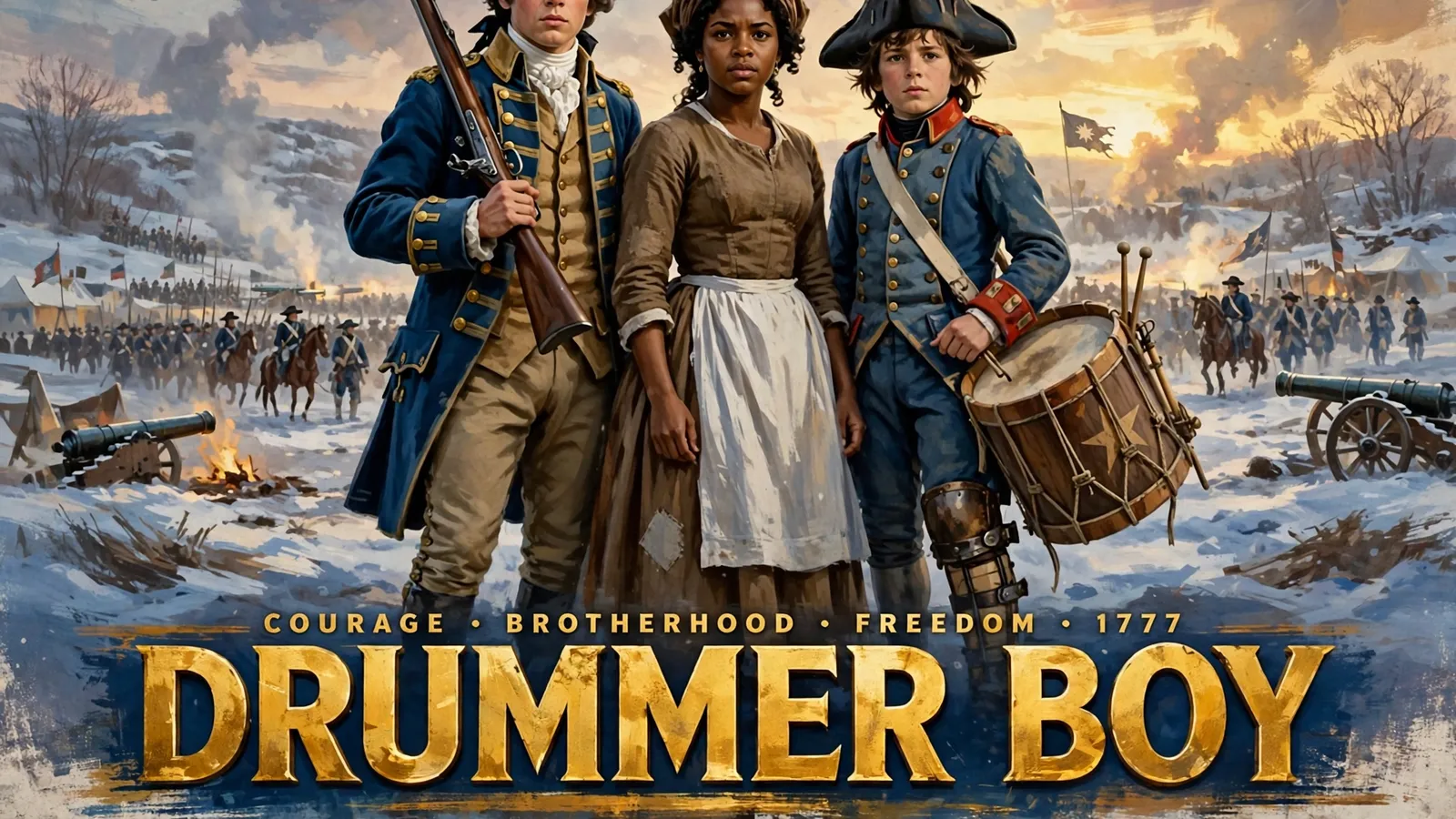
The film opens with a prologue set in 1762, as two families sail from England toward the American colonies. The Clems — led by father Nathaniel (Ioan Gruffudd) — are humble folk hoping to build a truly free life; the Balfours, led by the widowed Lord Balfour (Charles Esten), expect to carry their homeland’s aristocratic traditions across the Atlantic, servants included. Before they even reach land, tragedy strikes: Nathaniel dies in a skirmish, and the eldest son Jeremiah (Joel David Smallbone) is forced to step up as the man of the family, while his younger brother Benjamin (Lucas Leach), a drummer who wears a leg brace after an injury on the crossing, does his best to navigate a world that keeps underestimating him.
As the American Revolution begins, the brothers are pulled to opposing sides of the conflict — Jeremiah toward the Patriot cause, Benjamin toward the British forces — and the film follows the cost of that division on their mother Rachel (Melora Hardin), who wants nothing more than to keep her family whole. Running alongside the brothers’ story is that of Emmaline (India Brown), a young enslaved woman in the Balfour household who is fighting for her own freedom and her own future, caught between her growing feelings for Jeremiah and her devotion to Lizzy Balfour (Beth Easdown), the lord’s daughter. The story builds toward a snowy Christmas climax on the field of battle, where family, freedom and forgiveness finally collide.
It is, in outline, a familiar story — the divided family, the war that makes brothers enemies, the love that crosses the lines the war draws. What makes Drummer Boy more than its outline is the care with which it treats its people: this is a film that believes in its characters, and it asks the audience to believe in them too.
Joel David Smallbone as Jeremiah Clem — Smallbone, who also co-directs, gives it his all as Jeremiah, and his performance benefits from the more deliberate, complex material. He plays a young man who has had adulthood thrust upon him — a son who becomes a father to his family overnight — and he carries that weight without ever turning Jeremiah into a saint. The reviews have singled him out: he is, as one critic put it, so good that you find yourself wondering what other movies you have seen him in. The answer is not many — and that is part of the pleasure here, watching a performer announce himself.
Lucas Leach as Benjamin Clem — Leach is the heart of the film. His Benjamin is a drummer boy with a leg brace and a determination that refuses to be pitied, and Leach plays him with an effortless warmth that draws the audience in. The character’s journey — a boy who insists on being useful, on being seen as a person rather than a burden — is the film’s most moving thread, and Leach makes every beat of it land. If Jeremiah is the film’s spine, Benjamin is its soul.
India Brown as Emmaline — Brown brings quiet gravitas to Emmaline, a woman in love with someone she believes she can never have, while fighting for her own freedom as obstacles pile up against her. It is a difficult role — Emmaline is caught between two worlds, loyal to the family that owns her and drawn to a future beyond it — and Brown plays the contradictions without smoothing them away. She is, by several accounts, one of the film’s most compelling presences.
The ensemble — Melora Hardin delivers an agonizing, standout performance as the brothers’ mother Rachel, bringing raw emotional truth to a role that could easily have felt like a stock figure. Ioan Gruffudd, Charles Esten, Beth Easdown and Iain Glen — the latter superb as Major Ambrose, the Scotsman who teaches Benjamin more than battlefield strategy — round out a cast that is excellent across the board, taking material that could easily have become overwrought and making it believable and genuinely moving.
Ben and Joel David Smallbone direct from a screenplay by Richard L. Ramsey (Unsung Hero), and the film is their most ambitious work yet — a project they have reportedly been building toward for nearly a decade. Their direction is confident and mostly pleasing: this is a throwback to original screen musicals, confident in its emotions and unafraid of sincerity, and it tells a story about human morality rather than testing anyone’s faith. The film is the second 2026 Angel Studios release set during the American Revolutionary War, after Young Washington, and it wears its period with real care.
Cathal Watters’ cinematography is one of the film’s clearest strengths — gorgeous, expansive widescreen images that capture a world that seems to open up and close in on the characters at the same time, at moments recalling the more idealizing nineteenth-century landscape painters. The songs by for KING + COUNTRY and the backing score by Garrett P. Tyler and Danny Lopez support the emotional arc without overwhelming it, and the sound design — the drums, the muskets, the winter wind — gives the film a texture that makes it feel lived-in.
The film’s one recurring weakness is also its most honest flaw: it is a deeply earnest film, and earnestness has a cost. As several critics noted, the film works better as a period-piece character drama than as a Revolutionary War musical, and its heavily contrived, snowy Christmas climax stretches credulity to the breaking point — somehow, it mostly does not matter, because the co-directors’ sincerity and polish carry it through. But the gears do show: you can see every dramatic turn coming miles before it arrives, and the film never quite surprises you. Our rating of 7 reflects that balance: a solid, well-crafted night at the movies, handsome and genuinely moving, that delivers enough emotional punch to satisfy its audience without ever quite transcending its formula.
The music is central to the film’s identity — this is, after all, a film from the Smallbone brothers, and the songs carry much of its emotional weight. The musical numbers are woven into the drama rather than stopping it, and the score supports the story’s arc from loss to reconciliation. The drumming itself — Benjamin’s instrument, his voice in the world — is used beautifully as a motif: the sound of a boy insisting on being heard. The film’s music is functional and heartfelt rather than showy, which suits a story that is really about a family and a young woman’s freedom.
What we loved:
What could be better:
Drummer Boy opened in US cinemas on 6 November 2026, in the middle of one of the busiest weekends of the autumn — against Godzilla Minus Zero, The Cat in the Hat and Jimmy. Early forecasts put its opening weekend at roughly $10–14 million, which would make it one of Angel Studios’ stronger openings and the third-biggest film of the weekend. Critical reception has been warm if not unanimous: Today’s Christian Entertainment awarded it 5 out of 5, Keith & the Movies gave it 3.5 stars, MovieGuy247 gave it 3 stars, and ScreenRant praised its visual craft while noting it works better as drama than as musical. RogerEbert.com’s Matt Zoller Seitz found it far from dull, and said it “certainly plays its best for us”. The film’s PG-13 rating — for war violence and some bloody images — is warranted, and families should know the battle scenes are genuinely intense.
Yes — especially if you like your historical drama sincere and your musicals heartfelt. Drummer Boy is not a cynical film, and it is not a perfect one: its story is predictable, its climax is contrived, and it never quite surprises you. But it is beautifully shot, superbly acted — Lucas Leach and India Brown in particular — and it believes in its characters with a conviction that is increasingly rare. It is a solid, well-crafted night at the movies, and for audiences who have been waiting for a big-screen musical with a beating heart, it delivers. Our rating: 7 out of 10 — a sweeping, sincere period musical that earns its tears, even if you can see them coming.
When was Drummer Boy released?
The film opened in US cinemas on 6 November 2026, distributed by Angel Studios.
Who directed Drummer Boy?
Ben Smallbone and Joel David Smallbone, the brothers behind the Christian pop group for KING + COUNTRY, from a screenplay by Richard L. Ramsey.
Who stars in Drummer Boy?
Joel David Smallbone as Jeremiah Clem, Lucas Leach as his brother Benjamin, India Brown as Emmaline, with Ioan Gruffudd, Melora Hardin, Charles Esten, Beth Easdown and Iain Glen.
What is Drummer Boy about?
A Revolutionary War musical about two brothers who find themselves on opposing sides of the American Revolution, and an enslaved young woman fighting for her freedom — a story of family, freedom and forgiveness.
Is Drummer Boy a Christmas movie?
Partly — it is set during the Revolutionary War and builds to a Christmas climax on the battlefield, which is why it arrived in cinemas in early November.
What is the runtime of Drummer Boy?
About 129 minutes, rated PG-13 for war violence and some bloody images.