★ LATEST REVIEWS
★★★★☆ Our Rating: 7/10
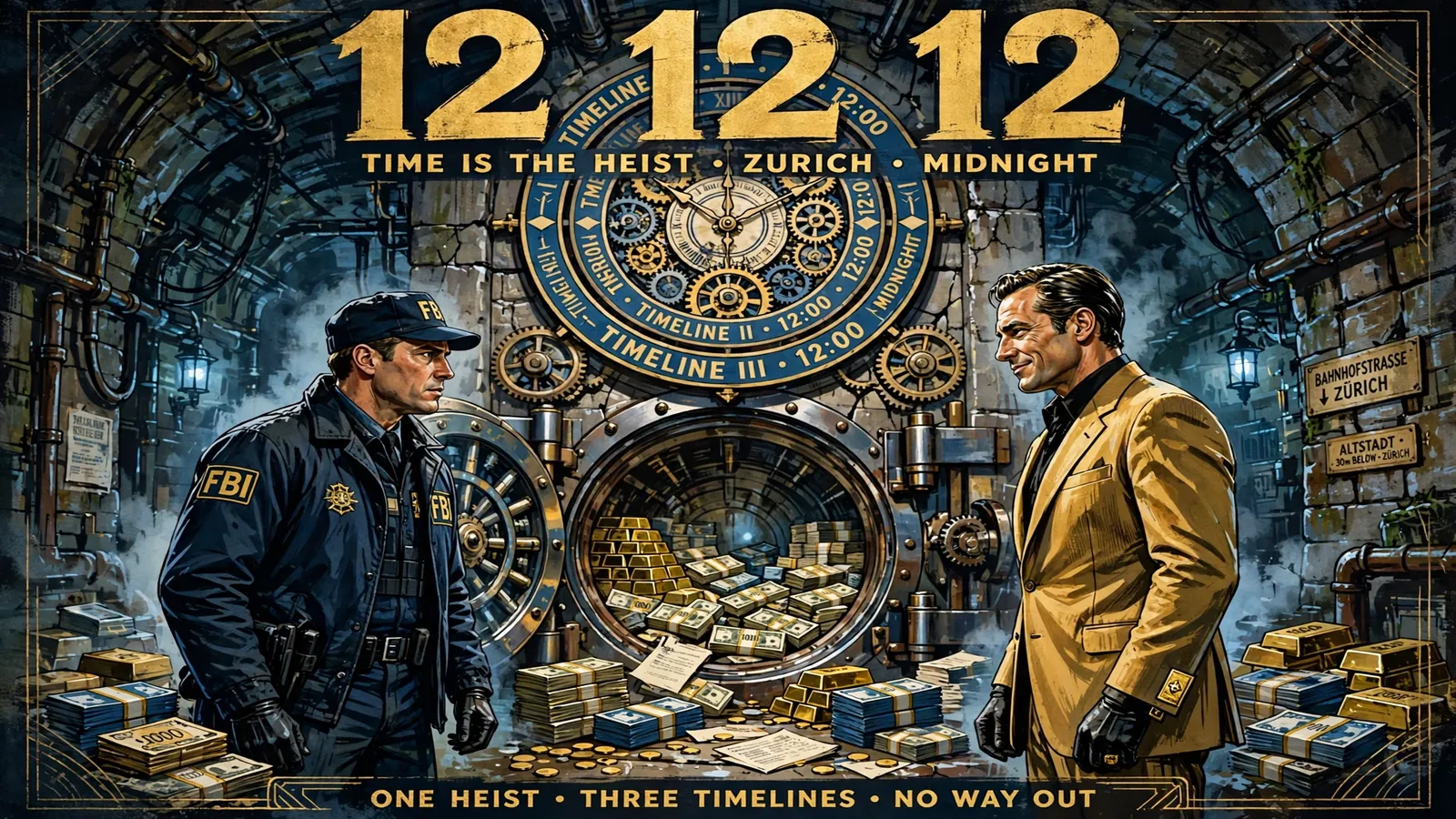
The heist thriller is one of the oldest pleasures in popular television: a clever plan, a crew of specialists, a vault that cannot be cracked — until it can. 12 12 12, which premiered on Apple TV on 13 November 2026 with its first two episodes, knows that pleasure well, and it adds a twist that makes the old formula feel new. The title is the show’s conceit: the 12 months of planning, the 12 hours of the heist, and the 12 days after. Three timelines, toggled every episode, telling one story from three directions at once. It is an ambitious structure, and on the evidence of the first two episodes, it is mostly working.
Read this review for what it is: a review of episodes 1–2 only. The series has eight episodes in total, with one new episode every Friday and the finale scheduled for Christmas Day, 25 December 2026. Nothing below judges episodes that have not aired, and the rating covers the two released episodes only. When the season is complete, this review will be worth revisiting — the show’s biggest question, whether three timelines can be brought to a satisfying close, is one the first two episodes cannot yet answer.
The series is created by Dudi Appleton and Jim Keeble, whose previous work includes Silent Witness and Wild Bill. It stars Anthony Mackie as Jack Strickland, a disgraced FBI agent, and Jamie Dornan as Paul Galvin, an American career criminal. Kari Skogland directs the pilot and executive produces. The early reception is mixed-positive: the AV Club’s review, published on 12 November 2026, called the show “occasionally thrilling” while noting it is “not entirely sure how to bring things to a satisfying close”, and ScreenRant named it one of Apple TV’s top picks of the week. Both of those judgements feel fair after two episodes.
| Detail | Information |
|---|---|
| Streaming premiere | 13 November 2026 on Apple TV (first two episodes) |
| Episodes | 8 total; one new episode every Friday; finale 25 December 2026 |
| This review covers | Episodes 1–2 only — the season so far |
| Created by | Dudi Appleton and Jim Keeble (previous work: Silent Witness, Wild Bill) |
| Pilot directed by | Kari Skogland (also executive producer) |
| Genre | Heist thriller series |
| Language | English |
| Starring | Anthony Mackie (Jack Strickland), Jamie Dornan (Paul Galvin), Jack Kesy, Kali Reis, Ólafur Darri Ólafsson |
| Executive producers include | Anthony Mackie and Jamie Dornan |
| The target | A bank vault deep beneath the streets of Zurich |
| Our rating | 7/10 (episodes 1–2 only) |
| Budget | Not publicly disclosed |
| Box office | Not applicable — streaming series |
| Early reception | AV Club (12 Nov 2026): mixed-positive, “occasionally thrilling”; ScreenRant: one of Apple TV’s top picks of the week |
The story begins with a failure. Jack Strickland, played by Anthony Mackie, is a disgraced FBI agent, burned by a heist that went wrong in Newark a little over a year earlier — a job in which a fellow agent lost her life. That is the wound the whole show is built around: Strickland is a man who knows exactly what a failed heist costs, and that knowledge makes him both the most dangerous man in the room and the most vulnerable one.
On the other side of the table is Paul Galvin, played by Jamie Dornan, an American career criminal planning the job of his life: a bank vault deep beneath the streets of Zurich. Galvin is the classic heist-movie operator — charming, precise, allergic to loose ends — and Dornan plays him with the easy confidence of a man who has done this many times before. The tension between these two men is the show’s engine: an agent who has already lost everything to a heist, and a criminal who is about to risk everything on one.
The structure is what sets 12 12 12 apart. The title counts out the plan: 12 months of planning, 12 hours of the heist itself, and 12 days after. Each episode toggles between three timelines — The Planning, The Heist, and The Takedown — so the audience is always watching the job from three directions: how it was built, how it is executed, and what it costs afterwards. In the first two episodes, that structure does real work: a detail planted in the planning timeline pays off in the heist timeline, and a consequence glimpsed in the aftermath timeline reframes something the audience thought it understood.
One fact needs a plain note, because the show’s own coverage disagrees about it. The loot is reported as 800,000 Swiss francs stashed by a Russian crime ring, according to the AV Club, while Collider describes the job as a €1 billion bank robbery. Those two figures cannot both be the whole story, and this review does not pick one as settled. The discrepancy may be a deliberate piece of misdirection — different characters, different numbers — or it may be that the full scale of the job is one of the things the show is still holding back. Either way, the honest thing is to record the conflict and let the later episodes settle it.
Anthony Mackie is doing some of his best television work as Jack Strickland. The character could easily have been a cliché — the haunted agent, the man with a past — but Mackie plays him as a professional first and a wounded man second. Strickland is careful, methodical, and quietly furious, and Mackie lets the fury show in small ways: a look held a beat too long, a question asked twice. The Newark failure is always present in the performance without ever being explained to death, and that restraint is what makes the character believable.
Jamie Dornan, as Paul Galvin, is the show’s other anchor, and he is playing a different kind of confidence. Galvin is a man who has built his whole identity on control: control of the plan, control of the crew, control of himself. Dornan gives him a surface of almost insulting calm, and the interest of the performance is in the moments when that calm cracks — a plan that does not quite fit, a crew member who asks the wrong question. The two leads are rarely in the same room in the first two episodes, and the show is smart enough to make their separation part of the tension.
The supporting cast gives the heist its texture. Jack Kesy and Kali Reis bring edge and unpredictability to the crew, and Ólafur Darri Ólafsson — a performer with a gift for quiet menace — adds weight to the Zurich side of the story. A heist lives or dies on its crew, and the first two episodes do a solid job of making each member feel like a person with a reason to be there rather than a function with a name.
The show’s biggest gamble is its structure, and in the first two episodes, Kari Skogland’s pilot direction and the show’s editing make that gamble pay. The three timelines are kept visually distinct without being loudly labelled: the planning timeline has a cooler, more deliberate feel; the heist timeline is tighter and faster; the aftermath timeline carries a sense of damage and consequence. The transitions between them are handled with confidence — a sound, a colour, a repeated image — so the audience is rarely confused about where it is, even when the episode is cutting between all three. That is harder than it looks, and it is the show’s most impressive technical achievement so far.
Zurich is used well. The vault deep beneath the city’s streets is the show’s centrepiece, and the production makes it feel like a real place: concrete, steel, fluorescent light, and the peculiar silence of somewhere far underground. Above ground, the city is shot with a cold, elegant eye — the kind of place where enormous amounts of money move quietly, which is exactly the point.
The writing, from Appleton and Keeble, is at its best when it trusts the audience. The planning scenes are genuinely interesting — the show enjoys the mechanics of a heist, the logistics, the timing, the small decisions that decide everything — and it does not over-explain them. Where it is weaker, in these first two episodes, is in the aftermath timeline, which occasionally tells the audience what to feel about a consequence before the audience has had time to feel it. It is a small flaw, and one the later episodes have room to correct.
The score is restrained and effective, built around low pulses and ticking rhythms that keep the show’s central idea — time — audible even when no clock is on screen. The heist sequences get a propulsive, percussive drive, while the planning scenes are scored with a cooler, more patient sound. The sound design deserves a mention too: the vault, the tunnels, the streets of Zurich all have a distinct acoustic signature, and the show uses silence well.
What we loved:
What could be better:
The early reception is mixed-positive, and that feels right for a two-episode judgement. The AV Club’s review, published on 12 November 2026, called the show “occasionally thrilling” and noted that it is “not entirely sure how to bring things to a satisfying close” — a fair caution about a structure this ambitious. ScreenRant, meanwhile, named 12 12 12 one of Apple TV’s top picks of the week, which speaks to the show’s immediate appeal: two strong leads, a clever structure, and a heist worth watching.
Yes — start it now, and keep watching on Fridays. The first two episodes of 12 12 12 are a confident, stylish heist thriller with a structure that genuinely adds something new to the genre, and two leading performances that carry the show’s weight with ease. The rating covers the episodes released so far only: 7 out of 10 for episodes 1–2, with the final word reserved until the season closes on Christmas Day, 25 December 2026. If the three timelines land the way the first two episodes suggest they might, this could climb higher. If they do not, the AV Club’s caution will have been proved right. Either way, it is worth the watch — a heist that respects its audience’s intelligence is a rare thing, and this one does.
When did 12 12 12 premiere on Apple TV?
The series premiered on Apple TV on 13 November 2026 with the first two episodes.
How many episodes does 12 12 12 have?
Eight episodes in total. One new episode arrives every Friday, and the finale is scheduled for Christmas Day, 25 December 2026.
Does this review cover the whole season?
No. This review covers episodes 1–2 only — the episodes released so far — and says so plainly in the title, the introduction and the verdict. The rating covers the aired episodes only.
What does the title 12 12 12 mean?
The title is the show’s conceit: the 12 months of planning, the 12 hours of the heist, and the 12 days after. Each episode toggles between three timelines — The Planning, The Heist, and The Takedown.
Who stars in 12 12 12?
Anthony Mackie plays Jack Strickland, a disgraced FBI agent burned by a Newark heist-gone-wrong, and Jamie Dornan plays Paul Galvin, an American career criminal. The cast also includes Jack Kesy, Kali Reis and Ólafur Darri Ólafsson. Mackie and Dornan are also executive producers.
Who created 12 12 12?
Dudi Appleton and Jim Keeble created the series; their previous work includes Silent Witness and Wild Bill. Kari Skogland directs the pilot and executive produces.
What is the heist target in 12 12 12?
A bank vault deep beneath the streets of Zurich. The reported loot is disputed: the AV Club reports 800,000 Swiss francs stashed by a Russian crime ring, while Collider describes it as a €1 billion bank robbery. This review records both figures and does not treat either as settled.
How has 12 12 12 been received so far?
Early reception is mixed-positive. The AV Club (12 November 2026) called it “occasionally thrilling” while questioning whether it can bring the story to a satisfying close; ScreenRant named it one of Apple TV’s top picks of the week.
Is there a box office or budget for 12 12 12?
No. It is a streaming series on Apple TV, so there is no box office, and no verified budget has been publicly disclosed.