★ LATEST REVIEWS

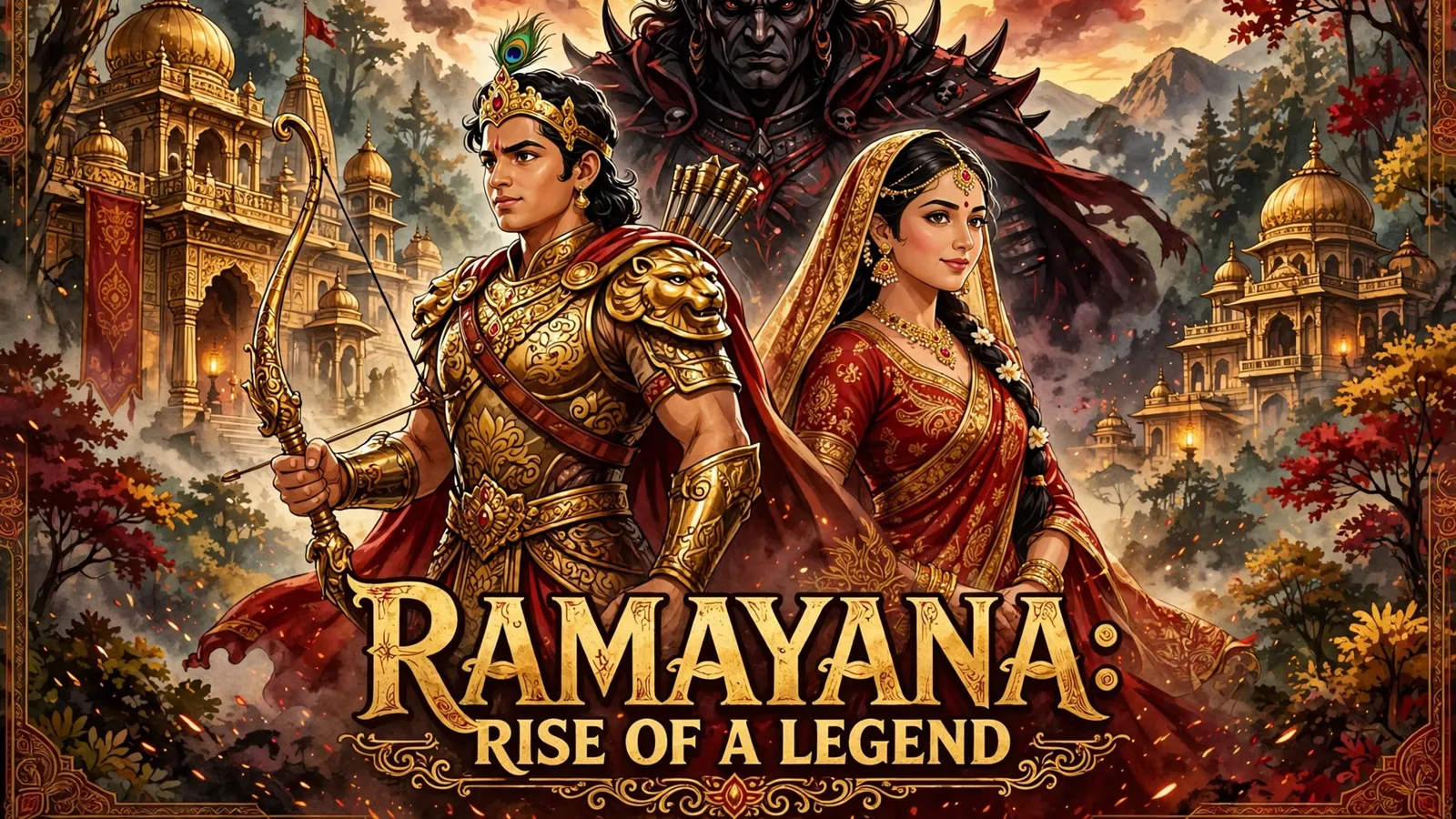
★★★★☆ Our Rating: 7.5/10
There are film releases, and then there are events that feel like festivals. Ramayana: Rise of a Legend belongs firmly in the second category. Nitesh Tiwari’s retelling of the ancient epic — the first of two planned films, with Part Two due around Diwali 2027 — arrived in cinemas worldwide on Thursday, 5 November 2026, after paid previews on the night of 4 November, and it did so trailing numbers Indian cinema has rarely seen: advance bookings past Rs 100 crore in India alone, more than 36 lakh tickets sold before release in some counts, and first shows beginning as early as 6:30 in the morning. In several cities, fans turned screenings into celebrations, with prayers and devotional chanting inside theatres, and the film’s opening day became a news story in itself. The question for a review, though, is separate from the frenzy: once the drums quieten, what kind of film is this?
This review is spoiler-free on the film’s specific staging of the epic’s key moments. The story of Rama’s exile is, of course, among the best-known narratives in the world, and nothing here depends on hiding it — but the film’s particular choices, images and surprises are left for the audience to discover.
| Detail | Information |
|---|---|
| Release date | 5 November 2026 (worldwide theatrical; paid previews 4 November) |
| Director | Nitesh Tiwari |
| Producer | Namit Malhotra (with Yash) |
| Genre | Mythological epic, fantasy drama |
| Language | Hindi (released in Tamil, Telugu, Kannada and Malayalam versions; internationally as Ramayana: Rise of a Legend) |
| Lead cast | Ranbir Kapoor (Rama), Sai Pallavi (Sita), Yash (Ravana), Sunny Deol (Hanuman), Ravie Dubey (Lakshman), Lara Dutta, Arun Govil, Rakul Preet Singh |
| Music | Hans Zimmer and AR Rahman |
| Runtime | About 3 hours 15 minutes |
| Budget | About Rs 4,000 crore reported across both parts (about Rs 2,000 crore for Part One) |
| Certification | U (India) |
| Our rating | 7.5/10 |
Part One follows the first great movement of the epic: Prince Rama, heir of Ayodhya, is sent into a fourteen-year exile, accompanied by his wife Sita and his brother Lakshman, and the film builds towards the abduction of Sita that sets up the war between good and evil promised by the second part. Anyone who knows the Ramayana knows the shape of this journey — the palace, the forest, the renunciation of comfort, the tests of character — and Tiwari’s film treats that familiarity as an asset rather than a problem. It does not rush to surprise viewers who already know the story; instead it tries to make them feel it again, at a scale and with a visual confidence that no earlier screen Ramayana has attempted.
The film’s emotional centre is the triangle at its heart. Rama’s duty and restraint, Sita’s strength and resolve, and Lakshman’s loyalty are played as human qualities first and divine attributes second, which is what keeps a three-hour epic grounded when the spectacle grows enormous. Around them, the film assembles its larger world: the court of Ayodhya, the forest hermitages, and, looming over everything, Lanka and its king. Yash’s Ravana is deliberately positioned as the film’s dark star — a figure of menace and charisma whose presence is felt long before his full confrontation with Rama — and early audience reactions have singled him out as a scene-stealer, with his aura and screen presence drawing as much discussion as any other element of the film.
Ranbir Kapoor as Rama — Kapoor plays Rama with a calm, inward gravity that suits Tiwari’s conception of the character: a prince defined less by display than by discipline. His Rama is a man who accepts exile not with resignation but with a kind of moral clarity, and Kapoor’s restraint gives the film’s grandest images a human anchor. Early reactions, including from fellow filmmakers and from the rapper Badshah after a screening, praised how completely the actors inhabited their characters, and Kapoor’s performance is the still centre around which the spectacle turns.
Sai Pallavi as Sita — Pallavi brings warmth and steel in equal measure to Sita, and the film gives her more interior life than a purely devotional telling might. Her Sita is not a passive figure waiting to be rescued but a partner in the exile, making the same sacrifices with open eyes, and Pallavi’s natural, unforced screen presence makes the forest passages — the quietest stretches of the film — among its most affecting.
Yash as Ravana — If one performance has dominated the opening-day conversation, it is Yash’s. His Ravana is menacing, magnetic and theatrical in the best sense: a king whose power is as much about presence as about armies. Viewers leaving early shows repeatedly named him the film’s standout, and his scenes carry the promise of the confrontation Part Two must deliver. The risk of such a dominant villain is that he overshadows the hero; here, for the most part, the contrast works, because Ravana’s fire throws Rama’s composure into sharper relief.
Sunny Deol as Hanuman, Ravie Dubey as Lakshman, and the ensemble — Deol’s Hanuman arrives with the weight of a beloved figure, and early word suggests his moments land with real force. Dubey’s Lakshman has been singled out in early reactions as exceptional, a loyal brother whose devotion never curdles into mere obedience. Lara Dutta, Arun Govil and Rakul Preet Singh round out a deep ensemble, and the film’s casting — mixing generations of Indian screen acting — is one of its smartest decisions.
Tiwari directs with a confidence that matches the project’s ambition. The film’s visual effects, production design and sheer physical scale have been the most consistently praised elements in early reactions: sweeping landscapes, battle imagery that invites comparison with The Lord of the Rings in its sweep, and a sense of a fully built world rather than a green-screen sketch. The Guardian’s four-star review called the film rousing and hugely enjoyable, singling out the lead trio and the score, and that enthusiasm captures the film’s best quality — it is, at its best, genuinely transporting.
The score, by Hans Zimmer and AR Rahman together, is a major part of that effect. It swells where it should, quiets where it must, and gives the film a sonic identity that feels both international and rooted. Early viewers singled out the background music repeatedly, and the much-discussed “dharti amber” musical moment arrives as a genuine high point.
The film is not without weaknesses, and an honest review must name them. Some early viewers found the storytelling familiar to a fault — “just another Ramayana” was one recurring criticism — and the film’s reverence for its source occasionally slows its dramatic pulse. The English-dubbed version has drawn specific criticism from some reviewers, and the early critical aggregate is genuinely split: while The Guardian awarded four stars, the Rotten Tomatoes figure reported during opening day sat around 45 per cent with reviews still arriving, and the IMDb audience rating was around 7.2 out of 10. That split is the honest picture of a film that dazzles many and leaves others wanting a bolder reinterpretation. Our rating of 7.5 reflects that balance: a spectacular, sincerely felt epic whose storytelling does not always match its scale.
Beyond the Zimmer–Rahman score, the film’s sound design is built for the big screen: the rumble of armies, the quiet of the forest, the devotional swell of crowds. This is a film designed to be heard in a packed auditorium, and the opening-day atmosphere — audiences reacting aloud, applauding, singing — is part of the experience the filmmakers clearly intended. On a home screen, some of that magic will inevitably fade, which is a real reason to see it in cinemas if you can.
What we loved:
What could be better:
Ramayana: Rise of a Legend opened with extraordinary pre-release business. Advance bookings in India crossed Rs 100 crore in several trade counts (about Rs 118.65 crore with over 32 lakh tickets sold by one tracker, and about Rs 130 crore including all categories in another), with overseas advance sales of roughly US$5.6 million pushing the worldwide advance total past Rs 150 crore gross. Trade estimates put the worldwide opening day at Rs 180–200 crore, with the Hindi version expected to contribute Rs 55–60 crore net in India, and some exhibitors projecting a lifetime run of Rs 1,000–3,000 crore if the film connects with its devotional audience through Diwali and beyond.
These are opening-day figures, and they will move: early on 5 November, trackers had the film at about Rs 42.67 crore India net in live morning counting, with the day’s final total still to come. What is already certain is that this is one of the biggest openings in Indian cinema history, and that its fate now depends on word of mouth beyond the opening weekend. A film of this budget — about Rs 4,000 crore across two parts, the most expensive project in Indian film history — needs more than a great weekend; it needs the long, family-driven run that epics can earn when audiences adopt them.
Yes — and yes in a cinema, with a crowd, if that is an option. Ramayana: Rise of a Legend is not a flawless film, and viewers hoping for a radical reimagining of the epic may find it too reverent. But as a piece of popular spectacle it delivers what its advance bookings promised: a grand, sincere, often thrilling retelling, carried by three strong central performances and a score that lifts the whole enterprise. It is the rare film whose opening day genuinely felt like an occasion, and Part One earns its audience’s patience for Part Two. Our rating: 7.5 out of 10 — a big-screen epic worth the pilgrimage, even if the storytelling does not always soar as high as the visuals.
When was Ramayana: Rise of a Legend released?
The film released in cinemas worldwide on 5 November 2026, after paid previews on 4 November 2026, ahead of Diwali.
Who plays Rama, Sita and Ravana?
Ranbir Kapoor plays Rama, Sai Pallavi plays Sita, and Yash plays Ravana. Sunny Deol plays Hanuman and Ravie Dubey plays Lakshman.
Is Ramayana: Rise of a Legend a two-part film?
Yes. This is Part One of a two-part adaptation directed by Nitesh Tiwari, with Part Two due around Diwali 2027.
What is the film’s budget?
Trade reports put the budget at about Rs 4,000 crore across both parts, with Part One costing an estimated Rs 2,000 crore.
Is the film suitable for families?
The film carries a U certificate in India and is designed as a family epic, though its runtime is about three hours and fifteen minutes.