★ LATEST REVIEWS

Our Rating: ★★★★☆ 8.0/10
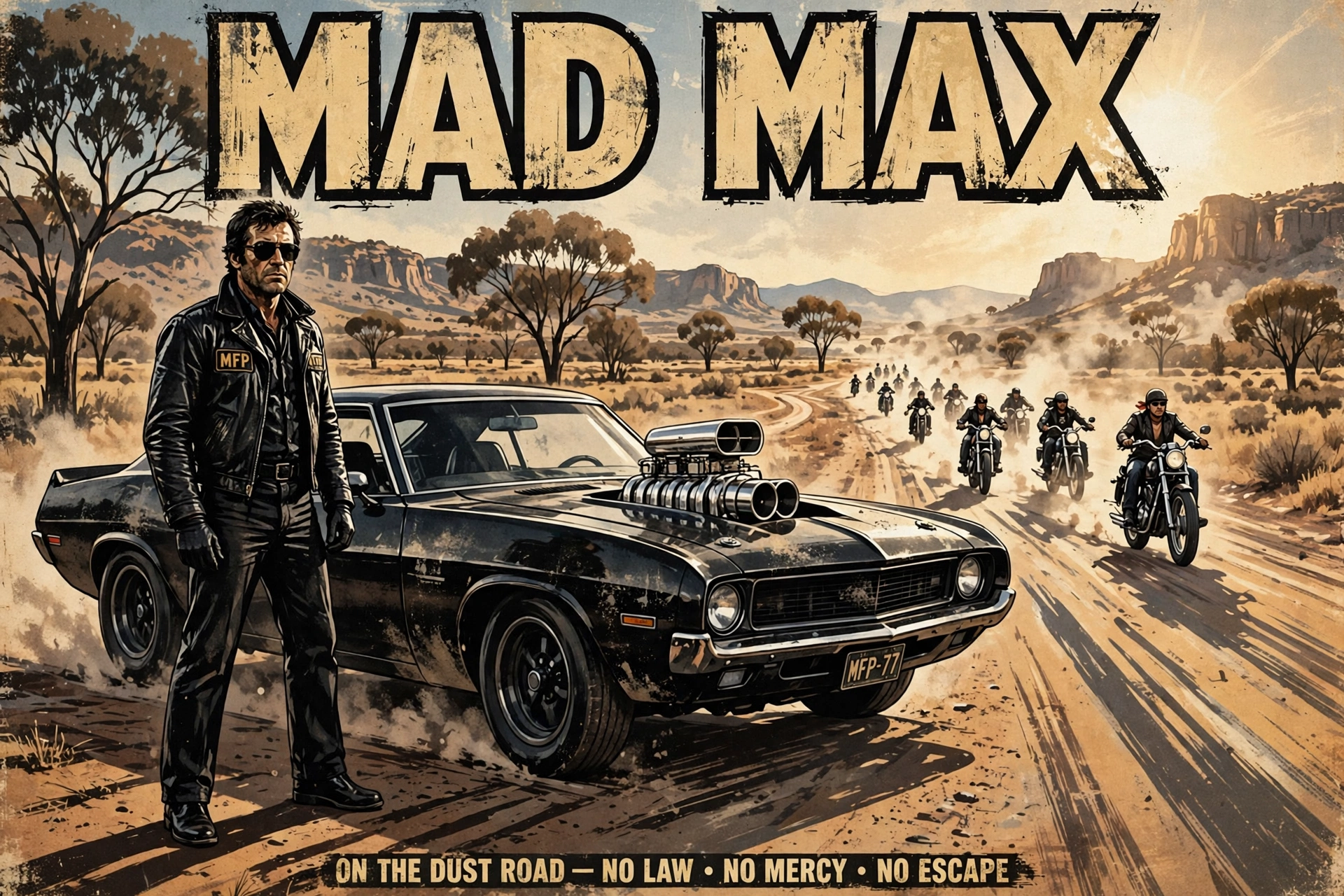
Before Fury Road, before the War Boys and the Doof Wagon, there was a lean, brutal little film shot around Melbourne for almost nothing — and it changed action cinema. George Miller’s Mad Max (1979) is the story of Max Rockatansky, a highway patrolman in a near-future Australia sliding into lawlessness, whose life is destroyed by a motorcycle gang’s revenge. Made by a first-time director who was, by trade, a doctor, on a budget that would barely cover a modern film’s catering, it became one of the most profitable films ever made and launched both Miller and a young Mel Gibson onto the world stage.
What is striking about the film today is how different it is from its sequels. This is not yet the desert wasteland of The Road Warrior. Society here is fraying rather than gone: there are towns, police stations, families, ice-cream stops and beach holidays, and the horror is that violence can reach into all of them. That half-collapsed world makes the film’s brutality hit harder — it is not a fantasy of the apocalypse but a warning about how thin the line between order and chaos really is.
It is a rough film in places: the acting is uneven, the pacing is unusual, and its violence is blunt rather than balletic. But its car chases remain genuinely thrilling, its atmosphere is unforgettable, and its influence is incalculable. In this review we look at the spoiler-free story, the performances, Miller’s direction, the music and the extraordinary box-office story, and we give an honest verdict.
| Detail | Information |
|---|---|
| Release date | 12 April 1979 (Australia) |
| Director | George Miller |
| Writers | James McCausland, George Miller |
| Story | George Miller, Byron Kennedy |
| Genre | Action, Dystopian, Thriller |
| Language | English |
| Runtime | 93 minutes |
| Budget | A$350,000–400,000 |
| Lead cast | Mel Gibson, Joanne Samuel, Hugh Keays-Byrne, Steve Bisley, Tim Burns, Roger Ward |
| Our rating | 8.0/10 |
In a near-future Australia, the roads belong to whoever is fastest and most ruthless. The Main Force Patrol — a dwindling highway police unit in leather uniforms and supercharged cars — tries to hold the line against outlaw motorcycle gangs. Max Rockatansky is the unit’s best driver, a man who is good at the violence his job requires and increasingly frightened by how good he is at it. When a confrontation with the gang led by the Toecutter escalates into a cycle of revenge, Max’s professional life and his private life — his wife Jessie and their baby son — are pulled into the same collision.
Without revealing how that collision ends, it is fair to say the film’s structure is unusual for an action movie. The first half is almost a workplace drama: patrolmen joking, arguing and worrying about their future, Max trying to decide whether to quit before the job hollows him out. The second half is something else entirely — lean, merciless and wordless in stretches. That shift is the point. Miller is showing us a man who tries to walk away from violence and discovers that violence has already decided to follow him home.
Mel Gibson as Max — Gibson was twenty-two and almost unknown when he took the role, and his performance is the film’s revelation. He plays Max as a man of few words and watchful eyes, a driver who expresses himself through the car rather than speeches. The stillness is what makes the later fury so shocking: this is not a hero who enjoys revenge but a man discovering, horribly, what he is capable of. It is a star-making turn, and it is easy to see why the world noticed.
Joanne Samuel as Jessie — Samuel gives Jessie a warmth and independence that make the family’s happiness feel real rather than merely functional. Her scenes with Gibson — at home, on holiday, in the car — are the film’s emotional ballast, and they are played with a naturalness that the genre rarely allows.
Hugh Keays-Byrne as the Toecutter — Keays-Byrne, who would return to the series decades later as Immortan Joe in Fury Road, is unforgettable as the gang leader: theatrical, menacing and strange, a cult leader as much as a criminal. Steve Bisley brings loyal, reckless energy as Max’s partner Jim Goose, and Tim Burns is chilling as Johnny the Boy, the gang member whose weakness makes him dangerous. Roger Ward rounds out the cast as Fifi, the patrol captain trying to hold a collapsing institution together.
George Miller’s direction is the film’s greatest asset, and it is astonishing for a debut. Working with cinematographer David Eggby, he shoots the Victorian countryside — shot in and around Melbourne over six weeks — as a landscape of long, empty roads and harsh light, and he stages the car chases with a visceral, ground-level energy that bigger-budget films still imitate. The crashes are real, the speeds are real, and the camera is often mounted low on the cars themselves, so the audience feels the road rather than merely watching it.
Miller, a former emergency doctor, brings a clinician’s eye to violence: it is sudden, messy and consequential, never glamorous. The film’s sound design — engines, wind, the scream of tyres — does as much work as the score. The editing by Tony Paterson and Cliff Hayes is jagged in the action and patient in the quiet scenes, and that contrast is deliberate: the film wants you to feel the difference between a life and a chase.
The rough edges are real, too. Some supporting performances are stiff, some dialogue is clunky, and the film’s low budget shows in places. But the craft where it matters — the driving, the tension, the atmosphere — is superb.
Brian May’s score (not the Queen guitarist, but the Australian composer of the same name) is propulsive and ominous, built on driving rhythms and brass that push the chase sequences forward without ever becoming mere noise. It is one of the film’s unsung strengths: the music gives the road a pulse, and it knows when to fall silent and let an engine do the talking.
What we loved:
What could be better:
Mad Max was made for between A$350,000 and A$400,000 — one of the smallest budgets ever for a film of its impact — and it earned more than US$100 million worldwide, setting a Guinness World Record as the most profitable film ever made at the time. Its success opened the global market to Australian New Wave cinema and launched a franchise that now spans five films and nearly half a century. Its critical reputation has only grown since its initially polarised reception, and it won multiple AACTA Awards (then AFI Awards) in Australia.
Yes — especially if you know Fury Road but have never seen where it all began. Mad Max is rawer, stranger and quieter than its sequels, and that is precisely why it is worth watching: it shows a great director learning his craft in public, a great star being born, and a national cinema announcing itself to the world with a scream of engines. Watch it before The Road Warrior for the full arc of Max’s fall.
Our rating: 8.0/10 — A lean, ferocious, historically vital action classic that still rattles the nerves.
Is Mad Max (1979) the first Mad Max film?
Yes. It is the first in the series, followed by Mad Max 2 (1981), Mad Max Beyond Thunderdome (1985) and Mad Max: Fury Road (2015).
How much did Mad Max cost to make?
Between A$350,000 and A$400,000 — a tiny budget that made its US$100 million-plus gross a world record for profitability.
Is Mad Max set after the apocalypse?
Not quite. Unlike its sequels, the first film is set in a society that is collapsing rather than collapsed — there are still towns, police and families.
Who plays the Toecutter?
Hugh Keays-Byrne, who later played Immortan Joe in Mad Max: Fury Road.
How long is Mad Max?
It runs 93 minutes.