★ LATEST REVIEWS

★★★★☆ Our Rating: 8.5/10
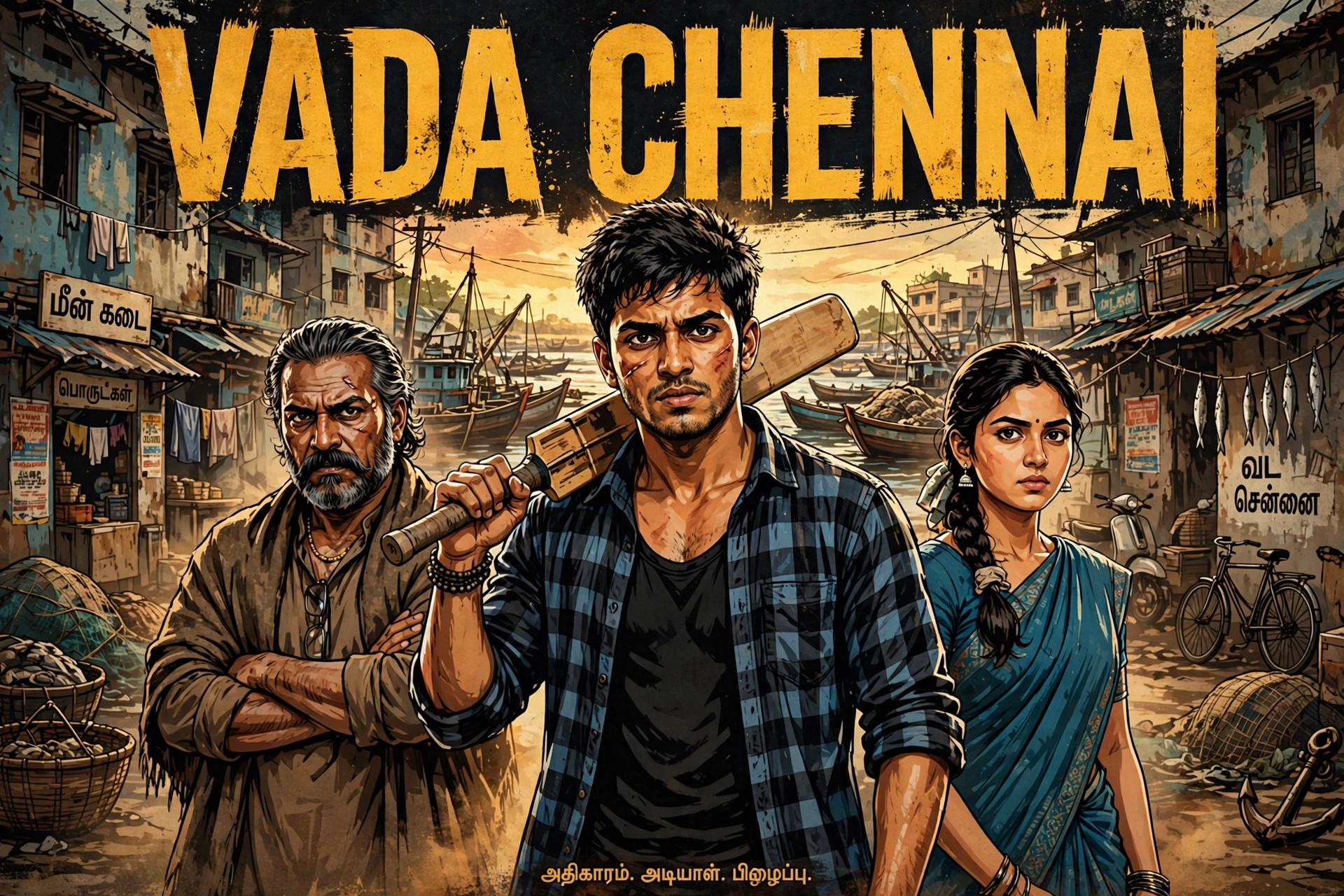
North Chennai has produced some of Tamil cinema’s greatest stories, and Vada Chennai is among the most ambitious of them. Directed by Vetrimaaran and starring Dhanush, it is the first chapter of a planned trilogy: a sprawling, multi-decade gangster saga about a carrom player named Anbu who drifts, almost accidentally, into the violent politics of his neighbourhood, and discovers that in North Chennai, nobody stays neutral for long. Released on 17 October 2018, it was praised for its realism, its performances and its refusal to glamorise the world it depicts. It is dense, bloody and uncompromising — and it is one of the finest Tamil crime films of its era.
This review is spoiler-free on the film’s major turns. The pleasure of Vada Chennai lies in watching its web of loyalties tighten, and its surprises should be met unspoiled.
| Detail | Information |
|---|---|
| Release date | 17 October 2018 (India) |
| Director | Vetrimaaran |
| Writers | Vetrimaaran |
| Genre | Crime drama |
| Language | Tamil |
| Budget | Reported figures conflict, ranging from around ₹50 crore to around ₹65 crore; no single official figure is settled |
| Box office | Reported worldwide totals range from around ₹55 crore to around ₹69 crore; figures vary by source and should be read as estimates |
| Lead cast | Dhanush, Ameer, Andrea Jeremiah, Aishwarya Rajesh, Samuthirakani, Daniel Balaji, Kishore, Pawan |
| Our rating | 8.5/10 |
Anbu (Dhanush) is a skilled carrom player in the fishing neighbourhoods of North Chennai, a young man whose ambitions are modest: play well, live quietly, stay out of trouble. But North Chennai does not allow neutrality. Two rival powers — the gangster-politicians who control the area’s land, votes and loyalties — are locked in a feud that has run for decades, and Anbu’s talent, his friendships and his family keep pulling him into their orbit. A murder, a prison sentence that is not his, and a series of debts and favours gradually transform him from a bystander into a player.
Vetrimaaran tells the story across two timelines, cutting between the present-day gang war and the decades of history that produced it. The film’s structure is its great strength and its great demand: there are many characters, many betrayals, and many threads, and the film trusts the audience to keep up. The reward for that trust is a world that feels genuinely lived-in, where every killing has a history and every alliance has a price. Anbu’s journey is not a rise-to-power fantasy; it is a study of how ordinary people get absorbed by violence, one small compromise at a time.
The film’s North Chennai is rendered with extraordinary specificity: the lanes, the fishing boats, the housing blocks, the carrom clubs, the slang, the food, the funerals. This is not a generic gangster backdrop but a place with its own codes, and Vetrimaaran, who has made a career of filming Tamil Nadu’s working-class worlds with anthropological care, films it like a man who knows every street.
Dhanush as Anbu — Dhanush gives one of his finest performances, and that is saying something. Anbu is not a swaggering don but a quiet, watchful young man, and Dhanush plays him with a restraint that makes his moments of violence genuinely shocking. As Anbu ages and hardens across the film’s timeline, Dhanush lets the change show in his body and his eyes rather than in speeches. It is a performance of accumulation: by the end, you understand exactly how this boy became this man, and the understanding is tragic rather than triumphant.
Ameer as Rajan — Ameer, himself a director, is magnificent as Rajan, the charismatic gang leader whose shadow falls over the whole film. Rajan is the kind of character Tamil cinema rarely writes well: a criminal with a political mind, a sense of honour and a fatal blind spot. Ameer gives him gravity and warmth, which makes his fate hit all the harder.
Andrea Jeremiah, Aishwarya Rajesh and the ensemble — Andrea Jeremiah brings toughness and tenderness to Chandra, a woman who refuses to be a bystander in the men’s war, while Aishwarya Rajesh gives Padma a quiet, grounded dignity. Samuthirakani, Daniel Balaji, Kishore and Pawan fill out a large cast of gangsters, cops, politicians and neighbours, each sharply drawn. Vetrimaaran’s films are always ensembles, and this is one of his richest.
Vetrimaaran directs with a documentarian’s eye and a novelist’s patience. The film’s violence is sudden, ugly and consequential — never stylish for its own sake — and its quiet scenes, of families eating, of carrom games, of funerals, are given as much weight as its murders. Velraj’s cinematography captures North Chennai in dusty, sun-bleached colour, and the editing weaves the two timelines together with confidence. The film’s length and density are deliberate: this is a saga, not a thriller, and it asks to be watched with attention.
The honest caveat is that the film’s first chapter ends mid-story. Vada Chennai was planned as a trilogy, and its ending is a pause rather than a conclusion: several threads are left deliberately unresolved, and viewers who want a complete arc may feel frustrated. Reports in recent years have suggested the sequel may be revamped with a new cast and director, so the trilogy’s future remains uncertain. Judged as a single film, Vada Chennai is a superb, if deliberately incomplete, opening movement.
Santhosh Narayanan’s score is one of the film’s quiet triumphs. Rather than heroic gangster themes, it uses folk instrumentation, mournful melodies and raw, percussive textures that root the film in North Chennai’s musical traditions. The songs, including the celebrated “Sandhanatha” and “Maadila Nikkura”, work as both period texture and emotional commentary. The sound design — the sea, the streets, the sudden gunfire — keeps the world feeling real and dangerous.
What we loved:
What could be better:
Vada Chennai‘s commercial record is a case study in why box-office figures for Indian films must be read carefully. Its budget is reported anywhere from around ₹50 crore to around ₹65 crore, and its worldwide total anywhere from around ₹55 crore to around ₹69 crore, depending on the source. What is not in dispute is the shape of the story: the film opened strongly, was declared a hit by its distributors within its first weeks, and went on to become one of the highest-grossing films of Dhanush’s career to that point, as well as a cult favourite that has only grown in reputation since. The conflicting figures reflect the absence of a single audited source, not any doubt about the film’s success.
Yes, if you like serious crime cinema. Vada Chennai is not a light watch — it is violent, dense and deliberately unresolved — but it is one of the great Tamil films of its decade: superbly acted, richly detailed, and morally serious about the world it depicts. Watch it with attention, and accept that it is the beginning of a story whose ending is still unwritten.
Our rating: 8.5/10 — A brutal, brilliant gangster saga: Dhanush and Vetrimaaran at their peak, in a North Chennai world that feels achingly real.
Is Vada Chennai based on a true story?
No, it is fiction, though it is deeply rooted in the real social and political history of North Chennai’s fishing communities and gang rivalries.
Who stars in Vada Chennai?
Dhanush as Anbu, Ameer as Rajan, Andrea Jeremiah as Chandra and Aishwarya Rajesh as Padma, with Samuthirakani, Daniel Balaji, Kishore and Pawan in key roles.
Is there a Vada Chennai 2?
A sequel was planned as part of a trilogy, but recent reports suggest it may be revamped with a new cast and director; no official announcement has confirmed its final form.
How much did Vada Chennai earn at the box office?
Reported worldwide totals range from around ₹55 crore to around ₹69 crore against a reported budget of ₹50–65 crore; figures vary by source and should be read as estimates.
Is Vada Chennai suitable for family viewing?
No. It is a violent adult crime drama with an A certificate, best suited to adult viewers.
