★ LATEST REVIEWS

★★★★☆ Our Rating: 8.5/10
Every few years a film arrives with no superheroes, no explosions and no franchise behind it, and still manages to outperform almost everything else at the box office. The Intouchables is that film for French cinema. Released in France on 2 November 2011, this modestly budgeted comedy-drama about a wealthy man who cannot move below the neck and the unemployed ex-convict who becomes his carer went on to become the second-biggest hit in French box office history at the time, and one of the most successful non-English-language films ever made worldwide.
Popularity alone does not guarantee quality, of course. Plenty of crowd-pleasers fade within a year. So does The Intouchables actually deserve its reputation more than a decade later, or is it simply a well-timed piece of sentiment? In this review we look honestly at the story, the performances, the direction and the music, and explain why this film still works — and where it plays things a little too safe.
| Detail | Information |
|---|---|
| Release date | 2 November 2011 (France) |
| Director | Olivier Nakache, Éric Toledano |
| Writers | Olivier Nakache, Éric Toledano |
| Genre | Comedy, Drama |
| Language | French |
| Runtime | 112 minutes |
| Budget | €9.5 million |
| Lead cast | François Cluzet, Omar Sy, Anne Le Ny, Audrey Fleurot |
| Our rating | 8.5/10 |
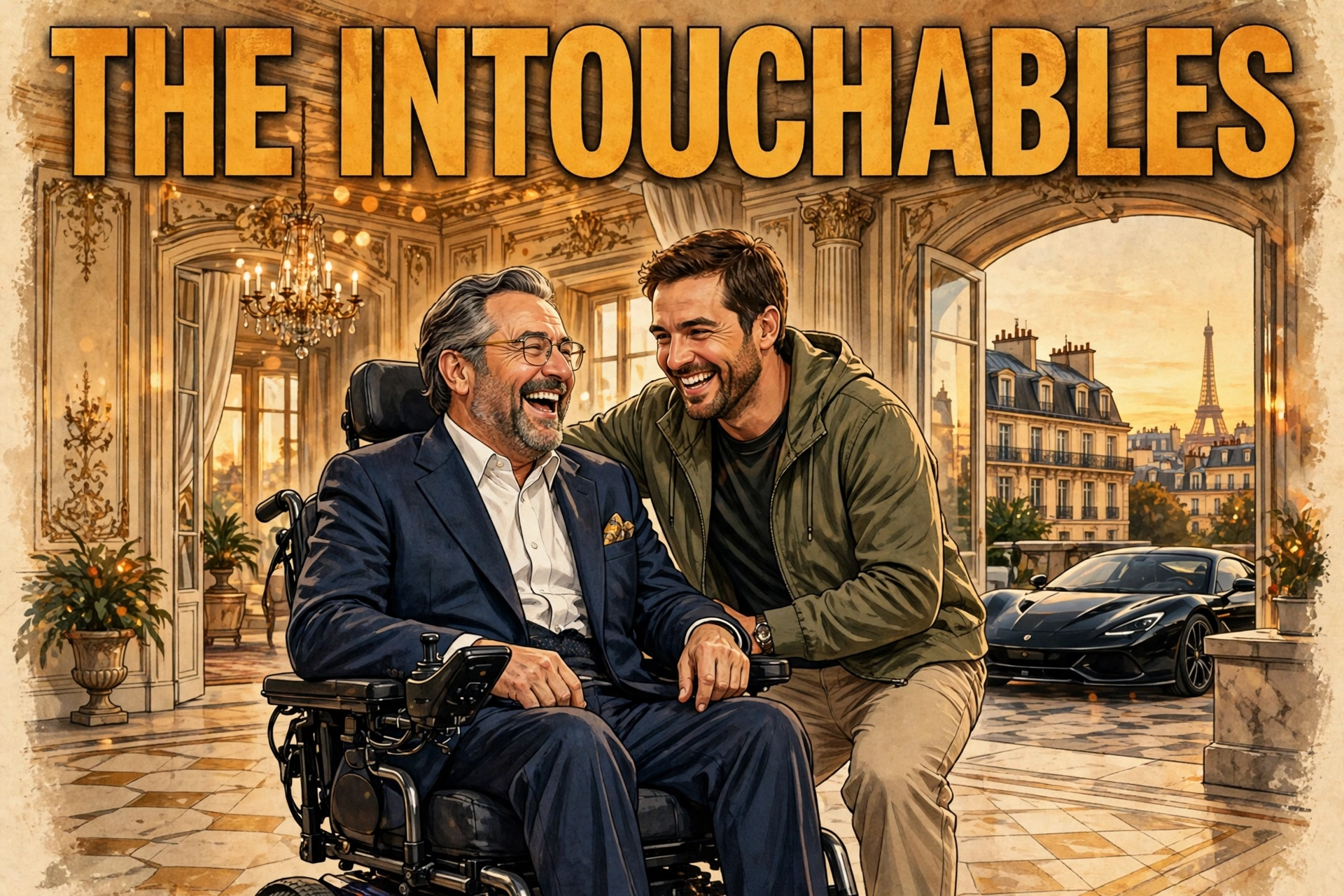
Philippe is a rich Parisian aristocrat living in a beautiful mansion, surrounded by art, classical music and staff who treat him with careful, distant politeness. A paragliding accident several years earlier left him quadriplegic, able to move only his head, and since the death of his wife he has quietly lost interest in the life going on around him. What he wants most is not sympathy. He wants someone who will treat him like a person rather than a patient.
Into his latest round of carer interviews walks Driss, a tall, confident young man from a housing estate on the edge of Paris. Driss has recently come out of prison, lives in a cramped flat with his aunt and a crowd of younger relatives, and has only turned up because he needs a signature to keep his unemployment benefits. He expects to be rejected within minutes. Instead, his complete lack of pity — he jokes, he flirts with the assistant, he forgets the wheelchair entirely — is exactly what Philippe has been looking for, and Driss is offered the job on a trial basis.
What follows is not a miracle cure story, and the film is better for it. Philippe’s condition never magically improves, and Driss does not suddenly become a saint. Instead, the film builds its story out of small, believable exchanges: Driss learning, often clumsily, how demanding full-time care really is, and Philippe being dragged, sometimes literally, back into pleasures he had given up on — fast cars, live music, even romance. Running underneath the comedy is a simple question that gives the second half its weight: what happens to a friendship built inside an employment contract when both men have to face the lives waiting for them outside the mansion?
The film is inspired by the real relationship between Philippe Pozzo di Borgo and his carer Abdel Sellou, whose story was told in a memoir and a television documentary before the directors adapted it. Knowing it grows out of something real helps explain why the film, for all its polish, keeps its feet on the ground.
François Cluzet as Philippe has the harder job in many ways, because he must do almost everything with his face and voice alone. He plays Philippe as dry, proud and quietly funny rather than tragic, which is essential — a self-pitying Philippe would sink the whole film. Watch how much he communicates in the interview scenes with small shifts of expression: amusement, irritation, and the first flicker of hope in years. It is a masterclass in restraint from one of France’s most reliable actors.
Omar Sy as Driss is the film’s explosion of energy, and it is easy to see why this role made him a star and won him the César Award for Best Actor — the first Black actor to win that prize. Sy is naturally charismatic, but the performance is more than charm. He lets Driss be genuinely selfish and unreliable early on, so that the character’s growth actually means something, and he handles the quieter scenes, particularly those involving Driss’s family, without turning them into a different film. Crucially, he never plays Driss as a lovable clown there to serve Philippe’s story; Driss has his own pride, his own shame and his own arc.
Anne Le Ny as Yvonne, Philippe’s long-serving housekeeper, provides the film’s warm centre, watching the chaos with weary affection, while Audrey Fleurot as Magalie, the assistant who is the target of much of Driss’s flirting, gives as good as she gets. The supporting cast is used sparingly but well, and nobody is wasted.
Directors Olivier Nakache and Éric Toledano, who also wrote the film, make a series of smart, unshowy choices. They shoot Philippe’s mansion as beautiful but faintly airless — a golden cage — and contrast it with the noise and colour of Driss’s neighbourhood, without turning either world into a caricature. The editing is brisk, the gags are allowed to land and then the film moves on, and scenes of personal care that could have been played purely for embarrassment are handled with a dignity that keeps the comedy kind rather than cruel.
Perhaps their best decision is structural. Rather than building towards one huge dramatic climax, they let the film accumulate small moments — a shave that goes wrong, an argument about opera, a birthday party that turns into something joyful — so that by the final act the audience has genuinely lived with these two men. When the emotional moments arrive, they feel earned rather than switched on.
Music is practically a third character here. Philippe loves classical music and opera; Driss loves Earth, Wind & Fire and funk, and the film uses that clash as both comedy and character development. The score leans heavily on the piano compositions of Ludovico Einaudi, whose gentle, repeating pieces give the film its reflective tone and have become inseparably linked with it in the years since. Purists occasionally complain that the Einaudi tracks are overused in modern cinema generally, but within this film they fit Philippe’s interior world perfectly — calm on the surface, full of feeling underneath.
What we loved:
What could be better:
The commercial story remains astonishing. Made for a reported €9.5 million, the film earned around $166 million in France alone and finished with a worldwide total of roughly $426–427 million, making it at the time the highest-grossing French-language film internationally and the second-biggest success in French box office history behind Welcome to the Sticks. It was a phenomenon in Germany, Spain, Italy and South Korea as well, and it achieved all of this as a French-language drama with subtitles, in an era when conventional wisdom said such films could not travel. Its success also paved the way for an English-language remake, The Upside (2019), starring Bryan Cranston and Kevin Hart — a pleasant film, but one that underlined how hard this original’s balance is to copy.
Yes — especially if you have somehow avoided it until now. The Intouchables is not a revolutionary film, and it does not pretend to be. Its story shape is familiar, and its ending tidies up more than real life would. But the execution is close to flawless: two outstanding performances, a script that respects both its characters and its audience, and a warmth that never curdles into manipulation. It remains the modern benchmark for the crowd-pleasing drama, and it still makes audiences laugh and cry in the same scene, often within the same minute.
Our rating: 8.5/10 — a funny, humane and beautifully acted modern classic of French cinema.
Is The Intouchables based on a true story?
Yes. It is inspired by the real friendship between Philippe Pozzo di Borgo, a French businessman left quadriplegic after a paragliding accident, and his carer Abdel Sellou. The characters and events are fictionalised, but the core relationship is real.
Is The Intouchables suitable for family viewing?
Mostly, yes. It deals with disability, grief and prison in a mature but gentle way, and contains some strong language. It is widely regarded as a feel-good film suitable for older children and teenagers with parental guidance.
Do I need to speak French to enjoy it?
No. The film is in French, but subtitled and dubbed versions are widely available, and the performances and physical comedy carry much of the meaning even before the dialogue.
How is The Intouchables different from The Upside?
The Upside (2019) is the official English-language remake of the same story, with Bryan Cranston as the wealthy quadriplegic and Kevin Hart as his carer. Most critics and audiences consider the French original the stronger, better-balanced film.
Where can I watch The Intouchables?
The film is widely available on streaming services and for digital rental in most countries, though the exact platform varies by region, so check your local services.