★ LATEST REVIEWS

★★★★★ Our Rating: 9/10
There is a moment early in Spider-Man: Across the Spider-Verse when Gwen Stacy’s world turns into shifting watercolour, colours bleeding with her mood, while drums crash around a family argument she cannot win with words. In that single sequence, the film announces its real ambition. This is not just a sequel to the much-loved Into the Spider-Verse from 2018, and it is not just another multiverse story in a market crowded with them. It is an attempt to make animation itself carry emotion, character, and argument, frame by frame, style by style.
That ambition mostly succeeds, dazzlingly. Miles Morales returns as a teenager trying to balance school, family expectations, secrets, and a growing belief that the older heroes who judge him may be wrong. Around him, the film builds a vast society of Spider-People from different worlds, each drawn and animated in a distinct visual language. It is funny, romantic, sad, and visually overwhelming, sometimes all in the same minute.
Honesty requires mentioning the cost: this is a middle chapter, and it ends on a major cliffhanger. Some viewers will feel they have watched half a masterpiece. In this review, we give you an honest breakdown of the story, performances, craft, music, and box office, without spoiling the final twists.
| Detail | Information |
|---|---|
| Release date | 2 June 2023 (United States) |
| Director | Joaquim Dos Santos, Kemp Powers, Justin K. Thompson |
| Writers | Phil Lord, Christopher Miller, Dave Callaham |
| Genre | Animation, Action, Adventure |
| Language | English |
| Runtime | 140 minutes |
| Budget | $100–150 million |
| Lead cast | Shameik Moore, Hailee Steinfeld, Brian Tyree Henry, Jake Johnson, Oscar Isaac |
| Our rating | 9/10 |
More than a year after the events of the first film, Miles Morales is an experienced Spider-Man in Brooklyn and an increasingly strained son and student at home. His parents, Jefferson Davis and Rio Morales, can see that he is hiding something important. School counsellors talk about his future. Miles talks around the truth. He is late, distracted, and desperate to prove that he can handle a life that keeps splitting in two directions.
Gwen Stacy returns to his world as part of a wider mission. Across the multiverse, anomalies, villains displaced from their own dimensions, are appearing where they do not belong. A team called the Spider-Society, led by the intense Miguel O’Hara, also known as Spider-Man 2099, works to contain those disruptions and protect what they call canon events, painful milestones they believe must happen in every Spider-Person’s life to keep reality stable. Miles, who became Spider-Man through an accident involving another universe, does not fit their model neatly, and Miguel’s suspicion of him is clear from their first meeting.
At the same time, a seemingly minor villain from Miles’s early patrols, the Spot, is becoming far more dangerous than anyone expected. What begins as a joke about a man covered in portals turns into a personal and growing threat connected to Miles’s own origin. When Miles follows Gwen across dimensions, visiting worlds including a Mumbai-inspired Manhattan hybrid and the sleek, severe headquarters of the Spider-Society, he discovers a belief about his own family that he refuses to accept. The heart of the story is that refusal. Experienced heroes tell a teenager that suffering is necessary and predetermined. Miles insists that his choices still matter. This section will not reveal where that argument leads, but it drives every major chase and confrontation that follows.
Shameik Moore as Miles Morales — Moore grows with the character. His Miles is funnier and more confident in a mask, then awkward and defensive the moment a parent asks a simple question. That contrast is the character. Moore also handles the film’s biggest emotional challenge, making Miles’s defiance feel like love rather than selfishness. He is not rejecting responsibility. He is rejecting the idea that responsibility must mean accepting a loss he might be able to prevent.
Hailee Steinfeld as Gwen Stacy — Steinfeld gets a much larger role here, including an opening section told from Gwen’s point of view, and she makes the most of it. Gwen is brave, funny, and carrying guilt she cannot share with her father or with Miles. Steinfeld’s voice work shows loneliness in small pauses, not just in big speeches, and the film is richer for treating Gwen as a co-lead rather than a guest star.
Oscar Isaac as Miguel O’Hara / Spider-Man 2099 — Isaac plays Miguel with a heavy, humourless intensity that is deliberately out of step with the quippier Spider-People around him. He is not a cackling villain. He sounds like a man who has seen disaster and decided that feeling less is the price of preventing more of it. That makes him a strong ideological opponent for Miles, even when the film leans a little hard on his exposition.
Brian Tyree Henry as Jefferson Davis and Luna Lauren Velez as Rio Morales — Henry and Velez give the film its grounding. Their scenes as parents trying to raise a good son while sensing a secret are funny, specific, and moving. In a film full of dimensions, they make an ordinary Brooklyn kitchen and a school meeting feel just as important as a collapsing universe, which is exactly the point.
Jake Johnson as Peter B. Parker, Daniel Kaluuya as Spider-Punk, and Karan Soni as Spider-Man India — Johnson returns with warm, tired-dad energy, now carrying baby Mayday, and provides both comedy and a gentler view of mentorship. Kaluuya’s Hobie Brown, Spider-Punk, steals scenes with a laid-back anti-authority attitude and an animation style that constantly shifts like torn magazine collage. Soni brings charm and speed to Pavitr Prabhakar, whose world is one of the film’s visual highlights. Jason Schwartzman also deserves credit for turning the Spot from comic relief into something genuinely unsettling.
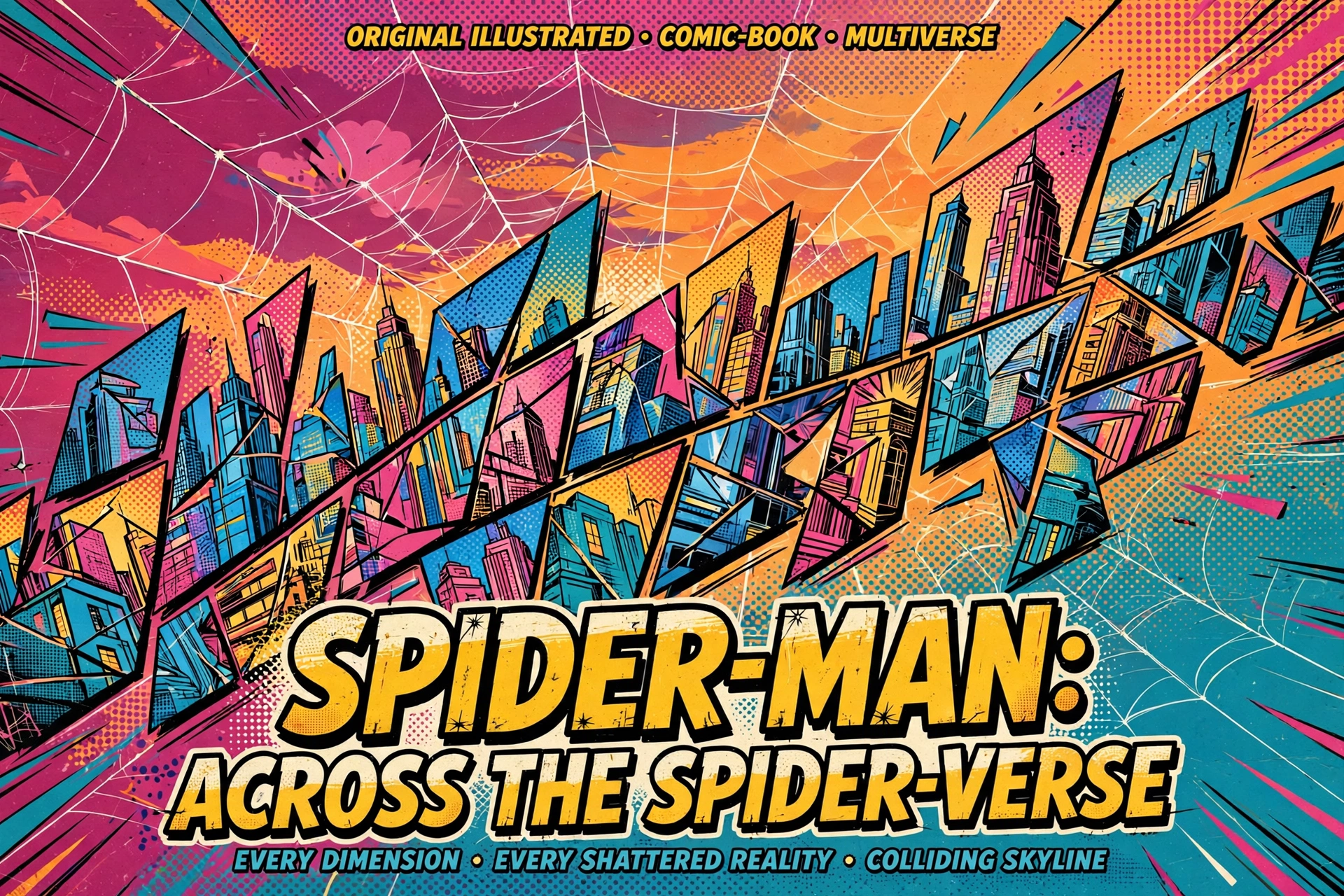
Directors Joaquim Dos Santos, Kemp Powers, and Justin K. Thompson, working from a screenplay by Phil Lord, Christopher Miller, and Dave Callaham, manage an extraordinary balancing act. Each universe has its own art direction, frame rate choices, colour logic, and texture. Gwen’s world melts and sharpens with emotion. Pavitr’s Mumbattan is dense, joyful, and layered with movement in every corner of the frame. Spider-Punk looks as if he has been cut from photocopied gig posters. Miguel’s future world is angular and cold. None of this is random showing off, at its best. Style tells you who a character is before they speak.
Action is staged with the same invention. A chase through the Spider-Society headquarters throws hundreds of distinct Spider-People into the frame, including deep-cut jokes for long-time fans, yet the camera keeps Miles and the emotional argument at the centre. Editing by Michael Andrews maintains momentum across a long film, though the sheer density means some viewers, especially younger children, may find certain sequences visually exhausting. There is simply a lot to look at, all the time.
The honest criticism is that the film’s inventiveness occasionally outruns clarity. Background gags fly past too quickly to register, a few action beats become a blur of colour and limbs, and the script needs several dense explanations of canon, anomalies, and multiverse rules. Those explanations are more elegant than in many superhero films, but they are still explanations, and they slow the second act. At 140 minutes, it was at release the longest American animated film, and while most of that length is justified, the final cliffhanger makes the scale feel even larger because the story does not close.
Daniel Pemberton’s score returns and expands on the first film’s musical identity, mixing orchestral superhero weight with electronic beats, scratches, and shifts in tempo that match different animation styles. Themes associated with Gwen, Miles, and Miguel feel distinct without turning the film into a collection of disconnected cues. Pemberton is particularly good in the opening Gwen sequence, where percussion becomes both score and storytelling, and in quieter family scenes where he steps back and lets the voices carry the emotion.
The soundtrack album, curated with producer Metro Boomin, gives Brooklyn scenes a youthful energy that suits Miles. Sound design also matters: each portal, web, and dimension shift has its own texture, helping the audience feel transitions that could otherwise become confusing.
What we loved:
What could be better:
Produced on a reported budget in the $100–150 million range, Across the Spider-Verse grossed about $690.8 million worldwide. That was a major jump from Into the Spider-Verse, which had earned around $384 million and built much of its reputation through awards and home viewing. The sequel opened strongly in North America with about $120 million, showing that Miles Morales had moved from a beloved discovery to a proven theatrical draw.
The result was significant for animation. This was not a film that sanded down its style to look like every other family release. It was long, visually experimental, aimed at older children, teenagers, and adults as much as at young children, and it still became one of the biggest films of 2023. It later won wide critical acclaim and numerous animation awards, though it lost the Academy Award for Best Animated Feature to The Boy and the Heron. Commercially, it confirmed that audiences will turn out for original, artist-driven animation when the craft and characters justify the risk.
Absolutely, with one clear warning: know that you are watching the middle of a story. If an unresolved ending frustrates you, you may prefer to wait until the sequel, Beyond the Spider-Verse, is close to release and watch them together. If you can accept that, Across the Spider-Verse offers some of the most joyful, moving, and daring filmmaking in modern superhero cinema.
It is for anyone who wants to see what animation can do when artists are trusted to be strange and specific. Beneath the colour sits a powerful question any teenager or parent will recognise: who gets to decide what your story must be?
Our rating: 9/10 — A dazzling, heartfelt middle chapter that pushes animation forward and only loses a point for its unfinished ending.
Is Across the Spider-Verse a sequel, and do I need to watch Into the Spider-Verse first?
Yes, it is a direct sequel. You should watch Into the Spider-Verse (2018) first to understand Miles, Gwen, Peter B. Parker, and the events that created the Spot.
Will there be another Spider-Verse film?
Yes. A third film, Spider-Man: Beyond the Spider-Verse, is planned to continue the story and resolve the cliffhanger ending. Release plans have changed in the past, so check official announcements for the current date.
Is the film based on a true story or only on comics?
It is fictional and based on Marvel Comics characters, especially Miles Morales. It draws on many Spider-Man comics, films, and shows for its multiverse of characters, but tells an original screen story.
What language is it in, and are subtitles and dubbing available?
The original version is in English. International releases offer dubbing and subtitles in many languages, depending on the country and platform.
Where can I watch it, and is it suitable for children?
Check major streaming, purchase, and rental services in your country, as availability changes. It is rated PG for sequences of animated action violence, some language, and thematic elements. It runs 140 minutes and its intense imagery and cliffhanger may suit older children better than very young viewers.