★ LATEST REVIEWS

Our Rating: ★★★☆☆ 5.5/10
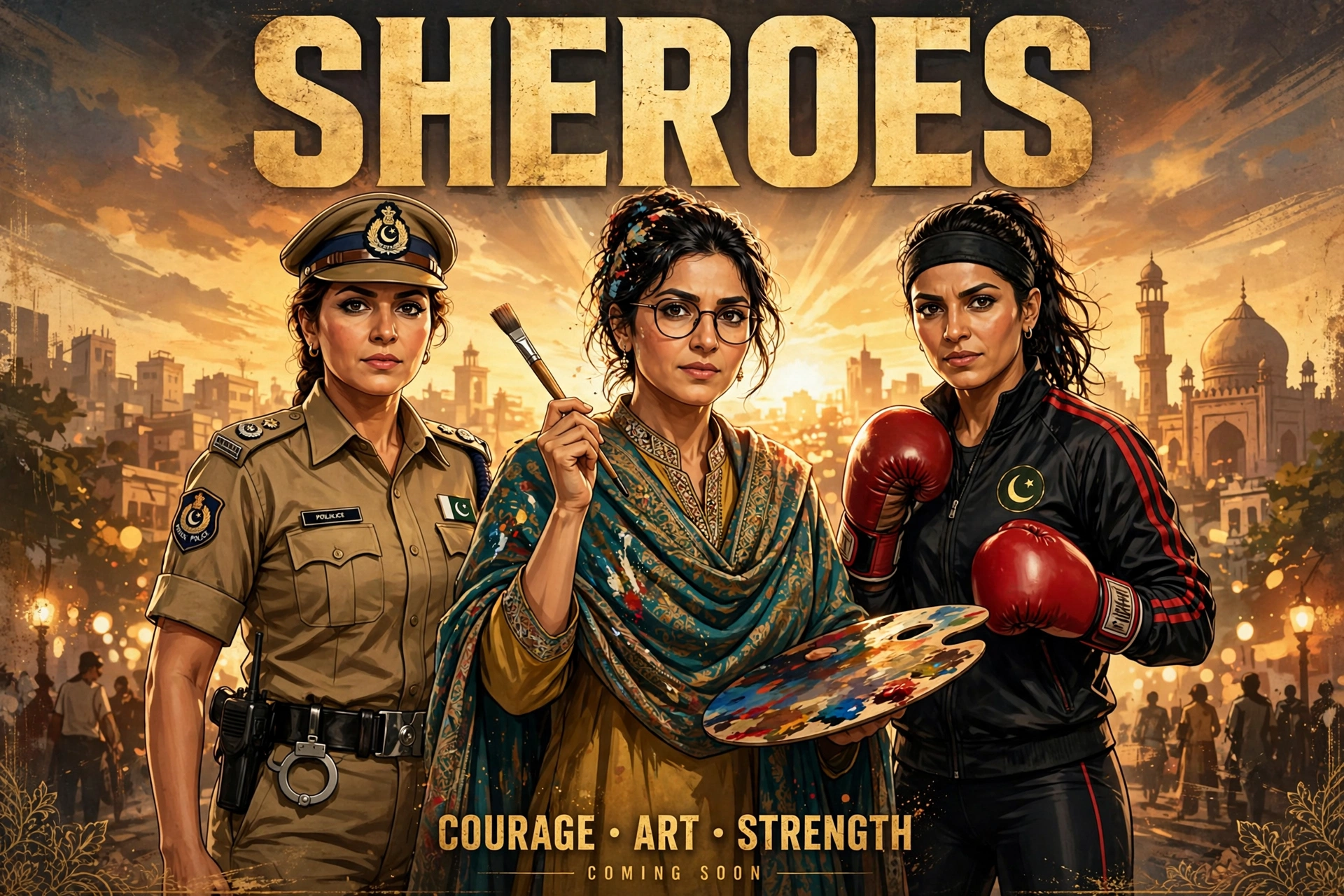
Sheroes arrives with a good idea and a good intention. Three actresses, three standalone stories, three women — a police officer, an artist and a boxer — each facing a world that expects her to be smaller than she is. Produced by Sindh Films and Tamasha Films, the anthology wants to celebrate women’s strength in Pakistani cinema. The intention is admirable. The execution, as Pakistani critics agreed with unusual unanimity, is not. Weak writing and television-style direction keep a promising anthology from becoming a good film, though individual performances — especially Ushna Shah’s — give viewers reasons to stay.
This review is spoiler-free on the individual stories’ endings.
| Detail | Information |
|---|---|
| Release date | 2 October 2026 (Pakistan; first announced for 18 September 2026, then shifted) |
| Directors | Saqib Khan and Badar Mehmood |
| Writers | Mohsin Ali, Hashim Nadeem and Amna Mufti |
| Genre | Anthology drama |
| Language | Urdu |
| Lead cast | Zara Noor Abbas, Kinza Hashmi, Ushna Shah, Gohar Rasheed, Mohammed Ehtashamuddin |
| Our rating | 5.5/10 |
Sheroes is built from three segments. In “Gear Up”, Zara Noor Abbas plays a police officer facing high-stakes professional challenges. In the art segment, Kinza Hashmi plays a woman entangled in art forgery and its consequences. In “Punch”, Ushna Shah plays Ifrah Ahmed, a boxer whose story becomes the film’s most affecting passage: a woman negotiating family responsibility, a husband’s support and her own ambition in the ring.
The three stories share a theme rather than characters: women insisting on their own choices in worlds that would prefer them to accept smaller ones. That is a strong, timely theme, and the anthology form suits it — three different lives, three different kinds of courage, one shared argument. The problem is not the idea. The problem is that the stories, as written, rarely give their heroines the complexity the theme promises. Too often the women talk about their choices rather than being shown making difficult ones, and the scripts resolve their dilemmas with speeches where a scene would have done more work.
The “Punch” segment is the exception that proves the rule. There, the film allows its heroine a more interesting argument: that empowerment need not mean rejecting home and family, and that willingly taking responsibility — supported by a husband, Zahid, played by Gohar Rasheed — can itself be a form of strength. It is a quieter, more grown-up idea than the film’s other segments manage, and it is why “Punch” is the segment viewers remember. The other two segments have their moments, but they feel like television episodes stretched to cinema length, with the pacing and staging to match.
Ushna Shah as Ifrah Ahmed in “Punch” — Shah is the film’s standout, and the critical consensus said so plainly. She plays Ifrah with warmth, frustration and physical conviction, and she makes the segment’s central argument — about responsibility, support and choice — feel lived rather than lectured. Gohar Rasheed, as her husband Zahid, does what one review called the heavy lifting of an entire segment: his performance gives Ifrah’s choices their emotional context, and the scenes between them are the film’s best.
Zara Noor Abbas and Kinza Hashmi — Abbas, in her first action-oriented film role, commits fully to the police officer’s physicality and authority, and Hashmi is fine in the art segment, but both are let down by scripts that give them situations rather than characters. Abbas’s segment in particular suffers from a screenplay that tells the audience she is strong more often than it shows her being strong under pressure. Neither performance is weak; both are stranded.
Gohar Rasheed, Mohammed Ehtashamuddin and the wider cast — Rasheed is excellent, as noted above. Ehtashamuddin, as a gruff old coach who visits Ifrah’s home, adds texture and humour to the strongest segment. Nayyer Ejaz, Nazar ul Hassan, Hammad Siddiq, Farrukh Darbar and others fill out the three stories competently. The cast, in general, is better than the material it has been given — which is both a compliment to the actors and an indictment of the writing.
Saqib Khan and Badar Mehmood direct the anthology, and here the film’s central weakness becomes visible. As Pakistani critics put it bluntly, the two directors have directed their short films like television serials: functional staging, flat coverage, little cinematic imagination, and a reliance on dialogue to do work that images should do. The cinematography is a minor plus in places, and the editing — credited to Fawad Bajwa, Noman Anwar and Rizwan AQ — keeps the pace moving, but pace is not the same as momentum, and the film often feels like it is hurrying through stories it has not fully thought through.
That television quality matters because anthologies live or die on variety and precision. A great anthology makes each segment feel like its own world; Sheroes makes all three feel like the same world shot the same way. The result is a film that is easy to watch in parts and hard to remember as a whole — a particular problem for a project asking audiences to pay cinema prices and choose it over the streaming series they already have at home.
No soundtrack detail was reliably published for this film in the sources checked, and this review therefore makes no claim about its music beyond the general observation that the film’s sound design is functional rather than distinctive. Readers should not treat the absence of a celebrated song or score as a criticism in itself; it is simply an area where the film does not stand out.
What we loved:
What could be better:
Sheroes struggled commercially, and contemporary reporting was unusually candid about it. Most theatres pulled the film by the end of its first week, and no reliable total box-office figure was published in the sources checked for this review. For that reason this review gives no box-office number and no budget figure: both are omitted rather than invented. The film’s commercial difficulty is part of its story, and it connects to a wider conversation in Pakistani cinema about audiences who, as Zara Noor Abbas herself has said, cannot be asked to support local films out of loyalty alone — films must give them a convincing reason to spend their money and time. Sheroes has the right intention; it needed stronger scripts to convert that intention into that reason.
If you want to support Pakistani cinema and women’s stories on screen, Sheroes is worth a watch for the “Punch” segment alone — Ushna Shah and Gohar Rasheed are genuinely good, and the segment’s argument is worth hearing. As a whole film, however, it is a disappointment: well-intentioned, unevenly written and flatly directed. Watch it for its best third, and be honest about the other two.
Our rating: 5.5/10 — A well-intentioned anthology whose best segment shows what the whole film could have been.
What is Sheroes about?
Three standalone stories about Pakistani women: a police officer, a woman involved in art forgery, and a boxer, linked by the theme of women’s strength and choice.
Who stars in Sheroes?
Zara Noor Abbas, Kinza Hashmi and Ushna Shah lead the three segments, with Gohar Rasheed and Mohammed Ehtashamuddin in key supporting roles.
Who directed Sheroes?
Saqib Khan and Badar Mehmood, with writing by Mohsin Ali, Hashim Nadeem and Amna Mufti, produced by Imran Hussain for Tamasha Films and Sindh Films.
When was Sheroes released?
2 October 2026 in Pakistan, after shifting from an initially announced 18 September date. That shift explains the conflicting dates in early listings.
Is Sheroes worth watching?
For the “Punch” segment, yes. As a complete anthology, it is uneven, and viewers should go in expecting strong intentions and one strong story rather than three equally strong ones.