★ LATEST REVIEWS

Our Rating: ★★★★★ 9.5/10
Most environmental films give you a side to cheer for. Princess Mononoke refuses. Hayao Miyazaki’s 1997 epic — his most violent, most adult and, for many admirers, greatest film — is set in a medieval Japan where an iron town is devouring a sacred forest, and it manages the near-impossible: the woman destroying the forest is one of its most admirable characters, the gods defending it are capable of horror, and the hero’s job is not to win but to see clearly. “To see with eyes unclouded by hate” is the advice its young prince receives early on. The film spends two hours teaching its audience how hard that actually is.
Some context for this Princess Mononoke review: Miyazaki had been developing versions of this story since 1980, and he poured everything into it — it was the most expensive animated film ever made in Japan at the time, he personally redrew or corrected a huge share of its roughly 144,000 cels, and he spoke of it as a possible farewell to filmmaking. Instead it became Japan’s highest-grossing film ever on release and the film that carried Studio Ghibli to the world. Nearly three decades on, restored in 4K and still filling IMAX screens, it has lost none of its power — or its relevance. This review covers its story, its remarkable voice casts in Japanese and English, its hand-drawn craft, Joe Hisaishi’s score, and the very few places where it strains.
| Detail | Information |
|---|---|
| Release date | 12 July 1997 (Japan) |
| Director | Hayao Miyazaki |
| Writers | Hayao Miyazaki; English version written by Neil Gaiman |
| Genre | Anime, Historical Fantasy, Adventure |
| Language | Japanese |
| Runtime | 133 minutes |
| Budget | ¥2.35 billion (approx. $23.5 million) |
| Lead cast (voices) | Yōji Matsuda, Yuriko Ishida, Yūko Tanaka, Kaoru Kobayashi, Akihiro Miwa, Hisaya Morishige (Japanese); Billy Crudup, Claire Danes, Minnie Driver, Billy Bob Thornton, Gillian Anderson (English) |
| Our rating | 9.5/10 |
A note on sources: some older references list a slightly lower budget figure (around ¥2.14 billion) and a 134-minute running time; the figures above follow the current standard references. The film’s lifetime money is even trickier to pin to one number, for reasons explained in the Box Office section.
In Muromachi-era Japan, the Emishi prince Ashitaka defends his hidden village from a rampaging demon — a boar god driven mad by pain and hatred, with an iron ball lodged in its body. Ashitaka kills the creature, but not before its corruption touches his arm, leaving a living curse that will slowly consume and kill him. Exiled by law and custom, he rides west to find where the iron ball came from and whether the Forest Spirit, the deer-like god of life and death, can lift what has been done to him.
His journey leads him into a war. On one side: Irontown, a fortified settlement built around iron smelting, which has stripped the surrounding hills bare. Its leader, Lady Eboshi, buys women out of brothels to work her bellows, gives people with leprosy dignity and work building firearms, protects her people fiercely — and shot the boar god, and now intends to kill the Forest Spirit itself so her town can expand without fear. On the other side: the ancient animal gods, the great wolves led by Moro, the boar clan under the blind Okkoto — and San, a human girl raised by the wolves, who rides with them, wears their fangs, and hates humanity with her whole heart. The townspeople call her Princess Mononoke, the princess of the spirits.
Ashitaka, cursed by the conflict’s hatred and literally marked by it, becomes the one person who belongs to neither side and understands both. That is the film’s engine and its moral design: every escalation — a duel in Irontown, a boar charge against rifles, a plot by the monk-agent Jigo to sell the Forest Spirit’s head to the Emperor — forces Ashitaka, and the audience, to hold two truths at once. We will not spoil where the war ends. We will say only that the film earns an ending that offers hope without offering innocence, and sends its characters back to the difficult work of living differently rather than the easy satisfaction of victory.
Unusually, this film must be judged twice, because both of its voice casts are excellent.
In Japanese, Yōji Matsuda as Ashitaka gives the hero a quiet, grave steadiness that never becomes dull — Ashitaka is polite to everyone, including people trying to kill him, and Matsuda makes that courtesy feel like strength under discipline rather than softness. Yuriko Ishida as San is all contained ferocity: few lines, each one bitten off, with a vulnerability that only surfaces in flashes — a girl who insists she is a wolf and cannot quite believe it herself. Yūko Tanaka as Lady Eboshi is the film’s secret weapon. Eboshi is never voiced as a villain; Tanaka gives her warmth, humour, command and genuine compassion for her people, which is exactly why the film’s refusal of easy sides works. Kaoru Kobayashi makes the monk Jigo cheerfully, slipperily pragmatic — comic relief with a knife in it — while Akihiro Miwa as Moro, the great wolf goddess, brings a deep, theatrical, unexpectedly gender-defying majesty, and Hisaya Morishige as Okkoto, the blind old boar god marching his clan to extinction, is heartbreaking.
The English dub, written by novelist Neil Gaiman — who adapted rather than literally translated, seeking emotional equivalents for jokes and cultural concepts — remains one of the finest anime dubs ever made. Billy Crudup (Ashitaka) and Claire Danes (San) match the originals’ restraint and fire; Minnie Driver is superb as Eboshi, all silk and steel; Billy Bob Thornton leans into Jigo’s folksy menace; and Gillian Anderson gives Moro a cold divine authority, with Keith David lending Okkoto and the opening narration his cathedral voice. Whichever language you choose, you are in good hands — though first-time viewers with a tolerance for subtitles should start with the Japanese track, where the film’s silences sit most naturally.
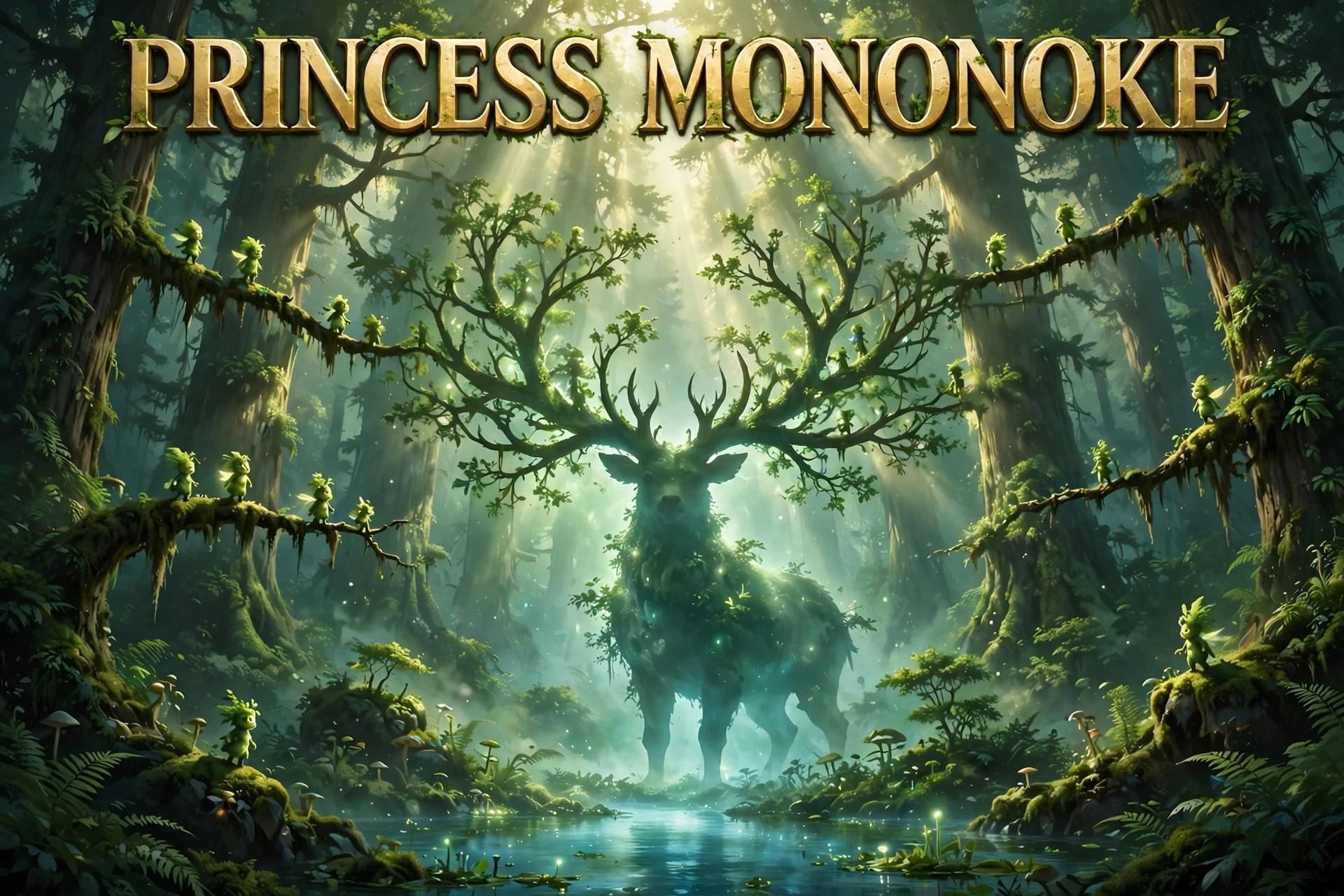
Princess Mononoke may be the summit of hand-drawn animation as a popular art form — one of the last great features made predominantly on painted cels, completed weeks before release, with Miyazaki personally checking or retouching tens of thousands of drawings. The craft serves a vision: a forest rendered as a genuine ecosystem, from moss and rain on stone to the tiny kodama spirits whose rattling heads signal the wood’s health, and a Forest Spirit whose transformations — deer-god by day, the towering, translucent Nightwalker by dusk — remain among the most awe-filled images in cinema, in any medium.
Miyazaki’s direction is classical and patient. He lets weather, labour and landscape breathe: Irontown’s furnaces and bellows-teams are drawn with a documentarian’s love of process, which matters, because the film needs you to respect what Eboshi has built in order to grieve what it costs. The action, when it comes, is startlingly violent for a filmmaker associated in the West with gentle family films — severed limbs, the writhing black corruption of the demon curse, war filmed as mud and panic. Wisely, he also used new tools for the first time: a small amount of computer-generated imagery and digital paint, most famously to render the demon’s writhing flesh, integrated so carefully that many viewers never notice it.
If the film has a craft limitation, it is density. The middle section balances a dozen speaking factions — town, wolves, boars, apes, monks, samurai, the Emperor’s agents — and a first viewing can feel like being handed a history book mid-chapter. Miyazaki trusts you to keep up rather than pausing to explain, and while that trust is ultimately rewarded, younger or casual viewers may need the film’s first half twice. It is a demand the film has every right to make — but it is a demand.
Joe Hisaishi, Miyazaki’s composer since Nausicaä of the Valley of the Wind, produced what many consider his greatest score. Developed, unusually closely with the director, from an “image album” of sketches into a full symphonic work performed by the Tokyo City Philharmonic, the music moves between Japanese pentatonic colour and Western orchestral weight: brass-heavy grandeur for the gods and war, strings for Ashitaka’s journey, and sudden, eloquent near-silence — rain, breath, birdsong — for the forest itself. Hisaishi understands that awe needs quiet around it.
The title theme, sung in Japanese by countertenor Yoshikazu Mera in a voice of almost otherworldly purity, became a hit single in Japan and gives San and the forest their musical soul; for the English version it was re-recorded by Sasha Lazard. And the cue known as “The Legend of Ashitaka,” which opens and closes the film, has taken on a concert life of its own — heroic, sorrowful and hopeful in a single theme, which is precisely the film’s emotional recipe.
What we loved:
What could be better:
Handle these figures with care, because Princess Mononoke is a textbook case of why a single “worldwide total” can mislead. On its original Japanese release it was a phenomenon: over 14 million admissions at home — roughly a tenth of the country — and distributor revenues that passed the record set by E.T. within months, making it the highest-grossing film in Japanese history until Titanic overtook it a few months later. The original international era is usually summarised at around $160 million worldwide, a total widely cited from the film’s earlier reference listings, including about $148 million from Japan and just $2.3 million from its limited, art-house-style North American release, where Miramax opened it on few screens despite the famous “no cuts” standoff that protected its length and content.
Since then, decades of re-releases — Studio Ghibli Fest screenings and, most strikingly, GKIDS’ 4K IMAX restoration in March 2025, which earned about $6.8 million in North America alone, more than the film’s entire original American run — plus home-media accounting in some tallies, have carried current lifetime references as high as $231.3 million as of early 2026. Meanwhile Box Office Mojo’s tracked theatrical total sits far lower, because its charts miss most of the original Japanese gross. The honest summary: roughly $160 million in its original era, and $170 million to $231 million lifetime depending on what a given source counts. Every version of the arithmetic tells the same story — a ¥2.35 billion gamble, the most expensive Japanese animated film of its day, that paid off many times over, became the first animated film to win the Japan Academy Prize for Picture of the Year, and opened the world’s doors to Studio Ghibli.
Yes — and if you have only ever seen the gentler Ghibli films, prepare to have your sense of Miyazaki rearranged. Princess Mononoke is an epic in the full sense: vast in scope, morally serious, visually unmatched, and brave enough to end a war story without a winner. It is the rare blockbuster that respects nature without romanticising it, respects industry without excusing it, and respects its audience enough to leave the hardest questions open. Watch it in Japanese with subtitles if you can, on the biggest screen you can find, and give it the attention it demands. It repays that attention like few films in any language, in any medium, ever have.
Our rating: 9.5/10 — Miyazaki’s fiercest film and one of the greatest animated features ever made; a war between forest and iron in which every side is human.
Is Princess Mononoke suitable for children?
Not for young children, despite the Studio Ghibli name. It is rated PG-13 and contains graphic battle violence, severed limbs, demonic corruption imagery and heavy themes. It suits teenagers and adults; younger viewers are better started on My Neighbor Totoro or Kiki’s Delivery Service.
Should I watch Princess Mononoke dubbed or subtitled?
Both are genuinely good. The English dub, scripted by Neil Gaiman and starring Billy Crudup, Claire Danes, Minnie Driver and Gillian Anderson, is one of anime’s best. We recommend the original Japanese first for atmosphere, but no viewer is short-changed either way.
What does “Mononoke” mean — is it San’s name?
No. Mononoke is a general Japanese word for spirits or monsters, not a character’s name. “Princess Mononoke” is the name Irontown’s people give San, the wolf-raised girl — effectively “princess of the spirits.” San is her actual name.
Is Princess Mononoke connected to other Studio Ghibli films?
No. It is a standalone story with no sequels or prequels, though it shares themes and imagery with Miyazaki’s earlier Nausicaä of the Valley of the Wind, whose manga he had completed shortly before making this film.
Where can I watch Princess Mononoke?
It is available on major streaming services in most regions (Max carries the Ghibli library in the US; availability differs elsewhere) and in excellent Blu-ray and 4K restorations. Check your local listings, as rights vary by country.