★ LATEST REVIEWS

★★★★☆ Our Rating: 8.5/10
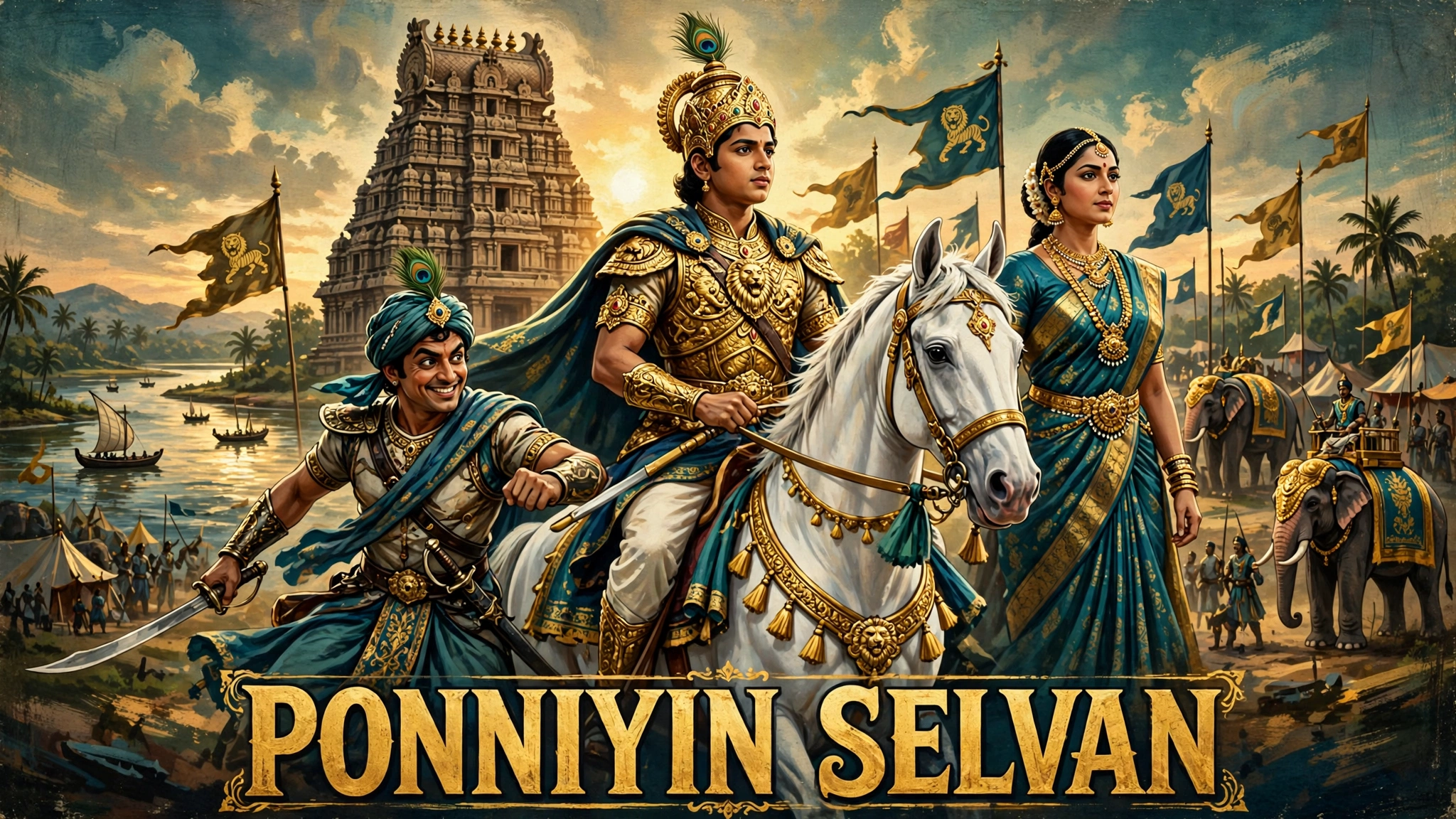
Some films are adaptations; this one is an inheritance. Kalki Krishnamurthy’s five-volume novel Ponniyin Selvan, serialised in the 1950s, is arguably the most beloved work of Tamil popular fiction, and for decades the biggest names in Tamil cinema — including M. G. Ramachandran and Kamal Haasan — tried and failed to bring it to the screen. Mani Ratnam finally did, and this Ponniyin Selvan Part I review can begin with the verdict its admirers hoped for: released on 30 September 2022, Ponniyin Selvan: Part I is a handsome, intelligent and emotionally rich epic that honours its source while remaining a film in its own right. It withholds the easy pleasures of a typical star spectacle — there are no punch dialogues, no indestructible heroes — and instead trusts story, character and craft. For patient viewers, that trust is repaid generously.
The honesty required here concerns accessibility, not quality. The film introduces dozens of characters, courts and conspiracies at speed, and viewers who know nothing of the novel will spend the first half hour working hard to map the Chola court. That effort is real, and we will not pretend otherwise. But it is the effort of entering a fully realised world, and once inside, the film’s web of loyalty, grief and ambition becomes genuinely gripping — and its portrait of tenth-century Tamilakam set a new standard for Indian historical cinema.
| Detail | Information |
|---|---|
| Release date | 30 September 2022 |
| Director | Mani Ratnam |
| Writers | Mani Ratnam, Elango Kumaravel, B. Jeyamohan (based on the novel by Kalki Krishnamurthy) |
| Genre | Epic Historical Drama, Action Adventure |
| Language | Tamil |
| Runtime | 167 minutes |
| Budget | Approx. ₹250 crore (₹500 crore reported for both parts combined) |
| Lead cast | Vikram, Aishwarya Rai Bachchan, Karthi, Jayam Ravi, Trisha Krishnan |
| Our rating | 8.5/10 |
A comet has appeared over the Chola empire, and in the popular imagination of the tenth century, comets mean a death in the royal house. Emperor Sundara Chozhar (Prakash Raj) is ailing. His elder son and crown prince, Aditha Karikalan (Vikram), campaigns in the north, brilliant, feared and privately broken by an old love and an older guilt. His younger son, Arulmozhi Varman (Jayam Ravi) — the Ponniyin Selvan of the title, the “son of the Ponni river” — fights in Lanka. And in the capital, their sister Kundavai (Trisha Krishnan), the shrewdest political mind in the family, watches chieftains and ministers gather in corners to discuss who should inherit: the emperor’s sons, or their uncle’s line, fronted by the claimant Madhurantakan.
Into this charged court rides Vallavaraiyan Vandiyadevan (Karthi), a charming, reckless warrior-messenger carrying Karikalan’s message to the emperor and to Kundavai. His journey across the empire is the film’s narrative thread: through him we meet the finance minister’s beautiful and enigmatic wife Nandini (Aishwarya Rai Bachchan), once Karikalan’s love and now, it is whispered, something far more dangerous to the Chola throne; the boatwoman Poonguzhali (Aishwarya Lekshmi), who rows against every current in her life; the warrior princess Vanathi (Sobhita Dhulipala); and a network of spies, including the gloriously theatrical Azhwarkadiyan Nambi (Jayaram). Each encounter tightens the web. Secret meetings are held, an assassination plot takes shape, and loyalties turn out to be layered like the empire’s own history.
We will stop there. Part I is openly the first half of a single story — it ends mid-crisis, on the sea, with fates unresolved — and viewers should know that going in. What it completes is the establishment of a world and a set of characters whose collisions the second part, released in 2023, exists to resolve.
Karthi as Vandiyadevan is the film’s beating heart and its wisest casting choice. As our guide through the empire, he must be rogue, lover, spy and fool by turns, and Karthi plays him with a light, funny, utterly natural charm that keeps a dense film buoyant. It is a star performance in the old sense — he makes everyone around him better — and it may be the finest work of his career.
Aishwarya Rai Bachchan as Nandini gives the film its mystery. Mani Ratnam photographs her as the court remembers her — impossibly beautiful — but the performance is in what she withholds: behind Nandini’s stillness sits a history of humiliation and a patience that reads, increasingly, as vengeance being carefully aged. In a dual presence that also touches on her mute mother Mandakini’s story, she becomes the film’s most haunting figure without raising her voice once.
Vikram as Aditha Karikalan does the opposite: he is all raised voices and wounded thunder, a crown prince drinking against the memory of the woman he lost and the act he cannot forgive himself for. It is a big performance, occasionally at the edge of excess, but entirely true to a man destroying himself in public. Trisha Krishnan as Kundavai is his equal in control — poised, witty and visibly the adult in every room — and her verbal duels are among the film’s most enjoyable scenes. Jayam Ravi as Arulmozhi Varman has the title role but, in this first part, a supporting amount of screen time; he plays the beloved younger prince with warmth and stillness, wisely underplaying a part the sequel would enlarge. Around them, an extraordinary bench — Prakash Raj, Jayaram stealing scenes wholesale as the spy Nambi, Aishwarya Lekshmi bringing salt and sorrow to Poonguzhali, Sobhita Dhulipala, Vikram Prabhu and R. Sarathkumar — performs without a single weak link.
Mani Ratnam directs this material with the confidence of a man who has carried it in his imagination for decades. His central decision defines the film: where a lesser adaptation would have inflated the novel into a war spectacle, he keeps the camera at human height. Battles exist — a campaign sequence and a storm-tossed sea climax are staged impressively — but the film’s real set pieces are conversations: a queen and a princess trading courtesies that are actually threats, a prince confessing by firelight. Ravi Varman’s cinematography is superb throughout, giving palaces a golden, lived-in glow and the Kaveri delta a green vastness that explains, visually, what these people are fighting to rule.
The adaptation itself, by Mani Ratnam with Elango Kumaravel and the eminent Tamil writer B. Jeyamohan, deserves study. Compressing five volumes, they preserve the novel’s structure of journeys and encounters while sharpening its political spine, and Jeyamohan’s dialogue carries literary weight without turning archaic. A. Sreekar Prasad’s editing manages the film’s many threads with clarity, though even he cannot fully solve the first act’s density — the sheer number of introductions is the film’s most common criticism, and it is a fair one. Production design avoids the marble-and-gold clichés of Indian period films: this Chola world is wood, water, temple stone and monsoon light, and it feels archaeologically believed rather than decorated. If there is a craft reservation beyond the dense opening, it is that a couple of visual-effects shots, particularly around water, sit below the film’s otherwise high standard.
A. R. Rahman, reuniting with Mani Ratnam in their long collaboration, composes with a historian’s restraint and a poet’s ear. The songs are woven into the narrative fabric rather than stopping it: “Ponni Nadhi” rides with Vandiyadevan’s journey like a travelling song the land itself might sing, “Chola Chola” carries martial pride, and “Ratchasa Maamaney” flashes with mischief. The background score is even finer — flutes, strings and percussion that evoke an ancient Tamil world while underlining Nandini’s scenes with an ache that tells you more than dialogue does. Rahman’s music never inflates emotion the film has not earned, a discipline that perfectly matches the director’s. It is, simply, one of the finest scores in an Indian historical film.
What we loved:
What could be better:
Trade figures for the film vary slightly by source, so we report them as the range they are: worldwide totals for Ponniyin Selvan: Part I are placed between roughly ₹488 crore and ₹500 crore, with some tallies landing just at or above the ₹500 crore line. On any of those figures it was, at the time, among the highest-grossing Tamil films ever made, and it set a landmark record in Tamil Nadu itself, becoming the first Tamil film to cross ₹200 crore in its home state according to trade reports, alongside exceptional overseas business for a film so rooted in Tamil literary culture. The budget requires the same care: the widely reported ₹500 crore figure covers both parts of the adaptation, shot back-to-back, which places Part I’s own share at roughly ₹250 crore. Judge it on those terms — a two-film investment — and Part I alone performed like the event Tamil cinema had promised its audiences for generations.
Emphatically yes, if you enjoy historical drama with the patience of a novel. Watch it before Part II, watch it on the largest screen available, and consider reading even a short summary of the Chola family tree beforehand if names overwhelm you — the film rewards the homework. Action-only viewers expecting a war epic should adjust expectations: this is a court intrigue carried by characters, and on those terms it is one of the finest Indian films of its decade.
Our rating: 8.5/10 — a majestic, literate epic whose density is its only real barrier, and whose rewards far outlast it.
Do I need to read the Ponniyin Selvan novel before watching the film?
No. The film tells its story completely for newcomers, though the opening act introduces many characters quickly. Readers of Kalki’s novel will enjoy recognising beloved scenes and details throughout.
Is Ponniyin Selvan: Part I based on a true story?
It is historical fiction. Arulmozhi Varman, who became the emperor Rajaraja I, and several other figures are real, but the novel and film weave invented intrigue, romance and conspiracy around the historical Chola court.
Does Part I have a complete ending?
No. It is the first half of one story and ends on a cliffhanger. Ponniyin Selvan: Part II (2023) completes the narrative, and the two films are best watched as a pair.
Is Ponniyin Selvan: Part I suitable for family viewing?
It contains battle violence and political themes but avoids graphic content, and its U/A certification reflects that. It is well suited to older children, teens and adults who enjoy historical drama.
Where can I watch Ponniyin Selvan: Part I?
The film is available on major streaming platforms in Tamil and dubbed versions in many regions. Availability changes over time, so check your local services.