★ LATEST REVIEWS

★★★★★ Our Rating: 9.5/10
Most fairy tales promise children that the world makes sense if you are brave and good. Pan’s Labyrinth promises something far more unsettling: that a child may need to invent a world of monsters because the real one, run by adults, has become unbearable. Guillermo del Toro’s Spanish-language masterpiece, which premiered at Cannes on 27 May 2006 before opening in Spain on 11 October 2006, is routinely described as a fairy tale for adults. That description is accurate but incomplete. It is also a war film, a horror film and one of the most moving portraits of childhood resistance ever put on screen.
Nearly two decades later, the film’s reputation has only grown. It won three Academy Awards and is regularly placed among the greatest films of the 2000s. In this review we examine the story, the extraordinary performances, the handcrafted visual world and Javier Navarrete’s unforgettable score — along with the reasons this undeniably great film is not for everyone.
| Detail | Information |
|---|---|
| Release date | 27 May 2006 (Cannes premiere); 11 October 2006 (Spain) |
| Director | Guillermo del Toro |
| Writers | Guillermo del Toro |
| Genre | Dark Fantasy, Drama, War |
| Language | Spanish |
| Runtime | 118 minutes |
| Budget | Approx. €14 million (around $19 million) |
| Lead cast | Ivana Baquero, Sergi López, Maribel Verdú, Doug Jones, Ariadna Gil |
| Our rating | 9.5/10 |
Spain, 1944. The civil war is officially over, but in the mountains the fighting has not stopped: Franco’s army is hunting down the republican guerrillas, the Maquis, who refuse to surrender. Into this landscape travels Ofelia, a thoughtful, book-loving girl of about eleven, with her mother Carmen, who is heavily pregnant and unwell. They are going to live at a remote mill that serves as an outpost for Carmen’s new husband, Captain Vidal, the father of the unborn child — an officer for whom order, obedience and reputation matter more than any human being in front of him.
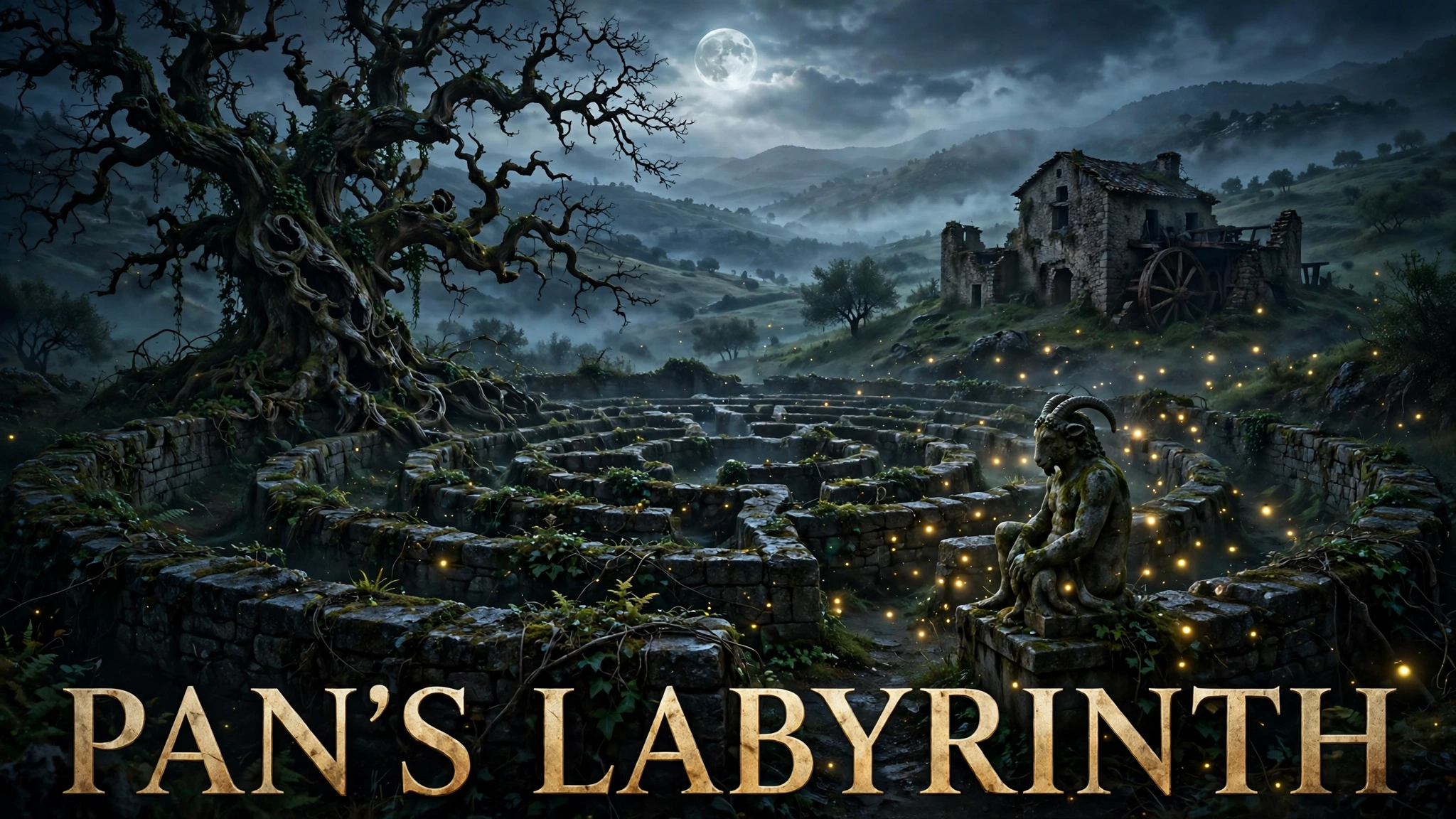
Near the mill stands an ancient stone labyrinth, and it is there, guided at night by a strange insect that transforms before her eyes, that Ofelia meets the Faun: a towering, creaking creature, part man, part goat, part tree, who tells her an astonishing secret. She is not an ordinary girl, he says, but the lost princess of an underground kingdom, and if she completes three tasks before the full moon, she will prove herself and be allowed to return to her true home.
Del Toro’s genius is to run these two worlds — the Faun’s moonlit realm of giant toads, fairies and chalk-drawn doors, and Vidal’s daytime world of interrogations, ration cards and execution squads — in perfect parallel, each commenting on the other. The tasks grow more dangerous as the situation at the mill deteriorates, Ofelia’s mother’s health collapses, and the guerrillas in the hills, helped quietly by people inside Vidal’s own household, prepare their next move. Whether the magic is literally real or the creation of a child’s mind is a question the film holds open with extraordinary care — and by the final act, del Toro makes clear that, in the deepest sense, it does not matter.
Ivana Baquero as Ofelia gives one of the finest child performances in cinema history. Cast at eleven, she carries the entire film, and she does it without a trace of cuteness or precocious showing off. Her Ofelia is serious, stubborn and morally clear-eyed in a way the adults around her are not; she disobeys precisely when obedience would be a betrayal. Baquero’s stillness in the scenes with the Faun, and her terror in the film’s most frightening sequence, anchor the fantasy in real emotion.
Sergi López as Captain Vidal creates a villain for the ages, and crucially not a cartoon one. Vidal is vain about his father’s reputation, obsessive about time and appearance, and capable of sudden, sickening violence — yet López also shows us the man’s hollowness, his need for a son to carry his name forward. He is the true monster of the film, and del Toro structures the story so that we understand the comparison: the creatures of the labyrinth have rules and keep their bargains; Vidal does not.
Maribel Verdú as Mercedes, Vidal’s housekeeper, is the film’s quiet hero. Outwardly obedient, she is in fact the link between the outpost and the guerrillas, and Verdú plays her courage as something costly and frightened rather than effortless. Ariadna Gil as Carmen brings a fragile dignity to a woman who has chosen security over freedom and is paying for it, while Doug Jones as the Faun and the Pale Man — performing in Spanish under elaborate prosthetics — gives both creatures a physical language of creaks, tilts and gestures that no digital creation could match.
Del Toro directs with total control of tone, colour and design. The real world is shot in cold blues, greys and greens; Ofelia’s fantasy world glows with golds and warm earth tones, so the audience feels the pull of the labyrinth exactly as she does. Guillermo Navarro’s cinematography, which won an Academy Award along with the film’s art direction and makeup, moves between the two registers seamlessly.
The creature work remains the film’s most famous achievement. The Faun and the Pale Man — the latter a sagging, eyeless horror who sits before a banquet he cannot touch, in a sequence that has terrified a generation of viewers — were created with practical makeup, animatronics and restrained digital assistance. Because the actors could touch and react to real beings on set, the fantasy never floats free of the physical world. The production design builds a complete visual logic: spirals, horns, clocks, keys and wombs recur across both worlds, rewarding the attentive viewer.
Javier Navarrete’s score is built around a simple lullaby, hummed by Mercedes, that threads through the entire film and returns at the moments of greatest pain and wonder. Around that fragile melody he builds waltzes and orchestral swells that feel like a music box heard through a wall — beautiful, slightly broken. The score was nominated for an Academy Award, and it is impossible to imagine the film’s emotional effect without it. It never tells you to cry; it simply remembers the tune a mother figure sings to keep a child safe.
What we loved:
What could be better:
Made for roughly €14 million (about $19 million), the film earned around $83–84 million worldwide — a healthy success for a subtitled, R-rated Spanish-language film, and enough to make it the highest-grossing Spanish-language film in North America at the time. But its real commercial story is its afterlife: three Academy Awards from six nominations, top prizes and honours across the festival circuit, and two decades of home-video and streaming life that have turned a modest theatrical performer into one of the most beloved films of its century. Its success also transformed del Toro’s career, establishing him internationally as a singular auteur and paving the road to The Shape of Water.
Yes — this is essential viewing for anyone who loves cinema. Pan’s Labyrinth is not light entertainment, and it should not be shown to young children despite its fairy-tale frame; its violence is real and its grief is real. But as a work of imagination, craft and moral seriousness it has few equals in modern film. It trusts a child’s inner life completely, it never insults the audience, and its final movement achieves something almost no film manages: it lets you choose what to believe, and breaks your heart either way.
Our rating: 9.5/10 — a towering achievement, and del Toro’s finest film.
Is Pan’s Labyrinth suitable for children?
No, despite the young heroine and fairy-tale structure. The film contains graphic violence, torture and intense horror imagery, and is rated R in the United States. It is a fairy tale made for adults.
Is the magic in Pan’s Labyrinth real?
The film deliberately leaves this open. Guillermo del Toro has said that he personally believes the magic is real within the story, but the film is constructed so that both readings work, and its themes hold either way.
Do I need to know Spanish history to follow it?
No. The film gives you everything you need: a victorious fascist regime hunting resistance fighters in 1944. A little knowledge of Franco’s Spain adds depth, but the story is fully clear on its own terms.
Is Pan’s Labyrinth connected to The Devil’s Backbone?
Del Toro describes it as a spiritual companion to his earlier film The Devil’s Backbone (2001), which is also set around the Spanish Civil War and also seen through a child’s eyes. They share themes and mood, but each stands alone.
Where can I watch Pan’s Labyrinth?
It is widely available on streaming platforms, Blu-ray and digital rental in most countries; the exact service varies by region.
