★ LATEST REVIEWS

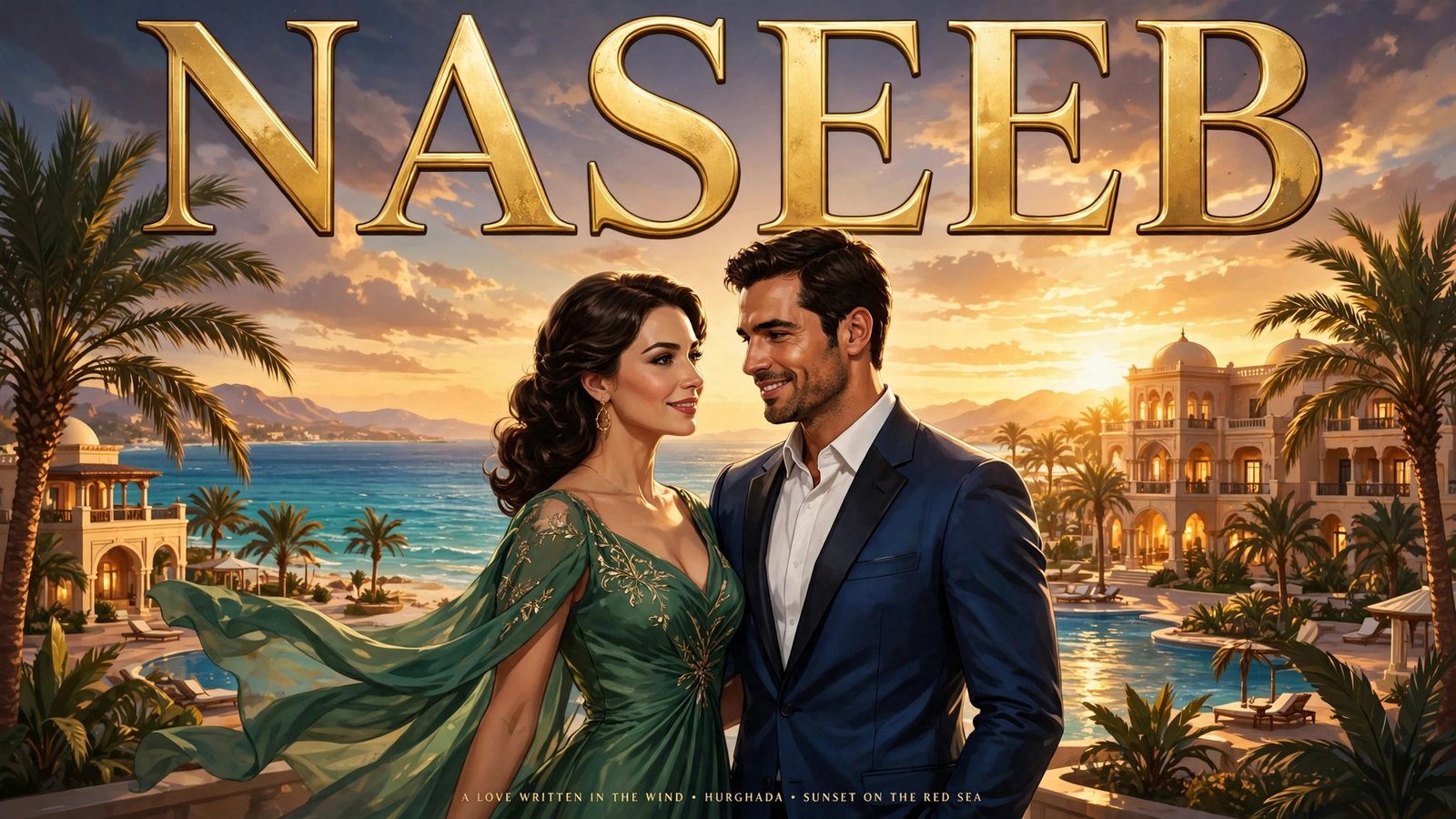
Our Rating: ★★★★☆ 7/10
An honest note before we begin: Naseeb reached Egyptian cinemas on 28 October 2026 — one day before this review was written — so critical consensus and box-office figures are not yet available. What follows is an early assessment built on verified reporting about the film: its confirmed premise, cast, director and production. Where information is not yet public, we say so plainly rather than filling the gap. We will revisit the verdict once reception and box-office reporting emerge.
Some pairings sell a film before a single scene is seen, and Naseeb is one of them. Yasmine Sabri and Moatasem Al Nahar — two of the Arab world’s most popular screen stars — headline their first film together in this Egyptian romantic drama, directed by Ahmed Khaled Amin and shot largely in the Red Sea resort city of Hurghada. The story, by screenwriter Ahmed Abdel Fattah, mixes romance, comedy, suspense and action around a wealthy widow, a resort she inherits, and a man who falls for her and sets out to win her attention by any means necessary. It is, on paper, exactly the kind of star-driven, sun-soaked crowd-pleaser that Egyptian commercial cinema does best.
| Detail | Information |
| Release date | 28 October 2026 (Egypt); 29 October 2026 (Saudi Arabia, UAE, Qatar, Kuwait, Iraq and the wider Arab world) |
| Director | Ahmed Khaled Amin |
| Writer | Ahmed Abdel Fattah |
| Genre | Romantic drama (with comedy, suspense and action elements) |
| Language | Arabic |
| Runtime | Not yet confirmed in reliable listings at the time of writing |
| Budget | Not publicly reported at the time of writing |
| Lead cast | Yasmine Sabri, Moatasem Al Nahar, Khaled Sarhan, Rahma Ahmed Farag, Donia Maher, Donia Samy, Omar El Shenawy, Mostafa Abu Saree, Walid Fawaz |
| Our rating | 7/10 (early assessment; see the note above) |
Sabri plays a wealthy widow who inherits a tourist resort in Hurghada after the death of her billionaire husband. Taking charge of the property — and of a new life she did not plan — she meets a man played by Al Nahar, who falls in love with her. His courtship, by all reported accounts, is unconventional: he resorts to deceptive, even questionable tactics to attract her attention, setting up a chain of comedic and romantic situations as she tries to run her resort and he tries to win her heart.
The story takes a more dramatic turn when the heroine becomes involved in a complicated case — the details of which the film’s pre-release reporting keeps deliberately vague — and her would-be suitor must switch from scheming admirer to protector, helping her and standing by her as events unfold. That shift, from comedy of pursuit to drama of loyalty, is the film’s central arc, and it is where the “naseeb” of the title — fate, destiny, what is written — stops being a word and starts being the story’s argument: that love arrives unplanned, through accidents and complications, and that it is proven not in the chase but in the crisis.
Pre-release coverage describes the film as combining romance, comedy, suspense and action, with the resort setting providing the backdrop for changing relationships and unexpected encounters. That genre blend is familiar territory for Egyptian commercial cinema, which has long mixed tones in a single film, and the Hurghada setting gives it a visual advantage few recent Egyptian romances have enjoyed: Red Sea light, resort glamour and a world of tourists, staff and secrets.
Yasmine Sabri as the widowed resort owner — Sabri is one of Egyptian cinema’s biggest contemporary stars, and the role plays to her established strengths: glamour, poise and a screen presence that can carry a film’s centre. The character’s arc — from grieving widow to a woman taking charge of a business and, gradually, of her own heart — gives her more to play than a simple romantic lead, and the dramatic turn in the story’s second half is where her performance will be judged once audiences have seen it.
Moatasem Al Nahar as her suitor — Al Nahar, a Syrian star with a large following across the Arab world, takes on the trickier role: a man whose methods of winning attention are, by the film’s own premise, questionable. The part asks him to be charming enough that the audience roots for him, and roguish enough that the comedy of his schemes lands, while still making his later turn to protector believable. It is the kind of role that lives or dies on the actor’s charm, and Al Nahar’s casting suggests the producers knew exactly what they were buying.
Khaled Sarhan, Rahma Ahmed Farag and the ensemble — The supporting cast is deep and experienced: Khaled Sarhan, Rahma Ahmed Farag, Donia Maher, Donia Samy, Omar El Shenawy, Mostafa Abu Saree and Walid Fawaz, with guest appearances reported from Muhammad Anwar, Nidal El Shafei and Mohamed Lotfy. In Egyptian commercial cinema, a bench this strong usually means the comedy and the complications are shared around, not loaded onto the leads alone — a good sign for the film’s lighter stretches.
Ahmed Khaled Amin directs from Ahmed Abdel Fattah’s screenplay, with production from Albatros Film Production and Distribution (producer Kamel Abu Ali) and Film Square Production, under the general supervision of Mohsen El Baghdady. Most of the film was shot in Hurghada, and the resort setting is clearly meant to be one of the film’s selling points: a glamorous, sunlit world that gives the romance its visual identity.
The production history is worth noting honestly. The film was initially aimed at a July 2026 release before being postponed to October, with the screenwriter confirming the revised window in August after filming had completed. A delay of that kind is common in commercial cinema and means little on its own, but it does mean the film arrives in a crowded autumn season, where its star pairing — rather than novelty — will have to do the work.
One honest caveat, repeated from the note at the top: because the film opened only yesterday, we cannot yet report on its critical reception, its audience response or its box office. The assessment here is therefore an early one, based on the confirmed premise, the pedigree of its cast and makers, and the strength of its setup. Readers should treat the rating below as a first impression to be revisited, not as a settled critical consensus.
No reliable pre-release reporting has yet detailed the film’s score or soundtrack, so we will not invent claims about them here. Egyptian romantic dramas traditionally lean on Arabic pop and orchestral scoring to carry their emotional peaks, and the resort setting offers obvious opportunities for both; we will update this section once the film’s music credits and audience response are public.
What looks promising:
What remains unproven:
Naseeb opened in Egypt on 28 October 2026, with its wider Arab release following on 29 October. At the time of writing, no reliable box-office figures have been published — the film has simply not been in cinemas long enough. Its commercial prospects look healthy on paper: two major stars, a first-time pairing, a broad regional release across Egypt, Saudi Arabia, the UAE, Qatar, Kuwait and Iraq, and a genre mix aimed squarely at mainstream audiences. But paper is not performance, and this section will be updated once reported figures exist. No budget figure has been publicly reported either, and we have omitted it rather than guess.
If you follow Egyptian or Arab cinema, or if you are a fan of either lead, yes — this is the kind of star-driven romantic drama that the region’s cinemas are built for, and the premise has charm, glamour and a dramatic turn worth seeing play out. Go in expecting a mainstream crowd-pleaser rather than an art-house drama, and judge the suitor’s schemes for yourself: whether they charm or grate will likely decide how much you enjoy it. We will revisit this verdict once the film’s reception is known.
Our rating: 7/10 — An early assessment: a promising star pairing and an appealing premise in a glamorous setting, with the final judgement reserved until audiences and critics have had their say.
What is Naseeb about?
A wealthy widow inherits a tourist resort in Hurghada and meets a man who falls in love with her and tries unconventional, deceptive tactics to win her attention; when she becomes involved in a complicated case, he must help and protect her.
Who stars in Naseeb?
Yasmine Sabri and Moatasem Al Nahar in their first film together, with Khaled Sarhan, Rahma Ahmed Farag, Donia Maher, Donia Samy, Omar El Shenawy, Mostafa Abu Saree and Walid Fawaz in support.
Who directed Naseeb?
Ahmed Khaled Amin, from a screenplay by Ahmed Abdel Fattah.
When was Naseeb released?
28 October 2026 in Egypt, and 29 October 2026 across the wider Arab world including Saudi Arabia, the UAE, Qatar, Kuwait and Iraq.
How much did Naseeb earn at the box office?
Not yet reported at the time of writing — the film opened only a day before this review, and reliable figures have not yet been published.