★ LATEST REVIEWS

★★★★☆ Our Rating: 8.5/10
Few films anywhere carry a reputation quite like this one in its homeland, and any My Father and My Son review written for newcomers has to start there: Çağan Irmak’s Babam ve Oğlum is the film Turks recommend when they want to test whether you have a heart. Taxi drivers quote it. Grown men admit, without embarrassment, that it made them cry. Released on 18 November 2005, it became one of the highest-grossing Turkish films of its era — not with action or comedy, but with a story about a father who disowned his son, and the grandson who arrives too late to fix everything and just in time to fix something.
This review will be honest about the film’s sentimentality, because the film itself is not embarrassed by it. My Father and My Son wants your tears, works openly to earn them, and — this is the part that matters — mostly does earn them, through superb acting and a story rooted in a real national wound: the 1980 military coup that scarred a generation of Turkish families.
| Detail | Information |
| Release date | 18 November 2005 |
| Director | Çağan Irmak |
| Writers | Çağan Irmak |
| Genre | Drama, Family |
| Language | Turkish |
| Runtime | 108 minutes |
| Lead cast | Çetin Tekindor, Fikret Kuşkan, Ege Tanman, Hümeyra, Şerif Sezer, Özge Özberk, Tuba Büyüküstün |
| Our rating | 8.5/10 |
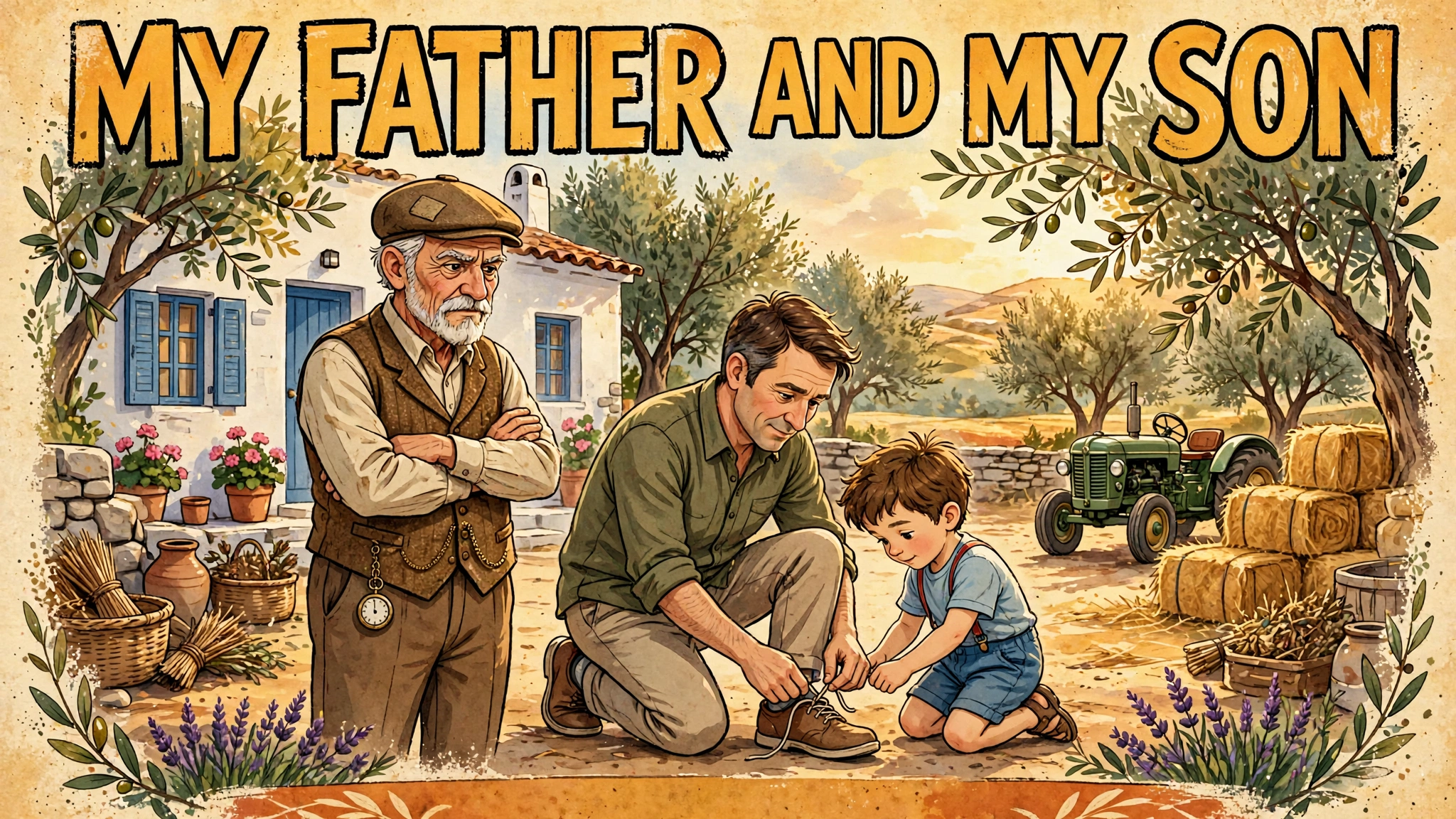
Sadık grew up on his family’s farm on Turkey’s Aegean coast, and he broke his father Hüseyin’s heart in the most ordinary way possible: he left. Hüseyin wanted his son to study agricultural engineering and take over the farm. Sadık chose journalism in Istanbul instead, fell in with left-wing student politics, and was disowned for it. Then history intervened. On the night of the 1980 military coup, Sadık’s wife went into labour; in the chaos of a country under curfew, she died giving birth to their son, Deniz. Sadık himself was arrested for his activism, imprisoned and tortured, and emerged years later as a single father raising a bright, film-mad little boy in Istanbul — while quietly carrying an illness he tells no one about.
Knowing his time is short, Sadık makes the journey he has avoided for years: back to the farm, back to the father who has not forgiven him, to ask the question no parent wants to ask. Can you give my son a room? The bulk of the film lives inside that return — an old man who expresses love through work and silence, a dying son who cannot say the one thing he came to say, and a small boy, obsessed with the comic books and movies his father feeds him, moving between them with the terrible honesty of children, asking the questions the adults have spent twenty years avoiding.
Around this central trio, Irmak builds a warm extended family — aunts, uncles, neighbours, a whole village ecosystem of teasing, cooking and meddling — so that the film’s sorrow always sits inside ordinary life rather than on top of it. How the reconciliation unfolds, and at what cost, is the film’s to reveal. We will only say that its final movement is famous in Turkey for a reason, and it lands as hard as its reputation promises.
Çetin Tekindor as Hüseyin is the film’s mountain. Tekindor, one of Turkey’s most revered stage and screen actors, plays the old farmer as a man whose feelings are enormous and whose vocabulary for them is almost zero. Hüseyin rages, sulks, works, and avoids — and then, in small unguarded moments Tekindor barely seems to act at all, the love breaks through and devastates you. It is a performance built on restraint, and it is the main reason the film’s melodrama never collapses into soap.
Fikret Kuşkan as Sadık carries the film’s other half: a man who has been broken by prison and illness and pride, trying to parent joyfully while arranging his own disappearance from his son’s life. Kuşkan plays Sadık’s cheerfulness with Deniz as an act of will, which makes it moving rather than cute, and his scenes of failing to reconcile with Hüseyin — two men in the same room, speaking about everything except the thing — are painfully true to how such estrangements actually work.
Ege Tanman as Deniz gives one of the great child performances in Turkish cinema. Deniz is not a angelic plot device; he is funny, demanding, lost in adventure stories, and equipped with a child’s gift for walking straight into the room where the unsayable thing lives. Tanman, only a child himself, holds scenes opposite Tekindor without being overwhelmed, and the grandfather-grandson bond that grows between them becomes the film’s real love story. The support is rich throughout: Hümeyra brings warmth and comic timing to the household, Şerif Sezer grounds the family’s older generation, and Özge Özberk and Tuba Büyüküstün add texture to the village world that will receive Deniz.
Çağan Irmak directs with a storyteller’s confidence and a television honed sense of what audiences feel. His great decision here is tonal: he lets the film be funny. The Aegean village material — family squabbles, local eccentrics, Deniz’s movie-obsessed imagination spilling into fantasy sequences — is played for genuine warmth and humour, so the drama, when it deepens, tightens around characters you have enjoyed rather than merely pitied. Many tearjerkers fail by pressing on the bruise for two hours; Irmak spends his first hour making you love this family, which is why the second hour hurts.
Rıdvan Ülgen’s cinematography gives the Aegean farmland a golden, remembered quality — the film is set in the recent past and photographed like a memory of it — while the Istanbul and prison material is kept harsher and colder. The editing serves the performances, holding on faces a beat longer than fashion dictates, which in this film is exactly right. If the craft has a weakness, it is a certain conventionality: the film rarely surprises you visually, and a couple of transitions lean on familiar melodramatic grammar. But conventional craft in service of an unconventional honesty about fathers and sons is a trade most viewers will happily accept.
The score is by Greek composer Evanthia Reboutsika, a frequent and inspired choice in Turkish cinema of this period, and her music is central to the film’s emotional identity. Built around strings and folk inflected melodies that feel shared across the Aegean rather than owned by either shore, the score does the thing melodrama music must do: it tells you, before the characters can admit it, what a scene actually costs. Used generously — some viewers will say too generously — it swells under the reconciliation scenes and the film’s famous climax.
An honest review should note the risk: Reboutsika’s music occasionally underlines a moment that the actors had already earned, and viewers allergic to being emotionally conducted may resist. But for most audiences the score is remembered as part of the film’s fabric, inseparable from its biggest scenes, and it is hard to imagine this story landing the same way in silence.
What we loved:
What could be better:
Turkish box-office reporting from 2005 is a mixture of lira totals, admissions counts and later database conversions, so figures differ between sources and should be quoted as ranges. What is not in dispute is the scale of the achievement. In its release year, My Father and My Son placed at the very top of the Turkish market — Box Office Mojo’s yearly table for Turkey lists it as the number one release of 2005 — and contemporary in-year listings put its domestic gross at roughly ₺12.3 million, second in calendar-year terms only because another hit’s run straddled the year boundary; reports differ on the ranking depending on whether they count release-year or calendar-year earnings. International databases that convert its performance into dollars commonly cite a figure in the region of $4.2 million, though other estimates run higher, and Turkish sources remember it above all for its admissions — several million tickets, an extraordinary total for a straight family drama with no stars marketed as action or comedy draws. It became, at the time, one of the highest-grossing Turkish films in history, won major honours at the Antalya Golden Orange Film Festival and the Istanbul Film Festival — including acting prizes for Tekindor and Kuşkan — and it has never really left Turkish popular culture since.
Absolutely — with tissues, and with the right expectations. This is a melodrama and proud of it: it will manipulate you, openly, and the manipulation works because the performances are honest and the family at its centre feels lived in. If you want to understand modern Turkish popular cinema, or if any story about fathers, sons and things left unsaid has ever found you, My Father and My Son is essential viewing. Watch it subtitled, watch it with family if you can bear to, and do not let anyone tell you how it ends.
Our rating: 8.5/10 — a beautifully acted, unashamedly emotional classic whose tears are, for once, fully earned.
Is My Father and My Son based on a true story? No, it is an original screenplay by Çağan Irmak. Its backdrop, however, is real history: the 1980 Turkish military coup and the imprisonment of political activists shaped a generation, and the film draws on that collective experience.
What does the Turkish title Babam ve Oğlum mean? It translates directly as “My Father and My Son” — a title that captures the film’s structure, in which Sadık stands between his own father and his own child, belonging fully to neither relationship until it is almost too late.
Why is this film so famous in Turkey? It was one of the highest-grossing Turkish films of its time, won major festival awards, and became a cultural touchstone — widely quoted, frequently rebroadcast, and famous for making audiences cry.
Is My Father and My Son suitable for family viewing? Yes, broadly. It deals with illness, death and political imprisonment, and younger children may find parts upsetting, but there is no graphic content. It is often watched as a family film in Turkey.
Where can I watch My Father and My Son? It circulates on Turkish streaming platforms and video services with subtitles in many regions. Availability changes, so check your local services for the subtitled version.