★ LATEST REVIEWS

Our Rating: ★★★★★ 9/10
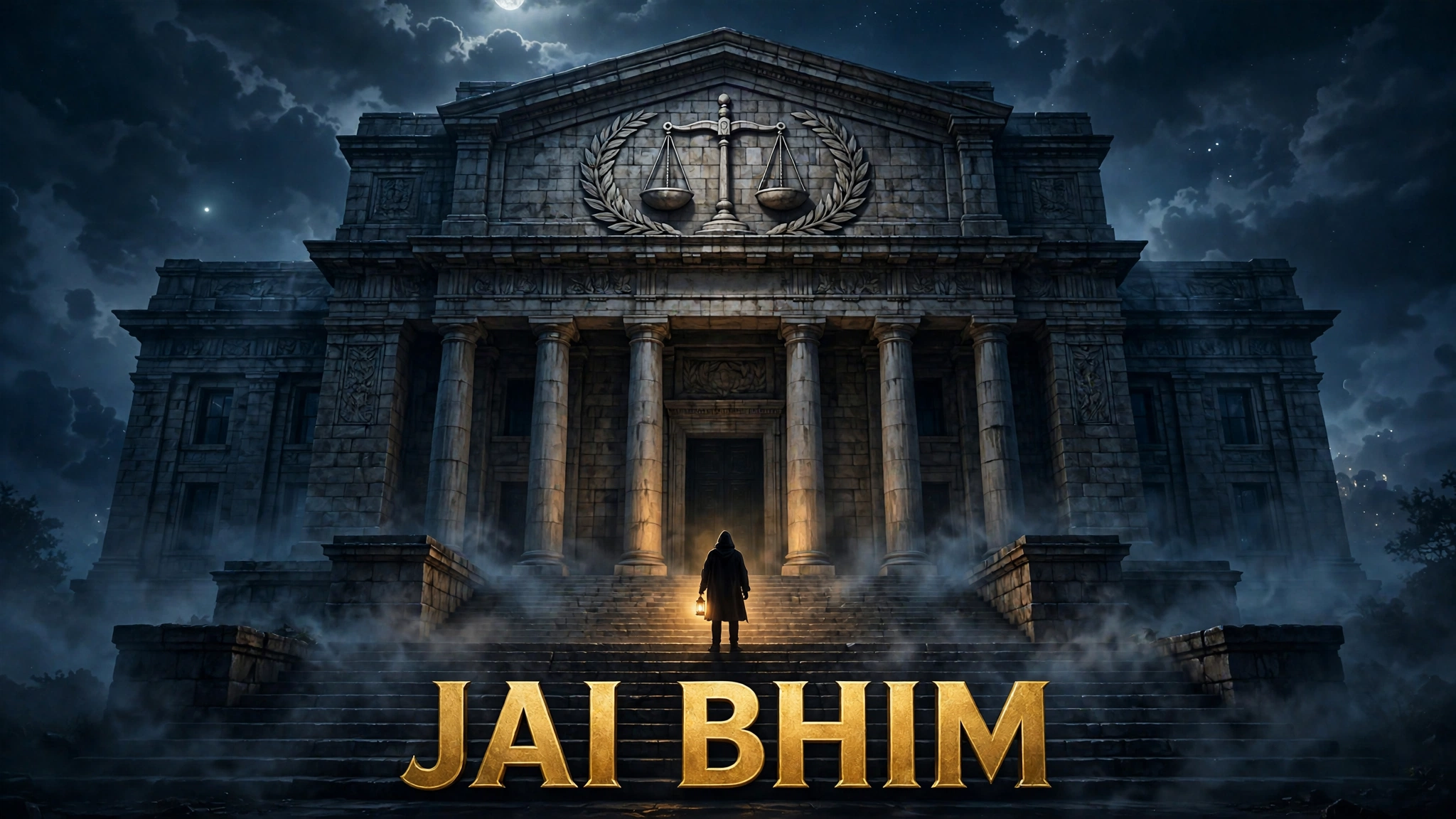
Most courtroom dramas are built around a question of guilt. Jai Bhim is built around a question of worth: whether the life of a poor tribal man counts for enough, inside a police station and then inside a courtroom, for the machinery of justice to bother telling the truth about what happened to him. T. J. Gnanavel’s Tamil legal drama, released directly on Amazon Prime Video on 2 November 2021, ahead of Diwali, is drawn from a real 1993 case fought by advocate K. Chandru — who later became a Madras High Court judge — and it became one of the most discussed Indian films of its year, at one point holding the highest user rating on IMDb of any film, Indian or otherwise, as audiences around the world discovered it.
That acclaim is earned, though not by a flawless film. This Jai Bhim review will be honest about both sides: the film contains passages of police brutality so prolonged that some viewers will find them difficult to watch, its courtroom plotting occasionally arranges its arguments a little too neatly, and its star, for all his restraint, remains a star in a story whose true heroes had no power at all. But few mainstream Indian films of the decade argue their case with this much evidence, anger and compassion. In the sections below we cover the true-story roots and the spoiler-free plot, the performances, the direction and technical craft, Sean Roldan’s score, the film’s unusual release and reception in place of a conventional box-office story, and a verdict on who must watch it — and who should prepare themselves first.
| Detail | Information |
|---|---|
| Release date | 2 November 2021 (Amazon Prime Video) |
| Director | T. J. Gnanavel |
| Writers | T. J. Gnanavel |
| Genre | Legal Drama, Social Drama |
| Language | Tamil |
| Runtime | 164 minutes |
| Lead cast | Suriya, Lijomol Jose, Manikandan, Rajisha Vijayan, Prakash Raj, Rao Ramesh |
| Our rating | 9/10 |
A note on the table: there is deliberately no budget row above. Unlike the film’s theatrical contemporaries, Jai Bhim was produced for a direct streaming release, and no reliable, properly sourced production budget has been published in the standard references — the film’s main reference listings leave the figure blank, and the scattered numbers on low-quality aggregator sites cannot be verified. Rather than print an unverifiable figure, we omit it, and we explain the film’s release economics in the Box Office section below.
Tamil Nadu, 1993. Rajakannu and his wife Sengeni belong to the Irular community, a tribal people whose traditional skills — catching rats that destroy crops, handling snakes, day labour in brick kilns and fields — are indispensable to the villages around them and rewarded with almost nothing: no land, no secure homes, and a standing suspicion in the eyes of the police, who treat Irular men as a convenient reservoir of ready-made accused whenever a crime needs a name attached to it. The film’s chilling opening sequence makes that system visible in a single stroke, as released prisoners are sorted at the jail gate by caste — some waved home, others held back to be fitted into unsolved cases.
When jewellery disappears from a wealthy household where Rajakannu had been called to catch a snake, suspicion falls on him by reflex. Police raid the Irular settlement; Rajakannu is taken, beaten and held, while Sengeni — pregnant — and members of the extended family are detained, humiliated and assaulted in an effort to produce confessions and locations. Then comes the claim that changes a police-brutality story into a legal one: the police announce that Rajakannu and two relatives have escaped from custody. Sengeni does not believe it. With the help of a schoolteacher who works among the Irulars, she reaches Chandru, a Chennai advocate known for taking up the cases of the dispossessed without fee, and he files a habeas corpus petition demanding the state produce her husband — a legal instrument designed for exactly the situation where the state itself is suspected of making a person disappear. What follows is an investigation fought exhibit by exhibit against perjury, planted evidence and institutional solidarity, with an honest senior officer’s inquiry running uneasily alongside the court battle. We will not spoil the findings, the verdict or the film’s devastating closing passages; suffice to say the film honours the record of the real case, in which the search for one man’s fate exposed an entire system’s habits.
Lijomol Jose as Sengeni gives the film’s greatest performance, and the film is wise enough to know it — she, not the lawyer, is its moral centre. Jose plays grief as labour: Sengeni works, walks, waits, petitions and endures, and her rare collapses into open anguish are overwhelming precisely because the character spends the rest of the film holding herself together in public. It is a portrayal without a single false, performative note, and it carries the film’s argument better than any speech: this is what the system looks like from underneath. Manikandan as Rajakannu has comparably little screen time and makes it indelible — a gentle, funny, dignified man in the early domestic passages, which is exactly why the custodial sequences, built around his helplessness rather than spectacle, are so hard to sit through.
Suriya as Chandru delivers the most disciplined star performance of his career. Producer as well as lead — the film was made under his and Jyothika’s 2D Entertainment banner — Suriya visibly subordinates himself to the case: the arguments are built from files, site visits and cross-examination rather than punch dialogue, and his Chandru loses his composure at the system’s cruelty more often than he performs heroism. If the character is written a shade too flawless — a crusader without doubt or error — Suriya’s quietness keeps him human. Prakash Raj as Perumalsamy, the senior officer ordered to investigate his own force, brings coiled ambiguity to the film’s second engine, while Rajisha Vijayan as Mythra, the teacher who bridges Sengeni’s world and Chandru’s, and Rao Ramesh as the polished counsel defending the police, complete an ensemble in which even the smallest roles — terrified constables, compromised witnesses, proud and broken family elders — are played as people rather than positions.
T. J. Gnanavel, a former journalist, directs like one: the film trusts documentation. His method is accumulation — a false entry here, a coached witness there, a timeline that refuses to hold together — until the official story collapses under the weight of its own paperwork. S. R. Kathir’s cinematography draws a hard visual line between the Irular world, photographed in open air, earth tones and communal warmth, and the enclosed, fluorescent, door-locked world of the police station and court, where the camera stays close and the air runs out. Philomin Raj’s editing — notably, he also edited Master the same year, a useful measure of his range — keeps a dense, procedural 164 minutes lucid, cross-cutting the courtroom, the inquiry and the settlement without ever losing the human thread of Sengeni’s search.
The direction is not beyond criticism. The custodial violence, though rooted in the real record — Gnanavel has said the reality was worse than what he filmed — is staged at a length that crosses from documentation into ordeal, and viewers are entitled to ask whether every minute of it was necessary to make the point. A mid-film song passage, however lovely in isolation, briefly relaxes a grip the film has worked hard to tighten. And the screenplay occasionally lets its courtroom opponents concede ground more gracefully than entrenched institutions usually do, smoothing the final movement toward moral clarity. These are real flaws. They are also the flaws of a film that chose the side of the powerless and refused to look away — a rarer directorial decision than technical polish.
Sean Roldan’s contribution is a study in knowing when not to play. The score’s dominant mode is restraint: sparse, mournful strings and folk-rooted instrumentation that sit underneath the Irular scenes like weather, and long stretches of near-silence in the police station and courtroom that force the audience to listen to language — testimony, evasion, procedure — as the film’s real action. When the music does rise, in the passages of communal resilience and in the closing movement, the release is correspondingly powerful, and the film’s best-known song became a quiet anthem far beyond its streaming audience. Roldan also understands the star problem: Chandru is given no swaggering hero theme, because the film’s argument is that he should not need one. In a year of thunderous Tamil soundtracks, this was the one that proved how much a composer can do by refusing to thunder.
What we loved:
What could be better:
There are no theatrical box-office figures for Jai Bhim, and any website quoting you a precise worldwide gross for it is inventing one. The film was made under 2D Entertainment’s multi-film deal with Amazon and released directly on Amazon Prime Video on 2 November 2021, days before Diwali, in Tamil with dubbed versions following. Its success must therefore be measured in the currency streaming allows us to see: reception and reach. Critically, it was among the best-reviewed Indian films of 2021. Commercially in attention terms, it was a phenomenon — its user rating on IMDb climbed to 9.3, briefly the highest of any film on the platform and widely reported as the first Indian film to top that chart, and a scene from the film was featured on the Academy of Motion Picture Arts and Sciences’ official YouTube channel as part of its scene-at-a-glance coverage, another first for an Indian production. It won honours including Best Film at the Norwegian Tamil Film Festival, and its dubbed versions carried it far beyond the Tamil audience. For the budget, see the Quick Facts note: no reliable published figure exists, and the ₹40-crore-style numbers circulating on aggregator sites are unverified trade-style estimates attached to a film that never had a theatrical cost structure to measure against. We omit them rather than launder them into fact.
Yes — this is essential viewing, and not merely as a duty-watch. Beneath its importance, Jai Bhim is a genuinely gripping procedural: a disappearance, a petition, an investigation assembling truth piece by piece against an institution closing ranks. It will anger you, it may well make you cry, and parts of it are legitimately hard to watch — viewers sensitive to depictions of custodial violence should know that the film does not flinch, and should choose their moment accordingly. But its final note is not despair; it is the stubborn, documented fact that one determined lawyer and one unbreakable woman once made the system answer. Few films argue better for why courts, evidence and stubbornness matter.
Our rating: 9/10 — a searing, superbly acted legal drama that turns a real 1993 case into one of the most powerful Indian films of its decade.
Is Jai Bhim based on a true story?
Yes. It is based on a real 1993 case in Tamil Nadu in which Rajakannu, a man from the Irular tribal community, disappeared from police custody after being detained in a theft case, and his wife — named Parvathi in real life, Sengeni in the film — fought for justice with the help of advocate K. Chandru, who later became a judge of the Madras High Court. Names and some details are dramatised, but the case’s core events are a matter of legal record.
Why is the film called Jai Bhim?
“Jai Bhim” is a greeting and slogan honouring Dr B. R. Ambedkar, the architect of India’s Constitution and its foremost champion of the oppressed, affectionately called Bhim. The title frames the film’s subject: constitutional rights claimed by those the Constitution was written to protect.
Is Jai Bhim difficult to watch?
In parts, yes. The film depicts custodial torture and humiliation at length, based on the real record. It carries an adult certification in India. The violence is purposeful rather than exploitative, but sensitive viewers should be prepared, and it is not suitable for children.
Did Jai Bhim really top IMDb’s ratings?
Its user rating reached 9.3 and it was widely reported in 2021 as the highest-rated film on IMDb at that time — ahead of long-standing chart-toppers — making it the first Indian film to hold that position. Audience ratings fluctuate over time, but the scale of the response reflected the film’s extraordinary word of mouth.
Where can I watch Jai Bhim?
It is an Amazon Prime Video release and remains available there in Tamil with dubbed and subtitled versions in other languages, including Hindi, Telugu, Malayalam and Kannada. Availability can vary by region, so check your local Prime Video catalogue.