★ LATEST REVIEWS

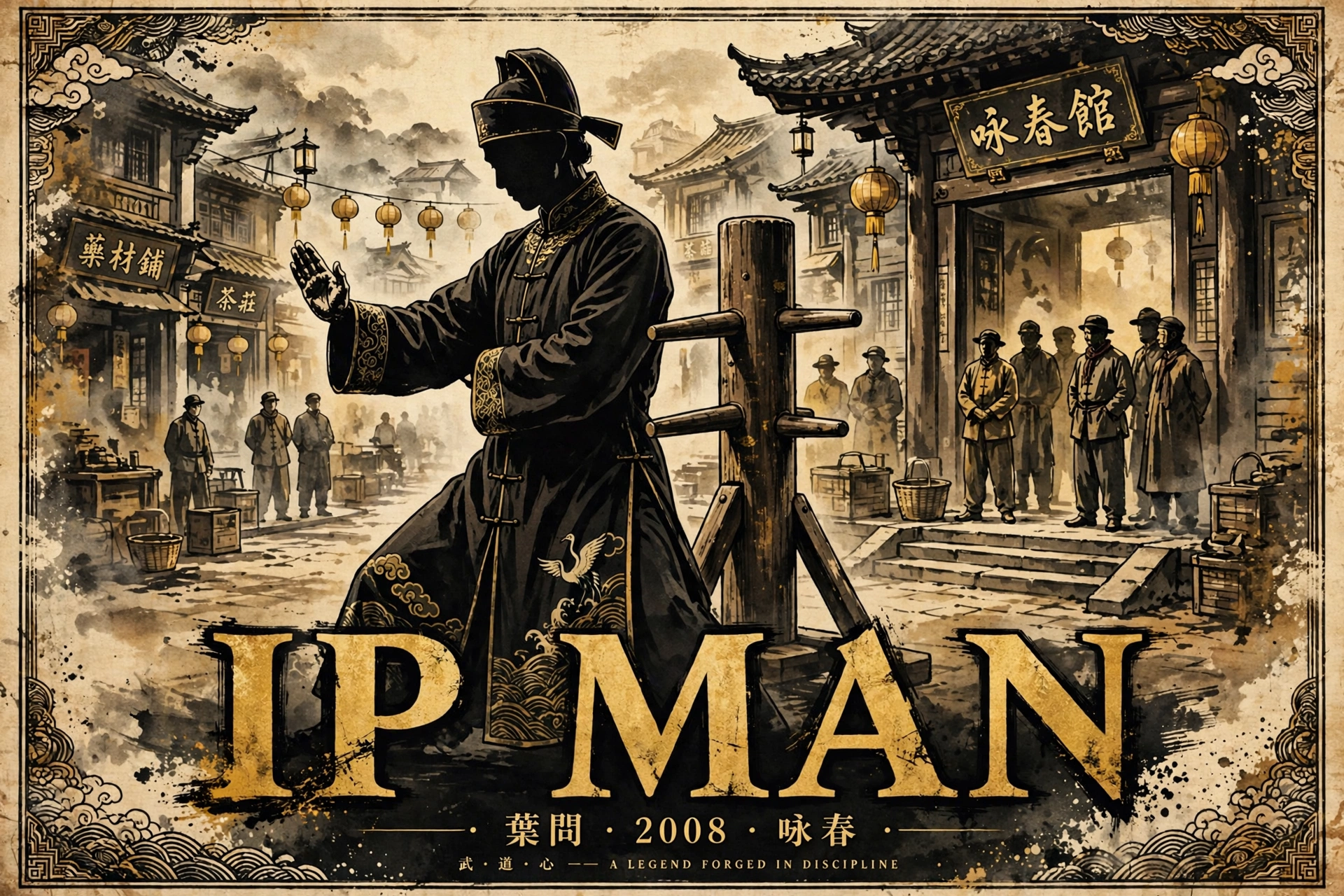
★★★★☆ Our Rating: 8.5/10
The greatest martial arts heroes usually announce themselves. Ip Man built a modern classic out of a hero who does everything he can not to. Released in Hong Kong on 18 December 2008, Wilson Yip’s semi-biographical portrait of the Wing Chun grandmaster who would one day teach Bruce Lee gave Donnie Yen the defining role of his career, revived the old-fashioned kung fu film for a new century, and launched a franchise that ran for over a decade. This Ip Man review will argue the case plainly: the sequels grew bigger and louder, but the first film remains the best of them, because it understands that its hero’s politeness is not a delay before the action — it is the meaning of the action.
The real Ip Man (1893–1972) was a Foshan martial artist of genuine historical importance, credited with bringing Wing Chun out of private, closed-door teaching and, after moving to Hong Kong, training a generation of students that included Lee. The film is honest about being a dramatisation rather than a documentary: it compresses his life in Foshan in the 1930s and during the Second Sino-Japanese War into a clean, rousing arc of dignity under pressure. Purists can and do argue with its liberties. Audiences, meanwhile, got something rarer than accuracy — a martial arts film with the emotional shape of a classic Hollywood biopic and fight scenes choreographed by Sammo Hung that still, today, set the standard for close-quarters screen combat.
If you have never seen a kung fu film and wonder where to start, this is one of the two or three best answers anyone can give you. Here is why, and where — honestly — it simplifies.
| Detail | Information |
| Release date | 18 December 2008 (Hong Kong) |
| Director | Wilson Yip |
| Writers | Edmond Wong, Chan Tai-lee |
| Genre | Action, Biography, Drama, Martial Arts |
| Language | Cantonese, Mandarin, Japanese |
| Runtime | 108 minutes |
| Budget | Approx. US$11.7 million |
| Lead cast | Donnie Yen, Simon Yam, Lynn Hung, Gordon Lam, Fan Siu-wong, Hiroyuki Ikeuchi |
| Our rating | 8.5/10 |
Foshan in 1935 is a prosperous southern Chinese town famous for its martial arts schools, whose masters test each other in friendly, ritualised duels behind closed doors. Ip Man (Donnie Yen) is the town’s worst-kept secret: a wealthy, gentle family man who takes no students, runs no school and spends his days training, drinking tea and being gently scolded by his wife Cheung Wing-sing (Lynn Hung) for enjoying other men’s challenges a little too much. Everyone in Foshan knows he is the finest Wing Chun practitioner alive. Ip Man is the only one who seems embarrassed by it.
The town’s pecking order is upended by the arrival of Jin Shanzhao (Fan Siu-wong), a rough, arrogant northern stylist who beats Foshan’s masters one after another and demands the famous Ip Man. Their duel — staged first as comedy, then as a clinic — is the first half’s centrepiece, and it establishes the film’s moral geometry: skill in this story is always measured against arrogance. Then 1937 arrives, and the film changes key entirely. War comes to Foshan. The Ip family’s mansion is seized, their fortune evaporates, and the master who once turned away students is reduced to shovelling coal and counting sweet potatoes, trying to keep his wife and young son alive in an occupied city while Japanese officers stage martial arts bouts — rice as the prize — to humiliate Chinese fighters.
It is in this second half that the film’s polite hero is finally given reasons to fight that have nothing to do with pride: hunger, grief, loyalty to friends like cotton-mill owner Chow Ching-chuen (Simon Yam), and the sight of cruelty that cannot be answered with courtesy. The story builds towards a public confrontation whose stakes — personal, communal and national — this review will leave for your viewing, except to say that the film earns its finale the old-fashioned way, by making you care about the man long before it asks you to cheer for the fighter. As biography it is simplified and at times invented; as a dramatisation of what the historical Ip Man came to represent — the teacher as guardian of dignity — it is completely sincere.
Donnie Yen as Ip Man is the performance this gifted action star had been waiting his whole career for, and he knew it. Yen had played brilliant fighters before, often with an edge of cockiness; here he suppresses almost everything showy. His Ip Man is soft-spoken, self-deprecating, visibly uncomfortable with praise, and funny in a dry, domestic way — the comedy of a husband caught sneaking out to a duel is played with genuine sitcom timing. The transformation across the film is done in the body: upright ease in the rich years, then a stoop of hunger and shame in the occupation, then, when he finally unleashes in the mill and arena sequences, a speed and precision that feel like a dam breaking. Yen trained extensively in Wing Chun for the role — the master’s son Ip Chun served as a consultant on the production — and the authenticity shows in the small things: the chain punches, the sticking hands, the economy of a style built for close quarters. This is the rare action performance where the acting and the fighting are the same achievement.
Simon Yam as Chow Ching-chuen brings warmth and eventual heartbreak as Ip Man’s friend, a mill owner whose generosity in good times makes his wartime fate land hard; Yam, one of Hong Kong cinema’s most reliable actors, underplays beautifully. Lynn Hung as Cheung Wing-sing has the film’s most thankless assignment — the wife who nags the hero about fighting — and lifts it above stereotype with flashes of dry wit and, in the war years, a quiet steel that reframes her completely. Fan Siu-wong as Jin Shanzhao is tremendous fun as the northern challenger, all swagger and appetite, and the film is smart enough to give him a second movement that complicates him. Gordon Lam as Li Zhao, the police officer turned interpreter for the occupiers, plays the story’s most morally uncomfortable role with exactly the right shiftiness, and Hiroyuki Ikeuchi as General Miura, the Japanese officer obsessed with Chinese martial arts, avoids cartoon villainy: his respect for Ip Man is real, which makes the conflict between them sadder and sharper than simple hatred would.
Wilson Yip, who had directed Yen in harder, modern action films, proved an inspired choice for period material. He directs the first half with the relaxed confidence of a filmmaker who knows his set pieces will deliver, letting Foshan breathe — all teahouses, courtyards and school banners, photographed by O Sing-pui in warm, prosperous tones that the war half then systematically drains of colour and comfort. Editor Cheung Ka-fai keeps the many duels legible and the 108 minutes moving; the film never sags, even in its quietest domestic stretches.
The action, choreographed by the legendary Sammo Hung with Tony Leung Siu-hung, is the headline craft achievement and it fully deserves the Hong Kong Film Award it won for Best Action Choreography. The philosophy is refreshingly grounded: minimal wire-work, no fantasy physics, fights that happen at conversational distance and end in seconds of terrifying efficiency rather than minutes of acrobatics. Three sequences define the film. The closed-door duels of the first half are courtly and witty, including a delightful exchange fought across a wobbling table and around a feather duster’s worth of household obstacles. The cotton-mill brawl, where Ip Man finally fights for his community rather than his reputation, escalates with real anger. And the celebrated sequence in which he faces ten black-belt opponents at once — shot to let the audience count every technique — remains a modern action benchmark: brutal, clear and emotionally motivated, because by then we know exactly what each blow is answering. The film was nominated for twelve Hong Kong Film Awards in total and won Best Film alongside the choreography prize, an accurate reflection of where its strengths lie.
The limitations are real, if forgivable. As history, the film tidies a complicated life into a national-pride fable, and viewers who know the real Ip Man’s story will find simplifications and inventions throughout. The wartime villains beyond Miura are drawn broadly, and one supporting character’s fate is handled with a melodramatic bluntness that momentarily breaks the film’s otherwise careful tone.
Japanese composer Kenji Kawai, a veteran of both anime landmarks and Hong Kong productions, supplies a score that gives the film much of its emotional scale. His music blends orchestral weight with East Asian instrumentation — plucked strings, percussion and mournful melodic lines — and it understands the film’s two registers: warm, almost playful colours for the Foshan of teahouses and duels, and stark, drumming severity as occupation takes hold. Kawai is particularly effective in restraint: several of the finest fight passages are allowed to play over little more than impact sounds and breathing, so that when the score does surge, in the mill sequence and the finale, it feels like the whole town exhaling. It is not a score of famous themes so much as a score of perfect temperatures, and it has become closely identified with the franchise it helped launch.
What we loved:
What could be better:
Ip Man was produced for a reported US$11,715,578 — roughly US$11.7 million — and its worldwide gross is most commonly cited at around US$21.9–22.1 million, with references differing slightly by source: Wikipedia’s film page lists US$22,108,789, while several other standard references round the total to about US$21.8 million, so we give the narrow range rather than pretend the sources perfectly agree. In Hong Kong itself it grossed over HK$25 million, an excellent result for a period martial arts film in 2008, and it performed strongly across Asia. The raw numbers, though, understate the commercial story. Ip Man arrived when the traditional kung fu film was considered commercially tired, and its success — critically sealed by the Hong Kong Film Award for Best Film — directly produced Ip Man 2 (2010), Ip Man 3 (2015) and Ip Man 4: The Finale (2019), alongside spin-offs and a wave of rival Wing Chun projects, and it re-established Donnie Yen as Asia’s premier action star for the following decade. Few films in this genre have ever returned so much influence on so contained a budget.
Emphatically yes. Ip Man is the ideal gateway to modern Hong Kong action: emotionally accessible, beautifully performed, and containing fight choreography that action fans will study and newcomers will simply feel. Go in expecting a dramatised legend rather than a history lesson, and what you get is the most satisfying martial arts biopic of its generation — the rare franchise starter that never needed its sequels to justify it.
Our rating: 8.5/10 — rousing, humane and brilliantly fought; the gold standard for modern kung fu biopics.
Is Ip Man based on a real person?
Yes. Ip Man (also written Yip Man, 1893–1972) was a real Foshan Wing Chun master who later taught in Hong Kong, where Bruce Lee was among his students. The film dramatises and compresses his life and invents freely in places — treat it as a legend built on a real man.
Do I need to know Wing Chun or martial arts to enjoy it?
Not at all. The film explains itself through character and stakes, and the fights are choreographed for clarity. Martial artists will appreciate the authentic Wing Chun technique; everyone else will simply see superb action.
Is Ip Man (2008) the first of a series?
Yes. It was followed by Ip Man 2 (2010), Ip Man 3 (2015) and Ip Man 4: The Finale (2019), all starring Donnie Yen and directed by Wilson Yip. The first film is a complete story in itself and widely considered the best of the series.
How violent is Ip Man?
It is a martial arts film with frequent, sometimes intense fight violence, including wartime brutality. There is little gore, but the occupation sequences are sobering. It is suitable for teens and above in most families’ judgement.
Where can I watch Ip Man (2008)?
It streams widely on major platforms in many regions, usually with subtitles and often in an English-dubbed version too. Availability changes over time, so check your local services.