★ LATEST REVIEWS

★★★★☆ Our Rating: 8.5/10
It is one of the great box-office stories of modern cinema: a first-time director, best known as a sketch comedian, makes a small, personal film about her late mother — and it becomes one of the highest-grossing films in Chinese history, and the highest-grossing film ever by a solo female director. Hi, Mom (Chinese title Ni Hao, Li Huanying — literally “Hello, Li Huanying”) is a fantasy comedy-drama about a daughter who travels back in time to meet her mother as a young woman, and tries to give her a better life. It is funny, warm, and — fair warning — it will very likely make you cry.
This review is spoiler-free on the film’s ending. The premise is widely known, but the final revelation deserves to be met unspoiled.
| Detail | Information |
|---|---|
| Release date | 12 February 2021 (China, during the Spring Festival holiday) |
| Director | Jia Ling |
| Writers | Jia Ling, Sun Jibin, Wang Yu, Bu Yu, Liu Honglu |
| Genre | Fantasy comedy-drama |
| Language | Mandarin |
| Runtime | 128 minutes |
| Budget | RMB 380 million (around US$59 million) |
| Lead cast | Jia Ling, Zhang Xiaofei, Shen Teng, Chen He |
| Our rating | 8.5/10 |
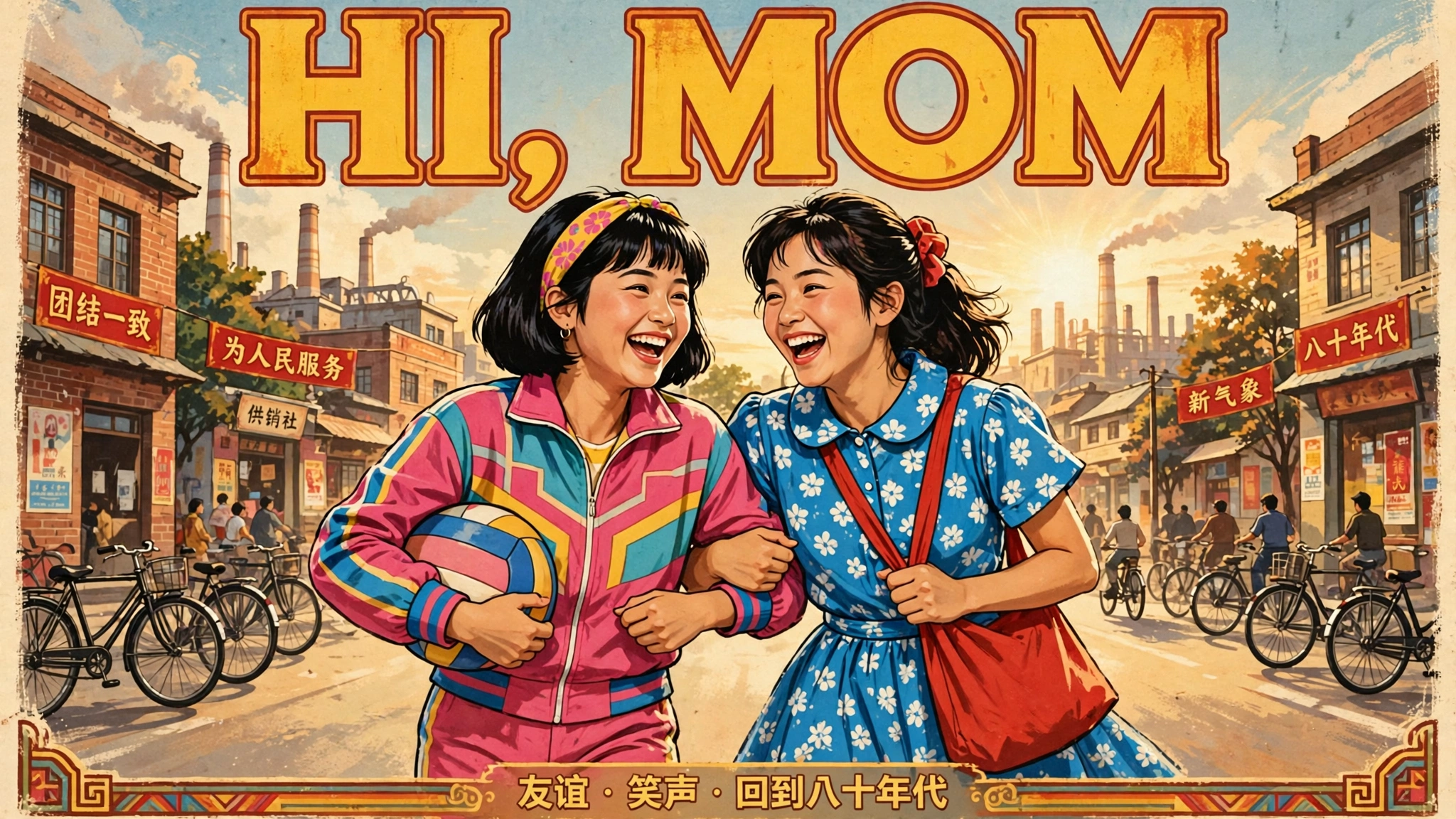
In 2001, Jia Xiaoling (Jia Ling) is a university student who has just received the worst news of her life: her mother, Li Huanying, has died in a car accident. Overwhelmed with grief and guilt — guilt at a lifetime of being, in her own eyes, a disappointment to her mother — Xiaoling suffers an emotional breakdown. And then, in the film’s fantasy turn, she wakes up in 1981, where she meets her mother as a young woman: Li Huanying (Zhang Xiaofei), a bright, funny, spirited factory worker, not yet a mother, not yet defined by sacrifice.
Xiaoling’s mission, as she sees it, is simple and selfless: she will use her knowledge of the future to give her mother a better life. She helps Li buy a television, organises a women’s volleyball tournament for her and her factory colleagues, and tries to set her up with Shen Guangliang (Shen Teng), the factory manager’s son — a match that, in Xiaoling’s reasoning, would give her mother wealth, status and a child to be proud of. The comedy comes from the collision between Xiaoling’s modern sensibilities and 1980s factory-town life; the emotion comes from something deeper, which the film reveals only gradually: the question of what a mother actually wants, and whether a daughter’s idea of “a better life” is the same as her mother’s.
Without spoiling the ending, it is fair to say the film’s final stretch reframes everything that came before. Audiences in China famously left screenings in tears — contemporary reports described cinemagoers wiping their eyes as the lights came up — and the reason is a twist that is less a plot trick than an emotional truth about parenthood. It is best experienced unspoiled.
Jia Ling as Jia Xiaoling — Jia Ling, directing herself in her debut feature, gives a performance of enormous warmth and comic timing. Xiaoling is funny without being a caricature, and her grief in the opening scenes is played straight, which makes the comedy that follows land harder. Jia’s background as a comedian shows in her timing, but her achievement here is emotional: she plays a daughter’s guilt and love without sentimentality, and she directs herself with a discipline many first-time directors lack.
Zhang Xiaofei as Li Huanying — Zhang Xiaofei is the film’s revelation. As the young Li Huanying, she is radiant: funny, stubborn, generous, and utterly believable as the woman Xiaoling’s mother must once have been. The chemistry between Zhang and Jia is the film’s engine — they play less like mother and daughter than like best friends, which is exactly the point, and their scenes together carry both the comedy and the ache. Zhang’s performance is what makes the ending devastating: by then, the audience loves Li Huanying as much as Xiaoling does.
Shen Teng as Shen Guangliang, and the supporting cast — Shen Teng, one of China’s most popular comic actors, brings his trademark charm to the factory manager’s son, and his scenes with Jia are among the film’s funniest. Chen He and the factory ensemble give 1981 its texture: a world of work-unit camaraderie, volleyball tournaments, television envy and small-town gossip, recreated with affectionate period detail.
Jia Ling directs with the confidence of someone telling a story she has carried for years — and she has: Hi, Mom grew out of a 2016 comedy sketch of the same name, which was itself drawn from her own life and her real mother, who died when Jia was young. That personal root shows in every frame. The 1981 setting is recreated with loving, unshowy detail — the factory, the dormitories, the clothes, the era’s pop culture — and the film’s pacing moves gracefully between broad comedy and quiet emotion.
The screenplay, credited to Jia and four co-writers, is structured like a classic comedy of errors that slowly reveals itself as something else. The first two acts are genuinely funny; the third act asks the audience to reconsider what they have been laughing at, and it does so without betraying the comedy. That tonal control is the film’s great directorial achievement, and it is why the film connected so powerfully: it earns its tears rather than demanding them.
One honest caveat: the film’s emotional machinery is, by design, powerful and direct. Viewers who prefer their family dramas understated may find the final stretch sentimental, and some of the middle stretch’s comic set-pieces run a little long. The fantasy mechanics, too, are deliberately loose — this is a film about feelings, not about time-travel logic, and anyone looking for rigorous rules will be disappointed. But those are quibbles beside what the film achieves.
The music, by Fei Peng and Michael Lai Siu-Tin, leans into the film’s period setting and emotional arc: 1980s-flavoured cues for the factory-town scenes, and a swelling, unabashedly emotional score for the climax. It works in the way the best melodrama scores work — it tells you what to feel, and you are happy to feel it. The sound design’s period details — factory announcements, television broadcasts, street sounds of 1981 — help sell the time-travel premise more than any visual effect could.
What we loved:
What could be better:
Hi, Mom‘s commercial performance is genuinely historic. Released on 12 February 2021 during China’s Spring Festival holiday, it earned more than RMB 4 billion in just over a week, overtaking the big-budget Detective Chinatown 3 to become the most successful film of the holiday period. Reported worldwide totals vary slightly by tracker — around US$841.7 million by one widely cited figure, around US$839.1 million by another, and around US$822 million by a third — but every source agrees on the shape of the achievement: one of the top five grossing films in Chinese history, China’s highest-grossing film of 2021, the second-highest-grossing non-English-language film of all time, and the highest-grossing film ever by a solo female director. On Douban, China’s leading review platform, it scored 8.1 out of 10, far ahead of its Spring Festival rivals. Against a reported budget of around US$59 million, it was one of the most profitable films of its year anywhere in the world.
Yes — and keep tissues nearby. Hi, Mom is a rare crowd-pleaser that is also deeply personal: a comedy that understands grief, and a fantasy that understands what daughters owe their mothers and what mothers actually want. It is one of the finest Chinese films of its decade, and its success was no accident. Watch it with someone you love, and call your mother afterwards.
Our rating: 8.5/10 — A hilarious, heartbreaking triumph: Jia Ling’s love letter to her mother is one of the great crowd-pleasers of modern Chinese cinema.
Who directed Hi, Mom?
Jia Ling, in her feature directorial debut. She also stars as Jia Xiaoling and co-wrote the screenplay.
Who stars in Hi, Mom?
Jia Ling as Jia Xiaoling, Zhang Xiaofei as her young mother Li Huanying, with Shen Teng and Chen He in supporting roles.
What is Hi, Mom about?
After her mother’s death in 2001, a young woman is transported back to 1981, where she meets her mother as a young factory worker and tries to give her a better life.
Is Hi, Mom based on a true story?
It is inspired by Jia Ling’s own life and her late mother, and grew out of a 2016 comedy sketch of the same name. The time-travel story itself is fictional.
How much did Hi, Mom earn at the box office?
Reported worldwide totals range from around US$822 million to US$841.7 million depending on the tracker, making it one of the highest-grossing Chinese films ever and the highest-grossing film by a solo female director.
Is Hi, Mom suitable for family viewing?
Yes, broadly. It is a warm family comedy-drama about a mother and daughter; younger children may find its emotional themes heavy, but there is nothing inappropriate for family audiences.
