★ LATEST REVIEWS

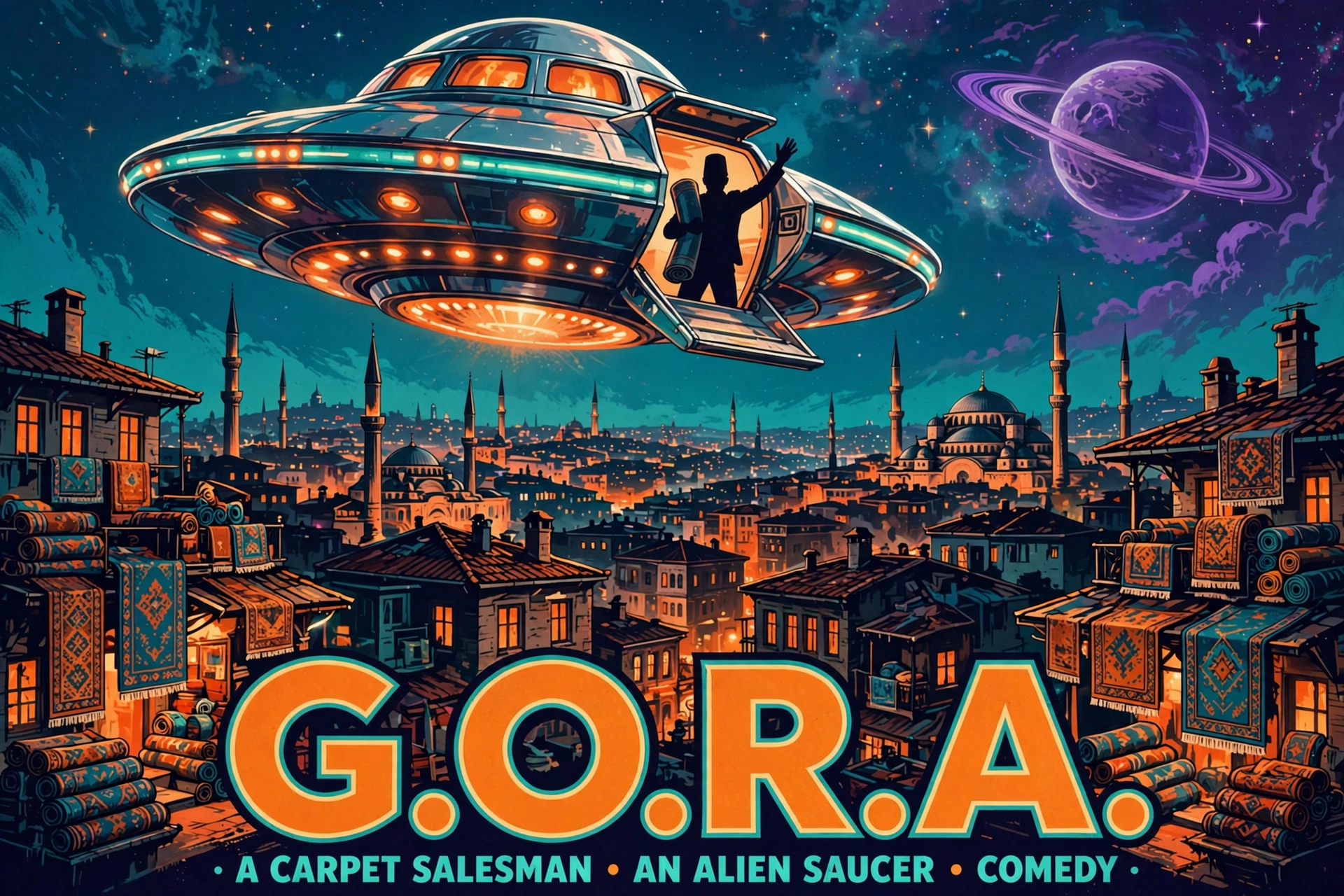
★★★★☆ Our Rating: 8/10
Every national cinema has one comedy that everybody can quote. For Turkey, that film is G.O.R.A. Released in November 2004, this science-fiction spoof took a fast-talking Istanbul carpet salesman, dropped him onto an alien planet, and became the highest-grossing film of its year in Turkey — out-earning every Hollywood blockbuster released alongside it, including Troy, which had the home advantage of being partly set in ancient Anatolia. More than twenty years later it remains the film that proved Turkish popular cinema could build its own glossy, effects-driven blockbuster and fill cinemas with it.
An honest G.O.R.A. review also has to admit two things up front. First, this is a parody, openly and shamelessly: Star Wars, The Matrix and The Fifth Element are all raided for jokes, set-ups and even whole sequences. Second, a portion of its humour is rooted in Turkish street slang, stand-up rhythms and early-2000s references that no subtitle can fully carry across. Neither fact stops it being very funny. What follows is a spoiler-free look at the story, the performances, the craft behind Turkey’s most expensive production of its era, and the record-breaking run that turned a comedy into a franchise — A.R.O.G (2008), Arif V 216 (2018) and a hit spin-off series followed.
| Detail | Information |
|---|---|
| Release date | 5 November 2004 (Turkey) |
| Director | Ömer Faruk Sorak |
| Writers | Cem Yılmaz |
| Genre | Science Fiction, Comedy, Parody |
| Language | Turkish |
| Runtime | 127 minutes |
| Lead cast | Cem Yılmaz, Özge Özberk, Ozan Güven, Özkan Uğur, Şafak Sezer, Rasim Öztekin, İdil Fırat |
| Our rating | 8/10 |
A note on the missing budget row: G.O.R.A. was widely reported at the time as the most expensive Turkish production ever made, and trade coverage described it as a big-budget gamble that spent years in a difficult production. No single, reliably audited budget figure has ever been published in a source we could verify, so — rather than repeat one of the round numbers that circulate on fan databases — we have left the row out and flagged the claim itself in the box-office section below.
Arif Işık (Cem Yılmaz) makes a living the Istanbul way: selling carpets to tourists, talking very fast, and running a small side business in faked UFO photographs, because why should honesty get in the way of a good story? The joke turns on him when a real UFO arrives. Arif is beamed up by the security forces of the planet G.O.R.A., whose commander, Logar Trihis — also played by Yılmaz — is nursing an ancestral grudge against Earth and has been quietly collecting human prisoners as a form of historical revenge.
Prison on G.O.R.A. is where the film finds its engine. Arif falls in with a fellow inmate known as Bob Marley Faruk, a philosophical chef, and with 216, a gentle, devoted robot who serves the planet’s royal household. Through 216, Arif learns of Princess Ceku (Özge Özberk), her father King Tocha, and Logar’s scheme to seize the throne by forcing a marriage. Meanwhile a mysterious figure called Garavel (Özkan Uğur) keeps appearing to Arif like a cut-price Jedi master, insisting the carpet salesman has a destiny.
From there the film becomes a cheerful obstacle course: escape attempts, a planetary disaster that only Arif seems able to fix, a sacred ritual borrowed brazenly from The Fifth Element, and a climactic fight that rebuilds The Matrix with Turkish timing. The plot is frankly a coat-rack — its job is to hang jokes on — but it is a well-built coat-rack. Every set-up returns, every borrowed blockbuster moment is re-staged with a local twist, and Arif’s romance with Ceku gives the mayhem just enough heart to land the ending. We will not spoil who ends up ruling G.O.R.A., or what happens when Arif tries to prove any of it back home.
Cem Yılmaz as Arif — and as Logar is the entire show, and the film knows it. Yılmaz, already Turkey’s biggest stand-up comedian when he wrote the script, in effect plays both hero and villain: Arif, all elbows, patter and wounded pride, and Logar, a preening, tantrum-prone military peacock. Some listings credit him with as many as four roles across the film. The double performance is more than a gimmick. Arif and Logar are mirror images — two loud men who bluff their way through life — and Yılmaz plays the difference in the eyes: Arif’s bluff is survival, Logar’s is vanity. His throwaway lines, delivered half to himself, are where the film is funniest, and they are the lines Turkish audiences still quote.
Ozan Güven as 216 gives the film its soul. Playing a robot could have been a voice and a costume; Güven makes 216 loyal, anxious and quietly heartbreaking, a servant who dreams of being treated as a person. His double act with Yılmaz — exasperated machine, impossible human — is the partnership the two sequels were built on. Özge Özberk as Princess Ceku has the thankless job of being the straight romantic lead in a parody, and she handles it with warmth and good comic exasperation, refusing to play Ceku as a prize rather than a person. Özkan Uğur as Garavel spoofs the wise-mentor archetype with total deadpan commitment, while Rasim Öztekin as Bob Marley Faruk and Şafak Sezer as Kuna round out a prison ensemble that feels like a repertory company having the time of its life. Nobody here is underplaying, but in a film this broad, commitment is the quality that counts.
Ömer Faruk Sorak had co-directed Vizontele (2001), the previous Turkish box-office champion, and he directs G.O.R.A. with a populist’s instinct for scale. Working with cinematographer Veli Kuzlu, he shoots the alien planet as a gleaming, slightly tacky space-opera stage — bright colours, big sets, costumes that look expensive and faintly ridiculous at the same time, which is exactly the joke. The production reportedly spent years getting its effects and sets finished amid financial and technical problems, and the effort shows: for 2004, and for a national industry that rarely attempted effects cinema, the spaceships, prison worlds and disaster sequences are remarkably confident.
The craft is not flawless. The editing is baggy in the middle act, where sketch follows sketch and the plot politely waits outside; a few effects shots have aged far worse than the practical sets; and the film’s structure — a chain of parodies — means momentum depends entirely on whether the last joke landed for you. Sorak’s real achievement is tonal. He never lets the film sneer at the genres it copies. This is a fan’s parody, made by people who clearly loved Star Wars and The Fifth Element enough to rebuild them in Turkish, and that affection is why the film plays as celebration rather than mockery.
The music is credited to Ozan Çolakoğlu, with contributions associated with Sagopa Kajmer and Özkan Uğur in the film’s credits, and it does precisely what a spoof score should do: it plays the space opera completely straight. Sweeping, mock-heroic cues swell under scenes whose hero is a man in a prison uniform complaining about the food, and the contrast generates half the comedy. Turkish pop and rap flavours cut through the orchestral pastiche at key moments, rooting the film in its home market rather than in a generic Hollywood sound. It is not a score anyone hums on the way out — the dialogue owns the audience’s memory — but as comic engineering it is expertly judged, and it never once winks before the joke does.
What we loved:
What could be better:
Here are the numbers we can stand behind. G.O.R.A. opened across Turkey on 5 November 2004 and finished as the number one film of the year in its home market. Box Office Mojo’s Turkish chart credits it with about $18.3 million in Turkey — comfortably ahead of Vizontele Tuuba and Troy — and Screen Daily, reporting during the run, put its Turkish gross at $17.4 million with more than $19 million internationally by mid-December 2004, noting that it had passed 3.5 million admissions in just four weeks and had overtaken Vizontele as the highest-grossing film in Turkey in two decades. A Turkish lira total of 30,805,474 TL is the figure most commonly attached to the full run. Final admissions are commonly reported at around four million; we flag that as a reported round figure rather than an audited one, but the direction of travel is not in doubt — contemporary trade press expected the run to head towards 4.5 million admissions, and the film’s record-holder status at the time is well documented.
Just as important is what the money meant. G.O.R.A. was reported on release as the most expensive Turkish film ever made, and its success told an entire industry that local audiences would turn out in record numbers for a local blockbuster with blockbuster craft. The sequels tell the rest of the story: A.R.O.G followed in 2008, Arif V 216 in 2018, Yılmaz’s Erşan Kuneri character received his own Netflix series in 2022, and the characters remain a going concern more than twenty years on.
Yes — with one condition. Watch it as what it is: a national comedy institution that happens to be dressed as a space opera. If you love affectionate parody, fast-talking comic leads and the pleasure of seeing a film industry bet big on itself and win, G.O.R.A. delivers two hours of high-spirited entertainment, anchored by a star performance (in fact, two of them) from Cem Yılmaz. If you need your comedy subtle, or you are watching in subtitles and fear the jokes will not travel, know that much of the visual parody and all of Ozan Güven’s robot do travel — and that what you are watching is, for millions of Turkish viewers, a piece of shared cultural furniture.
Our rating: 8/10 — Turkey’s defining sci-fi comedy: broad, baggy, occasionally dated, and carried to classic status by sheer comic energy and heart.
Is G.O.R.A. written by Cem Yılmaz? Yes. Yılmaz wrote the film and stars in it, playing Arif and the villain Logar among his roles, while Ömer Faruk Sorak directed. It grew directly out of Yılmaz’s stand-up persona — a fast-talking everyman bluffing his way out of impossible situations.
Do I need to watch G.O.R.A. before A.R.O.G and Arif V 216? It helps a great deal. A.R.O.G (2008) sends Arif back in time, and Arif V 216 (2018) builds its entire plot on Arif’s friendship with the robot 216, which is established here. Both are watchable alone, but the jokes compound if you start with this film.
Is G.O.R.A. suitable for children? It is a broad, mostly harmless space spoof with comic violence and innuendo in the dialogue. Older children who enjoy Star Wars parodies will follow the visual comedy easily, though some jokes are aimed squarely at adults.
Why is the budget of G.O.R.A. not listed? Because no single figure has been reliably published. The film was widely reported in 2004 as the most expensive Turkish production of its time, after a long and difficult production, but the exact numbers quoted online come from unverified databases, so we have flagged the claim rather than inventing a figure.
Where can I watch G.O.R.A.? The film has been available on Netflix in many regions in recent years and circulates on Turkish home-video and digital services. Streaming availability changes by country, so check your local catalogue.