★ LATEST REVIEWS

★★★★★ Our Rating: 9/10
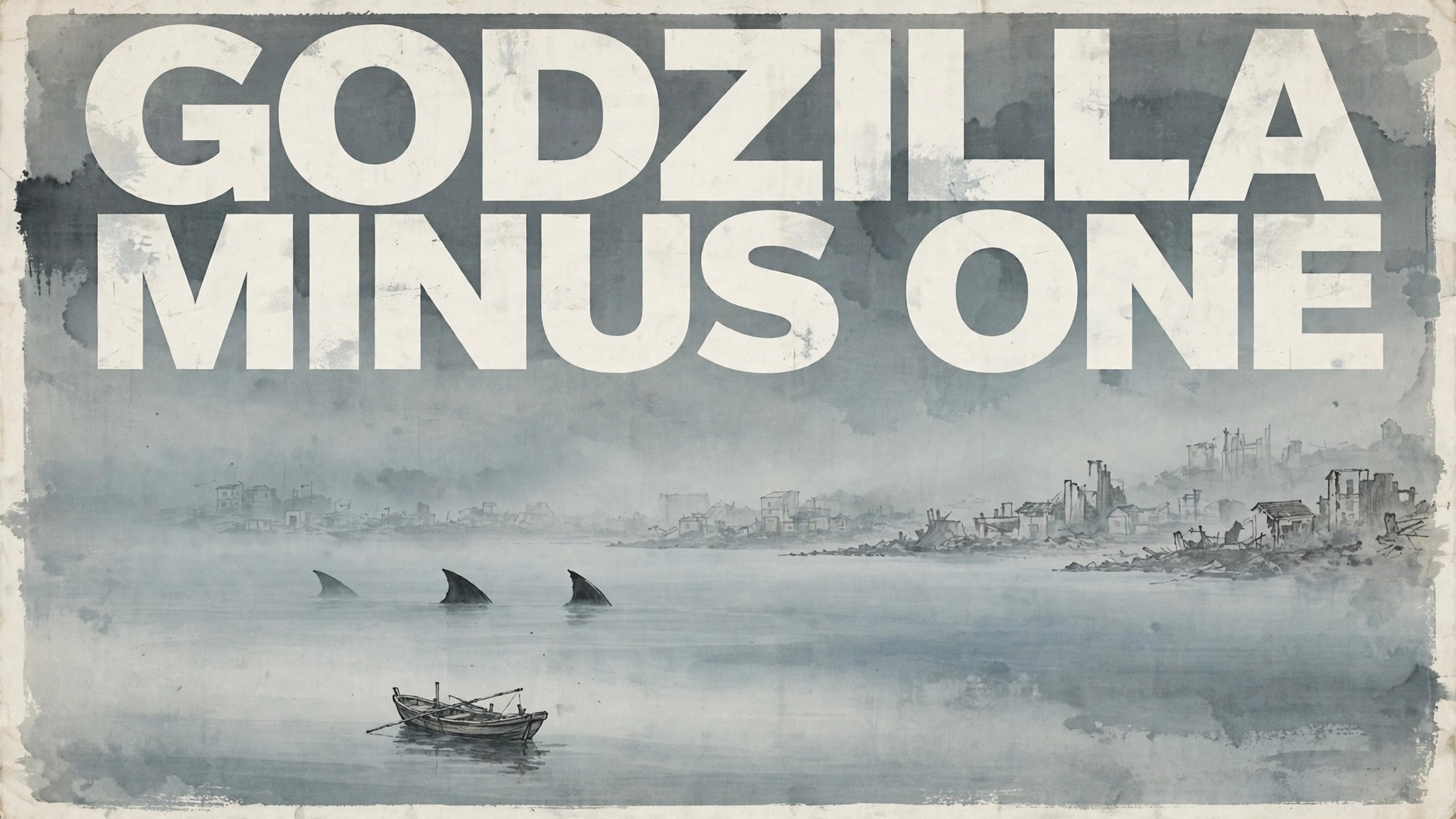
Most monster films ask you to care about a city being flattened. This one asks you to care about a man who cannot forgive himself for surviving, and a woman and child trying to build a home from rubble. That is why Godzilla Minus One is not just the best Godzilla film in decades — for many viewers it is the rare blockbuster that leaves you wiping your eyes as the credits roll. This Godzilla Minus One review will explain why the monster works here precisely because the human story works first.
Released in Japan on 3 November 2023 — the same date the original 1954 Godzilla opened — Takashi Yamazaki’s film is the thirty-seventh Godzilla film overall and the fifth of the Reiwa era, but it stands completely alone. You need no prior knowledge of the franchise, no homework, no timeline. It is a self-contained story set in the final years of the Second World War and its immediate aftermath, and it treats its monster the way the 1954 original did: not as a wrestling opponent for other creatures, but as a walking catastrophe that arrives when a nation is already at its lowest.
| Detail | Information |
| Release date | 3 November 2023 (Japan) |
| Director | Takashi Yamazaki |
| Writers | Takashi Yamazaki |
| Genre | Kaiju, Action, Drama, Sci-Fi |
| Language | Japanese |
| Runtime | 124 minutes |
| Budget | Approx. $10–15 million (reported range) |
| Lead cast | Ryunosuke Kamiki, Minami Hamabe, Yuki Yamada, Munetaka Aoki, Hidetaka Yoshioka, Sakura Ando, Kuranosuke Sasaki |
| Our rating | 9/10 |
The film’s title is its thesis. As a character explains it, Japan in 1945 has already been reduced to zero — cities burned, industry shattered, a population grieving. Then Godzilla arrives, and takes the country from zero to minus one. Everything that follows is about people who have nothing left trying to protect what little they have rebuilt.
The story begins with Kōichi Shikishima, a young kamikaze pilot who, in the war’s final days, lands his plane on Odo Island claiming engine trouble. The truth is simpler and harder: he could not bring himself to fly his suicide mission, and the shame of that failure will define him. On Odo Island he encounters a creature the locals fear — not yet the towering Godzilla of legend, but a smaller, feral dinosaur that will become him — and in an attack that leaves almost everyone dead, Shikishima freezes. He survives again, and hates himself for it.
Back in the rubble of Tokyo, Shikishima stumbles into a makeshift household with Noriko Ōishi, a young woman who has taken in an orphaned baby, Akiko, after losing her own family. Neither of them is ready to call what they have a family, and neither can bear to walk away from it. Shikishima finds dangerous, poorly paid work clearing mines from the sea with a small crew of former sailors — men who, like him, are trying to be useful in a country that has stopped asking them to die and has not yet told them how to live.
Then Godzilla returns, larger, irradiated, and heading for Tokyo. With Japan’s military disarmed by the post-war settlement and the occupying powers unwilling to intervene, the defence falls to the people with the least to offer and the most to lose: civilian volunteers, former naval engineers, and one disgraced pilot with a plan that depends on everything going right. What that plan is, and what it costs, is the film’s climax, and we will not spoil it here — except to say that its emotional logic, about choosing to live rather than choosing to die gloriously, is the point of the whole film.
Ryunosuke Kamiki as Kōichi Shikishima carries the film on his shoulders, and he never lets the monster-movie frame shrink the performance. Shikishima’s guilt is not played as a single note; Kamiki lets it curdle into anger, tenderness and a stubborn refusal to be forgiven, often within the same scene. The scenes with the baby Akiko are the film’s quiet test — a hardened pilot learning, clumsily, how to hold a child without flinching — and Kamiki passes it without sentimentality.
Minami Hamabe as Noriko Ōishi gives the film its spine. Noriko is practical, funny and unwilling to be a symbol; she works, she argues, she refuses Shikishima’s self-pity without cruelty, and Hamabe plays her with a warmth that makes the film’s later stakes genuinely frightening. Yuki Yamada as Shirō Mizushima, the young minesweeper who idolises Shikishima and then has to grow past that admiration, is the crew’s beating heart.
The ensemble around them is unusually strong for a kaiju film. Hidetaka Yoshioka as Kenji Noda, the former naval engineer who designs the civilian defence plan, brings a weary, decent authority; Munetaka Aoki as Sōsaku Tachibana, the mechanic from Odo Island who knows exactly what Shikishima did and did not do, supplies the film’s moral reckoning; Sakura Ando as Sumiko Ōta, the neighbour who watches the household form and fracture, grounds the domestic scenes; and Kuranosuke Sasaki as Captain Akitsu, the minesweeper’s captain, gives the sea sequences their gruff humour. No one here is a cardboard victim waiting for a monster; everyone has a job, a history and a reason to be afraid.
Takashi Yamazaki directed, wrote and supervised the visual effects — a triple role that explains the film’s rare coherence. Because the same mind controlled the story and the spectacle, the monster sequences are never just set pieces; they are arguments. The Ginza attack, the film’s centrepiece, is staged as a slow, almost unbearable escalation: a tail, a footstep, a train lifted and dropped, a city flattening in a mushroom cloud of dust. Yamazaki withholds the full creature longer than most directors would dare, and when Godzilla finally stands in the open, the scale feels earned rather than merely loud.
The visual effects, supervised by Yamazaki with Kiyoko Shibuya and produced by Shirogumi, won the Academy Award for Best Visual Effects — the first Godzilla film ever to win an Oscar — and the achievement is more remarkable for what it cost. On a reported budget far below a Hollywood blockbuster’s catering bill, the film delivers water, fire, destruction and a creature with real weight and texture. Kōzō Shibasaki’s cinematography keeps the human scale legible inside the spectacle, and Ryūji Miyajima’s editing knows when to cut to a face instead of another explosion. The film was later released in a black-and-white version, Godzilla Minus Color, which strips the spectacle back to its 1954 roots and proves how much of the horror is in the composition, not the colour.
Honesty requires one caveat. The final defence plan, ingenious as it is as drama, depends on a piece of pulp science that will not survive much scrutiny — a mechanism involving gas and pressure that works because the film needs it to, not because physics obviously agrees. Most viewers will grant it, because the emotional stakes are so high by then, but it is the one moment where the film asks for more goodwill than it has strictly earned.
Naoki Satō’s score understands the assignment: this is a human drama that happens to contain a monster, so the music is mostly quiet, mournful and patient. Strings and sparse piano carry the domestic scenes, giving Shikishima’s guilt and Noriko’s resolve a musical language of their own, while the monster cues are percussive and overwhelming — low brass, deep drums, a sense of something enormous moving through water. Satō also knows when to borrow: echoes of Akira Ifukube’s classic Godzilla themes surface at key moments, not as nostalgia bait but as a reminder that this creature has a history, and that the audience’s own memories are part of the dread. The silences matter too. Several of the film’s most affecting moments play with almost no music at all, just wind, water and breathing — which is why the score’s return, in the finale, lands so hard.
What we loved:
What could be better:
The budget is the first headline. Reports consistently place it in the range of $10–15 million, with Yamazaki himself indicating it came in below $15 million — a figure that makes the film’s visual achievement almost absurd. Against that, the worldwide gross landed at roughly $113–116 million, with most tallies settling around $115–116 million. That made it, among other records, the highest-grossing Japanese live-action release of its year in North America, and a genuine theatrical event rather than a niche success.
The awards followed the money. The film won the Academy Award for Best Visual Effects — a first for the franchise and a first for a non-English-language film in that category — alongside a haul of Japanese Academy Prizes. Its success also revived Toho’s confidence in the character’s dramatic potential: a monster film, made cheaply and seriously, could out-earn and outlast far more expensive spectacle. Hollywood noticed. So did audiences who had never cared about Godzilla before.
Yes — and bring someone who thinks monster films are not for them. Godzilla Minus One is the rare blockbuster that works as a war drama, a family drama and a disaster film at once, and it earns its tears honestly, through character rather than manipulation. Watch it on the biggest screen you can find, with the sound up, and let the Ginza sequence do what it was designed to do.
Our rating: 9/10 — a kaiju film with a broken, beating heart; only some pulp science and a touch of melodrama keep it from perfection.
Do I need to have seen other Godzilla films first?
No. The film is a standalone story set in 1945–1947. It rewards long-time fans with echoes of the 1954 original, but it explains everything a newcomer needs.
Is it connected to Shin Godzilla or the American MonsterVerse films?
No. It is a separate Toho continuity, unrelated to Shin Godzilla (2016) and to Legendary’s MonsterVerse. Think of it as its own self-contained reboot.
Why is it called Minus One?
Because Japan in 1945 has already been reduced to zero by war, and Godzilla’s arrival takes it below zero — to minus one. The title is the film’s premise in two words.
Is Godzilla Minus One suitable for children?
It is intense rather than gory — mass destruction, wartime trauma and grief are its main content concerns — and it is aimed at teens and adults rather than young children.
Where can I watch Godzilla Minus One?
It streams on major platforms and is available on home video in many regions, including the black-and-white Minus Color version. Availability changes over time, so check your local services.