★ LATEST REVIEWS

★★★★☆ Our Rating: 7/10
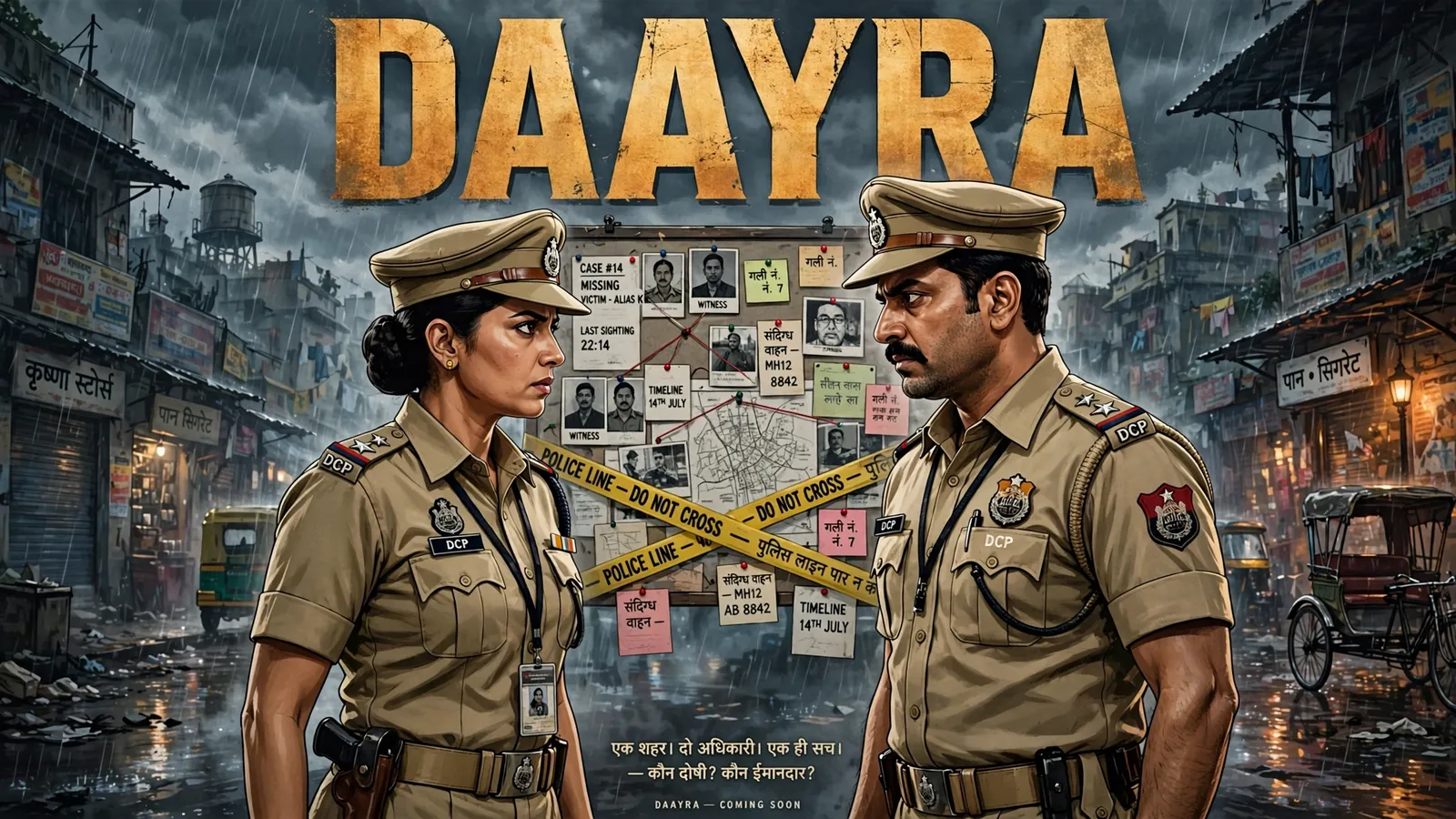
Some crime films do not begin with a murder. They begin with a question — not who did it, but what the system did after it happened. Daayra is that kind of film: directed by Meghna Gulzar, released in cinemas on 18 September 2026, an investigative crime thriller inspired by true events, built around two police officers whose ideas of justice point in opposite directions. Kareena Kapoor Khan and Prithviraj Sukumaran play the two DCPs, in one of the most seriously made Hindi films of the year — one that trusts its audience to sit with an uncomfortable question rather than handing them a comforting answer.
The film’s theatrical run was not a commercial success — Daayra was a box-office flop despite good reviews. But flop and quality are two different things: a film can fail at the box office and still be worth watching, and Daayra is worth watching. With its Netflix premiere on 13 November 2026, it now has a second chance to find the audience that largely missed it in cinemas.
This review is spoiler-free. It describes the premise, the characters and the shape of the story, not the ending.
| Detail | Information |
|---|---|
| Theatrical release | 18 September 2026 (Hindi and Malayalam) |
| Netflix premiere | 13 November 2026 |
| Director | Meghna Gulzar |
| Written by | Meghna Gulzar, Yash Keswani and Sima Agarwal |
| Produced by | Junglee Pictures and Pen Studios (Dr. Jayantilal Gada) |
| Genre | Crime thriller |
| Language | Hindi (also released in Malayalam) |
| Starring | Kareena Kapoor Khan (DCP Ajooni Kohli), Prithviraj Sukumaran (DCP Raman Kumar), Jitendra Joshi, Kanwaljit Singh, Achint Kaur, Anuja Sathe, Seema Azmi, Biswapati Sarkar |
| Inspired by | True events |
| Runtime | Not verified at the time of writing |
| Budget | ₹50–55 crore (Wikipedia-reported range, unverified) |
| Rotten Tomatoes | 74% positive from 19 critics, 6.6/10 average |
| Box office | Day 1 ~₹1 crore net; first weekend ₹4.50 crore; first week ₹5.60 crore (Pinkvilla); Day 11 ~₹8.07 crore India net / ₹11.72 crore worldwide (Koimoi); overseas ~₹2.2 crore |
| Our rating | 7/10 |
A rape and murder case sparks public outrage, and the pressure on the police — public, press and a political system that wants a result it can announce — is enormous. Then four suspects are killed in police custody. The encounter, as the police call it, closes the case. Or it is supposed to.
DCP Ajooni Kohli (Kareena Kapoor Khan) is assigned to find out what really happened: whether the encounter was lawful — a legitimate police action — or a calculated move, a killing dressed up as procedure. That puts her on a collision course with DCP Raman Kumar (Prithviraj Sukumaran), whose view of justice is very different. The two are not hero and villain in any simple sense, but professionals who arrived at opposite answers to the same question: when the system fails, what is a police officer allowed to do about it?
That is the circle — the daayra — of the title. The film’s argument is that violence does not end when the case is closed: crime produces outrage, outrage produces pressure, pressure produces a killing, and the killing produces a new crime to investigate. The people inside the circle — the victim’s family, the suspects’ families, the officers who carry out the orders and those who question them — are all trapped in it together.
The film is inspired by true events, carried the way Meghna Gulzar’s films always have: not as a claim that this exact story happened, but as a recognition that stories like this one happen again and again. The encounter killing is one of the most contested questions in Indian policing, and the film does not pretend it is easy to answer. It shows the pressure, the temptation and the cost — and asks the audience to decide what they think. That is a brave choice for a mainstream Hindi film, and the choice that defines Daayra.
Kareena Kapoor Khan plays DCP Ajooni Kohli, in one of the most restrained and serious performances of her career. Kohli is not a star vehicle; she is an investigator, played quiet, methodical and watchful — a woman doing a difficult job in a system that would prefer her to stop asking questions. There is no glamour here, no moment designed to remind the audience they are watching a movie star. The performance is built from small things: the way Kohli listens, reads a file, holds her ground in a room full of men who have already decided the answer. It only works if the actor trusts the material, and Kapoor Khan plainly does.
Prithviraj Sukumaran, as DCP Raman Kumar, is her equal and her opposite — a career built playing men of intelligence and conviction, and Kumar is both. His idea of justice is not cruelty; that would be too easy, and the film is too smart for it. His idea is that the system is too slow, too compromised and too broken to deliver what the public demands, and that an officer who waits for the system to work has failed. Sukumaran plays that conviction without swagger and without apology, and the film’s power comes from the audience understanding why he believes it, even as they see where it leads.
The scenes between them are the film’s centre of gravity. Two DCPs, two ideas of justice, one case — and neither is written to win the argument easily. The film gives both officers a fair hearing: Kohli is right that a killing in custody must be investigated, and Kumar is right that the public’s demand for justice is real and the system often fails to meet it. The tension between those two truths is what the film is about, and the two lead performances carry it without ever tipping into melodrama.
The supporting cast is strong and well used. Jitendra Joshi, Kanwaljit Singh, Achint Kaur, Anuja Sathe, Seema Azmi and Biswapati Sarkar fill out the world around the two DCPs — colleagues, superiors, family members, the people who live with the consequences of the case. Nobody here is a caricature: the senior officers are not cartoon villains, the families are not props, and everyone in the circle has a reason for being where they are. That care is what separates Daayra from a routine procedural: it cares about people, not just plot.
Meghna Gulzar is one of Hindi cinema’s most consistent directors, and Daayra plays to her strengths. Her films — Talvar, Raazi, Sam Bahadur — share a method: research thoroughly, stage plainly, refuse to sensationalise, trust the audience. Daayra follows it. Co-written by Gulzar with Yash Keswani and Sima Agarwal, the screenplay has the density of a real investigation: it does not rush, letting the case unfold through interviews, files, contradictions and small discoveries, trusting the viewer to keep up.
The direction is deliberately unshowy: no set pieces designed to make the audience gasp, no stylised violence, no score telling you how to feel at every moment. The camera watches rather than performs. That restraint is the film’s greatest strength and, for some viewers, its greatest limitation — a thriller that refuses to thrill conventionally will frustrate audiences who came for a chase and a twist, but reward those who came for a story about a real question. And the question here is as real as it gets.
The film’s visual language is grounded and grey. The India of Daayra is not the glossy India of the big commercial films: it is police stations, court corridors, crowded streets, the rooms where decisions are made and their consequences felt. The monsoon-grey palette suits a film about a system under pressure. The production design earns its realism honestly: evidence boards, files, uniforms, the details of a working police investigation all feel observed rather than invented, which is exactly what a film inspired by true events needs.
The editing holds the tension by controlling information carefully: the audience learns what Kohli learns, when she learns it, and the film does not give away its hand too early — discipline that keeps a two-hour procedural gripping even when the action is mostly people talking in rooms.
A film like this one does not need songs, and it does not have them in any conventional sense. The sound design is functional and realistic — the noise of a police station, the murmur of a crowd, the quiet of an interrogation room — and the score stays underneath the drama rather than competing with it. A crime thriller about an encounter killing that used music to manufacture excitement would betray its own subject, and Daayra lets the story carry the tension.
What we loved:
What could be better:
The critical reception and the commercial result point in opposite directions, and both deserve to be reported accurately.
The critical reception was good: Rotten Tomatoes records 74% positive from 19 critics (6.6/10 average), News18’s Showsha gave it 3/5, and the Free Press Journal 3.5/5, calling it “one of the best works of Meghna Gulzar”. Those are not the numbers of a masterpiece — they are the numbers of a good, serious film that critics respected.
The box office was poor. The film opened on 18 September 2026 to around ₹1 crore net, a weak start reflecting its serious subject and a crowded window — it clashed with Vibe and Hanuman Ansh / Mirzapur: The Movie. The first weekend brought ₹4.50 crore net, the first week ₹5.60 crore net (Pinkvilla), and after eleven days Koimoi put it at roughly ₹8.07 crore India net and ₹11.72 crore worldwide gross, with overseas around ₹2.2 crore. Against a reported ₹50–55 crore budget (Wikipedia, unverified), those numbers make Daayra a clear flop. It did not recover its costs in cinemas.
Why did a good film fail commercially? The subject is difficult and unglamorous, and such films rarely open big. The release clashed with rivals for the same audience. And the film’s own virtues — restraint, a refusal to entertain conventionally — are precisely what make it a harder sell on a Friday night. None of that makes it a bad film; it makes it one that was always going to need a second life, and the Netflix premiere on 13 November 2026 is that second life. Streaming is where serious, mid-budget Hindi films increasingly find their audience, and Daayra plays better on a quiet evening at home than in a crowded opening-weekend cinema.
Yes — if you like crime thrillers that take their subject seriously. Daayra is not a popcorn film. It is a procedural about a question that matters: what happens when the police, under unbearable public pressure, stop being investigators and start being executioners? Carried by two excellent lead performances and directed by one of Hindi cinema’s most reliable filmmakers, it earns its 7 out of 10 honestly — a good film, not a great one, that respects its audience and its subject in equal measure.
Watch it for Kareena Kapoor Khan’s quiet, determined Kohli, for Prithviraj Sukumaran’s equally determined Kumar, and for the scenes between them — two officers, two ideas of justice, one case that will not let either of them go. Do not watch it expecting a chase, a twist every ten minutes, or a hero who wins cleanly. Watch it expecting a film that leaves you thinking long after the credits end. The box office said no. The critics said yes. On the evidence of the film itself, the critics were right — and the Netflix premiere on 13 November 2026 is the perfect chance to find out for yourself.
When is Daayra released?
Cinemas on 18 September 2026 (Hindi and Malayalam); Netflix on 13 November 2026.
What is Daayra about?
A rape and murder case sparks outrage, and four suspects are killed in police custody. DCP Ajooni Kohli must find out whether the encounter was lawful or a calculated move, against DCP Raman Kumar’s opposing view of justice.
Who stars in Daayra?
Kareena Kapoor Khan (DCP Ajooni Kohli) and Prithviraj Sukumaran (DCP Raman Kumar), with Jitendra Joshi, Kanwaljit Singh, Achint Kaur, Anuja Sathe, Seema Azmi and Biswapati Sarkar.
Who directed Daayra?
Meghna Gulzar, who co-wrote it with Yash Keswani and Sima Agarwal; produced by Junglee Pictures and Pen Studios.
Is Daayra based on a true story?
Inspired by true events. It is not a documentary of one case, but a fictional story built around the real, contested question of encounter killings in Indian policing.
How did Daayra do at the box office?
A flop despite good reviews: around ₹1 crore net on Day 1, ₹4.50 crore net in its first weekend and ₹5.60 crore net in its first week (Pinkvilla), reaching roughly ₹8.07 crore India net and ₹11.72 crore worldwide gross after eleven days (Koimoi).
What did critics think of Daayra?
Rotten Tomatoes: 74% positive from 19 critics (6.6/10). News18 Showsha gave it 3/5, the Free Press Journal 3.5/5, calling it “one of the best works of Meghna Gulzar”.
What is the budget of Daayra?
₹50–55 crore as reported by Wikipedia — a reported range only, unverified by the producers.
Where can I watch Daayra?
On Netflix from 13 November 2026.
