★ LATEST REVIEWS

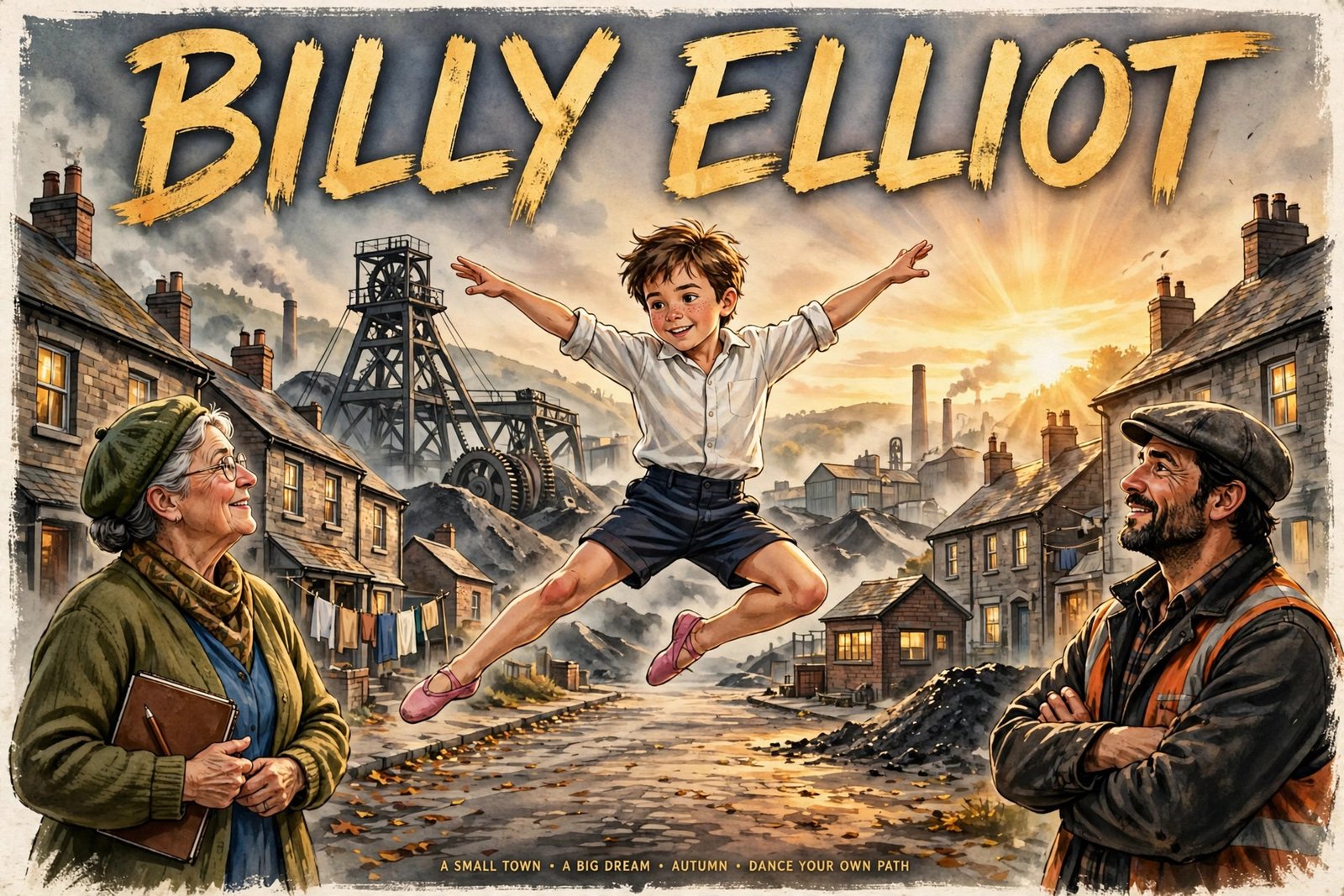
★★★★★ Our Rating: 9/10
Some films earn their reputation slowly, and some announce themselves immediately. Billy Elliot did both: it premiered at Cannes in 2000, charmed audiences worldwide, and has never really left the affections of British cinema since. Stephen Daldry’s film tells the story of an 11-year-old boy from a County Durham mining family who discovers ballet during the 1984–85 miners’ strike, and it tells it with a warmth and honesty that never tips into sentimentality. It is funny, heartbreaking and, in its final scenes, genuinely uplifting — the rare crowd-pleaser that never cheats to earn its applause.
This review is spoiler-free on the film’s ending. The destination matters less than the journey, but the journey deserves to be met fresh.
| Detail | Information |
|---|---|
| Release date | 19 May 2000 (Cannes premiere); 29 September 2000 (United Kingdom) |
| Director | Stephen Daldry |
| Writer | Lee Hall |
| Genre | Coming-of-age drama |
| Language | English |
| Runtime | 110 minutes |
| Budget | $5 million |
| Lead cast | Jamie Bell, Julie Walters, Gary Lewis, Jamie Draven, Jean Heywood, Stuart Wells |
| Our rating | 9/10 |
Billy Elliot (Jamie Bell) is 11 years old, growing up in the fictional mining village of Everington in County Durham, in 1984. His father Jackie (Gary Lewis) and older brother Tony (Jamie Draven) are coal miners, out on strike against pit closures, and the family is barely holding together: Billy’s mother has died, his grandmother (Jean Heywood) lives with them, and money is short. Jackie’s plan for his son is simple and traditional — boxing lessons at the local gym, a toughening-up for a tough world.
But Billy hates boxing. One afternoon he stays behind in the gym hall and watches the ballet class that shares the space, and something clicks. Without telling his father, he starts joining the class, taught by the chain-smoking, sharp-tongued Mrs Wilkinson (Julie Walters). She sees, almost at once, that Billy is not just enthusiastic — he is talented, unusually so. The film’s engine is the collision between that talent and everything around it: a father who sees ballet as something boys from mining families simply do not do, a community in the middle of a bitter industrial war, and a boy who cannot explain in words what dance means to him, because dance is the only language he has for it.
Daldry and writer Lee Hall (adapting his own play Dancer) never reduce this to a simple story of a boy versus a prejudiced father. Jackie is not a villain; he is a grieving, frightened man trying to protect his son in a world that is collapsing around him. Tony is not a bully; he is a young man fighting for his community’s survival. The strike is not background colour but the film’s moral weather: picket lines, police confrontations and soup kitchens are woven through Billy’s story, so that his private dream and his family’s public struggle are always in the same frame. When the film’s famous audition sequence arrives, it carries the weight of all of it.
Jamie Bell as Billy — Bell was chosen from around 2,000 boys who auditioned, and the casting is one of modern British cinema’s great discoveries. He was a dancer himself, and it shows: the dance sequences are performed, not faked, and his physicality gives the film its credibility. But the acting matters just as much. Bell plays Billy as stubborn, funny, confused and fiercely private, a boy who expresses himself with his body because words fail him. He became, at the time, the youngest winner of the BAFTA for Best Actor in a Leading Role, and the award was fully earned.
Julie Walters as Mrs Wilkinson — Walters is magnificent. Mrs Wilkinson could easily have been a stock inspirational-teacher figure; Walters makes her something far more interesting — frustrated, funny, a little bit broken by her own unfulfilled life, and ferociously committed to a boy she recognises as her one real chance to matter. Her scenes with Bell are the film’s comic and emotional heart, and her Oscar nomination for Best Supporting Actress was richly deserved.
Gary Lewis as Jackie, and the supporting cast — Lewis gives the film its emotional anchor. Jackie’s journey from furious disapproval to a father’s desperate, self-sacrificing support is the film’s quiet masterpiece, and Lewis plays it without a single false note. Jamie Draven’s Tony is hot-headed but never a caricature, Jean Heywood’s grandmother is a small miracle of warmth and eccentricity, and Stuart Wells, as Billy’s best friend Michael, brings a tender, funny honesty to a character exploring his own identity alongside Billy.
Daldry, making his feature debut after a career in theatre, directs with a confidence that belies his inexperience. He shoots the mining village with documentary realism — grey streets, terraced houses, pithead winding gear — and then lets the dance sequences lift the film into something almost musical without ever breaking its realism. The famous sequence in which Billy dances through the village streets, intercut with the strike’s violence, is a perfect example: fantasy and reality in the same shot, neither cancelling the other.
Cinematographer Brian Tufano keeps the palette muted and working-class, so that the colour of the dance studio feels like another world. The editing, by John Wilson, is crisp and musical, and the film’s pacing is exemplary: it never lingers on a joke or a tear longer than it should, and its final act earns its emotion through restraint rather than swelling strings.
One honest caveat: the film’s ending, while deeply moving, resolves its tensions a little more neatly than real life would, and some viewers may feel the strike storyline fades slightly in the final stretch as Billy’s story takes over. But this is a minor complaint against a film whose emotional logic is otherwise airtight.
Stephen Warbeck’s score is warm and unobtrusive, but the film’s real musical identity comes from its soundtrack: T. Rex’s “Cosmic Dancer” and “Get It On”, The Clash’s “London Calling”, and other period tracks that place the film firmly in 1984 while giving Billy’s dancing a rebellious, rock-and-roll energy. The music is not decoration; it is how Billy hears the world, and the film uses it to make dance feel like defiance as much as art.
What we loved:
What could be better:
Billy Elliot was made for just $5 million — a budget its producers initially struggled to raise, with backers doubting a story about a boy ballet dancer during the miners’ strike — and it earned approximately $109.3 million worldwide, more than twenty times its cost. It won three BAFTAs from thirteen nominations and earned three Academy Award nominations (Best Director for Daldry, Best Original Screenplay for Hall, and Best Supporting Actress for Walters). Its afterlife has been just as remarkable: a novel adaptation in 2001 and the stage musical Billy Elliot the Musical, which opened in London’s West End in 2005 and on Broadway in 2008, carrying the story to millions more.
Yes, without hesitation. Billy Elliot is one of those rare films that works for almost everyone — for dance lovers and for people who have never seen a ballet, for viewers who remember the strike and for those who have never heard of it. It is funny, moving and honest, and its final scenes are among the most satisfying in modern British cinema. If you have somehow never seen it, fix that this weekend.
Our rating: 9/10 — A modern British classic: funny, humane and genuinely inspiring, carried by a once-in-a-generation young performance.
What is Billy Elliot about?
An 11-year-old boy from a coal-mining family during the 1984–85 miners’ strike discovers a talent for ballet and fights for the chance to pursue it, against his family’s expectations and his community’s traditions.
Who plays Billy Elliot?
Jamie Bell, chosen from around 2,000 auditioning boys. He won the BAFTA for Best Actor, becoming its youngest winner at the time.
Is Billy Elliot based on a true story?
No. It is an original screenplay by Lee Hall, adapted from his play Dancer, though it is set against the real historical backdrop of the 1984–85 miners’ strike.
Did Billy Elliot win any awards?
It won three BAFTAs (including Best Actor for Bell) and earned three Oscar nominations, and was later adapted into a hugely successful stage musical.
How much did Billy Elliot earn at the box office?
Approximately $109.3 million worldwide against a $5 million budget.
