★ LATEST REVIEWS

Our Rating: ★★★★★ 9/10
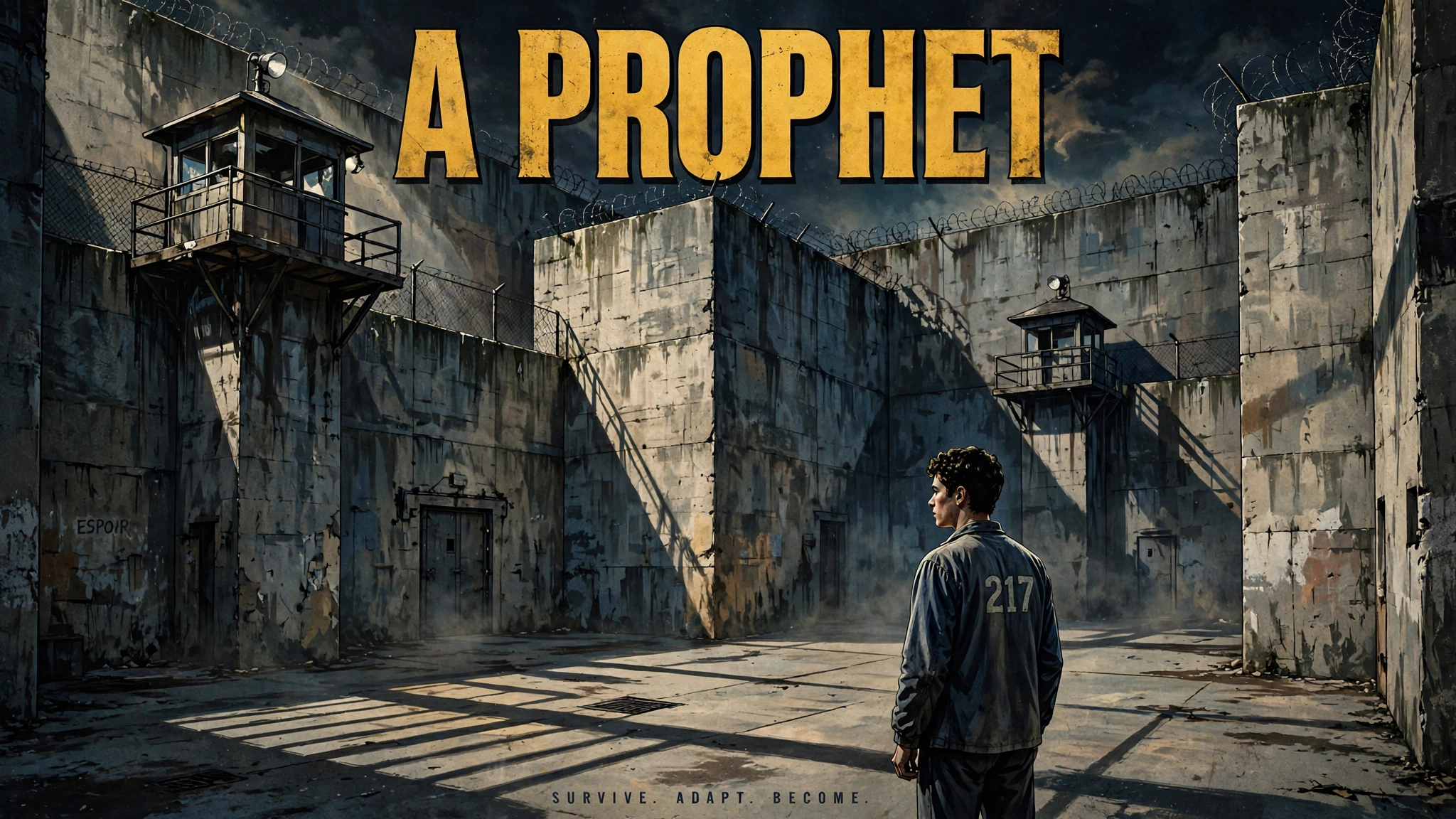
There is a moment early in A Prophet that tells you everything about what kind of film it is. Malik El Djebena, a nineteen-year-old French-Algerian inmate arriving to serve six years, is stripped, searched and processed with the routine indifference of a system that has done this ten thousand times. He cannot read or write properly. He belongs to no gang. He is, by every measure the prison understands, nobody. Two and a half hours later he walks out of prison a different person — educated, connected, dangerous, and quietly in command of his own life. Jacques Audiard’s film is the story of that education, and it is one of the great crime films of modern cinema.
A Prophet won the Grand Prix at Cannes, was nominated for the Academy Award for Best Foreign Language Film, and won the BAFTA for Best Film Not in the English Language. But its reputation has grown beyond its awards: it is now routinely cited alongside The Godfather and Goodfellas as a film that understands power — how it is gained, held and used — from the inside.
| Detail | Information |
|---|---|
| Release date | 16 May 2009 (Cannes); 26 August 2009 (France) |
| Director | Jacques Audiard |
| Writers | Jacques Audiard, Thomas Bidegain, Abdel Raouf Dafri, Nicolas Peufaillit |
| Genre | Crime, Drama, Prison |
| Language | French, Arabic, Corsican |
| Runtime | 155 minutes |
| Budget | About $13 million (about €12 million) |
| Lead cast | Tahar Rahim, Niels Arestrup, Adel Bencherif, Reda Kateb |
| Our rating | 9/10 |
Malik El Djebena arrives in prison alone. He is nineteen, of Algerian origin, barely literate, with no family waiting outside and no faction inside. The prison is divided along ethnic lines: the Corsican gang, led by the formidable César Luciani, runs the place, and the Muslim inmates are their rivals and victims. Malik, caught between the two worlds and belonging to neither, is noticed by Luciani — and offered protection at a terrible price. This review will not spell out what Luciani demands, or what Malik does in return, except to say that the bargain binds Malik to the Corsicans and sets the whole film in motion.
From that bargain, the film unfolds as an education in three acts. First, survival: Malik learns the prison’s rules, its languages (French, Arabic, Corsican), its economy of favours and violence. Then, ambition: given day-release privileges, he begins to build his own connections outside the walls, running errands that grow into enterprises. Finally, independence: as the old order inside the prison weakens, Malik — the boy who arrived able to do nothing — becomes the person everyone needs. The film follows him for the full six years of his sentence, and its power is in watching a character change so gradually that you only notice the transformation when it is already complete.
Audiard tells this story without sentimentality and without ever making Malik a hero in the simple sense. Malik does terrible things, and the film does not excuse them. But it does something rarer: it shows you, step by step, how a system that offers a young man nothing except its own rules ends up teaching him to master them.
Tahar Rahim as Malik — Rahim, then a near-unknown, gives one of the great screen performances of the century. His Malik begins as a watchful, frightened boy — eyes always moving, body always braced — and changes by degrees: a straighter back, a steadier gaze, a voice that stops asking and starts telling. Rahim never signals the transformation; he lets it accumulate, so that the audience realises, almost with a shock, that the man walking out of prison is not the boy who walked in. It is a performance of extraordinary control, and it made Rahim a star overnight.
Niels Arestrup as César Luciani — Arestrup is magnificent as the Corsican boss: ageing, ailing, terrifying and, in his own way, paternal. Luciani treats Malik as both a servant and a son, and Arestrup plays that contradiction without ever softening the character’s menace. His scenes with Rahim are the film’s core — a master and pupil relationship in which the pupil is quietly, patiently learning how to replace the master.
The ensemble — Adel Bencherif is memorable as Ryad, Malik’s closest friend inside, whose loyalty gives the film its emotional anchor; Reda Kateb, Hichem Yacoubi and the large cast of inmates give the prison a dense, believable population, with factions, friendships and grudges that feel lived-in rather than sketched. The film’s world is built out of faces as much as plot, and every face earns its place.
Audiard’s direction is muscular, restless and precise. He shoots the prison with handheld cameras and a cool, blue-grey palette, cutting between the claustrophobia of cells and corridors and the sudden openness of the prison yard, filmed from high angles that make the inmates look like pieces on a board. The film’s rhythm is its secret weapon: long stretches of routine and waiting — Malik learning to read, learning a language, sitting through meetings — are cut against sudden, shocking violence that arrives without warning, because in prison it does.
The film’s most audacious device is also its most discussed: Malik is haunted by visions of a man from his past, a figure who appears in his cell and seems to guide him. Audiard never explains whether the visions are supernatural, psychological or both, and the ambiguity is the point — the film is called A Prophet, and it leaves the audience to decide what kind of prophet Malik is becoming. The device could have sunk the film; in Audiard’s hands it gives the crime story a mythic undertow.
Stéphane Fontaine’s cinematography and Juliette Welfling’s editing keep a 155-minute film moving with relentless forward pressure, and Alexandre Desplat’s score — spare, tense, occasionally mournful — underlines the story without ever telling the audience how to feel about it. The prison itself, a real location filmed with documentary attention to routine, is the film’s most convincing creation.
Desplat’s score is one of his most restrained: low strings, sparse piano, long silences. It does not accompany the violence — the violence arrives in silence, which makes it worse — but rather the moments of thought, of waiting, of Malik planning his next move. The film’s most memorable musical choices are diegetic: a song on a car radio, music in a cell, the sounds of the prison itself. Audiard understands that a prison’s soundtrack is mostly noise, and he uses music the way Malik uses freedom: sparingly, and only when it matters.
What we loved:
What could be better:
A Prophet premiered at Cannes on 16 May 2009, where it won the Grand Prix, and opened in France on 26 August 2009. Made for about $13 million (roughly €12 million), it grossed about $17.9 million worldwide — a modest figure by blockbuster standards, but a strong one for a subtitled prison drama, and it does not count the film’s long life on home video, streaming and repertory screenings, where its reputation has only grown. One less careful source claims a total above $20 million; the widely reported figure is $17.9 million, and we use that here.
Its honours were extensive: nine César Awards including Best Film, Best Director and Best Actor for Rahim, the BAFTA for Best Film Not in the English Language, and the Academy Award nomination for Best Foreign Language Film. More than the awards, though, the film’s legacy is its influence: it reset what a prison film could be, and it remains the benchmark against which serious crime cinema is measured.
Yes — without hesitation, if you can handle its intensity. A Prophet is not a comfortable film, and it does not ask you to like its hero. It asks you to watch, closely, as a young man with nothing learns to survive a system designed to break him — and to ask yourself, at the end, whether his survival is a triumph, a tragedy, or both. That question is what makes the film great.
For crime-film lovers, it is essential viewing. For everyone else, it is the rare genre film that transcends its genre entirely.
Our rating: 9/10 — A towering crime epic about power, survival and education, with a star-making central performance.
Is A Prophet based on a true story?
No. It is an original story by Abdel Raouf Dafri, developed into a screenplay by Dafri, Audiard, Thomas Bidegain and Nicolas Peufaillit. Its prison world is fictional, though grounded in research.
Why is it called A Prophet?
The French title is Un prophète. The film leaves the meaning open: Malik is guided by visions, and he seems to foresee shifts in the prison’s power that others miss. Whether he is a prophet, a gangster or both is the film’s central question.
How violent is A Prophet?
It contains strong, sometimes sudden violence, and it is rated for adults. The violence is never played for fun, but it is intense and realistic.
How long is A Prophet?
It runs 155 minutes — about two hours and thirty-five minutes.
Where can I watch A Prophet?
It is available on major streaming and digital purchase services in many regions, though availability changes by country and over time, so check your local platforms.