★ LATEST REVIEWS

Our Rating: ★★★★☆ 8.5/10
When Weathering with You arrived in 2019, it carried an impossible burden: it had to follow Your Name, one of the highest-grossing films in Japanese history and a genuine cultural event. Makoto Shinkai’s answer was to make a film that rhymes with its predecessor without repeating it. Once again there is a boy and a girl, a supernatural gift, and a choice between the world and one person. But where Your Name was about time and distance, Weathering with You is about weather — and about a boy who decides, with full knowledge of the cost, that he would rather have the girl than the sunshine.
Set in a Tokyo drowning under the longest rainy season anyone can remember, the film is Shinkai’s most visually distinctive work: a city of grey skies, neon reflections and sudden, miraculous breaks of blue. It is also his most morally provocative. Its ending has divided audiences ever since, and that division is the point. This is a romance that refuses to apologise for choosing love over the greater good, and whether you admire that or resent it will decide how much you love the film.
| Detail | Information |
|---|---|
| Release date | 19 July 2019 (Japan) |
| Director | Makoto Shinkai |
| Writer | Makoto Shinkai |
| Genre | Fantasy, Romance, Drama |
| Language | Japanese |
| Runtime | 112 minutes |
| Budget | About $11.1 million (¥1.2 billion, as mentioned by Shinkai) |
| Lead cast | Kotaro Daigo (Hodaka Morishima), Nana Mori (Hina Amano), Shun Oguri, Tsubasa Honda |
| Our rating | 8.5/10 |
Hodaka Morishima is a sixteen-year-old who has run away from his island home to Tokyo, with little money, no plan and a stubborn belief that the city will give him a life. What it gives him, at first, is rain. Tokyo in this film is under a freak, endless downpour that has lasted for weeks, flooding streets, cancelling events and wearing everyone down. Hodaka finds scrappy work at a small occult magazine run by the kindly, chaotic Keisuke Suga, and sleeps in a cupboard-sized room above the office.
Then he meets Hina Amano, an eighteen-year-old orphan raising her younger brother on her own, working part-time jobs and keeping the household together with a determination that puts Hodaka’s own to shame. Hina has a gift: when she prays, the rain stops. A patch of blue sky opens above her, sunlight pours down, and for a few minutes the city remembers what summer feels like. Hodaka, ever the entrepreneur, suggests they turn the gift into a business — hire Hina out as a “sunshine girl” to clear the skies for weddings, festivals and outdoor events.
Business booms, and so does the relationship between the two teenagers. But the gift has a price, and the film is honest about it from early on: the more Hina uses her power, the more of herself she gives away. The rain, meanwhile, is not just weather. It is the world pushing back. This review will not reveal the choice Hodaka finally makes, or what Tokyo looks like afterwards. It is enough to say that the film’s climax is a deliberate provocation — a hero who looks at the cost of his happiness, understands it completely, and chooses it anyway.
Kotaro Daigo as Hodaka — Daigo, a newcomer cast from auditions, gives Hodaka a restless, earnest energy. His Hodaka is not a dreamy romantic hero but a stubborn kid: impulsive, sometimes selfish, fiercely loyal once he has decided someone matters. Daigo’s voice work makes the character’s growth believable — the early scenes of a boy bluffing his way through Tokyo sound genuinely young, and the later scenes carry a weight that the script earns rather than assumes.
Nana Mori as Hina — Mori is the film’s emotional centre. Her Hina is bright and practical in public — the girl who keeps a household running, who laughs easily, who treats her gift as a job — and quietly frightened underneath. Mori plays that split with great subtlety: you can hear, in the small hesitations before Hina prays, that she understands more about the cost than she lets Hodaka see. The chemistry between Mori and Daigo is the film’s engine; without it, the ending would feel like a thesis rather than a choice.
The supporting cast — Shun Oguri brings warmth and world-weariness to Keisuke, the magazine editor who becomes an unlikely father figure, and Tsubasa Honda is lively as his niece Natsumi, whose motorbike and common sense keep the story grounded. The younger brother, Nagi, played by Sakura Kiryu, steals several scenes as a pint-sized romantic adviser. The ensemble gives Tokyo a populated, working feel that keeps the fantasy anchored in a real city.
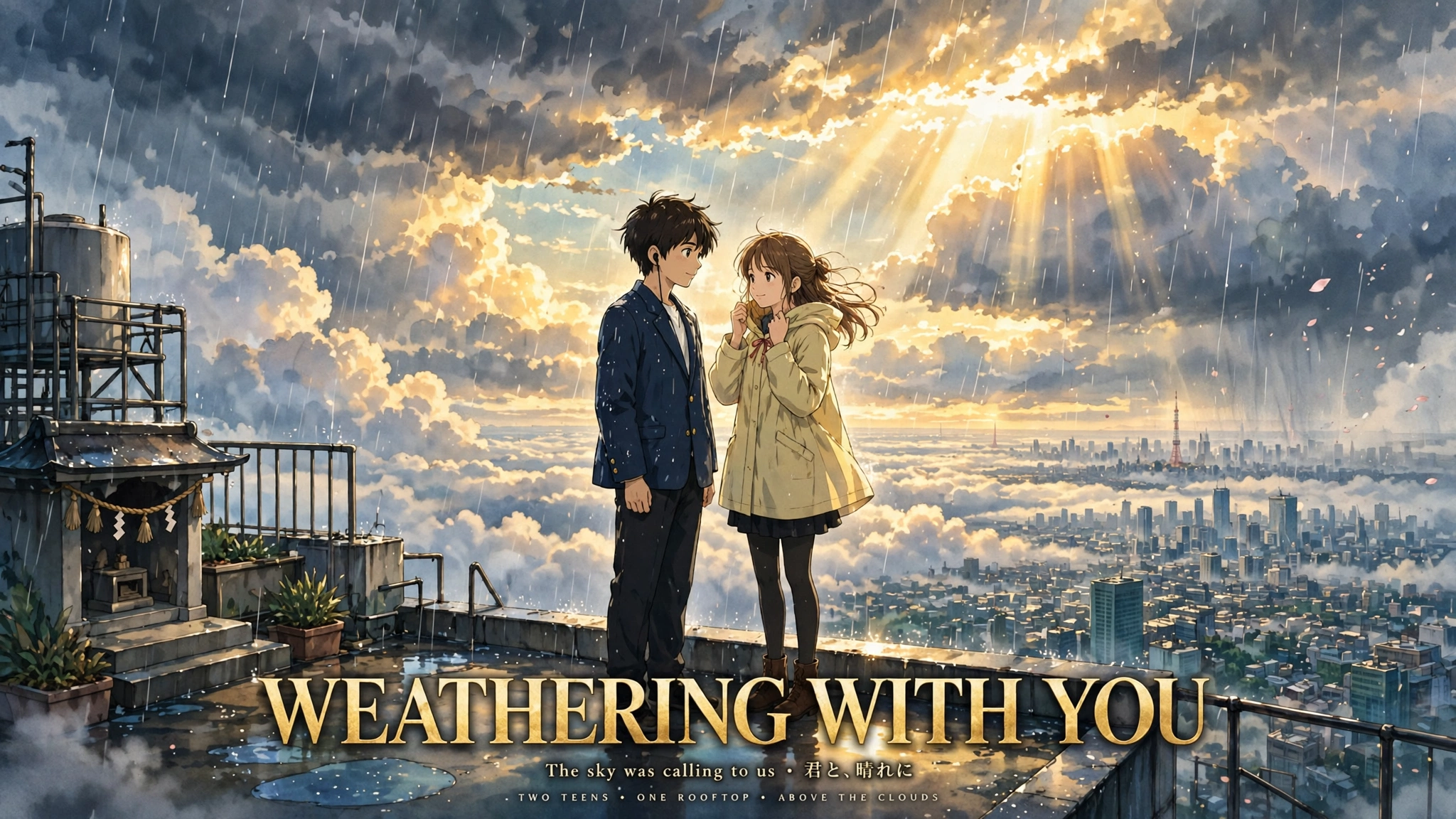
Shinkai’s direction is at its most visually assured here. The rain is not a backdrop but a character: animated in extraordinary detail, from individual drops on a window to whole streets turned to mirrors. Tokyo is rendered with the obsessive specificity that is Shinkai’s trademark — train lines, convenience stores, shrine steps, the view from a rooftop — and the contrast between the grey, rain-soaked city and the sudden, saturated blue of Hina’s clearings is genuinely thrilling. When the sky opens, the whole screen seems to exhale.
The film’s structure is looser than Your Name‘s clockwork plotting, and that is both a strength and a weakness. The middle stretch — the sunshine-girl business, the small jobs, the growing closeness — is a delight, a sequence of sunlit vignettes that lets the audience fall for the couple. But the mythology around Hina’s gift is sketched rather than developed: the film gestures at legends and weather maidens without ever quite building a system, and viewers who want the rules to cohere may feel short-changed. Shinkai is clearly more interested in the emotional choice than in the mechanism, and the film is honest about that priority — but it does leave a few threads dangling.
The climax, staged across a flooded Tokyo of extraordinary beauty, is one of the most striking sequences Shinkai has ever made. Water, light and height are combined with a confidence that makes the moral argument visual: this is what the world looks like when one boy chooses one girl. Whether that image moves you or angers you, it is unforgettable.
RADWIMPS return after Your Name, and their score is again woven into the film’s fabric rather than laid over it. The songs — “Grand Escape” above all — arrive at the moments of greatest lift, and Shinkai cuts the animation to their rhythms so that music and image feel like one movement. The quieter score, all piano and atmosphere, gives the rainy city its melancholy pulse. As with Suzume, the film knows when to go quiet: several of the most affecting scenes play with only rain and voices, and the contrast makes the musical peaks hit harder.
What we loved:
What could be better:
Weathering with You opened in Japan on 19 July 2019 and became one of the biggest Japanese films of the year. It earned ¥14.06 billion in Japan alone, and worldwide grosses are reported between $192.4 million and $193.8 million depending on the source and cut-off date — we quote it here as roughly $193 million. It was selected as Japan’s entry for Best International Feature Film at the 92nd Academy Awards, the first anime film chosen since Princess Mononoke in 1998, and it received four Annie Award nominations.
On the budget: Shinkai himself mentioned a figure of ¥1.2 billion — about $11.1 million — in a public Q&A, and that figure is widely repeated. It was never formally announced by the studio, so treat it as a reported rather than official number; it is the best figure available, and it makes the film’s return — roughly seventeen times its cost — all the more remarkable.
Yes, especially if you liked Your Name but wanted something a little stranger and more argumentative. Weathering with You is not quite as tightly constructed as its predecessor, and its mythology is thinner. But its images are extraordinary, its young leads are wonderful, and its ending is one of the bravest in mainstream animation: a film that asks whether one person’s happiness can be worth a city’s rain, and refuses to give you the comfortable answer.
Watch it for the rain, stay for the argument you will have afterwards.
Our rating: 8.5/10 — A beautiful, provocative romance that chooses its hero’s heart over the world’s weather.
Do I need to watch Your Name before Weathering with You?
No. It is a standalone story, though there are small cameos that fans of Your Name will recognise.
What is a “sunshine girl”?
In the film’s world, a weather maiden is a person whose prayers can clear the sky. Hina discovers she has this gift, and she and Hodaka offer it as a service for events that need sunshine.
Why is the ending controversial?
Without spoiling it: Hodaka makes a choice that puts Hina’s happiness ahead of restoring Tokyo’s weather, and the film does not punish him for it. Some viewers find that romantic; others find it selfish. The film presents both readings honestly.
How long is Weathering with You?
It runs 112 minutes — just under two hours.
Where can I watch Weathering with You?
It is available on major streaming and digital purchase services in many regions, though availability changes by country and over time, so check your local platforms.