★ LATEST REVIEWS

★★★★★ Our Rating: 9.4/10
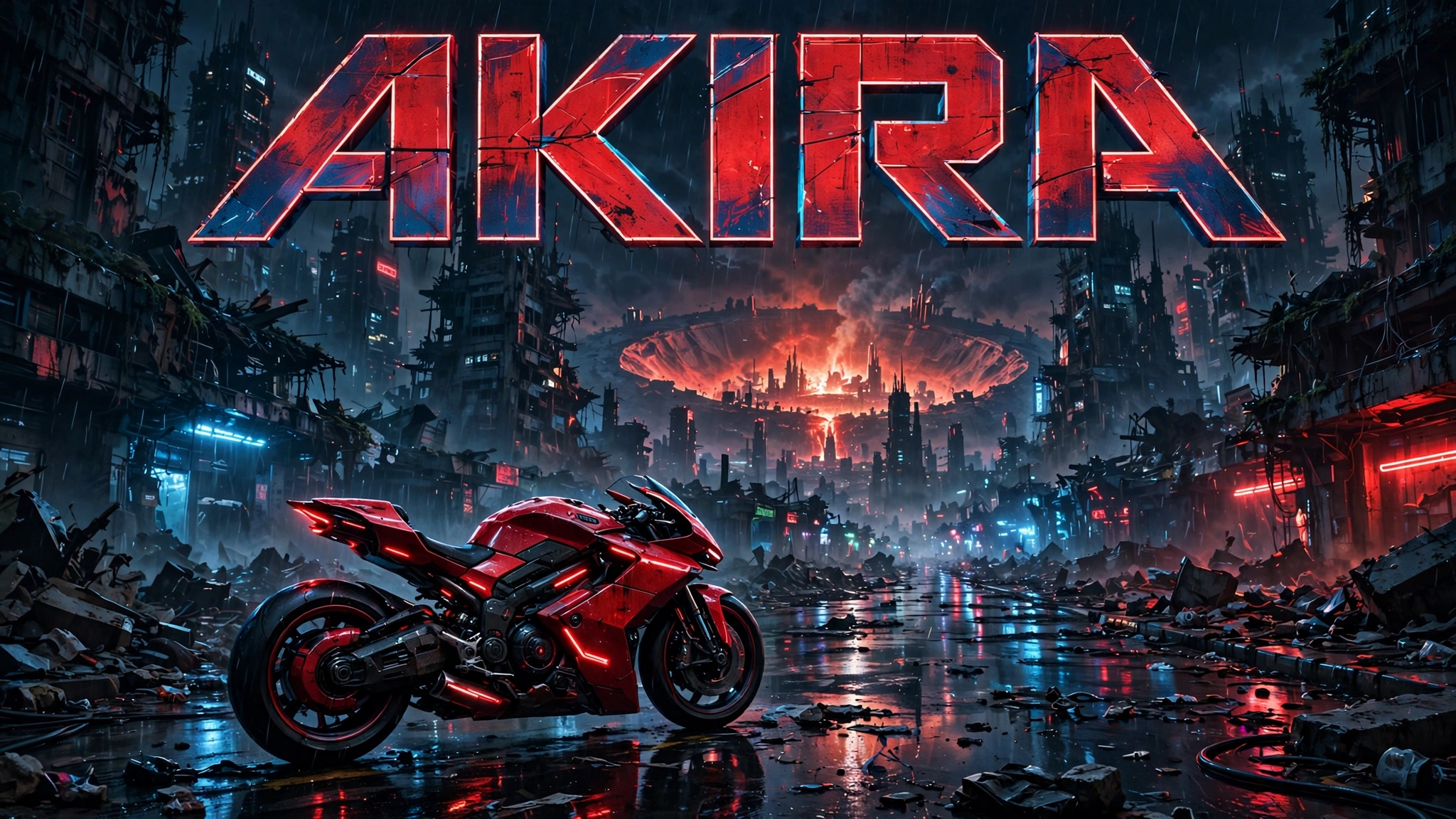
There are films that entertain you, films that move you, and a very small number that rearrange what you believe animation — or cinema itself — can do. Akira belongs to that last group. Released in Japan in July 1988 and directed by Katsuhiro Otomo from his own long-running manga, it arrived as the most expensive animated film the country had ever produced, and it still plays like a detonation: a biker gang, a military experiment, a boy whose new power is far too large for his body or his mind, and a rebuilt Tokyo waiting for its second apocalypse. Almost four decades later, its images — the light-trails of motorcycles at night, a city folding in on itself, a child’s face on an enormous, uncontrollable body — remain burned into global pop culture.
Context matters in any Akira review, because the film’s reputation can make it sound like homework. It is not. Otomo and co-writer Izo Hashimoto compressed a sprawling, still-unfinished comic of more than two thousand pages into a single two-hour story, changing the ending and discarding whole subplots, and the result is a film that moves with the confidence of a chase movie while quietly asking enormous questions: What does power do to a person who has always felt powerless? What does a government owe the children it experimented on? And can a city — or a friendship — survive being rebuilt on top of buried violence?
This review looks at the spoiler-free story, the Japanese voice performances (and the two very different English dubs), the hand-drawn craft that still sets the standard for animated spectacle, Shoji Yamashiro’s extraordinary score, and the handful of places where the film’s density and coldness may lose some viewers. It also treats the money honestly, because Akira‘s budget and box office are both routinely misquoted — and the true story is more interesting than the myth.
| Detail | Information |
|---|---|
| Release date | 16 July 1988 (Japan) |
| Director | Katsuhiro Otomo |
| Writers | Katsuhiro Otomo, Izo Hashimoto, based on the manga by Katsuhiro Otomo |
| Genre | Anime, Cyberpunk Science Fiction, Action |
| Language | Japanese |
| Runtime | 124 minutes |
| Budget | Reported ¥700 million – ¥1.1 billion (roughly $5.7–9 million at the time) — see note below |
| Lead cast (voices) | Mitsuo Iwata, Nozomu Sasaki, Mami Koyama, Taro Ishida, Tessho Genda, Mizuho Suzuki (Japanese) |
| Our rating | 9.4/10 |
A note on the budget: sources disagree, and any honest Akira review should say so. Figures between ¥700 million and ¥1.1 billion are both widely reported, with the higher figure — around $9 million — most often cited for the claim that this was the most expensive anime feature of its era. We present it as a reported range rather than a single settled number, because the production was financed by a consortium of companies and no one official audited figure exists.
The film opens in 1988 with Tokyo destroyed by a blinding explosion that triggers a third world war — then jumps to 2019 and Neo-Tokyo, a glittering, rotten megacity built beside the crater, restless with protests, cults, corrupt politicians and teenage biker gangs who treat the expressways as their kingdom. Among them are the Capsules, led by the confident, quick-smiling Shotaro Kaneda. His closest friend is Tetsuo Shima, the gang’s smallest and least respected member, forever riding a borrowed bike and living in Kaneda’s shadow.
During a night clash with a rival gang, Tetsuo nearly collides with a strange, aged-looking child who has escaped from a military convoy — and the crash changes everything. The army seizes both children. In a military hospital, doctors discover that Tetsuo carries latent psychic potential of a terrifying order, comparable to the subject of a secret project from before the war: a child codenamed Akira, whose power is whispered to be the real cause of Tokyo’s destruction thirty-one years earlier.
What follows is an escape story, a chase story and a tragedy braided together. Tetsuo, drunk on abilities he cannot control and tormented by headaches, visions and a lifetime of humiliation, breaks free determined to find Akira and prove himself stronger than everyone who ever pitied him. Kaneda, drawn in through Kei — a young resistance activist who knows more about the project than she first admits — races to save a friend who increasingly does not want to be saved. Around them, the Colonel who runs the project, a rotten council of politicians, revolutionary cells and apocalyptic cults all reach for the same weapon. We will not describe the final act here. It is enough to say the film ends not with a battle won but with a scale of imagery Japanese animation had never attempted before — and a quiet, human note struck exactly when it is needed most.
Because this is animation, the performances are voices, and the original Japanese cast is superbly chosen.
Mitsuo Iwata as Shotaro Kaneda gives the hero a cocky, bright energy that slowly cracks into desperation. Kaneda jokes first and thinks later, and Iwata keeps that bravado likeable rather than arrogant — which is why his panic, when it finally comes, lands so hard. Nozomu Sasaki as Tetsuo Shima has the harder role and gives the film’s greatest performance: whiny, resentful and frightened at first, then intoxicated, then godlike and terrifying, then — in flashes — a scared boy again. Sasaki lets you hear the exact moment power stops feeling like freedom. The famous shouted exchange of the two friends’ names has become a meme, but in context it is genuinely heartbreaking.
Mami Koyama as Kei avoids every cliché of the token female lead: she is dry, capable and morally serious, the film’s one adult among teenagers and soldiers alike. Taro Ishida as the Colonel brings a gravelled, exhausted authority — a man who has carried a terrible secret for decades and is the only official in Neo-Tokyo who fully understands the danger. Tessho Genda and Mizuho Suzuki round out a cast that treats the material with complete seriousness; nobody performs “a cartoon.”
English-speaking viewers have two dubs, and they are not equal. The original 1989 Streamline dub, made quickly for the film’s first Western release, has period charm but loose translation and uneven acting. The 2001 Pioneer dub — with Johnny Yong Bosch as Kaneda, Joshua Seth as Tetsuo and Wendee Lee as Kei — is far more accurate and much better acted, and it is the English version to choose. Even so, first-time viewers who can manage subtitles should start with Japanese: the score, the sound design and Sasaki’s Tetsuo in particular are inseparable from the film Otomo made.
Otomo directed Akira with a control that still astonishes. He demanded full creative authority, storyboarded the film to an extraordinary level of detail, and drove a production of roughly 160,000 cels, more than 2,200 shots and a palette of over 300 colours — numbers far beyond normal practice for the time. The decisive technical choice was to animate much of the film “on twos” rather than the cheaper television standard of “on threes,” giving movement a fluidity that Western viewers, raised on Disney and Hanna-Barbera extremes, had simply never seen from Japan. Add pre-recorded dialogue — voices laid down first, mouths drawn to match, a rarity in anime then — and the performances gain a naturalism that still feels modern.
Neo-Tokyo itself is the film’s greatest creation: a hand-painted city of layered expressways, holographic advertisements, flooded ruins, military checkpoints and back-alley bars, every background dense enough to reward pausing. The celebrated opening motorcycle chase, with its ribbons of tail-light, remains a masterclass in staging speed without confusion. And the climax — in which the city, an Olympic stadium and a human body all fail to contain what has been unleashed — uses scale, silence and sudden stillness as skilfully as it uses destruction.
Honesty requires two criticisms. First, compression: the film introduces factions, espers, cults and council politics at a pace that can bewilder a first viewing, and several manga characters arrive as vivid sketches rather than full people. Second, emotional temperature: Otomo is more interested in systems and spectacle than in warmth, and viewers who need a strong sentimental anchor may find Kaneda and Tetsuo’s friendship more asserted than explored until the final act. Both flaws are real. Neither survives contact with the film’s sheer filmmaking force — but a fair Akira review should name them.
The score, composed by Shoji Yamashiro and performed by his collective Geinoh Yamashirogumi, is one of the great film scores of the 1980s in any country — and one of the strangest. Yamashiro built it from Indonesian gamelan percussion, Japanese noh theatre chanting, Buddhist shomyo singing, synthesisers and massed voices, and much of it was composed from Otomo’s images and storyboards before the animation was finished, so music and picture feel grown together rather than matched afterwards.
The results are unforgettable: the metallic, galloping percussion of “Kaneda” under the bike sequences; the eerie children’s polyphony of “Dolls’ Polyphony” for the aged esper children; the vast choral dread of “Shohmyoh” and “Requiem” as Tetsuo’s power passes beyond the human. Just as important is Otomo’s use of near-silence — engines, wind, a capsule rolling across a floor — letting Yamashiro’s score detonate at chosen moments instead of underscoring everything. The album, released as Symphonic Suite Akira, has been sampled across hip-hop and electronic music ever since, and in 2017 it received a lavish reissue that introduced it to a new generation. If you remember one element of this film decades later, it may not be an image. It may be the sound of those drums.
What we loved:
What could be better:
The financial story of Akira corrects two myths at once: that it was an instant blockbuster, and that it flopped. In Japan it earned about ¥1.7 billion in distributor revenues at home — respectable, but not enough, on its first run, to comfortably recoup a budget reported between ¥700 million and ¥1.1 billion, the largest ever spent on an anime feature at that point. Its initial American theatrical release through Streamline Pictures was limited and cult-sized. Reference totals for its theatrical life usually settle around $49 million worldwide, a figure that mixes eras and re-releases and should be treated as approximate.
The fortune was made afterwards. Akira became one of the defining titles of the home-video era: VHS, LaserDisc, DVD, Blu-ray and 4K restorations sold for decades, with home-video earnings alone widely reported at more than $80 million worldwide, alongside enormous manga sales and merchandising. Its 4K remaster returned it to cinemas internationally in 2020 and performed strongly for a catalogue title. In other words, this is a film the box office under-rewarded and history over-delivered on: the expensive gamble of 1988 became the gateway through which much of the world discovered anime at all. Any accounting that stops at the original theatrical gross misses the point of Akira entirely.
Yes — if you care about animation, science fiction or film history, Akira is not optional viewing; and if you simply want a propulsive, visually overwhelming night at the movies, it delivers that too, provided you accept adult violence and a plot that asks you to keep up. Watch the Japanese version with subtitles, or the 2001 English dub, on the largest screen and the best sound system available to you. Some classics feel like museums. This one still feels like an explosion.
Our rating: 9.4/10 — A landmark of animation and cyberpunk cinema: visually unmatched, sonically extraordinary, and only slightly held back by a compressed plot and a cool emotional centre.
Is Akira suitable for children?
No. Despite being animated, it is an adult film, rated R in the United States, with graphic violence, body horror, drug references and heavy themes. It is made for older teenagers and adults, and it helped prove in the West that animation could be exclusively for grown-ups.
Should I read the Akira manga before watching the film?
You do not need to. The film tells a complete, self-contained version of the story and changes the ending, because the manga was still unfinished in 1988. Many viewers enjoy the film first and then turn to Otomo’s six-volume manga for the far larger story it eventually became.
Which English dub of Akira should I watch?
Choose the 2001 Pioneer dub (Johnny Yong Bosch, Joshua Seth, Wendee Lee) over the 1989 Streamline dub, which is looser and weaker. Better still, watch the original Japanese track with subtitles for Nozomu Sasaki’s definitive performance as Tetsuo.
Why is Akira considered so influential?
It demonstrated — to Hollywood as much as to audiences — that Japanese animation could deliver adult, big-budget spectacle. Its Neo-Tokyo, biker gangs, psychic children and apocalyptic imagery flow directly into later science fiction, animation, music videos and games worldwide, and it opened the Western market that anime now thrives in.
Where can I watch Akira?
It is widely available on Blu-ray and 4K Ultra HD in excellent restorations, and it rotates through major streaming and anime platforms in most regions. Check your local listings, as rights vary by country — but make sure the version you pick carries the Japanese audio or the 2001 dub.