★ LATEST REVIEWS

Our Rating: ★★★★★ 9/10
Makoto Shinkai has built a career on a single, devastatingly effective formula: take an ordinary young person, give them a brush with the impossible, and let the fate of the world hinge on whether they can hold on to one other person. Your Name did it with time, Weathering with You did it with weather, and Suzume — his most ambitious film yet — does it with doors. Doors standing alone in ruins across Japan, doors that must be closed before something vast and terrible slips through them. It is a road movie, a coming-of-age story, a romance and, quietly, a film about the 2011 Tohoku earthquake and the grief it left behind. That it works as all of these at once is a considerable achievement.
What makes Suzume special is not just its spectacle, though the spectacle is extraordinary. It is the way Shinkai grounds his fantasy in something painfully real: the abandoned places of rural Japan, towns hollowed out by depopulation, and a young woman who lost her mother as a small child and has been running, in one way or another, ever since. The doors she must close are not random. They stand in places people have left behind, and closing them is an act of remembering, not just of rescue.
| Detail | Information |
|---|---|
| Release date | 11 November 2022 (Japan) |
| Director | Makoto Shinkai |
| Writer | Makoto Shinkai |
| Genre | Fantasy, Adventure, Romance |
| Language | Japanese |
| Runtime | 122 minutes |
| Lead cast | Nanoka Hara (Suzume Iwato), Hokuto Matsumura (Souta Munakata), Eri Fukatsu, Shota Sometani |
| Our rating | 9/10 |
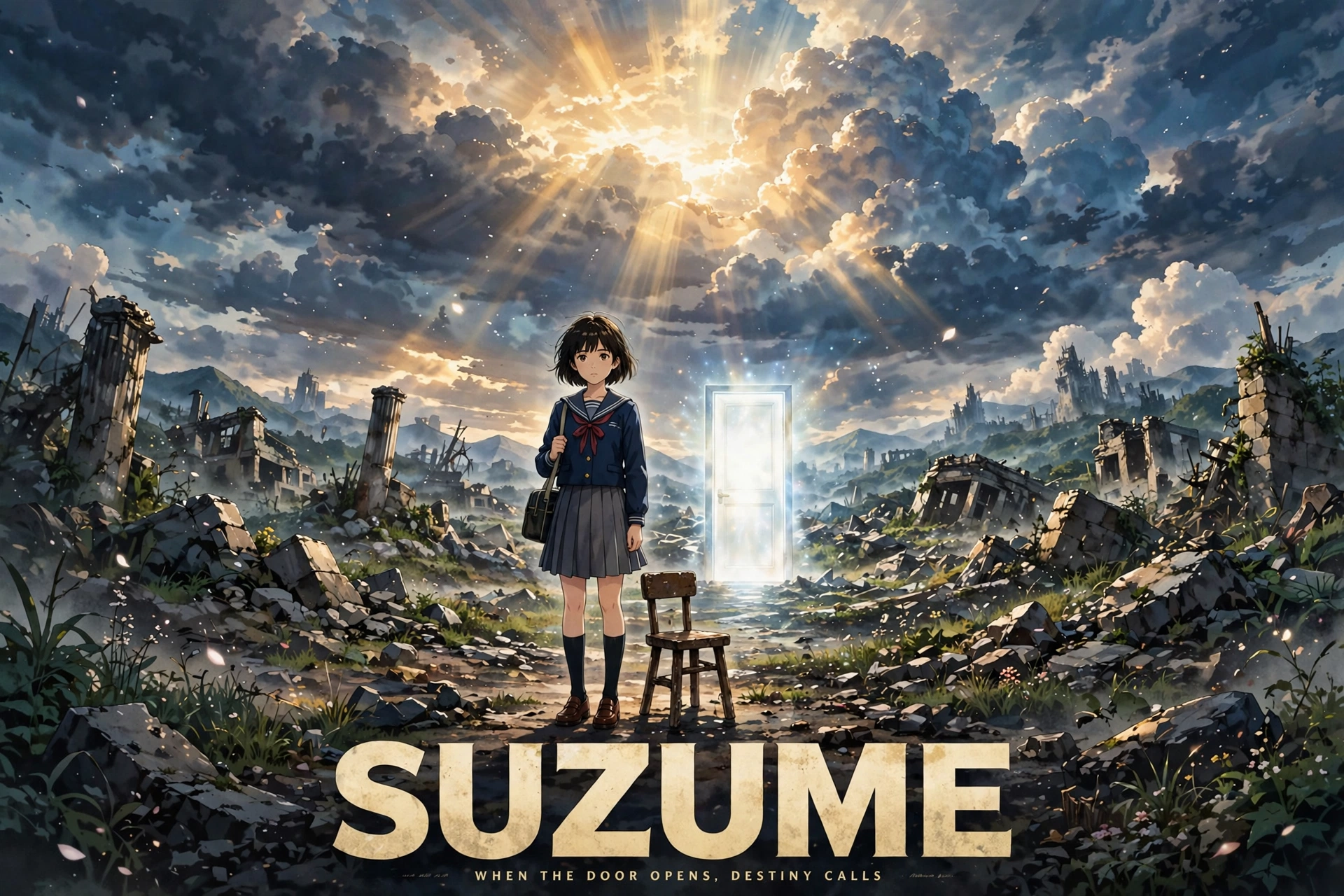
Seventeen-year-old Suzume Iwato lives a quiet life with her aunt in a small town in Miyazaki, on the southern island of Kyushu. One morning on her way to school she meets a handsome young stranger who asks her for directions to some nearby ruins. Curiosity gets the better of her, and she follows him — and finds, standing alone in the middle of the abandoned resort, a single white door, upright in the open air, as if it had been left there by someone who forgot to take the walls with it.
Suzume opens the door. That is her mistake, and the film’s engine. Opening it releases a vast, smoke-like force — a “worm” visible only in the sky — that threatens to bring an earthquake crashing down on the region. The stranger, Souta Munakata, turns out to be a “Closer”, one of a line of people tasked with sealing such doors before disaster strikes. But before the first door can be properly sealed, a mischievous cat-like creature intervenes, and Souta pays a strange price: he is transformed into a small wooden chair — the very chair Suzume made as a child, with one leg shorter than the others.
What follows is a road journey the length of Japan, from Kyushu through Shikoku and Kobe to Tokyo and finally to the north, as Suzume and chair-Souta chase the creature and close door after door. Along the way they are sheltered by strangers: a bar owner, a teacher, a pair of sisters, a student. Each stop is a small story of kindness, and each ruined place they visit carries its own quiet history. This review will not reveal how the journey ends, or what Suzume finds when she finally reaches the place her own story began. It is enough to say that the ending earns its emotion honestly, and that the final door is the most personal one of all.
Nanoka Hara as Suzume — Hara, cast from an open audition, is the film’s great discovery. Her Suzume is headstrong, funny and stubbornly kind — she charges into danger without a plan and then improvises her way out with a warmth that makes strangers want to help her. Hara’s voice work gives Suzume a real teenager’s texture: breathless when excited, flat when frightened, suddenly steady when someone else needs her. It is a performance that has to carry almost every scene, and it never falters.
Hokuto Matsumura as Souta — Matsumura has the harder job, since his character spends most of the film unable to speak as a human being. As a chair, Souta communicates through movement, timing and the occasional muffled protest, and the comedy of it — a three-legged chair sprinting, sulking and being sat on — is played with total commitment. In his human scenes, Matsumura is calm, formal and quietly burdened, the voice of someone raised to a duty he never chose. The contrast between the dignified young man and the undignified chair is the film’s best joke and, eventually, its most moving image.
The supporting voices — Eri Fukatsu brings dry, tired affection to Tamaki, Suzume’s aunt, whose worry for her niece is the film’s emotional anchor in the ordinary world. Shota Sometani is excellent as Serizawa, Souta’s friend, whose laid-back exterior hides real loyalty. And the parade of one-scene strangers along the road — each voiced with distinct warmth — is what keeps the film from feeling like a mere chase. Shinkai has always understood that a road movie is only as good as its stops, and here every stop gives Suzume a reason to keep going.
Shinkai’s direction here is more confident and less sentimental than in his earlier work. The structure is episodic by design — each door is a new location, a new small crisis — but the episodes accumulate into something larger: a portrait of a country full of places people have abandoned, and of the memories that linger in them. The film’s central visual idea, a door standing alone in a ruin, is simple, eerie and endlessly photogenic, and Shinkai returns to it with variations that never repeat themselves.
The animation, from CoMix Wave Films, is ravishing. Skies are Shinkai’s signature, and here they do real dramatic work: the worm coiling above a city is genuinely frightening, a storm of cloud and light that makes the stakes visible. But the quieter images linger longer — sunlight on a school corridor, rain on a ferry deck, a ruined bathhouse overgrown with grass, a chair sitting patiently on a train seat. The backgrounds are dense with lived-in detail, and the camera moves through them with a patience that lets the audience breathe between set pieces. The action sequences are staged with clarity and scale, but the film never mistakes noise for excitement.
There is also a discipline to the storytelling that Weathering with You sometimes lacked. The rules of the doors are explained just enough, the cat’s motives stay teasingly unclear for exactly as long as they should, and the film trusts its audience to feel the Tohoku connection without spelling it out in dialogue. When the connection is finally made explicit, it lands because the film has earned it through images rather than exposition.
The score, by RADWIMPS with Kazuma Jinnouchi, is the third Shinkai–RADWIMPS collaboration after Your Name and Weathering with You, and it may be their most varied. The songs — including the soaring main theme — arrive at the moments of greatest emotional lift and never feel pasted on, because Shinkai cuts his sequences to the music rather than the other way round. The quieter passages matter just as much: piano and strings under the road-trip scenes give the journey a wistful, forward-moving pulse, and the sound design around the doors — wind, creaking wood, a low rumble — makes the supernatural feel physical.
One of the film’s pleasures is how it uses silence. Several of the most affecting scenes play with almost no score at all, just footsteps, weather and voices. In a film about a girl learning to listen to places other people have stopped hearing, that restraint feels deliberate.
What we loved:
What could be better:
Suzume opened in Japan on 11 November 2022 and became a phenomenon far beyond the usual anime audience. It grossed over $316 million worldwide — about $317 million by most tallies — making it the fourth highest-grossing Japanese film of all time, behind only Demon Slayer: Mugen Train, Spirited Away and Shinkai’s own Your Name. Its success in China, where it earned over $112 million and became the highest-grossing Japanese film ever released there, and in South Korea, where it passed $35 million, showed that Shinkai’s appeal had become genuinely global. In North America it earned around $10.9 million, a strong result for a subtitled anime feature.
A note on the numbers: no reliable budget figure for Suzume has been published, so we have omitted the budget row from our Quick Facts rather than guess at one. The worldwide gross is consistently reported at just over $316 million, with some sources rounding to $317–318 million depending on exchange rates and the cut-off date; the picture is the same in every telling — a very large hit.
The film’s honours included a nomination for Best Animated Feature at the Golden Globe Awards and the Audience Award at the Annecy International Animation Film Festival, and it finished as one of the highest-grossing films of 2022 in Japan. More importantly for Shinkai’s career, it confirmed that his post-Your Name audience was not a one-film accident.
Yes — and watch it on the biggest screen you can find, because the skies and the worm demand scale, while the small human scenes repay attention. Suzume is Shinkai’s most complete film: it keeps the romance and the beauty that made him famous, but it adds a subject — loss, memory and the places we abandon — that gives the fantasy real weight. It is funny, frightening and, in its final stretch, quietly devastating.
For viewers new to Shinkai, it is an ideal starting point: you need no knowledge of his earlier films, and the story explains itself as it goes. For longtime fans, it is the film where his preoccupations finally come together into something that feels bigger than a love story.
Our rating: 9/10 — A door-closing road epic that turns grief into adventure and adventure back into grief, beautifully.
Is Suzume connected to Your Name or Weathering with You?
No, it is a standalone story. There are small cameo nods for sharp-eyed fans, but you need no knowledge of Shinkai’s earlier films to follow it.
Why is Souta turned into a chair?
A mischievous supernatural cat transforms him as a trick early in the film, leaving Suzume to carry him — literally — on the journey to close the doors. The chair is one Suzume made as a small child, which becomes important later.
Is Suzume about the 2011 Tohoku earthquake?
Its themes were inspired by the 2011 earthquake and tsunami. The film never recreates the disaster directly, but its story of doors, ruins and remembering is shaped by it, and the climax makes the connection clear.
How long is Suzume?
It runs 122 minutes — just over two hours.
Where can I watch Suzume?
It is available on major streaming and digital purchase services in many regions, though availability changes by country and over time, so check your local platforms.