★ LATEST REVIEWS

★★★★☆ Our Rating: 8.5/10
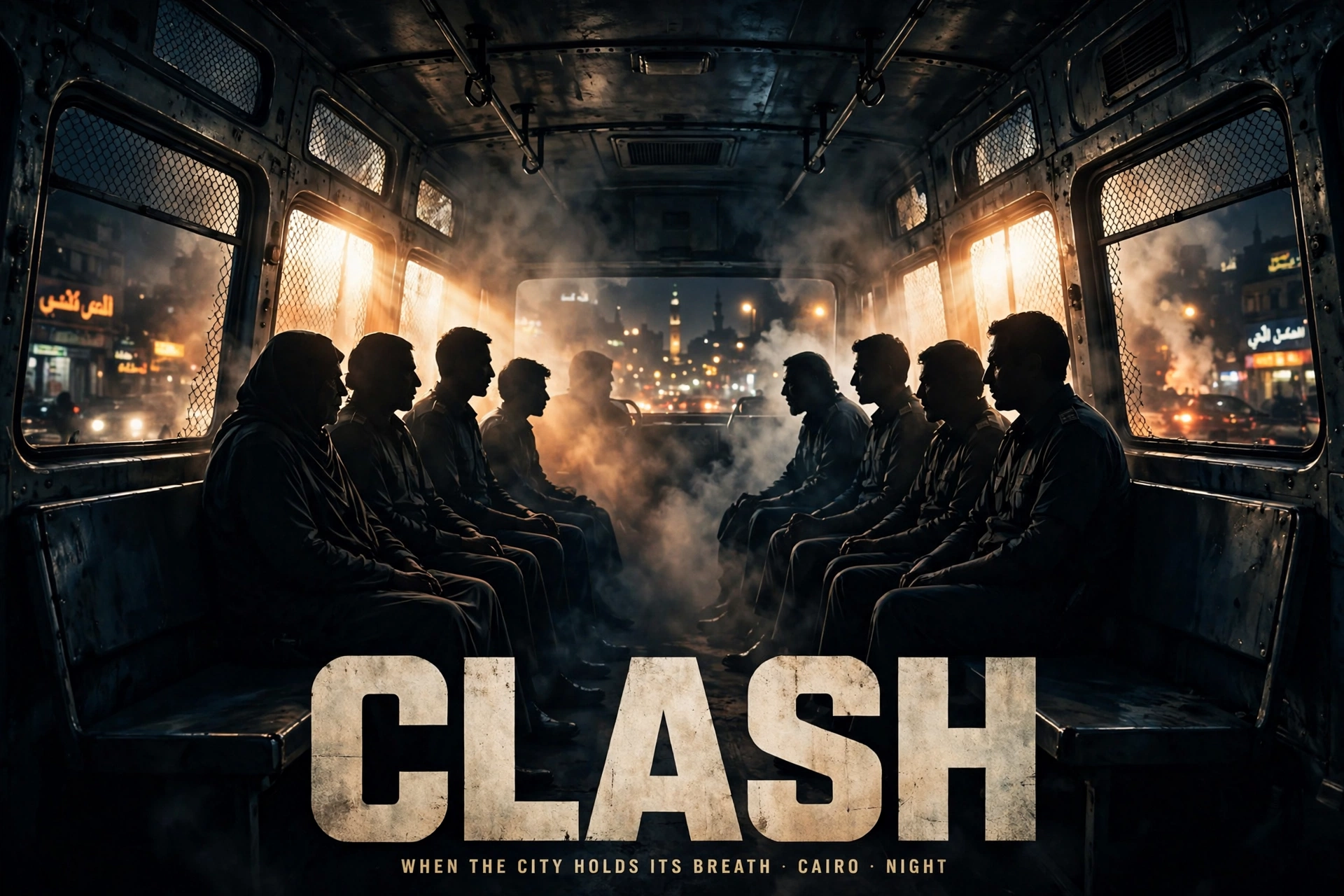
Take roughly twenty-five Egyptians — supporters of the Muslim Brotherhood, supporters of the army, journalists, a mother, a teenager, an ageing actor, a nurse — arrest them all on the same burning Cairo day in 2013, lock them in an eight-metre police van, and do not let the camera leave. That single, audacious decision is Clash (Eshtebak), and any honest Clash review should admit how easily it could have become a filmed lecture. Instead, Mohamed Diab’s second feature became the film that opened the Un Certain Regard section at the Cannes Film Festival in 2016, was chosen as Egypt’s entry for the Academy Awards, won Best Film at the International Film Festival of Kerala, and earned a public endorsement from Tom Hanks, who urged anyone who could see it to do so.
The setting needs one paragraph of context for readers outside Egypt. In 2011, mass protests ended the thirty-year presidency of Hosni Mubarak. Mohamed Morsi of the Muslim Brotherhood was elected president, governed divisively for a year, and on 3 July 2013, after enormous demonstrations against him, was removed by the army. Clash takes place in the violent days that followed, when Egyptians who had stood in the same squares two years earlier were now on opposite sides of street battles — and, in Diab’s van, on opposite benches of the same locked vehicle, breathing the same air.
Diab, whose debut 678 (2010) had tackled sexual harassment on Cairo’s buses, co-wrote Clash with his brother Khaled Diab over several years. What they built is part thriller, part chamber drama and part national reckoning. It is a political film that conspicuously refuses to hand its audience a side to cheer for, which is exactly why it has been praised across the political divides it depicts — and why, nearly a decade on, it remains the most internationally celebrated Egyptian film of its generation.
| Detail | Information |
|---|---|
| Release date | 12 May 2016 (premiere, Cannes Film Festival); 27 July 2016 (Egypt) |
| Director | Mohamed Diab |
| Writers | Khaled Diab, Mohamed Diab |
| Genre | Drama, Thriller |
| Language | Arabic |
| Runtime | 97 minutes |
| Lead cast | Nelly Karim, Hany Adel, Tarek Abdel Aziz, Ahmed Malek, Mai Elghety, Mohamed Abdel Azim, Gamil Barsoum |
| Our rating | 8.5/10 |
A note on the facts: no reliable production budget for Clash has been published in trustworthy sources — the producers have not released one, and reference databases do not carry a verified figure — so we omit the budget row rather than guess. Its documented box office is also partial, for reasons explained in the Box Office section below.
Cairo, in the turmoil after President Morsi’s removal. Street clashes are spreading, arrests are indiscriminate, and a police truck is filling up. First come two journalists — Adam, an Egyptian-American reporter, and his photographer colleague Zein — picked up while covering the protests. Then the van begins to collect Egypt itself: Brotherhood supporters arrested at their own march, pro-army demonstrators seized in the confusion, and bystanders whose only crime was geography. A woman named Nagwa forces and pleads her way in, refusing to be separated from her detained husband and young son. An elderly, once-famous actor finds himself seated with people who do not know his films. A DJ, a nurse, teenagers and thugs and true believers accumulate on the benches, and the doors close.
From that point the film essentially never leaves the truck — a space the production built to be filmed from within, with the outside world visible only through its small windows and mesh: fires, chanting crowds, snipers’ rooftops, army checkpoints, attacks on the van itself. Inside, the detainees re-enact their country’s argument in miniature. Old slogans are shouted, injuries are triaged, water is hoarded and shared, alliances form across the divide over a cigarette, a phone battery, a wounded stranger — and dissolve again at the next provocation from outside the walls. Diab structures the day as a series of pressure waves: violence outside forces cooperation inside; calm outside lets the inside tear at itself. Individual stories keep surfacing — why this teenager is here, what that marriage is weathering, which man is hiding what he did that morning — until the van holds not factions but people, frightened people, as the streets around them tip towards a catastrophe whose scale we will not spoil. The final movement of Clash is among the most discussed endings in modern Egyptian cinema, and it earns that status; go in knowing as little as possible.
A film shot in one cramped set lives or dies on its ensemble, and Clash is cast — largely with actors who were not yet stars — with remarkable precision. There is no weak bench in the van.
Nelly Karim as Nagwa is the film’s moral centre and its most recognisable face. Karim, a major Egyptian star, plays a wife and mother who gets herself detained rather than let her family disappear into the system alone, and she builds Nagwa out of stubbornness rather than saintliness: funny, furious, tender and manipulative by turns, cajoling enemies into sharing medicine one minute and defending her own side’s prejudices the next. It is the performance that most fully embodies the film’s thesis — that decency in a crisis is a practice, not a position.
Hany Adel as Adam, the Egyptian-American journalist, gives the audience its partial outsider’s eye — a man who belongs to the van’s world and is also, by passport and profession, protected from its worst outcomes, a privilege the other detainees notice and resent. Adel plays that discomfort honestly, without making Adam a hero. Tarek Abdel Aziz as Hossam, a Brotherhood supporter, and Mohamed Abdel Azim as Radwan, among the pro-army detainees, handle the film’s most dangerous material — the shouting matches — and keep them human: these are not debate-club representatives but exhausted men performing loyalties that the day keeps testing. Ahmed Malek as Mans, a young detainee whose bravado keeps slipping, and Mai Elghety as Aisha, the veiled teenage girl whose presence shames and softens several of the men around her, represent a generation that inherited a revolution it did not choose. Gamil Barsoum as Salah, the elderly actor, provides the film’s dry, sorrowful comedy — a man measuring his vanished fame against a country that no longer resembles the one that applauded him — and his scenes give the audience, and the van, necessary breath. That twenty-odd performers sustain distinct, believable arcs in this space, under Ahmed Gabr’s roaming camera, is the film’s quiet miracle of direction as much as of acting.
The technical achievement of Clash cannot be overstated, and it is worth explaining, because the film’s confinement is real filmmaking, not a gimmick. Diab and cinematographer Ahmed Gabr shot inside a truck interior constructed for the production, rehearsing the large ensemble like a theatre company and then filming with a mobile camera that weaves between faces, shoulders and windows, often in long, choreographed movements that must absorb actors, props, light changes and the world outside the mesh in a single flow. Gabr won Best Cinematography honours at festivals including Valladolid and Carthage, and editor Ahmed Hafez — who also won festival awards for this film — cuts a 97-minute feature set in eight metres so that it never feels airless: the rhythm alternates crush and release exactly as the script’s pressure waves demand.
The sound design deserves its own sentence: Egypt, in this film, is mostly heard — chants swelling and fading, gunfire near and far, helicopters, a phone’s dying buzz — and the unseen outside becomes more frightening than most films’ visible battlefields. Diab’s discipline about viewpoint is total; because we never leave the van, we share the detainees’ ignorance, rumours and dread, and the film’s politics are expressed through that shared helplessness rather than speeches.
Criticism, honestly given, runs in two directions. Some viewers find the middle section’s rotation of arguments repetitive — the van’s debates do circle, by design, and a minority of the micro-storylines resolve a little neatly. Others have questioned whether the film’s even-handedness is itself a stance, softening real asymmetries of power in 2013 Egypt; that debate is a legitimate one, and the film has been argued about in Egypt on exactly those terms. Our view is that the even-handedness is aimed at the detainees, not the state — the van, the heat, the thirst and the danger all come from the authorities outside — and that Diab’s refusal to sort his passengers into heroes and villains is the film’s moral engine, not an evasion. A handful of melodramatic beats near the end push harder than they need to. They do not break the film.
Khaled Dagher’s score is used sparingly, which in a film this dialogue-dense is a mark of judgement. Long stretches play with no music at all — only breathing, traffic, chanting and the truck’s own metallic groans — so that when Dagher’s strings and percussion do enter, underlining a reconciliation or a fresh wave of external violence, the effect is physical. Popular music also does character work inside the van, in shared songs and the DJ detainee’s world, small reminders that these people had lives, tastes and jokes before the doors closed. The closing passages use music at full strength for the first time, and whether you find that cathartic or emphatic will likely track with your response to the ending itself; for us, the film had banked enough restraint to spend it there.
What we loved:
What could be better:
The documented record, presented honestly, is in two parts. In Egypt, Clash was an exceptional success for a serious independent drama: distributor MAD Solutions reported it grossing over EGP 2 million — about $225,000 at the time — in its first week from 27 July 2016, starting on 36 screens, expanding to over 50 within days, topping the local chart against Hollywood competition and breaking house records at individual multiplexes. Those first-week figures were widely reported in the industry press and are the strongest Egyptian numbers available for the film. Internationally, however, tracking is thin: some databases list a total of only about $143,121, which plainly cannot include the full Egyptian run already documented above, and no complete, verified worldwide total was ever published by the producers. We therefore give you the pieces rather than a false total: a record-breaking Egyptian opening for its kind of film, a long international festival and arthouse life — Cannes opener, Egypt’s Oscar submission, Best Film at Kerala, multiple prizes at Carthage, Valladolid and Zagreb — and a gross that is certainly higher than the partial database figure, by an amount nobody can state reliably. Its cultural box office, in any case, is not in dispute.
Yes — Clash is the essential Egyptian film of the post-2011 era, and it plays as a thriller even for viewers who know nothing of the politics it depicts, because its true subject is universal: what strangers owe each other when the walls start shaking. It is tense, funny in the bleakest places, superbly engineered and acted, and it ends on images that stay with you for days. Viewers who want a documentary’s clarity about 2013 should treat it as what it is — a dramatist’s compression of a national trauma into one van and one day — and it loses nothing by being judged on those terms.
Our rating: 8.5/10 — a claustrophobic, humane and technically dazzling chamber thriller that locks a divided country in a truck and will not let it, or you, look away.
What does Eshtebak, the original title of Clash, mean?
Eshtebak is Arabic for “clash” or “engagement” — a word used both for street confrontations and for arguments. The English title Clash is a direct translation.
Is Clash filmed entirely inside the police van?
Essentially, yes. Almost the whole film takes place inside the police truck, with the outside world seen only through its windows and mesh or heard beyond its walls. The truck interior was a purpose-built set that allowed Ahmed Gabr’s camera to move freely among the ensemble.
Is Clash based on a true story?
It is fiction set against real events: the unrest in Cairo following the removal of President Mohamed Morsi on 3 July 2013. The detainees are invented characters representing real positions in Egyptian society, not portraits of specific people.
Which side does Clash take?
Deliberately, neither — among the detainees. Brotherhood supporters, pro-army demonstrators, journalists and bystanders are all written as full characters, while the fear, heat and violence that govern the van come from the authorities and the chaos outside it. That stance has itself been debated, which the film seems to welcome.
Where can I watch Clash?
It circulates on arthouse streaming services and is available on disc in several regions, following releases by distributors including Kino Lorber in the United States. Availability varies by country, so check your local services.