★ LATEST REVIEWS

★★★★★ Our Rating: 9/10
Some classics are easy to admire from a distance. Cairo Station is not one of them. In just 77 minutes, Youssef Chahine’s 1958 film — Bab el-Hadid, “The Iron Gate” — packs a love triangle, a labour dispute, a portrait of a whole city’s working poor, and a descent into obsession so intense that Egyptian audiences of the time recoiled from it. Any serious Cairo Station review today has to hold that paradox: the film that was rejected and even boycotted on its first appearance is now routinely called the landmark of Egyptian cinema, selected for the Berlin International Film Festival in 1958, submitted as Egypt’s entry for the Academy Awards, and restored and reissued for new generations, most recently in a major Criterion edition.
Context helps explain the shock. Chahine was only 32, already an established director, working inside a popular Egyptian industry built on melodrama, musicals and star vehicles. Into that industry he dropped a black-and-white film set entirely in and around Cairo’s central Ramses Station, shot with the location realism of Italian neorealism and the shadowy psychology of film noir and German expressionism, about a disabled newspaper seller’s fixation on a drinks vendor. Nothing in mainstream Arab cinema of the 1950s looked quite like it — and at its centre, because no established Egyptian actor would take the role, Chahine cast himself.
That decision gives the film its dangerous charge. This is not a director observing a disturbed character from a safe height; it is the director inside the character, sweating in the station heat with everyone else. The result is a film that feels startlingly modern about desire, disability, poverty and the way a crowd can watch a man fall apart and call it entertainment. It is also, at 77 minutes, ruthlessly economical — there is not a wasted scene in it.
| Detail | Information |
|---|---|
| Release date | 20 January 1958 (Egypt) |
| Director | Youssef Chahine |
| Writers | Abdel Hay Adib (screenplay), Mohamed Abu Youssef (dialogue) |
| Genre | Drama, Crime, Thriller |
| Language | Arabic |
| Runtime | 77 minutes |
| Lead cast | Youssef Chahine, Hind Rostom, Farid Shawqi, Hassan el Baroudi |
| Our rating | 9/10 |
A note on the facts: no reliable production budget for Cairo Station survives in trustworthy public sources, so — rather than invent a figure, as some websites do — we omit the budget row here. Egyptian production records from 1958 were not published in the modern sense, and any precise number you see quoted online for this film should be treated with suspicion.
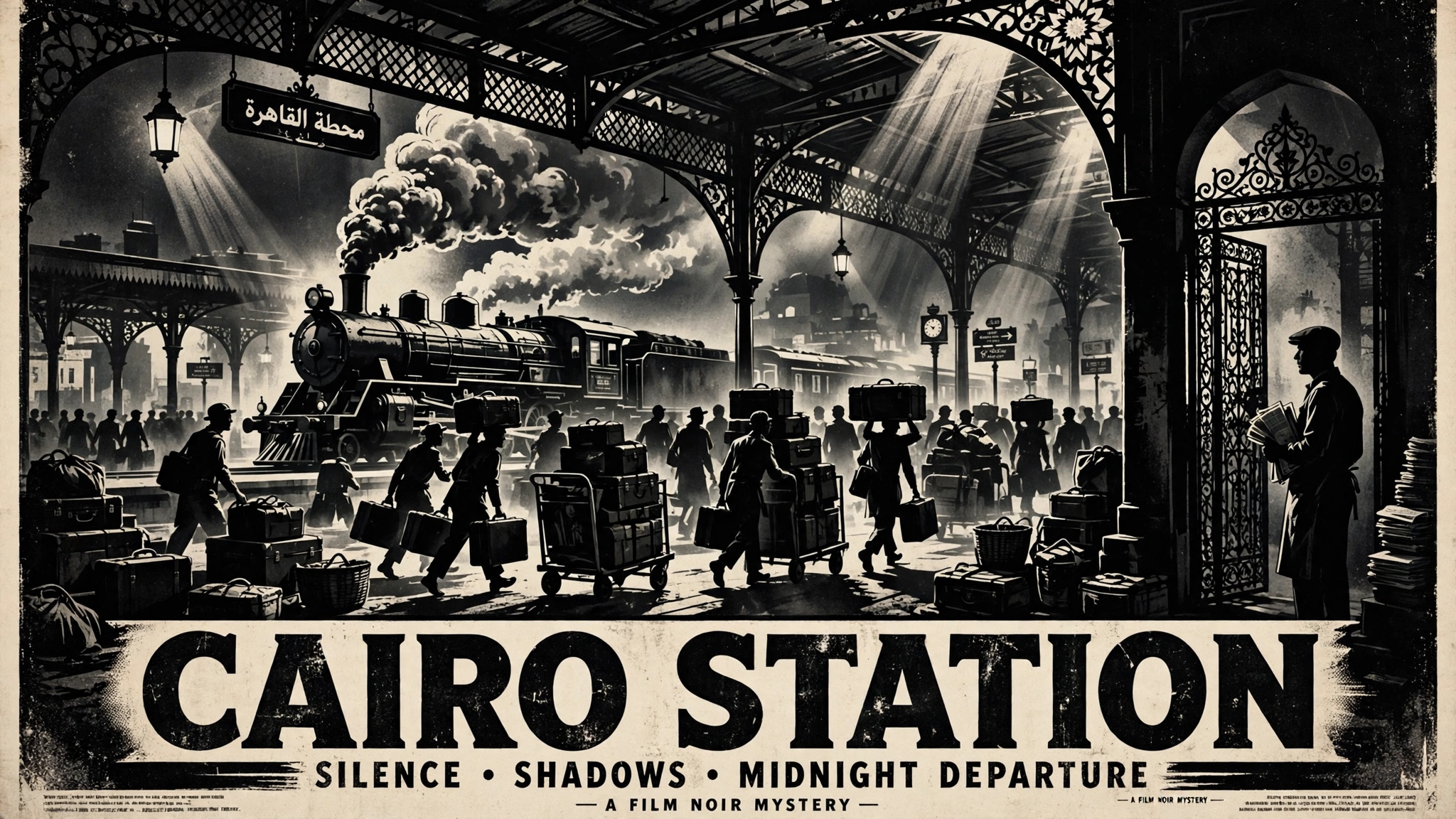
Ramses Station is the film’s world entire: trains arriving and departing, porters hauling luggage, vendors selling newspapers, lemonade and sweets, travellers, pickpockets, musicians and the station clock ruling over all of it. Madbouli, the elderly owner of a station kiosk, takes pity on Qinawi, a poor, limping young man from the countryside found half-starved by the tracks, and gives him work selling newspapers. Qinawi takes the job, a shack by the tracks to live in, and — almost immediately — a fixation.
The fixation is Hanuma, the station’s bold, funny, beautiful lemonade seller, who works the platforms with her bucket, dodges the authorities who chase unlicensed vendors, and teases Qinawi the way she teases everyone. But Hanuma is engaged, in every sense that matters, to Abu Siri, a powerful porter who is trying to organise his fellow porters into a union against their exploitative boss. Their storyline — loud, physical, full of music, quarrels and tenderness — plays as the film’s bright surface, a popular melodrama about working people demanding dignity.
Underneath it, Chahine builds the shadow story. Alone in his shack, Qinawi covers his walls with magazine pictures of women and measures his real life against Hanuma’s laughter, her casual kindnesses and her mockery. He comes to believe that marriage to her will rescue him from loneliness and shame, and he prepares, with terrible patience, to propose. The film observes, without underlining, how the whole station treats him: as a joke, a nuisance, a man whose desire is considered absurd because his body is disabled. When humiliation finally turns his longing in a violent direction, the film becomes a suspense thriller — one whose outcome, and whose remarkable final scenes, we will leave for you to discover. Around the triangle, subplots flicker past: a women’s-rights campaigner addressing the station, a famous singer passing through, porters voting, vendors fleeing inspectors. The station is Egypt in miniature, and Qinawi is the man Egypt refuses to see.
Youssef Chahine as Qinawi gives one of the boldest performances by a director in cinema history. It is a fully physical characterisation — the limp, the darting eyes, the ingratiating smile that arrives half a second too eagerly, the hands that never settle — and it is brave precisely because it refuses dignity as a shield. Chahine plays longing, self-pity, cunning and breakdown without asking the audience to forgive any of it. Accounts of the production say he took the role when no Egyptian star would accept such a character; watching the film, it is hard to imagine a star’s vanity surviving it. This is the performance the whole film stands on, and it has lost none of its discomforting power.
Hind Rostom as Hanuma is the film’s blazing counterweight, and it is no wonder she was Egypt’s most popular actress of the era, nicknamed the Arab world’s Marilyn Monroe. Rostom plays Hanuma not as a femme fatale — the trap a lesser film would fall into — but as a working woman with a body, a temper, a sense of humour and plans of her own. Her Hanuma is kind to Qinawi in flashes and cruel to him in others, not from villainy but from the carelessness of someone who has never had to consider him seriously. Rostom’s star charisma is essential to the film’s honesty: the audience must understand the whole station’s fascination with her, so that Qinawi’s obsession reads as an extreme of a common condition, not an alien one.
Farid Shawqi as Abu Siri brings the popular-cinema muscle. Shawqi was one of Egyptian film’s great stars of strongmen and everymen, and his porter — boasting, tender, politically fired-up, jealous — gives the film its earth and its comedy. His union storyline could have been a lecture; in Shawqi’s hands it is a love story and a livelihood at once. Hassan el Baroudi as Madbouli, the kiosk owner whose kindness sets the plot in motion and whose narration frames it, provides the film’s moral temperature: decent, limited, and ultimately helpless to protect either of his station’s children from the other.
Chahine directs the station like a symphony conductor who also wants you slightly out of breath. Alvise Orfanelli’s black-and-white cinematography swings between neorealist location observation — real platforms, real crowds, heat you can feel — and expressionist shadow for Qinawi’s interior world, the shack’s pin-up walls lit like a shrine in a horror film. Kamal Abul Ela’s editing keeps all the plotlines colliding at speed; the station clock, the arriving trains and the editing rhythm make time itself a pressure cooker, in the classical manner: essentially one place, one span of hours, tension rising until it must break.
What is most striking, formally, is the tonal collage. Within 77 minutes Chahine folds in melodrama, social realism, a musical interlude, crime-film suspense, near-documentary labour politics and psychological horror, and the modes energise rather than cancel each other. That mixture was the scandal and it is now the glory: Egyptian popular cinema’s own ingredients, rearranged by a director who had studied in America and absorbed European art cinema, until the result exposed what the formulas usually hid — that the cheerful station crowds, the songs and the romances all share a platform with exploitation, sexual frustration and violence. Modern viewers should still be prepared for period attitudes and for the film’s intense treatment of its subject; Chahine’s sympathy is clear, but he does not soften Qinawi’s threat or Hanuma’s danger to make anyone comfortable. Occasionally a subplot — the visiting singer, the campaigner — feels like a sketch the running time cannot quite finish, which is the film’s only real structural flaw, and a small one at this length.
The music, credited to Fouad El-Zahry, works in two registers that mirror the film. Around Hanuma and the porters there is the sound of the station itself as music: popular song, street rhythm, and a celebrated sequence built around a rock-and-roll act, Mike & His Skyrockets, performing for the crowds — a burst of 1950s modernity that shows Chahine happily raiding the popular culture of his moment. Under Qinawi’s scenes, the scoring darkens into suspense textures that belong to the thriller the film gradually becomes. The contrast is the meaning: one man’s inner life is scored as horror while the world around him dances. Sound design matters as much as score here — train whistles, announcements, crowd noise and the station clock build a pressure that the music then releases or tightens.
What we loved:
What could be better:
Here we must be straightforward with you, because this section usually invites invention. No trustworthy box office totals for Cairo Station survive. Egyptian grosses from 1958 were not tracked and published the way modern figures are, and the numbers occasionally pasted onto database pages for this film are unverifiable. What is documented is the shape of its reception: the film was controversial on release, its subject matter provoked boycott calls and walkouts, and its initial commercial life in Egypt was difficult — audiences expecting a conventional Chahine entertainment, with Farid Shawqi and Hind Rostom on the poster, were confronted with something far darker.
Its real “box office” is the long term, and there it is one of the great earners in reputation. Cairo Station was Egypt’s submission for the Academy Award for Best Foreign Language Film and screened in competition at Berlin in 1958. Over the following decades it was canonised by critics in Egypt and abroad as Chahine’s early masterpiece, restored by Misr International Films and the Cineteca di Bologna’s World Cinema Project network, widely taught, and issued in a major Criterion Collection edition in 2025. For a film its first audiences rejected, that is a more durable success than any opening weekend.
Emphatically yes — this is essential viewing for anyone who cares about world cinema, and it is only 77 minutes long. Cairo Station delivers pleasures the canon sometimes forgets to provide: stars at full wattage, a plot that tightens like a wire, comedy and music woven into tragedy, and under it all a serious, unsettling question about who is allowed to desire and be desired. Newcomers to classic Egyptian cinema could not ask for a better door in; the “Iron Gate” title, in the end, suits a film that opens onto an entire national cinema.
Our rating: 9/10 — a compact, feverish masterpiece that was too honest for 1958 and has been outrunning its era ever since.
What does Bab el-Hadid mean?
It is the film’s original Arabic title and means “The Iron Gate,” a name associated with Cairo’s central Ramses Station, where the entire film is set. Cairo Station is the English-language title under which it became known internationally.
Did Youssef Chahine really play the lead himself?
Yes. Chahine directed the film and starred as Qinawi, reportedly after established Egyptian actors declined a role considered too disturbing and unglamorous. His performance is now considered one of the film’s defining strengths.
Is Cairo Station based on a true story?
No, it is an original screenplay by Abdel Hay Adib with dialogue by Mohamed Abu Youssef. Its power comes from observation — of the station, its workers and its social tensions — rather than from a specific real case.
How long is Cairo Station and in what language?
It runs about 77 minutes — some archive listings give 74 to 76 minutes for particular prints — and is in Arabic, normally shown with English subtitles outside the Arab world.
Where can I watch Cairo Station?
The restored version circulates on curated streaming services, appears in Chahine retrospectives, and is available in a Criterion Collection edition released in 2025. Availability varies by region, so check your local services and disc retailers.