★ LATEST REVIEWS

★★★★☆ Our Rating: 8/10
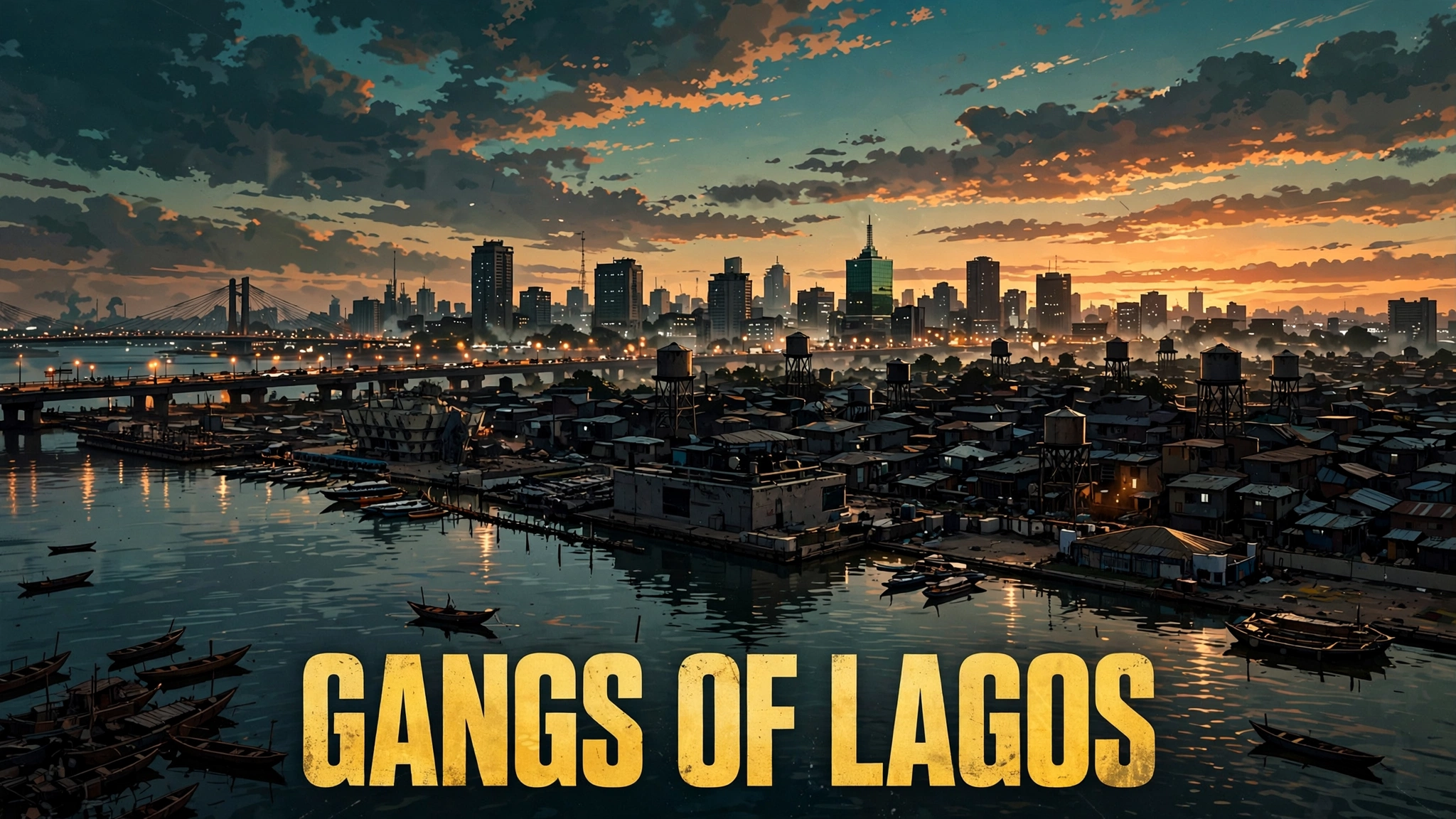
Begin, as this site always begins with a streaming film, with the honest disclosure: Gangs of Lagos has no box office. Jade Osiberu’s crime thriller was released worldwide on Amazon Prime Video on 7 April 2023 as the platform’s first African Original film, and its audience is measured in streams, charts and arguments, not tickets. And what arguments. Within days of release the film had been condemned by the Lagos State Government, defended by its makers as fiction, and pulled into a cultural dispute over its portrayal of Isale Eko and the sacred Eyo masquerade that would eventually reach a courtroom settlement in 2025. Few Nollywood films have ever mattered this loudly.
Strip the headlines away and the film itself is something older and sadder than the controversy suggests: a coming-of-age tragedy about three childhood friends — Obalola, Gift and Ify — growing up in Isale Eko, the dense historic district on Lagos Island where gangs and politicians are frequently the same people wearing different clothes. Directed and co-written by Osiberu, already one of Nollywood’s most bankable filmmakers after Isoken, Sugar Rush and Brotherhood, it is a flawed, furious, frequently magnificent film. This Gangs of Lagos review covers the story without spoiling its ending, the performances, the craft, the streaming record, and the controversy — which deserves honesty from both directions.
| Detail | Information |
|---|---|
| Release date | 7 April 2023 (Prime Video); screened at Toronto International Film Festival, September 2022 |
| Director | Jade Osiberu |
| Writers | Kay Jegede, Jade Osiberu |
| Genre | Crime Thriller, Action Drama |
| Language | Yoruba, English, Nigerian Pidgin |
| Runtime | 124 minutes |
| Lead cast | Tobi Bakre, Adesua Etomi, Chike, Olarotimi Fakunle, Tayo Faniran, Chioma Akpotha, Iyabo Ojo |
| Our rating | 8/10 |
A note on the missing budget row: no reliable production budget for Gangs of Lagos has ever been officially published. Osiberu has said the film was raised independently with friends and partners before Amazon acquired it, but no verified figure exists in any source we could check, so the row is omitted rather than filled with a guess.
Isale Eko raises its children hard. Obalola loses his father — a local kingpin — to violence while still a small boy, shot down in circumstances involving men dressed as Eyo masquerades, an image the film plants early and returns to with terrible purpose. Taken in first by the streets and then by Nino (Tayo Faniran), a rising gang figure who becomes the father the boy actually needed, Obalola grows up alongside two friends who complete him: Gift (Adesua Etomi), fierce and loyal to the point of self-destruction, and Ify (Chike), who dreams, genuinely and hopelessly, of escaping through music.
Adulthood in Isale Eko means employment, and employment means Kazeem (Olarotimi Fakunle), the district’s reigning Eleniyan — a crime boss whose real business is politics, supplying muscle, crowds and fear to election campaigns in exchange for protection and power. Obalola becomes Kazeem’s trusted enforcer, telling himself it is temporary, that it is for his family, that loyalty to Nino’s memory demands it. Gift embraces the life. Ify is dragged along by love for his friends. Around them, Osiberu builds a complete ecosystem: mothers praying and grieving, party rallies that function as gang musters, weddings and funerals where every guest is armed with history.
The machinery of tragedy engages when a mission for Kazeem goes wrong and the three friends are pulled into a war between factions — a war in which every adult who claimed to protect them reveals a price. We will not spoil who falls, who betrays whom, or what Obalola finally learns about the men who raised him. It is enough to say the film’s true villain is not a person but a cycle: Isale Eko keeps producing the same story, and the only variable is which child it happens to.
Tobi Bakre as Obalola gives the performance that redefined his career. Bakre, who came to fame through reality television, had already impressed in Osiberu’s Brotherhood; here he carries a whole life, from wary street boy — played as a child by Maleek Sanni, who won the Africa Movie Academy Award for Best Young/Promising Actor — to a grown enforcer whose decency is being taxed scene by scene. Bakre has said he prepared by listening to emotional music to keep himself inside Obalola’s grief rather than performing it, and the strategy shows: his silences are the film’s loudest statements.
Adesua Etomi as Gift plays the friend who chose this life with open eyes, and Etomi — one of Nollywood’s most decorated stars — makes Gift’s hardness feel like armour over an old wound rather than a personality. Chike as Ify uses his real-life identity as a singer-songwriter to devastating effect: Ify’s musical dream is the trio’s one window out of Isale Eko, and Chike plays him as a boy the streets never quite managed to ruin. Olarotimi Fakunle as Kazeem is a superb villain — patient, paternal, smiling, a godfather whose affection is a leash — and his performance drew wide critical praise. But the film’s emotional summit belongs to Chioma Akpotha (credited also as Chioma Chukwuka) as Mama Ify, a mother trying to shield her son from a world she understands better than he does; her work won an award at the Africa International Film Festival and supplies the grief the whole third act runs on. Iyabo Ojo as Obalola’s mother, Tayo Faniran as Nino and musician Pasuma as London round out a cast that blends Nollywood royalty with street casting to convincing effect.
Osiberu conceived the film after shooting a scene for her series Gidi Up on an Isale Eko rooftop in 2016 and watching, through a window, a mother cooking dinner and scolding her children in the middle of the district’s chaos — ordinary tenderness inside an extraordinary pressure cooker. That origin shows in every frame. Working with cinematographer Olumuyiwa Oyedele, she shoots the real Isale Eko — production took place on Lagos Island in 2021, over about two months, on RED cameras — as a place of colour, music, faith and menace all occupying the same alley. The famous climax, an ordinary Nigerian party that detonates into gunfire, was reportedly the hardest sequence to stage, involving blackouts, generator failures and hundreds of extras, and it plays as the film’s thesis: in Isale Eko, celebration and violence share a guest list.
The craft is not uniformly controlled. The film’s structure leans on narration and flashback more than it needs, some action is cut so quickly that geography dissolves, and the large cast means several promising figures — Gift’s family, Kazeem’s political masters — get outlines rather than arcs; more than one Nigerian critic suggested the material wanted to be a series. But Osiberu’s gifts are the ones that cannot be taught: casting, atmosphere, and the patience to hold on faces. When the film slows down and simply watches its neighbourhood, it is as good as anything Nollywood has produced.
The score is by Tolu Obanro, who has said he wanted music that felt “massive and huge,” and the opening cue announces exactly that intent — a big, ominous orchestral swell over the Lagos lagoon that declares this a crime epic, not a neighbourhood drama. Obanro’s score runs under the film like a second heartbeat, dropping away for the street scenes where diegetic sound — generators, sermons, traffic, party music — does the authenticating. Chike contributes songs within the film as Ify, and those moments are load-bearing: his music is the sound of the life the trio might have had, which is why the score’s return after each of Ify’s scenes hurts. The soundtrack overall is one of the film’s unambiguous strengths, matching its scale without smothering its Lagos texture.
What we loved:
What could be better:
Plainly stated: there is no box-office figure for Gangs of Lagos, because the film was made for streaming. It premiered on Prime Video worldwide on 7 April 2023 after a festival screening at Toronto in September 2022, and Amazon does not publish per-title viewing numbers, revenue or anything resembling a gross. On that basis, we must flag a claim readers will meet elsewhere — including, at the time of writing, in the film’s own encyclopaedia entry — that the film “earned more than ₦230 million.” That figure is attached to a weak citation, is inconsistent with a direct-to-streaming release that had no ticket sales to earn it from, and appears to conflate the film with theatrical Nollywood releases. Treat it as unverified. We do not use it.
What is verifiable is chart performance reported from Amazon’s own disclosures. In 2023 Prime Video published a ranking of its most-travelled non-English local originals, measured by viewing outside the home country in the first three days of release, and Gangs of Lagos placed ninth on that global list — the only African title in the top ten, alongside hits such as Spain’s My Fault. Coverage of the launch also recorded it debuting at number one in West African markets and trending in more than 30 countries. That is the honest commercial story: not a gross, but a Nigerian film travelling the world on a global platform in its opening weekend — precisely the outcome Osiberu has said the production, raised independently before Amazon came aboard, was built to chase. The controversy, addressed in our FAQ below, forms part of its public record too: in 2025 a settlement of the Isale Eko Descendants’ Union lawsuit required apologies from the producers and Amazon over the Eyo portrayal — a reminder that this film’s audience included the very community it depicted, watching closely.
Yes. Gangs of Lagos is essential modern Nollywood: imperfect in structure, formidable in feeling, and important in ways that go beyond its running time. Come for a crime thriller and you will get one — propulsive, handsome and violent — but stay for the tragedy underneath it, three friends the city never gave a fair chance, played by a cast at the top of its game. Viewers from Lagos, and especially Isale Eko, will judge its portrayal by standards the rest of us can only respect from a distance; the filmmakers’ position, stated throughout, is that the film is fiction made in love for the place, and the 2025 settlement closed the legal argument with apologies offered. As cinema, our judgement is clear: this is one of the defining Nigerian films of the streaming era.
Our rating: 8/10 — a raw, ambitious Lagos crime tragedy with career-best performances; sprawling in places, unforgettable in total.
Is Gangs of Lagos based on a true story? No. Obalola, Gift, Ify and Kazeem are fictional, and Osiberu has consistently described the film as fiction. It is, however, rooted in observed Isale Eko life — the idea came to her while filming nearby in 2016 — and in the real, documented overlap between street gangs and election politics in Lagos.
Why is there no box office for Gangs of Lagos? Because it was released directly to Amazon Prime Video worldwide on 7 April 2023 as the platform’s first African Original film, with no conventional cinema run. Amazon does not publish viewing revenue, so claims of a naira gross — including a widely repeated ₦230 million figure — are unverified and should not be trusted.
What was the Eyo masquerade controversy? The film depicts figures in Eyo regalia — the white masquerade costume central to Lagos festivals — in connection with violence. The Lagos State Government, traditional institutions and the Isale Eko Descendants’ Union objected that this disrespected the tradition and the community. The dispute ended in a court-approved settlement in March 2025 under which the producers and Amazon apologised; no damages were reported as paid.
Is Gangs of Lagos the first African film on Prime Video? It was Prime Video’s first African Original movie — the platform’s flagship Nigerian commission — and the first title from Osiberu’s multi-year overall deal with the service. It later ranked ninth on Prime Video’s own list of most-travelled non-English local originals.
Where can I watch Gangs of Lagos? On Amazon Prime Video, where it was released globally. It had earlier screened at the Toronto International Film Festival in September 2022. Availability can vary by region and over time.