★ LATEST REVIEWS

Our Rating: ★★★★☆ 7/10
Marc Ma’s Go for Broke (also known as Rebirth) was a surprise hit in China in 2024, a grim crime thriller about parents pushed past breaking point. Its thematic sequel, Go for Broke 2 (Chinese: 重生2, Rebirth 2), arrived in Chinese cinemas on 3 October 2026 and in North America on 23 October 2026, distributed by CMC Pictures and Maoyan Entertainment. It is a lurid, violent, emotionally direct revenge film: a mother who loses her child to a criminal network joins forces with a young man whose sister suffered the same fate, and together they hunt the men responsible. It is not subtle, and it does not try to be. But it has a committed central performance, a genuinely menacing Sammo Hung, and an anger that feels real even when its spectacle strains belief.
A content note first: this film’s story centres on crimes against children, and its revenge violence is graphic and prolonged. It is not a film for sensitive viewers or for family viewing.
| Detail | Information |
|---|---|
| Release date | 3 October 2026 (China); 23 October 2026 (North America) |
| Director | Marc Ma |
| Writer | Marc Ma |
| Genre | Action, crime, drama |
| Language | Chinese |
| Runtime | 132 minutes |
| Lead cast | Isabella Leong, Wen Junhui, Sammo Hung, Bai Ke, Alan Aruna, Wang Longzheng, Danny Chan Kwok-kuen, Casper, Liu Yuze |
| Music | Ding Ke |
| Our rating | 7/10 |
The film is set in a foreign land where the powerful hold absolute control and treat human lives as disposable — a deliberately generalised setting that lets the film play as a fable of corruption as much as a specific crime story. Xila (Isabella Leong) loses her child to a ruthless underground network. In her grief she meets Su Cheng (Wen Junhui), a young man whose sister suffered a similar fate. Bound by shared loss, the two strangers join forces to uncover the truth behind the crimes and take revenge on the masterminds: Zuoman (Sammo Hung) and his son Zuoke (Bai Ke).
What follows is, as the film’s own premise promises, not merely a tale of vengeance but a story of two people pushed to the brink, fighting for justice and, ultimately, for their own rebirth — the meaning of the film’s Chinese title. As Xila and Su Cheng’s plan unfolds, the conspiracy they uncover proves darker than they imagined, and the film escalates from investigation to confrontation to a prolonged final assault. This review will not spoil the fates of its characters, but it is fair to warn that the film’s violence grows more elaborate as it goes, and that its emotional logic — grief justifying punishment — is exactly what its critics have questioned.
The film’s strength is its premise’s directness. There is no irony here, no clever distance: a mother who has lost a child, a young man who has lost a sister, and a criminal empire that treats children as commodities. That directness is what gives the film its power, and also what makes its excesses uncomfortable. When the punishment becomes increasingly spectacular while the loss that authorises it remains irreparable, the film asks its audience to keep enjoying what it is also asking them to mourn.
Isabella Leong as Xila — Leong gives the film its emotional weight. Her Xila is not a slick action heroine but a grieving mother whose pain stays credible even as the film around her grows more outlandish. Critics who were divided on the film agreed on this: Leong’s performance keeps the revenge fantasy grounded in something human, and her physical commitment to the action sequences is considerable. She is the reason the film’s first half works as drama rather than mere exploitation.
Wen Junhui as Su Cheng — Wen, known to many as a K-pop idol, holds his own as Su Cheng, the young man whose quieter grief complements Xila’s fiercer one. His action work is convincing, and his scenes with Leong give the film its few moments of tenderness — two strangers who understand each other’s loss without needing to explain it.
Sammo Hung as Zuoman — The Hong Kong legend is the film’s most memorable presence. Hung plays Zuoman with stillness rather than bluster: authority expressed through calm, through a look, through the simple fact of his presence. It is a reminder of why Hung has endured for five decades — he does not need to raise his voice to be threatening. Bai Ke, as his son Zuoke, provides the more volatile counterpart, and the supporting cast of Alan Aruna, Wang Longzheng, Danny Chan and others fills out the criminal world with workmanlike menace.
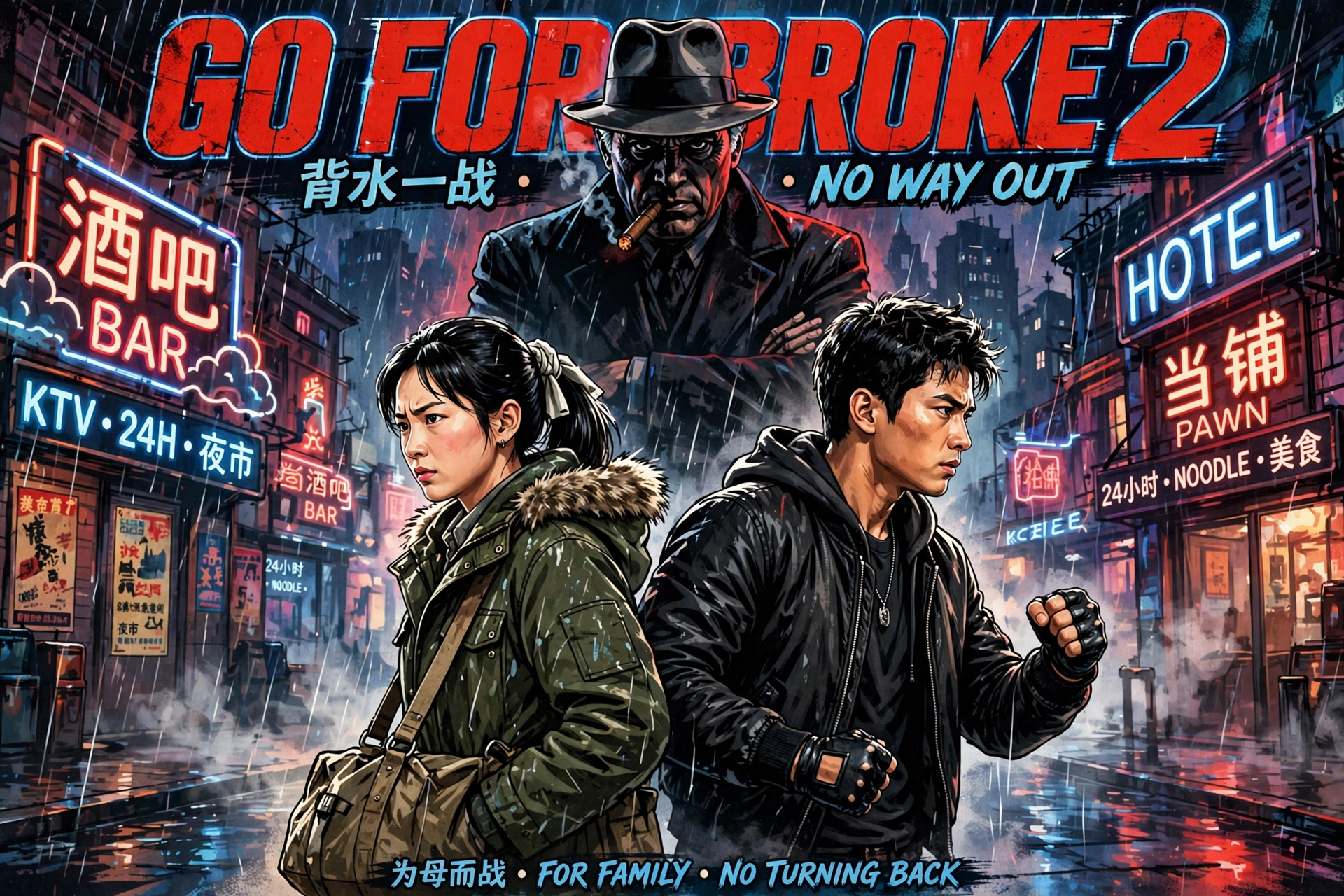
Marc Ma, who writes, directs and appears in the film, clearly knows the Hong Kong exploitation tradition he is working in, and he pushes its aggression hard. The action is staged with energy, and the film’s neon-drenched, rain-soaked foreign city has a lurid, comic-book atmosphere. Chan Chi Ying’s cinematography and Ding Ke’s score keep the film moving at a propulsive clip across its 132 minutes.
The honest criticisms, which the film’s early reviews have already raised, are worth stating plainly. The visual effects are uneven, the protagonists grow increasingly invulnerable as the film goes on — which weakens the action’s tension — and the prolonged final assault strains the film’s own emotional logic, asking grief to finance a spectacle that keeps demanding one more reprisal. The film also inherits a weakness of its predecessor’s formula: its generalised “foreign land” setting, while clearly a commercial choice to broaden the film’s appeal, can feel fabricated rather than real. These are the reasons this review’s rating stops at 7 rather than higher: the film is powerful, but it is also uneven.
Ding Ke’s score drives the film’s action rhythms with propulsive, percussive energy, and the sound design leans into the genre’s pleasures: rain, engines, gunfire, breaking glass. There is no subtlety here, and none is needed — the music’s job is to keep the audience’s pulse up, and it does that job well. The film’s quieter moments, when Xila and Su Cheng simply sit with their loss, are notable precisely because the score steps back and lets silence work.
What we loved:
What could be better:
The original Go for Broke (2024) was a commercial success in China, grossing approximately $65 million — the benchmark its sequel must be measured against. For Go for Broke 2 itself, no reliable box-office total has yet been published by the sources this review relies on, and this review will not invent one. The film’s rollout is still expanding — it opened in Australia, New Zealand and Malaysia on 15 October, in Britain and Ireland on 16 October, and in the United States and Canada on 23 October — so its international performance will become clearer over the coming weeks. What is known is the scale of the release: a major Chinese National Day-season title with a genuine international footprint, which already marks it as one of the more widely travelled Chinese action films of the year.
Yes, if you like hard-edged Hong Kong-style revenge thrillers and you can handle the film’s subject matter. Go for Broke 2 is brutal, uneven and sometimes excessive, but it is carried by Isabella Leong’s performance and Sammo Hung’s presence, and its anger on behalf of its victims is genuine. Go in expecting exploitation-cinema intensity rather than prestige drama, and be aware of the child-harm theme before you press play.
Our rating: 7/10 — A brutal, uneven revenge thriller: Leong and Hung elevate lurid material, but escalating spectacle and uneven effects keep it from greatness.
Is Go for Broke 2 a sequel to Go for Broke?
Yes, it is a thematic sequel to Marc Ma’s 2024 hit Go for Broke (also known as Rebirth), with a new story and largely new characters in the same revenge-thriller world.
Who stars in Go for Broke 2?
Isabella Leong as Xila, Wen Junhui as Su Cheng, Sammo Hung as the crime boss Zuoman, and Bai Ke as his son Zuoke.
When was Go for Broke 2 released?
3 October 2026 in China, followed by Australia, New Zealand and Malaysia on 15 October, Britain and Ireland on 16 October, and North America on 23 October 2026.
How long is Go for Broke 2?
132 minutes.
Is Go for Broke 2 suitable for family viewing?
No. It is a violent adult action thriller centred on crimes against children, with graphic revenge violence; it is intended for adult viewers only.