★ LATEST REVIEWS

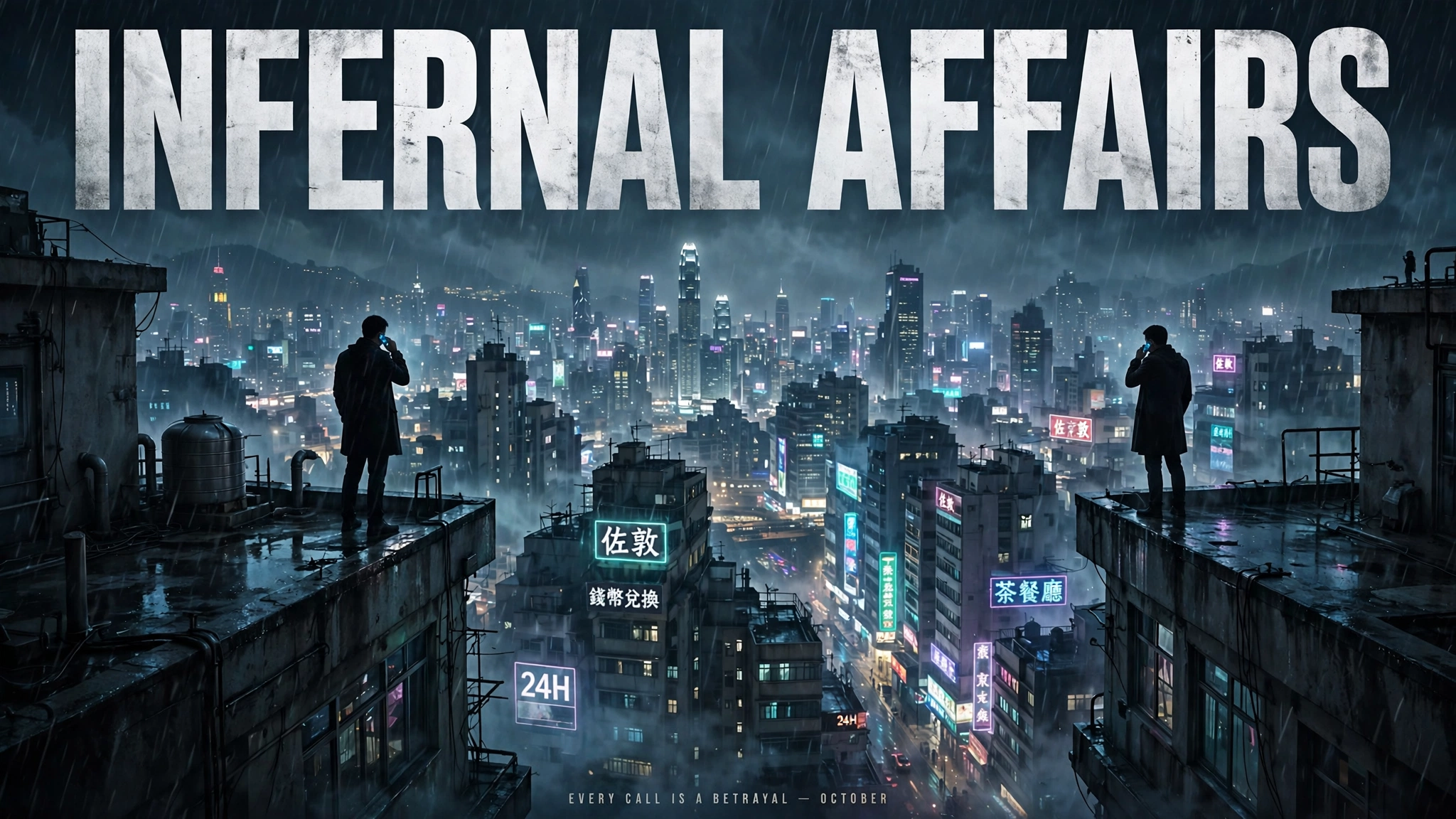
Our Rating: ★★★★★ 9.5/10
The premise of Infernal Affairs can be explained in one sentence, and it has been imitated ever since: a police officer has spent so long undercover inside a triad that only one man alive knows who he really is — while, inside the police force itself, a triad mole has risen to senior rank, feeding his boss every move the police make. Released in Hong Kong in December 2002, Andrew Lau and Alan Mak’s crime thriller took that perfect high concept and executed it with a speed, elegance and melancholy that revived a struggling Hong Kong film industry and travelled the world — most famously as the source of Martin Scorsese’s Oscar-winning remake, The Departed.
An honest Infernal Affairs review should start by separating the film from its famous remake. The Departed is bigger, louder and starrier. Infernal Affairs, at a lean 101 minutes, is tighter, sadder and — for many viewers who discover it second — the purer machine. This review covers its mirrored story without spoiling its ending, the career-defining performances at its centre, its influential craft, and the modest numbers behind a film whose legacy vastly outweighs its budget.
| Detail | Information |
|---|---|
| Release date | 12 December 2002 (Hong Kong) |
| Director | Andrew Lau, Alan Mak |
| Writers | Alan Mak, Felix Chong |
| Genre | Crime Drama, Thriller |
| Language | Cantonese |
| Runtime | 101 minutes |
| Budget | HK$20 million (see Box Office section for conflicting figures) |
| Lead cast | Andy Lau, Tony Leung, Anthony Wong, Eric Tsang |
| Our rating | 9.5/10 |
Chan Wing-yan (Tony Leung) was a promising police cadet when he was secretly recruited for deep undercover work: expelled from the academy in disgrace as cover, inserted into the triad organisation of crime boss Hon Sam (Eric Tsang), and left there. Years pass. Yan has arrests, injuries and a criminal record built to protect his legend, and almost no life of his own — only Superintendent Wong (Anthony Wong), his handler, knows his true identity. On the other side of the mirror, Lau Kin-ming (Andy Lau) was a young triad member planted by Sam in the police academy. He has flourished: a respected, fast-rising inspector with a comfortable home and a fiancée, whose secret reports keep Sam one step ahead of every raid.
The film’s engine starts when a major drug deal forces both organisations to hunt for a mole at the same time. Sam orders Ming to find the police plant in his gang; the police order Yan — through Wong — to help unmask the triad’s informant in the force. Each man is, in effect, assigned to catch himself. Lau and Mak stage the resulting cat-and-mouse with famous economy: phone calls made under the enemy’s nose, a rooftop’s worth of suspicion, and set pieces — a drug bust directed in real time by both moles simultaneously, an electronics shop, a cinema — that generate unbearable tension from information rather than gunfire.
What elevates the plot is its symmetry of suffering. The title references the Buddhist concept of continuous hell, and both men are living in one: Yan desperate to recover the honest identity that is rotting away from disuse, Ming increasingly desperate to become the good man he pretends to be and erase the one he is. To describe the final movement here would be a disservice; suffice to say the film’s closing passages and its famous rooftop imagery have been quoted, remade and homaged for two decades, and the original ending remains the most debated element of the trilogy it launched — Infernal Affairs II and III followed in 2003, a prequel and a sequel completing the design.
Tony Leung as Chan Wing-yan gives one of the defining performances of his career — which, given a filmography including In the Mood for Love and Chungking Express, is saying a great deal. His Yan is exhaustion made human: unshaven, sleepless, jumpy in public and quietly falling apart in the office of the police psychologist who treats him as a patient without knowing why. Leung won the Hong Kong Film Award for Best Actor for the role, and the performance’s genius is its restraint — a man who cannot afford a single honest expression, communicating a decade of damage in glances. You believe both his toughness among gangsters and his terror that the police have forgotten him.
Andy Lau as Lau Kin-ming has the subtler trap of a role: Ming must be genuinely capable and likeable, because the worse truth is that he is good at being a policeman. Lau plays him as polished control slowly cracking — the neat apartment, the careful speech, the dawning wish to simply be the man in the photograph. Where Leung shows a good man corroded by a false life, Lau shows a false man corroded by a good one. Their scenes of near-discovery work because both actors keep everything under the surface.
Anthony Wong as Superintendent Wong supplies the film’s conscience and much of its warmth; his fatherly, weathered handler is the one thread connecting Yan to the honest world, and Wong won Best Supporting Actor at the Hong Kong Film Awards for it. Eric Tsang as Hon Sam is equally crucial — avuncular one moment, chilling the next, a boss whose intelligence makes him a worthy architect of both men’s prisons. Smaller turns, including Shawn Yue and Edison Chen as the young Yan and Ming in the prologue passages, complete a cast with no weak link.
Andrew Lau — who also served as co-cinematographer with Lai Yiu-fai — and Alan Mak direct with a sleek, blue-grey visual discipline rare in Hong Kong genre cinema of the period. The city is all glass towers, rooftops and reflective surfaces: a place where everyone is watched and no one is seen clearly. Editing by Danny Pang and Curran Pang is famously ruthless; at 101 minutes there is scarcely a wasted scene, and cross-cutting between the two moles during the central drug-bust sequence is a masterclass in parallel suspense that filmmakers still study.
The craft serves character first. Note how often the film’s biggest moments are two men and a phone, or a conversation in which both parties are lying. The celebrated hi-fi shop scene — the two leads meeting as strangers, listening to music together, neither knowing the other — establishes their strange kinship in a few quiet minutes. If the film has craft limitations, they are of budget rather than imagination: a couple of digital effects have dated, and the female characters — a fiancée, an ex-girlfriend, a psychologist — are sketched more thinly than the men, serving the mirrored design rather than standing fully outside it. The sequels would thicken some of this; the original remains the leanest and, for most viewers, the best.
Chan Kwong-wing’s score is built on tension and ruefulness rather than bombast: low strings, piano figures and electronic pulses that tighten under the cat-and-mouse sequences and open into something genuinely mournful when the film contemplates its characters’ stolen lives. Just as important is the film’s use of songs and sound — the audiophile scene turns a classic Cantonese vocal recording into a character moment, contrasting the two men’s tastes and temperaments while the equipment around them gleams. The sound work was recognised at the Golden Horse Awards, and the overall effect is a thriller that sounds as polished as it looks: every phone buzz feels like a heartbeat, every silence on a rooftop like a held breath.
What we loved:
What could be better:
Infernal Affairs was made cheaply by blockbuster standards, though the sources require honest handling. Wikipedia and standard references cite a budget of HK$20 million; other databases list dollar figures around $5–6.4 million — TMDB, for example, lists $6.4 million — which do not reconcile neatly with the Hong Kong dollar figure at period exchange rates, suggesting some trackers converted loosely or recorded different cost definitions. We use HK$20 million in the Quick Facts table as the most consistently cited local figure, and flag the discrepancy rather than present a false precision.
What is not in dispute is the result at home: the film grossed HK$55.1 million in Hong Kong, becoming one of the territory’s biggest local hits of its era — reported at the time as second only to Shaolin Soccer among Hong Kong films — and worldwide totals in the region of $8.7–8.8 million are commonly listed, modest in dollars but transformative in impact. At the 22nd Hong Kong Film Awards it won seven prizes from sixteen nominations, including Best Film, Best Director, Best Actor and Best Supporting Actor, and repeated those wins at Taiwan’s Golden Horse Awards. It was Hong Kong’s submission for the Academy Award for Best Foreign Language Film. And then, of course, came the remake: The Departed (2006) took its premise to Boston, won the Academy Award for Best Picture, and sent a generation of viewers back to discover this leaner, sadder original.
Yes — whether you arrive as a crime-film lover, a Departed fan curious about the source, or a newcomer to Hong Kong cinema, Infernal Affairs is close to a perfect thriller: 101 minutes, no fat, two monumental performances, and an emotional undertow that remakes and imitators have rarely matched. Watch it before the sequels — the prequel Infernal Affairs II is excellent in its own right — and, if you can, watch it in Cantonese with subtitles, where its performances live.
Two decades on, its influence is everywhere in the genre, yet the original still feels startlingly fresh, because its real subject was never procedure. It is two men who have each lived the wrong life for so long that the right one no longer fits — and that tragedy plays in any language.
Our rating: 9.5/10 — a lean, mirrored masterpiece of the crime genre and essential Hong Kong cinema.
Is Infernal Affairs the film The Departed was based on?
Yes. Martin Scorsese’s The Departed (2006) is a remake of Infernal Affairs, moving the story to Boston’s Irish-American crime world. The Hong Kong original is shorter, more melancholic, and its ending differs in significant ways.
Do I need to watch the sequels?
No — the first film is complete and self-contained. Infernal Affairs II (2003) is a prequel exploring the characters’ younger years and is highly regarded; Infernal Affairs III (2003) continues the story. Watch them in release order after the original.
Is Infernal Affairs very violent?
It is a crime thriller with gun violence and intense scenes, rated R in the United States, but its tension comes mainly from suspense and character rather than graphic violence. It is considerably less bloody than many films in the genre.
Infernal Affairs or The Departed — which should I watch first?
Ideally the original first, so its twists arrive fresh; but either order is rewarding. Many viewers find the original tighter and more moving, the remake broader and more operatic. They make a fascinating double bill.
Where can I watch Infernal Affairs?
It is available on streaming platforms and in restored Blu-ray editions in many regions, often alongside its sequels. Availability varies, so check your local services.