★ LATEST REVIEWS

Our Rating: ★★★★★ 9/10
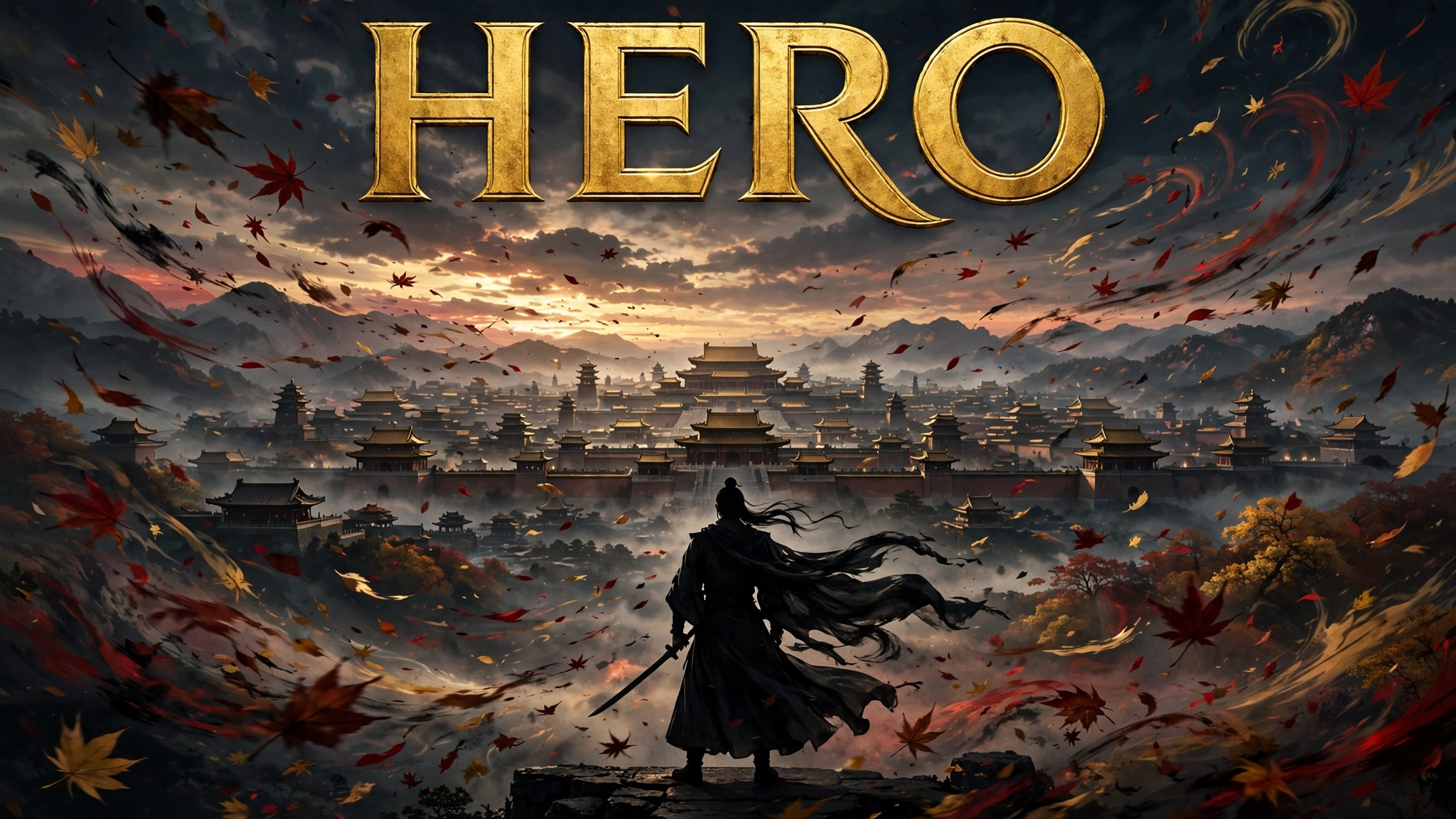
There are action films, and there is Hero. Zhang Yimou’s 2002 wuxia epic took the martial arts genre — duels, flying swordsmen, ancient China — and treated it with the visual ambition of a painter and the narrative structure of a philosophical argument. A swordsman tells a king how he defeated three legendary assassins. The king does not believe him. From that simple frame, Zhang builds one of the most gorgeous films ever shot, a story told in competing versions, each bathed in its own dominant colour, until the film becomes as much about how stories justify power as about swordplay itself.
An honest Hero review, more than twenty years on, has to hold two truths at once. As pure cinema — image, music, movement — it is close to untouchable, and its influence on global action filmmaking is enormous. As a political fable, its ending remains genuinely contested: some viewers find its conclusion moving and tragic, others find its message about unity and submission deeply troubling. This review will cover both, without spoiling the final choice, alongside the story, the extraordinary cast, and the numbers behind its landmark success.
| Detail | Information |
|---|---|
| Release date | 24 October 2002 (China); 21 December 2002 (Hong Kong); 27 August 2004 (United States) |
| Director | Zhang Yimou |
| Writers | Feng Li, Bin Wang, Zhang Yimou |
| Genre | Wuxia, Martial Arts, Historical Epic |
| Language | Mandarin |
| Runtime | 99 minutes (theatrical cut); 110 minutes (Director’s Cut) |
| Budget | $31 million |
| Lead cast | Jet Li, Tony Leung, Maggie Cheung, Zhang Ziyi, Donnie Yen, Chen Daoming |
| Our rating | 9/10 |
China, late in the Warring States period: the land is divided among rival kingdoms, and the King of Qin (Chen Daoming) is fighting to unify them under one rule — and surviving repeated assassination attempts in the process. Into his vast, guarded palace comes a minor official and swordsman known only as Nameless (Jet Li). He brings extraordinary news and the weapons to prove it: he claims to have killed the three assassins the king fears most — Sky (Donnie Yen), and the lovers Broken Sword (Tony Leung) and Flying Snow (Maggie Cheung).
Granted the rare honour of approaching close to the throne, Nameless recounts how each victory was won. His account unfolds in flashback: a duel in the rain at a chess courtyard, a killing amid swirling autumn leaves, a confrontation on a mirror-still lake. But the king, a shrewd and suspicious man, has studied the evidence — and Nameless’s story, he believes, contains impossibilities. What follows is a duel of narratives. The king offers his own version of events. Nameless answers with another. Each retelling changes the meaning of the same duels — who loved whom, who sacrificed what, and what a single phrase written in calligraphy might command a man to do.
This Rashomon-like structure is the film’s spine, and it is kept deliberately free of full spoilers here: the pleasure lies in watching identical faces and places become different stories. Underneath the swordplay sits the film’s central idea, expressed in the concept of tianxia — “all under heaven” — the dream of one unified land ending the age of war. What that dream demands of individuals, and whether it justifies them, is the question the entire film is built to ask.
The casting of Hero was an event in itself — arguably the greatest assembly of Hong Kong and Chinese screen talent of its generation — and Zhang uses his stars counterintuitively: he asks them to underplay.
Jet Li as Nameless gives the most restrained performance of his career. Famous for explosive charisma, Li here works in stillness and small reactions, a man whose face must remain readable in several different ways depending on which version of the story we are watching. It is disciplined, intelligent acting, and his physical authority in the duels — particularly the rain-soaked spear fight with Donnie Yen — needs no embellishment.
Tony Leung as Broken Sword and Maggie Cheung as Flying Snow carry the film’s emotional weight. Both were icons of Hong Kong cinema, famously paired in In the Mood for Love, and Zhang exploits their shared history: their scenes together, especially in the red-hued version among falling leaves and in a windswept desert confrontation, play like a whole tragic romance compressed into gestures. Leung’s quiet gravity and Cheung’s fierce, wounded pride make the film’s argument about sacrifice land in human terms, not just philosophical ones.
Zhang Ziyi as Moon, Broken Sword’s devoted servant, brings youthful fire to the film’s most purely exhilarating duel — a storm of red leaves against Maggie Cheung that remains a benchmark for wuxia choreography. Donnie Yen as Sky appears briefly but indelibly; his duel with Li, intercut with an elderly blind musician, is the film’s first great set piece and a statement of intent. Chen Daoming as the King of Qin completes the design: theatrical, formidable and increasingly thoughtful, he turns what could have been a framing device into a genuine second lead, a ruler whose intelligence makes the final movement a debate between equals.
Zhang Yimou began his career as a cinematographer and made his name with colour-saturated dramas like Raise the Red Lantern; in Hero, working with cinematographer Christopher Doyle, he pushes colour further than any mainstream film before or since. Each version of the story is assigned a palette — the cold blues of the king’s account, the passionate reds of deception and desire, the greens of memory and youth, the whites of truth — and entire landscapes are dressed to match, from armies in uniform black to a forest of golden poplar leaves chosen and timed for a single sequence. Doyle won major international cinematography honours for the film, and individual frames of Hero are reproduced as art prints for a reason.
The action, choreographed with wire-assisted wuxia grace, is closer to dance and calligraphy than to combat: swordsmen skim across water, arrows darken the sky in their thousands, and a duel is fought partly inside two warriors’ imaginations. Zhang’s control of scale is equally striking — thousands of Qin soldiers moving as one machine, against tiny human figures debating what that machine is for.
Critics of the film, then and now, tend to aim at the same targets. The structure means the emotion can feel diagrammed — characters sometimes speak the film’s thesis aloud — and Zhang’s visual perfection leaves some viewers admiring the film at a distance rather than being swept into it. The deeper debate is political: the story’s climax endorses, or at minimum mourns in a very complicated way, the surrender of individual vengeance to a unifying ruler. Western critics including several prominent voices criticised that as an apology for authoritarian power, while defenders read the ending as tragedy — the price of peace shown, not celebrated. Both readings are honestly available in the film, and a good review should tell you the argument exists rather than pretend it is settled.
Tan Dun, fresh from his Oscar-winning work on Crouching Tiger, Hidden Dragon, composed a score built on spareness and virtuosity: solo violin passages performed by Itzhak Perlman soar over drums, chanting and long, windswept tones. Where a lesser score would underline every duel beat, Tan Dun often lets a single line of violin or a struck drum carry a scene, matching Zhang’s restraint — the famous lake duel plays almost like a concerto for two swords. The music’s blend of Western orchestral writing and Chinese instrumentation mirrors the film itself: classical forms, executed with total polish, in service of an ancient story. It won the Hong Kong Film Award for Best Original Film Score among the film’s seven wins there, and it remains one of the most listened-to scores in Chinese cinema.
What we loved:
What could be better:
Hero was a watershed commercially as well as artistically. Made for a reported $31 million — at the time an enormous budget for a Chinese production — it broke records at home, earning more than ¥240 million in mainland China, and eventually grossed $177.4 million worldwide. Its American release became a story in itself: held for nearly two years, it finally opened in August 2004 — promoted with Quentin Tarantino’s name attached as presenter — and debuted at number one at the US box office, holding the top spot for two weeks and earning roughly $54 million in North America, a remarkable result for a subtitled Mandarin film.
One figure requires a flag: while $31 million is the widely cited production budget, some databases — including The Numbers — list a $17 million figure. The higher number matches contemporary reporting on the production’s scale and is the one used in the Quick Facts table; readers comparing sources will encounter both, and we present the range honestly rather than hide it.
The film was nominated for the Academy Award for Best Foreign Language Film, won seven Hong Kong Film Awards including Best Cinematography and Best Original Film Score, and took the Alfred Bauer Prize at Berlin. More importantly, alongside Crouching Tiger, Hidden Dragon it proved a global audience existed for prestige Chinese-language cinema — a door many films have walked through since.
Absolutely — Hero is essential viewing for anyone who cares about action cinema, cinematography, or the moment Chinese film stepped onto the world stage as a blockbuster force. New viewers should choose a good screen, surrender to its colour-coded storytelling, and expect a film more interested in beauty and ideas than in speed. Viewers troubled by its politics will find this review has not hidden that debate: the film’s vision of unity is presented at a real human cost, and whether Zhang mourns or endorses that cost is the conversation you will have afterwards. Either way, you will have seen images unlike any others.
Our rating: 9/10 — a visually peerless, intellectually provocative wuxia landmark whose ending still sparks argument for good reason.
Is Hero based on a true story?
It is inspired by history — the Warring States period and the famous assassination attempts against the King of Qin, including Jing Ke’s — but Nameless, Broken Sword and Flying Snow are fictional creations, and the film’s events are a philosophical fable rather than a history lesson.
Do I need to have seen Crouching Tiger, Hidden Dragon first?
No. The films are unrelated, though they are natural companions: both are prestige wuxia epics with Tan Dun scores. Hero is more stylised and colour-driven; Crouching Tiger is more romantic and character-led.
Which version should I watch — the 99-minute or Director’s Cut?
The 99-minute theatrical cut is the version most audiences know and is perfectly complete. The roughly 110-minute Director’s Cut restores additional material and is a rewarding second viewing for enthusiasts.
Is Hero suitable for children?
It is rated PG-13 in the US for stylised martial arts violence and a scene of sensuality. The violence is balletic rather than graphic, and the film is suitable for most teenagers, though its pacing and themes are aimed at adults.
Where can I watch Hero?
It is widely available on streaming platforms and in restored Blu-ray editions in many regions. Availability varies, so check your local services.