★ LATEST REVIEWS

Our Rating: ★★★★☆ 7.5/10
Some star vehicles introduce their hero with a slow-motion walk and a punchline. Pushpa: The Rise introduces its hero with a grievance. Pushpa Raj has no surname he is allowed to use, no family name that opens doors, and no patience left for a world that keeps reminding him of both. That wound — more than the smuggling, more than the fights — is what powers Sukumar’s sprawling Telugu action drama, and it is why a film about red sandalwood theft in the Seshachalam hills became a genuine pan-India phenomenon in December 2021, playing strongly even in its Hindi dubbed version in markets where its star had never opened a film before.
Honesty first: this is a long, uneven, deliberately excessive movie. At nearly three hours it repeats its beats, it pauses for songs that stretch the running time, and its final stretch is openly a bridge to a sequel rather than a complete ending. Yet it never loses its central charge. Allu Arjun disappears into a man who has decided, once and for all, that he will not bend — and the film builds everything else around that refusal. This Pushpa: The Rise review looks at the story without spoilers, the performances, the craft, Devi Sri Prasad’s chart-conquering music, the box office in honest numbers, and who this film is really for.
| Detail | Information |
|---|---|
| Release date | 17 December 2021 (India) |
| Director | Sukumar |
| Writers | Sukumar (story and screenplay); Srikanth Vissa (dialogues) |
| Genre | Action, Crime, Drama |
| Language | Telugu |
| Runtime | 179 minutes |
| Budget | ₹200–250 crore (reported range — see Box Office note) |
| Lead cast | Allu Arjun, Rashmika Mandanna, Fahadh Faasil, Jagadeesh Prathap Bandari, Sunil, Anasuya Bharadwaj |
| Our rating | 7.5/10 |
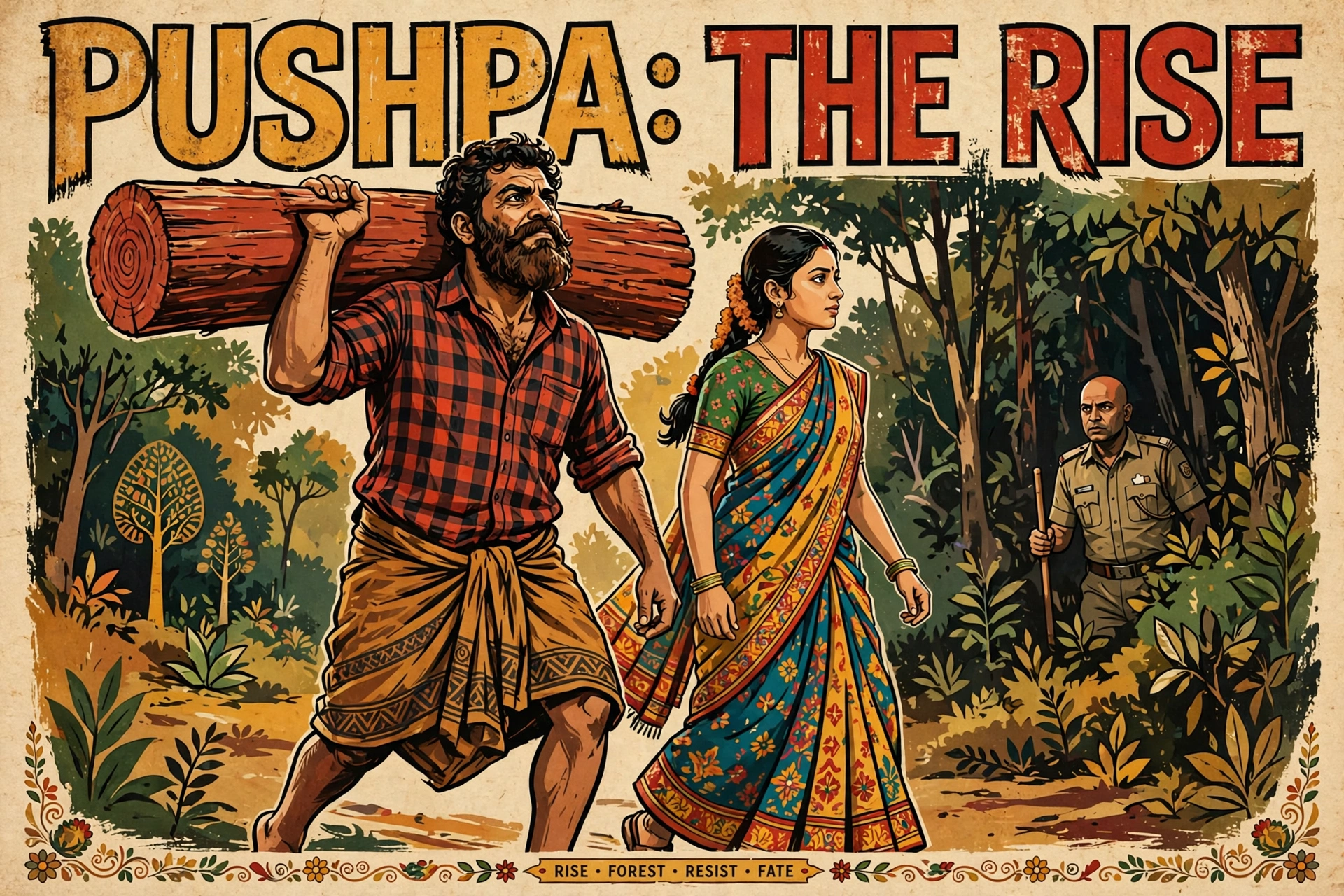
In the forests of the Seshachalam range, red sandalwood grows into a fortune for anyone ruthless enough to cut it and clever enough to move it. At the bottom of that trade are daily-wage cutters who risk prison and worse for a few notes, while a layered syndicate above them — transporters, middlemen, local strongmen and political patrons — divides the real money. Pushpa Raj starts at the very bottom of that ladder: a coolie with a sharp mind, a volcanic temper and a private humiliation that follows him into every room, because society will not let him claim the family name he was born beside.
The film follows his climb, rung by rung, and it is at its best when that climb is about ingenuity rather than muscle. Pushpa finds smarter ways to hide timber, outthinks the men who cheat the cutters, and slowly converts street-level cunning into leverage over people who once would not have looked at him. Around him the story arranges a full ecosystem: a comic-loyal friend who becomes his right hand, a village girl, Srivalli, whose affection gives the film its soft centre, rival operators who smile while they plot, and a police force that is alternately bought, outwitted and humiliated. Late in the film a new senior police officer, Bhanwar Singh Shekhawat, arrives with an ego as large as Pushpa’s own — and the film essentially becomes a duel of pride between two men who would rather lose anything than lose face. We will not spoil where that duel stops; the film itself deliberately leaves it unfinished, closing on a confrontation built to be continued in Pushpa 2: The Rule.
Allu Arjun as Pushpa Raj gives the defining performance of his career, and the industry agreed: he won the National Film Award for Best Actor at the 69th National Film Awards, becoming the first Telugu actor to win in that category, while composer Devi Sri Prasad took Best Music Director (Songs) for the same film. The transformation is total and mostly unglamorous. Arjun drops his famous dancer’s grace into a slouched, shoulder-rolling walk, roughens his voice, and lets the character’s intelligence show through small, watchful pauses rather than speeches. His best scenes are not the fights but the humiliations — a family function where his place is made clear to him, negotiations where richer men talk past him — because you can see the insult being stored away for later use. The famous mannerisms, the beard-stroke and the refusal-to-bow attitude, work because the pain underneath them has been established first.
Fahadh Faasil as Bhanwar Singh Shekhawat enters very late for an actor of his calibre, and the film frankly underuses him in screen time. What he does with those minutes, though, is memorable: a vain, theatrical, quietly menacing officer whose politeness is more frightening than shouting. His final passages set up the sequel’s conflict more effectively than any action scene could. Rashmika Mandanna as Srivalli has a thinner role than her billing suggests — the character is largely written as warmth and motivation for the hero — but she brings an earthy directness to their scenes that keeps the romance from feeling pasted on. Jagadeesh Prathap Bandari as Kesava, Pushpa’s friend and narrator-like companion, is the film’s secret weapon: funny, loyal and increasingly worried, he gives the audience someone normal to stand next to inside an abnormal world. Sunil and Anasuya Bharadwaj, playing members of the syndicate Pushpa must outmanoeuvre, round out a supporting cast that understands the assignment — everyone plays the power game, nobody plays it innocently.
Sukumar has always been a director fascinated by clever men — his protagonists tend to win by thinking in public — and Pushpa lets him apply that fascination to a raw, dusty milieu far from his usual urban polish. The world-building in the first hour is the strongest stretch: the cutting camps, the weighing tricks, the chain of bribes and beatings that keeps the trade alive are laid out with an almost procedural patience. Miroslaw Kuba Brozek’s cinematography finds real beauty in the forest without prettifying the labour — shafts of hard light, red earth, sweat and timber dominate the frame, and the action is staged to feel heavy rather than balletic, a deliberate contrast with Allu Arjun’s earlier, sleeker star image.
The problems are structural. Sukumar’s films often run long, and at 179 minutes this one feels its length in the middle, where Pushpa’s rise repeats a pattern — new obstacle, clever solution, celebration — one time too many. The editing, by Karthika Srinivas and Ruben, keeps individual scenes punchy but does not solve the repetition. A much-discussed item song became a sensation in its own right, yet in the film it arrives as a clear commercial pause. None of this is fatal, because the emotional spine stays clear, but a tighter second act would have made this a leaner, stronger film rather than merely a very enjoyable long one. The climax, too, is intentionally unresolved: judged purely as a standalone film, the ending withholds the payoff it has been promising, and viewers who dislike sequel-bait should know that going in.
Devi Sri Prasad’s soundtrack was not just successful; it was inescapable, in five languages at once, and it earned him the National Film Award for Best Music Director (Songs). The genius of the album is how rooted it sounds. The love ballad built around Srivalli’s name turns Pushpa’s longing into something tender and slightly obsessive, the folk-flavoured celebration numbers feel harvested from the soil of the story rather than imported from a studio playlist, and the big mass track that introduces Pushpa’s swagger became a wedding-and-reels staple across India. The Hindi versions travelled unusually well for a dubbed album, which is a large part of why the film broke out in the north. As a background score, Prasad leans on a recurring, chant-like motif for Pushpa that functions almost as a second dialogue track — the audience starts anticipating it the way they anticipate the hero himself. If there is a criticism, it is placement rather than quality: a couple of songs arrive where the narrative does not need rest, and contribute to that mid-film sag.
What we loved:
What could be better:
Indian trade figures are not audited, so treat every number in this section as trade-reported rather than exact. The production budget itself is reported across a wide band: reference listings commonly cite ₹200–250 crore, while some trade and older box-office sites quote noticeably lower figures in the ₹140–150 crore region, likely reflecting different accounting of prints, publicity and multi-language release costs. We have carried the ₹200–250 crore range in the Quick Facts table because it is the most widely cited current reference figure, but the disagreement is real and we flag it rather than hiding it. On collections, the picture is more consistent: most trackers place the worldwide gross in the region of ₹350–360 crore, with some Indian box-office compilations putting the final total closer to ₹365–375 crore including all versions. Even at the conservative end, the film was a major commercial success — remarkable for a December 2021 release still shadowed by Covid-era theatre restrictions — and its Hindi dubbed version was the breakout story, earning over ₹100 crore net in Hindi according to widely cited trade tallies and turning Allu Arjun into a household name far beyond the Telugu states.
Yes — especially if you enjoy rise-of-the-underdog stories told at full volume and full length. Go in expecting a mass entertainer with a real performance at its centre, not a tight crime thriller: forgive the sag in the middle and the unfinished ending, and what remains is a vivid world, a hero whose swagger is rooted in genuine hurt, and songs you will be humming whether you planned to or not. Viewers who need lean pacing or a self-contained story may find it exasperating in stretches; viewers who surrender to its rhythm will understand exactly why Pushpa Raj became a cultural fixture.
Our rating: 7.5/10 — an overlong, sequel-shaped film carried triumphantly by a career-best star turn, a superb soundtrack and a world worth getting lost in.
Is Pushpa: The Rise based on a true story?
No. Pushpa Raj is a fictional character, but the film is set inside the real illegal red sandalwood trade of the Seshachalam hills in Andhra Pradesh, and its depiction of cutters, syndicates and police raids draws on that real-world setting.
Do I need to watch anything before Pushpa: The Rise?
No, it is the first film in its series. Its story continues directly in Pushpa 2: The Rule (2024), which picks up the rivalry this film leaves unresolved — so watching this one first is essential before the sequel.
Why did Allu Arjun win a National Award for this film?
At the 69th National Film Awards he was named Best Actor — the first Telugu actor to win that category — for a performance that discarded his polished star image in favour of a rough, physically transformed portrayal. Devi Sri Prasad also won Best Music Director (Songs) for the film.
Is Pushpa: The Rise suitable for family viewing?
It carries a U/A-style profile: there is frequent stylised violence, smuggling and criminal themes, drinking, and one widely discussed item song. It is best suited to older teenagers and adults rather than young children.
Where can I watch Pushpa: The Rise?
It has been widely available on major streaming platforms in Telugu and in dubbed versions including Hindi. Availability varies by region and changes over time, so check your local services for the version you want.