★ LATEST REVIEWS

Our Rating: ★★★★☆ 8.5/10
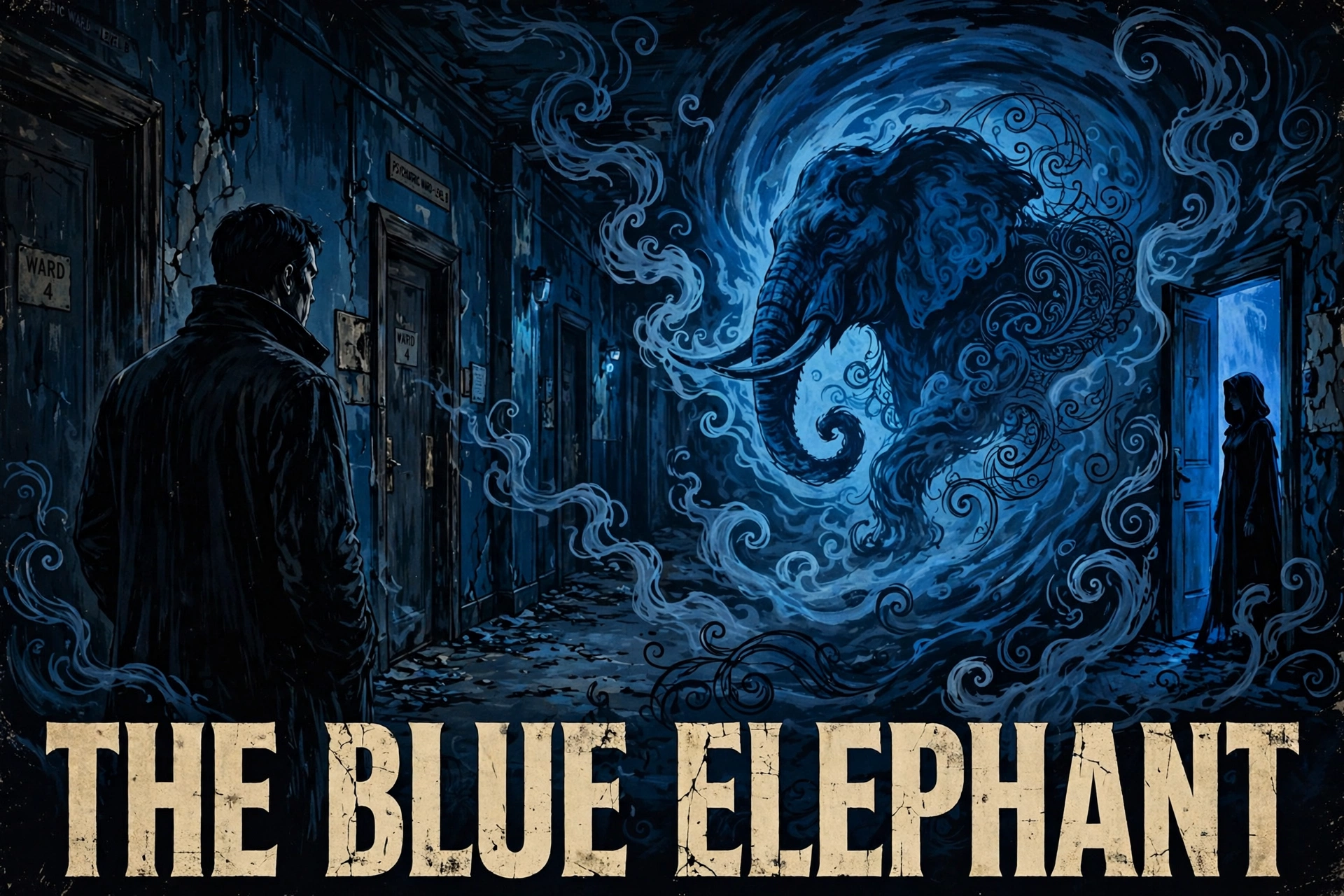
Egyptian popular cinema was not supposed to make films like this. For years the safe commercial formula at home was comedy, romance and action, in bright colours, at a comfortable length. Then, in the middle of the Eid holiday season of 2014, along came a two-hour-and-fifty-minute psychological horror-thriller about a grief-destroyed psychiatrist, a psychiatric ward for the criminally insane, black magic, elaborate tattoos and a little blue pill that opens a door no sane man should walk through — and audiences went, in huge numbers. This The Blue Elephant review looks back at a film that did not just succeed despite breaking the local rules; it succeeded in a way that changed what Egyptian producers believed audiences would accept.
Directed by Marwan Hamed, returning to the director’s chair with the ambition he had shown in The Yacoubian Building, and adapted by novelist Ahmed Mourad from his own 2012 bestseller, The Blue Elephant is part murder investigation, part supernatural descent and part portrait of a man being punished by his own guilt. It is too long, and its final act divides viewers to this day. It is also one of the most striking Egyptian films of its decade — in performances, in craft and in sheer nerve — and its success, including a sequel in 2019 that became an even bigger hit, proved the first film was no accident.
| Detail | Information |
|---|---|
| Release date | 28 July 2014 |
| Director | Marwan Hamed |
| Writers | Ahmed Mourad (also author of the original novel) |
| Genre | Drama, Horror, Mystery, Thriller |
| Language | Arabic (Egyptian dialect) |
| Runtime | 170 minutes |
| Lead cast | Karim Abdel Aziz, Khaled El Sawy, Nelly Karim, Mohamed Mamdouh |
| Our rating | 8.5/10 |
Five years before the story begins, psychiatrist Dr Yehia Rashed lost his wife and young daughter in a car accident — and he has been losing himself, methodically, ever since, to drink, pills, gambling and isolation. When his superiors at Cairo’s Abbasseya psychiatric hospital finally force the issue, Yehia returns to work and is assigned to the ward known as 8 West: the section reserved for patients who have committed crimes and been found insane. It is the last place a man in his condition should be, and he knows it.
Among the patient files waiting for his evaluation is a name that stops him cold. Sherif Al Kordy — a former psychiatrist himself, and once Yehia’s closest friend — stands accused of a brutal killing inside his own home, and now speaks, when he speaks at all, as if someone or something else occasionally speaks through him. Yehia takes the case personally. His search for the truth about what happened that night leads him to Sherif’s sister Lobna, the great love of Yehia’s youth, now carrying her own scars from the same broken family story. And it leads him, step by step, out of the rational world of case notes and diagnoses: into old crime scenes, coded numbers, protective and possessive tattoos, a tattoo artist who treats her work as something far older than decoration, and finally to the blue elephant pill itself — a drug said to let its user cross into the hidden world where the answers, and the dangers, actually live.
What Yehia finds there, and what follows him back, is the film’s to reveal. Structurally, The Blue Elephant plays fair in the way that matters most: it lets the audience hold two explanations at once — a damaged mind constructing a supernatural story to survive its guilt, or a genuine darkness exploiting a damaged mind’s invitation — and it keeps both alive far longer than most thrillers dare. Whether the film’s ending, which differs from the novel’s, satisfies you will likely decide your final verdict on the whole experience. Ours is below, without spoilers.
Karim Abdel Aziz as Dr Yehia Rashed carries nearly every scene of a very long film, and the performance is a career landmark. Abdel Aziz was one of Egypt’s most bankable popular stars, associated largely with likable leading-man roles, and here he dismantles that image piece by piece: the shaking hands, the self-medicating routine performed with practised shame, the professional mask that keeps cracking in front of colleagues. His Yehia is never played as noble suffering. He is selfish, evasive and partly responsible for his own ruin, which is exactly why his slow climb toward courage registers. In the pill sequences, where the film asks him to play terror, wonder and recognition in near-silence, he delivers work of a standard Egyptian commercial cinema rarely even attempts.
Khaled El Sawy as Sherif Al Kordy is his equal and opposite. El Sawy must play a man who may be mad, may be possessed, may be performing — sometimes within a single conversation — and he calibrates the shifts so precisely that Yehia’s confusion becomes the audience’s. His stillness is the film’s most frightening special effect. When Sherif’s manner changes, it changes in the eyes and the voice before anything theatrical happens, and the ward scenes between the two old friends have the tension of a chess game where one player may not be human. It is one of the great supporting performances in modern Egyptian film.
Nelly Karim as Lobna gives the story its human ground. Lobna could easily have been reduced to the hero’s lost love; Karim instead plays a woman managing her own catastrophe — a brother destroyed, a marriage endured, a past she has worked hard to seal — and her guarded scenes with Yehia carry a decade of unspoken history without a single explanatory speech. Mohamed Mamdouh as Dr Sameh, Yehia’s colleague, provides the film’s few releases of warmth and dry humour, and plays the professional concern of a man watching his friend volunteer for destruction. In smaller roles, Lebleba as Dr Safaa lends the hospital administration real authority, Shereen Reda as Deega, the tattoo artist, brings an unsettling calm to the film’s occult doorway, and Dareen Haddad as Maya colours Yehia’s dissolute private life in the early reels.
Marwan Hamed directs The Blue Elephant as a prestige production and a genre film at the same time, and the confidence of that double ambition is visible in every department. The production design rebuilds Abbasseya’s world — institutional corridors, tiled wards, cramped offices — with a texture that feels observed rather than staged, and then contrasts it with the film’s other Cairo: nightclubs, rooftops, the tattoo studio’s lamplit clutter, and the pill-world sequences, where the design team is finally allowed to build pure nightmare. Ancient Egyptian and folk-magical imagery is woven into sets, props and body art with a researcher’s care, giving the supernatural a specifically Egyptian visual language instead of imported horror clichés.
Ahmed El Morsi’s cinematography is the film’s signature achievement. He lights the hospital in sickly, draining tones, lets Yehia’s private life smear into neon and shadow, and then, for the sequences beyond the pill, constructs some of the most elaborate images in Egyptian cinema of the period — long, choreographed movements through impossible spaces that hold together because the camera never loses the character inside the spectacle. The editing, credited to Mohamed Attia, manages the film’s braided timelines and reality levels with clarity most of the time; the middle investigation, in particular, is cut for accumulation rather than shock, which makes the later eruptions land harder.
The honest criticisms belong here too. At 170 minutes, the film is long, and a stretch of the second hour repeats investigative beats the audience has already absorbed. The visual effects, ambitious for an Egyptian production of 2014, are uneven — some sequences are genuinely visionary, others show the limits of the budget precisely because the direction aims so high. And the closing movement, reshaped from the novel at Hamed’s suggestion according to Mourad himself, opts for broader emotional resolution than the film’s darkness has prepared; some viewers find it cathartic, others find it a softening. What cannot be argued is the intent: this was a local industry deciding to compete on craft, and largely succeeding.
The score is by Hesham Nazih, and it is one of the major Egyptian film scores of its generation. Nazih builds the sound of The Blue Elephant from unease rather than melody: low strings that seem to breathe, percussive patterns that tighten like a held nerve, and choral and folk-tinged colours that connect the modern hospital corridors to the much older forces the story invokes. His music for the pill sequences does the heaviest lifting in the film, giving shape and momentum to journeys that are otherwise pure image — when the theme finally gathers itself in the late reels, it carries an emotional force the dialogue never has to explain.
Nazih, who would go on to international attention with Marvel’s Moon Knight, understands horror scoring’s first rule: the silences matter as much as the swells. Ward scenes are often allowed to sit in near-quiet, so that a voice, a rattle, a change in breathing becomes the scare. It is difficult to imagine the film’s reputation without this score; more than one sequence that could have tipped into excess is held in the realm of dread by Nazih’s control of tension and release.
What we loved:
What could be better:
As with all Egyptian releases, the figures come from press and distributor compilations rather than one audited ledger, and they differ between sources — so read them as Egyptian-pound ranges, with any United States dollar equivalents understood as approximate. The film was released for the Eid season on 28 July 2014 and, defying its genre and length, became one of the biggest Egyptian hits of its period. Figures commonly reported put its domestic theatrical total at around EGP 30 million, with distributor-linked reporting from MAD Solutions putting the total higher, at more than EGP 35 million, with roughly 1.2 million tickets sold. The lower figure was converted in contemporary reporting to roughly US$4.2 million; treat all such conversions as approximations that vary with the rate and the source. There is no serious dispute about the conclusion: a grim, nearly three-hour horror-thriller outgrossed the comedies it competed with, remained a television and streaming staple for years, and earned a sequel — The Blue Elephant 2 (2019) — that went on to set records of its own. A note on budget: an estimated figure of about $3.5 million circulates in online databases, but we could not verify it against reliable production reporting, so we have deliberately omitted a budget figure from the Quick Facts table rather than present an unverifiable number as fact.
Yes — especially if you believe you know what Egyptian popular cinema looks like and want that belief challenged. The Blue Elephant is a big, dark, beautifully crafted thriller anchored by two outstanding performances and a score that gets under the skin, made with a confidence that reshaped its industry’s sense of the possible. Pace yourself for its length, forgive a few stretched effects and prepare to argue about the ending; that argument, a decade on, is itself a sign of how alive this film remains. International viewers should watch it in Arabic with subtitles, where the performances’ rhythms are intact.
Our rating: 8.5/10 — Egypt’s boldest mainstream thriller of its decade, carried by acting and craft of the first order.
Is The Blue Elephant based on a novel?
Yes. It is adapted from Ahmed Mourad’s bestselling 2012 Arabic novel of the same name, which was shortlisted for the International Prize for Arabic Fiction. Mourad also wrote the film’s screenplay, though the film’s ending differs from the book’s — a change the filmmakers have discussed openly.
Is The Blue Elephant really a horror film?
It is a blend: part psychological drama, part murder mystery, part supernatural horror. Its scares come more from dread, atmosphere and performance than from gore, though it contains disturbing imagery and themes throughout.
Is The Blue Elephant suitable for family viewing?
No. It deals with addiction, violent crime, mental illness and occult themes, and contains intense and frightening sequences. It is firmly an adult film.
Does The Blue Elephant have a sequel?
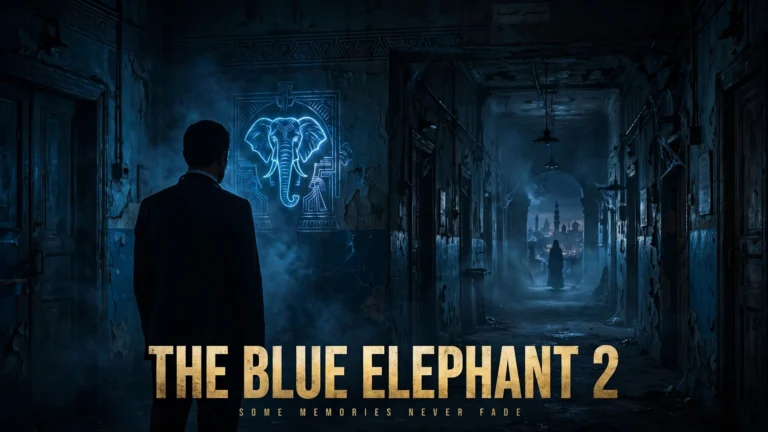
Yes — The Blue Elephant 2 (2019), again directed by Marwan Hamed from Ahmed Mourad’s writing, reunites Karim Abdel Aziz and Nelly Karim for a new case set five years later, and became an even larger box-office success in Egypt.
Where can I watch The Blue Elephant?
It is widely available on Arab-world streaming platforms and appears on international services in some regions, with subtitles. Availability changes over time, so check your local listings.